Table of Contents
1 Sections
challenge link: https://malops.io/challenges/simda
Scenario
A workstation in your network has been flagged for suspicious outbound traffic to multiple foreign IP addresses linked to the Simda botnet. Forensic triage reveals a malicious file (svchost32.exe) in C:\Users\Public\Libraries\ and DNS queries to random-looking domains resolving via fast-flux hosting. Simda is known as a loader, capable of downloading other malware. Your task is to investigate the provided PCAP, event logs, and filesystem artifacts to identify the initial infection vector, C2 infrastructure, and any additional payloads delivered, and to recommend containment steps.
Question 1:
What is the first windows API used by the malware to allocate memory?
When analyzing the binary's Import Table (.idata), standard memory allocation functions (such as VirtualAlloc, HeapAlloc, LocalAlloc, or malloc) are conspicuously absent. Instead, the binary imports LoadLibraryA and GetProcAddress from KERNEL32.dll, indicating dynamic API resolution.
Tracing execution from the main entrypoint (start at 0x401200):
LoadCursorA, CreateFileW, GetDriveTypeW).sub_4014F0.sub_4016B0 (0x4016b0), which dynamically resolves and invokes VirtualAllocEx.start (0x401200)
0x40121D) if(LoadCursorA(0,(LPCSTR)0x142D))
sub_401130(); The malware checks if certain standard cursors load. If abnormal sandbox conditions are met, sub_401130() is triggered to terminate or stall execution.
0x401242 – 0x40127C) CreateFileW(word_4CA044,...);
GetDriveTypeW(&RootPathName);Basic system environment probing.
0x401346) dword_4CA0C4=sub_4014F0(); If you double-click sub_4014F0, you will see it calling RegQueryValueExA in a loop to check system configuration or decrypt payload data.
0x40135A) dword_4CA084=sub_401180(dword_4CA0C4); Extracts a length/size field (*(_DWORD *)(a1 - 4)) from the buffer retrieved in the previous step.
0x40136D) [TARGET] dword_4CA0C8=sub_4016B0(dword_4CA084);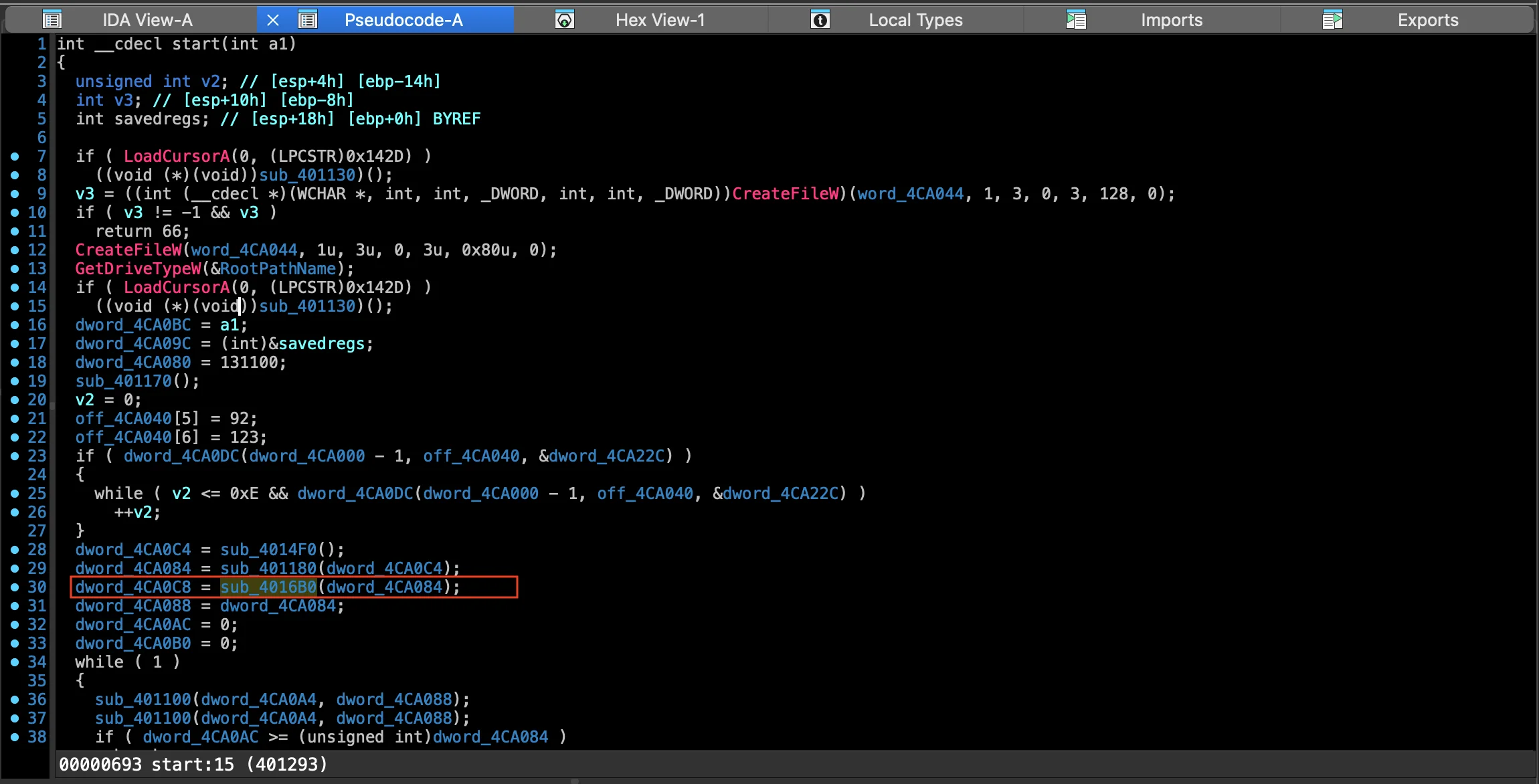
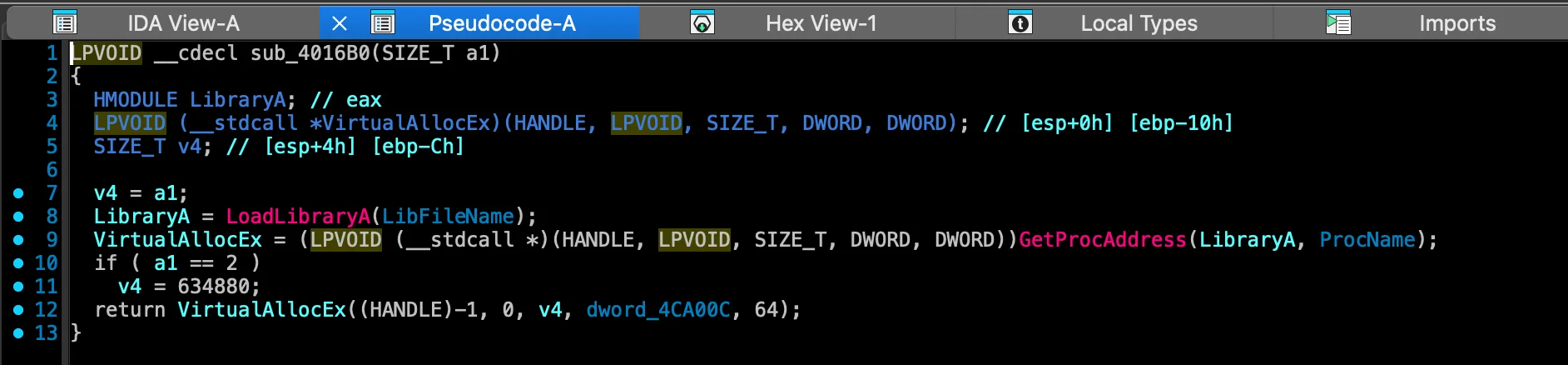
Double-clicking into sub_4016B0 reveals the dynamic resolution:
    LPVOID __cdecl sub_4016B0(SIZE_T size)
    {
      HMODULE hKernel32 = LoadLibraryA("kernel32"); // LibFileName
      LPVOID (__stdcall *pVirtualAllocEx)(HANDLE, LPVOID, SIZE_T, DWORD, DWORD);

      pVirtualAllocEx = GetProcAddress(hKernel32, "VirtualAllocEx"); // ProcName

      if ( size == 2 )
        size = 634880;

      // Allocates memory in current process ((HANDLE)-1) with PAGE_EXECUTE_READWRITE (64 / 0x40)
      return pVirtualAllocEx((HANDLE)-1, 0, size, 0x3000 /*MEM_COMMIT|MEM_RESERVE*/, 0x40);
    }
ANSWER
VirtualAllocExQuestion 2:
What does the second parameter given to RegOpenKeyA call point to?
The prototype for the Windows API function is:
LSTATUS RegOpenKeyA(
  HKEY   hKey,
  LPCSTR lpSubKey,  <-- 2nd Parameter
  PHKEY  phkResult
);
Looking at the disassembly and decompiled code in start (0x401200):
4012c8  mov     eax, off_4CA040
4012cd  mov     byte ptr [eax+5], 5Ch ; '\'
4012d1  mov     ecx, off_4CA040
4012d7  mov     byte ptr [ecx+6], 7Bh ; '{'
4012db  push    offset dword_4CA22C      ; 3rd param: phkResult
4012e0  mov     edx, off_4CA040
4012e6  push    edx                      ; 2nd param: lpSubKey
4012e7  mov     eax, dword_4CA000
4012ec  sub     eax, 1                   ; 1st param: hKey (0x80000001 - 1 = 0x80000000 -> HKEY_CLASSES_ROOT)
4012ef  push    eax
4012f0 call dword_4CA0DC ; RegOpenKeyAoff_4CA040): The second argument pushed onto the stack (edx) is loaded from global variable off_4CA040.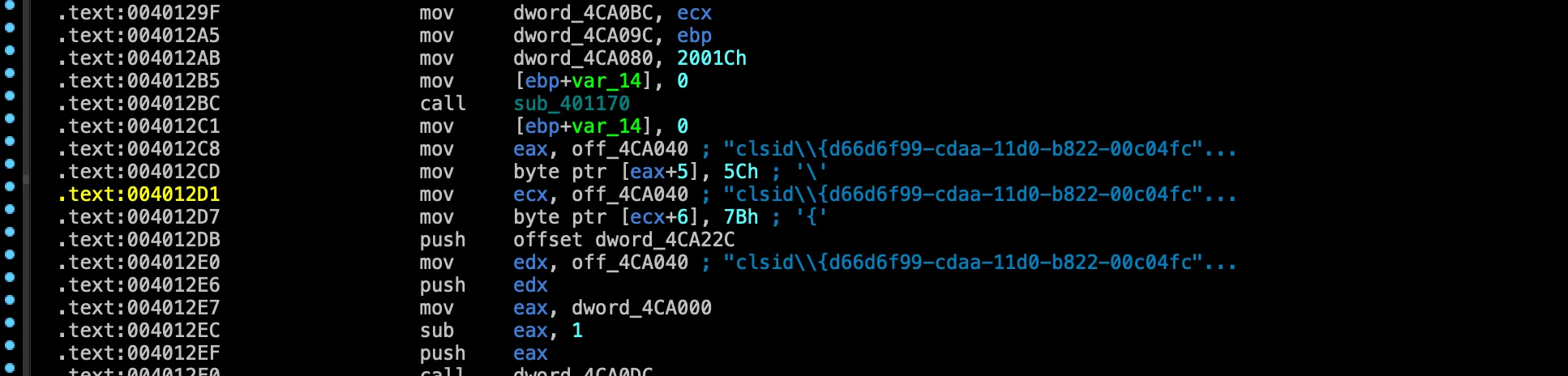
off_4CA040 contains the memory address 0x4CA010, which points directly to the ASCII string buffer "clsid\{d66d6f99-cdaa-11d0-b822-00c04fc9b31f}".
5 with \ (0x5C) and index 6 with { (0x7B) to assemble the well-formed COM Class ID subkey path inside HKEY_CLASSES_ROOT.Answer
clsid\{d66d6f99-cdaa-11d0-b822-00c04fc9b31f}Question 3:
The malware dynamically resolves Windows API function names in memory, and decrypts a large blob of data, which function is responsible for grabbing the encrypted blobs? Provide address in hex.
To unpack its second stage, the malware first allocates an executable memory region using dynamically resolved VirtualAllocEx. Once allocated, the loader enters a chunked extraction loop inside the main entrypoint routine start (0x401200).
By tracing the arguments passed inside this loop, we identify subroutine sub_4011B0 (at hex address 0x4011B0) as the function responsible for actively grabbing the encrypted payload chunks from the raw source buffer and transferring them into the executable memory space.

; Disassembly snippet from main extraction loop in start (0x401200)
40143E  push    edx               ; Source: Raw encrypted payload buffer
401450  push    eax               ; Destination: Allocated VirtualAllocEx buffer
401451  call    sub_4011B0        ; <-- Grabs & copies encrypted blob chunks
Decompiled Pseudo code sub_4011B0
int __cdecl sub_4011B0(int a1, int a2, unsigned int a3)
{
  int result; // eax
  unsigned int i; // [esp+4h] [ebp-4h]

  for ( i = 0; ; ++i )
  {
    result = 523;
    if ( i >= a3 )
      break;
    *(_BYTE *)(i + a1) = *(_BYTE *)(i + a2);
  }
  return result;
}
Once sub_4011B0 finishes grabbing the entire encrypted blob across multiple iterations of 0x44-byte chunks, the malware immediately executes sub_401000 (0x401000) to decrypt the staged buffer in-place.
ANSWER
0x4011B0Question 4:
What is the initial decryption key used to decrypt the encrypted blobs (word size)?
Following the payload extraction loop, the main entrypoint start (0x401200) calls function sub_401000 (0x401000) passing the allocated buffer to decrypt it in memory.

Inside sub_401000, the malware iterates through the payload buffer in 4-byte increments (i += 4):
Decompiled sub_401000
int __cdecl sub_401000(int buffer_ptr, unsigned int total_size)
{
  for ( unsigned int i = 0; i < total_size; i += 4 )
  {
    // Step 1: In-place offset addition
    *(_DWORD *)(buffer_ptr + i) += i;

    // Step 2: XOR decryption using dynamic rolling key (i + 0xB0B6)
    **sub_401650(3, i + 0xB0B6);**
  }
  return 0;
}
And examining subroutine sub_401650 (0x401650) confirms the exact XOR decryption logic:
int __cdecl sub_401650(int flag, int current_key)
{
  int decrypted_dword = current_key ^ *(_DWORD *)current_buf_chunk;
  *(_DWORD *)current_buf_chunk = decrypted_dword;
  return decrypted_dword;
}
Breakdown of the Key Generation:
0 + 0xB0B6.i=0
0xB0B6 (16-bit word size, equal to 45238 in decimal) serves as the initial starting decryption key, which dynamically rolls upward as the loop progresses across the payload.ANSWER
0xB0B6Question 5
What is the name of the first Windows API function decrypted.
Dynamic Payload Decryption (sub_401000)
Once the encrypted second-stage payload is staged into executable memory, the loader calls subroutine sub_401000 (0x401000) to unpack it in place.
The decryption routine operates on 32-bit (DWORD) blocks. It first adds the current loop offset i to the ciphertext block, and then applies an XOR transformation against a dynamic rolling key computed as i + 0xB0B6:
; Disassembly snippet from decryption loop in sub_401000 (0x401000)
401064  mov     ecx, dword_4CA098         ; Loop index 'i' (increments by 4)
40106A  add     ecx, 0B0B6h               ; Rolling Key = i + 0xB0B6
...
4010D6  call    sub_401650                ; <-- In-place XOR decryption
Decompiling the decryption loop confirms the arithmetic formula:
int __cdeclsub_401000(int buffer_ptr,unsignedint total_size)
{
for(unsignedint i=0; i< total_size; i+=4)
{
*(_DWORD*)(buffer_ptr+ i)+= i;// Step 1: Offset arithmetic
sub_401650(3, i+0xB0B6);// Step 2: XOR with rolling key
}
return0;
}
At the very first iteration (i=0i=0), the calculated key evaluates to 0xB0B6 (word size / 45238 decimal), which serves as the initial decryption key.
API Import Table Reconstruction
Decryption of the raw payload blob reveals an embedded stage-2 API resolution table at the very start of the unpacked memory region.
Inspecting the first 64 bytes of the decrypted plaintext buffer reveals that GetProcAddress is the very first API string recovered at offset 0x00. The unpacked stage-2 payload immediately leverages GetProcAddress to resolve subsequent memory management and process injection functions (VirtualAlloc, VirtualFree, UnmapViewOfFile):
+0x0000:  47 65 74 50 72 6f 63 41 64 64 72 65 73 73 00 00  |GetProcAddress..|
+0x0010:  00 56 69 72 74 75 61 6c 41 6c 6c 6f 63 00 00 00  |.VirtualAlloc...|
+0x0020:  00 00 56 69 72 74 75 61 6c 46 72 65 65 00 00 00  |..VirtualFree...|
+0x0030:  00 00 00 55 6e 6d 61 70 56 69 65 77 4f 66 46 69  |...UnmapViewOfFi|
ANSWER
GetProcAddressQuestion 6
What is the address of the ret instruction responsible for jumping to decrypted shellcode?
To evade heuristic analysis looking for suspicious indirect register jumps (e.g., jmp eax or call ecx), the malware employs a classic "Push-and-Return Trampoline" technique inside subroutine sub_401130 (0x401130).
At the end of start (0x401200), the malware calculates the exact entrypoint offset inside the newly decrypted stage-2 buffer (allocated_buffer + 0x86ED0) and stores it inside global variable dword_4CA094:
4014B5  mov     ecx, dword_4CA0C8
4014BB  add     ecx, 86ED0h           ; Stage-2 Shellcode Entrypoint (552656 decimal)
4014C1  mov     dword_4CA094, ecx     ; Stores target address in dword_4CA094
The loader then invokes sub_401130. Looking at the disassembly inside sub_401130:
401150  mov     ecx, dword_4CA094     ; Loads Stage-2 Shellcode Address into ECX
401156  jmp     short loc_401164
...
401164  push    ecx                   ; Pushes Shellcode Address onto top of Stack
401165  jmp     short $+2             ; 2-byte anti-disassembly junk jump
401167  retn                          ; <-- RETN pops ECX directly into EIP!
How the Jump Works:
0x401164 pushes the target shellcode memory address (ecx) onto the stack frame.retn instruction at 0x401167, the CPU pops the top stack value directly into the Instruction Pointer register (EIP).ANSWER
0x401167Question 7
Based on the memory allocated by the malware, what is the offset of the first instruction executed after decryption? in hex
Looking at the disassembly at the very end of start (0x401200), immediately after calling the stage-2 decryption routine (sub_401000), the malware computes the exact target jump address:
4014AD  call    sub_401000            ; In-place payload decryption
4014B2  add     esp, 8
4014B5  mov     ecx, dword_4CA0C8     ; Base Address of allocated memory (VirtualAllocEx)
4014BB  add     ecx, 86ED0h           ; <-- Entrypoint Offset = +0x86ED0
4014C1  mov     dword_4CA094, ecx     ; Stored for trampoline jump
And in the decompiled pseudocode of start:
c

sub_401000(dword_4CA0C8, dword_4CA084);// Decrypt payload
  dword_4CA094= dword_4CA0C8+552656;// 552656 decimal = 0x86ED0 hex
returnsub_401130(dword_4CA0C8+552656);
Calculation Summary:
dword_4CA0C8dword_4CA0C8 + 0x86ED00x86ED0 (55265610 bytes into the unpacked buffer).55265610
ANSWER
86ED0Question 8
What is the second API called by the malware after decryption?
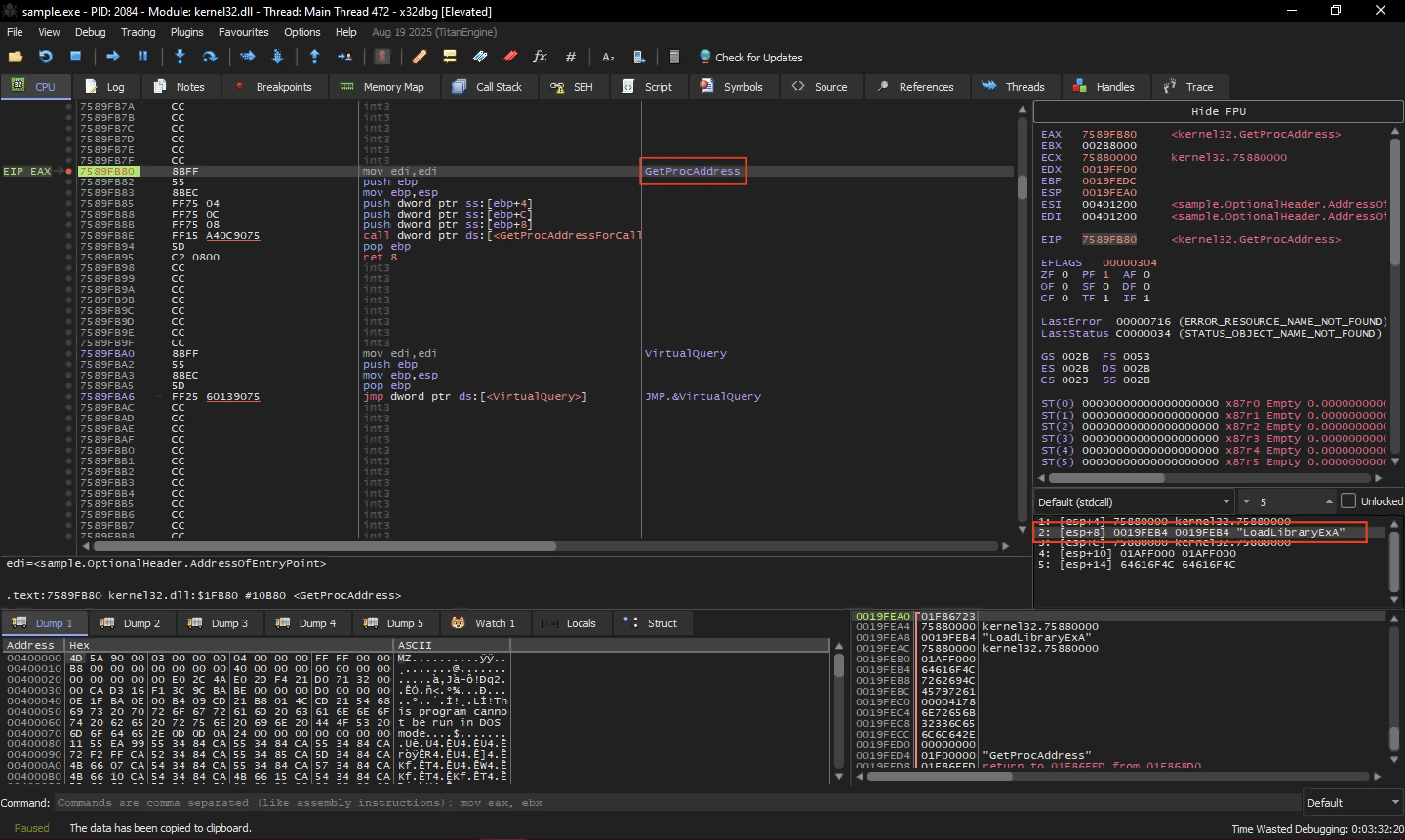
In x32dbg, click on the Command bar at the very bottom of the window and execute these three breakpoint commands one by one (hit Enter after each):
bp GetProcAddress
bp VirtualAlloc
bp ZwUnmapViewOfSection
Now follow these simple steps:
Ctrl + F2 to restart the malware, then hit F9 until it hits your GetProcAddress breakpoint.GetProcAddress, look at the Stack panel in the bottom-right corner. The second argument on the stack ([ESP+8]) will display the plain-text ASCII string of the exact Windows API name the malware is requesting right at that moment!F9 once -> Look at stack [ESP+8] (First API resolved).F9 a second time -> Look at stack [ESP+8] (This is the 2nd API requested/called!).What exact string name shows up at [ESP+8] on that second hit of GetProcAddress ?
Each time x32dbg pauses at GetProcAddress, list out the API strings that pop up in order!
ANSWER
LoadLibraryExAQuestion 9
The malware decrypts another part in memory with another dynamic key, what is the fixed addition value to the key in hex (word size)?
To locate the secondary decryption routine without relying on static offsets, dynamic analysis was performed using x32dbg:
VirtualAlloc to reserve memory for unpacking the embedded PE payload. Upon returning from the API call, the base address of the allocated memory buffer was retrieved from the EAX register.F9) initially breaks on a buffer clearing routine (memset). Continuing past the initialization triggers the hardware breakpoint a second time, pausing execution directly inside the unpacking loop.mov edx, dword ptr ss:[ebp-4] ; Load loop counter index (i)
add edx, 3E9 ; Add fixed constant 0x03E9 to derive key
...
xor edx, dword ptr ds:[eax] ; Decrypt payload: buffer[i] ^= (i + 0x03E9)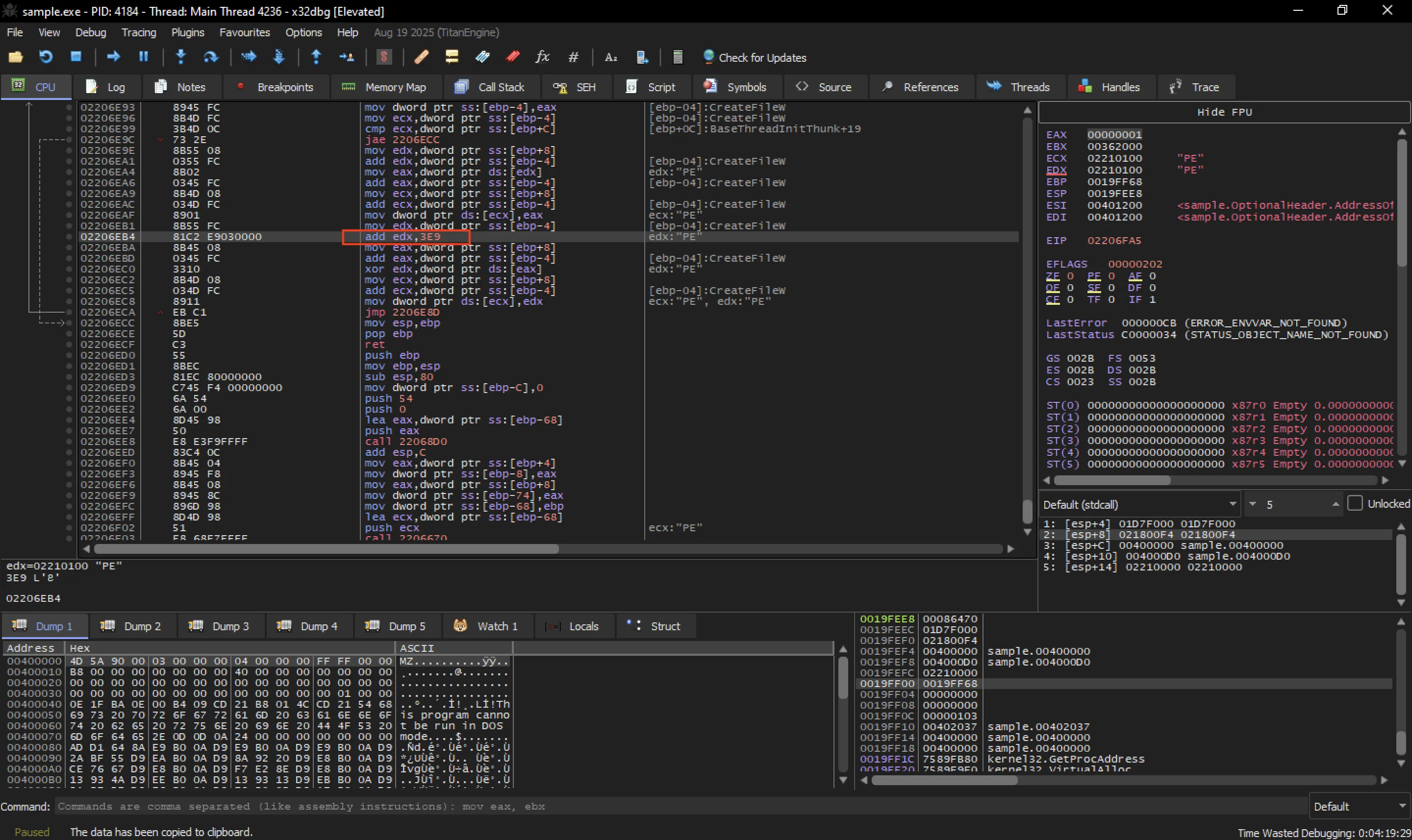
By formatting the immediate value 3E9 as a 16-bit word size, we determine the fixed addition value is 0x03E9.
ANSWER
0x03E9Question 10
There are 3 hardcoded IPs, list them in the format: IP1,IP2,IP3 (same order as found)
1. Dynamic Unpacking via VirtualAlloc Tracing
To extract the secondary payload without manually reversing the cryptographic routines, we tracked memory allocations dynamically in x32dbg:
bp VirtualAlloc) to intercept Stage 2 requesting a new buffer for the unpacked Stage 3 payload.Ctrl + F9) to let the API call finish. Upon returning to user code, the register EAX held the base address of the newly allocated, empty memory buffer (e.g., 0x02250000).add edx, 0x03E9) to completely process and write the decrypted payload into the memory address pointed to by EAX.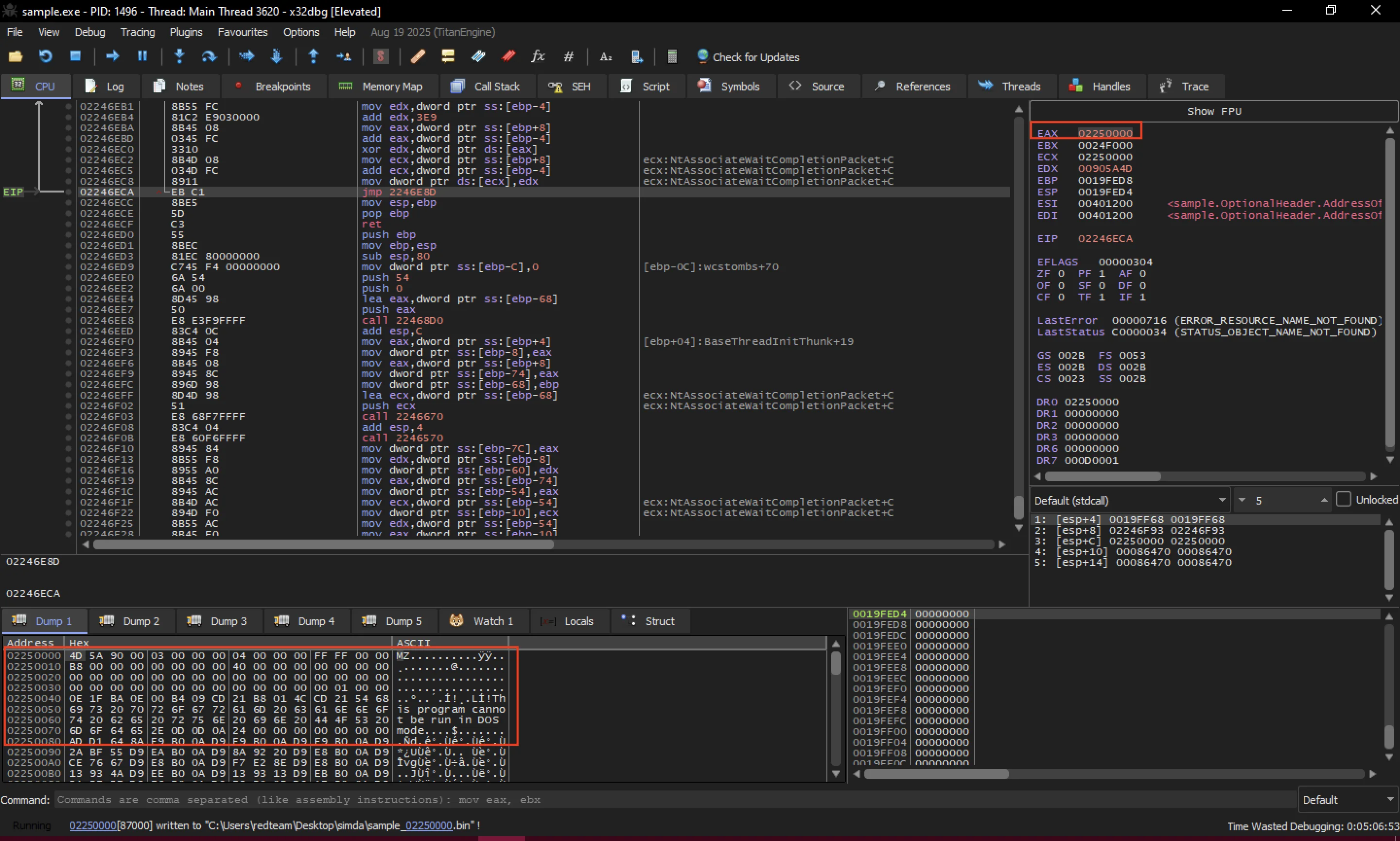
2. Dumping the Unpacked Payload from Memory
Once the decryption routine finished populating the buffer, inspecting the memory address from EAX revealed the standard Portable Executable signature:
4D 5A 90 00 03 00 00 00 | MZ......To extract the clean binary:
Alt + M).EAX.3. Indicator Extraction
Loading sample_02250000.bin into IDA Pro and inspecting the ASCII strings inside the read-only data section (.rdata) revealed the malware's core Command and Control (C2) configuration block.
Stored sequentially in plain text right next to the C2 check-in URL parameter controller=hash&mid= were the three hardcoded fallback IP addresses:
212.117.176.187
79.133.196.94
69.57.173.222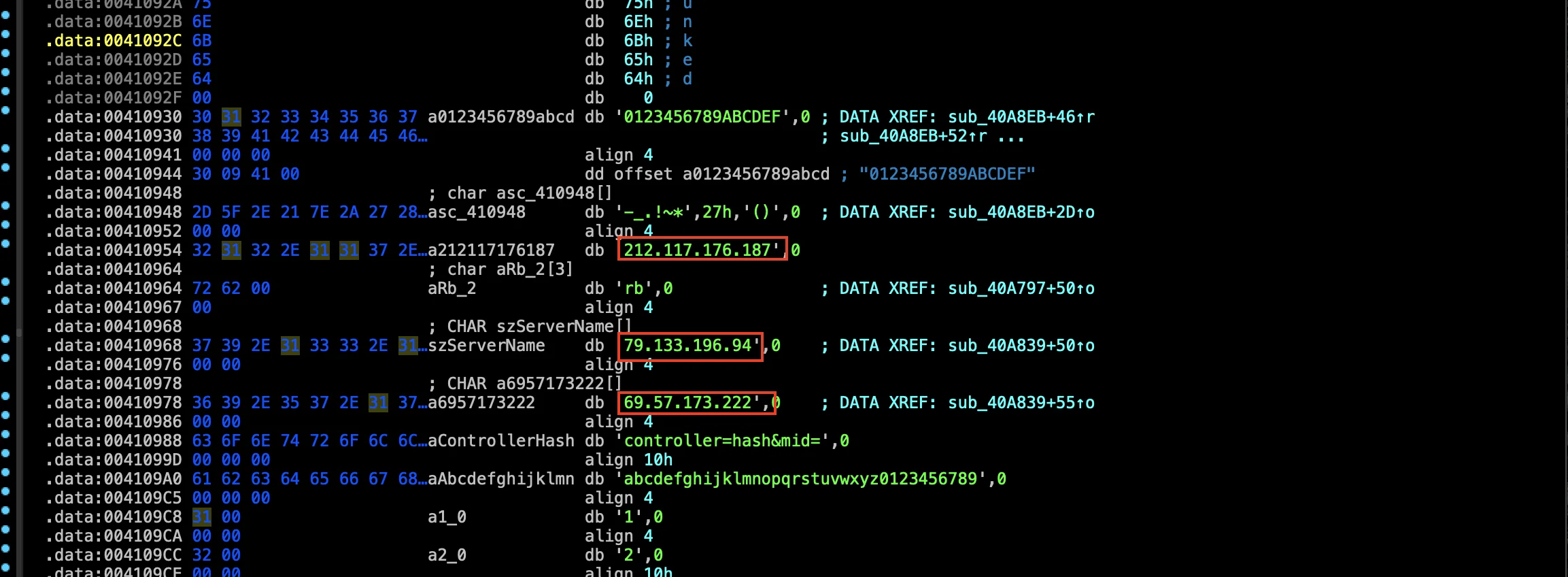
Answer
212.117.176.187,79.133.196.94,69.57.173.222Question 11
What is the address of the function that perform anti analysis checks
1. Locating the Environment & Sandbox Checks
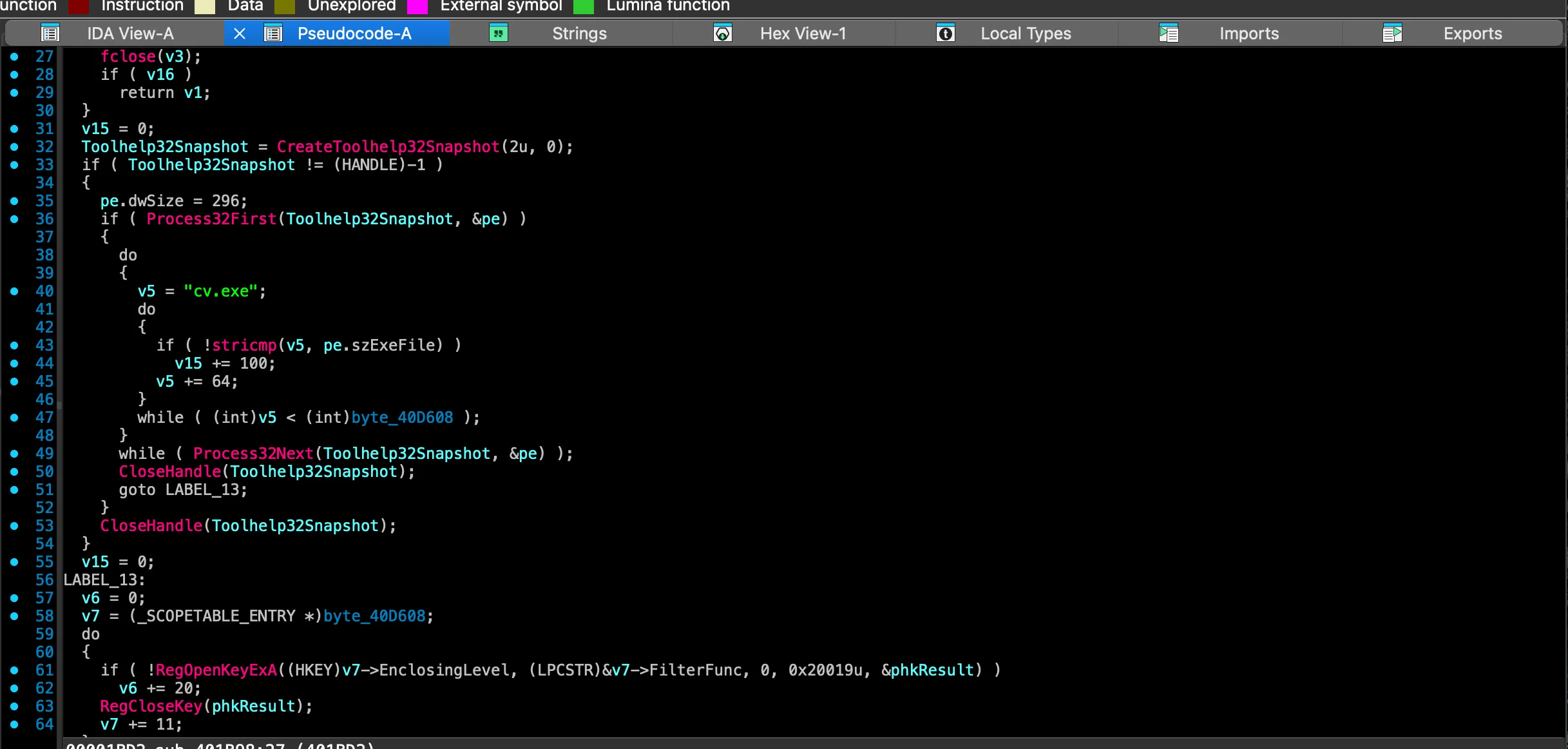
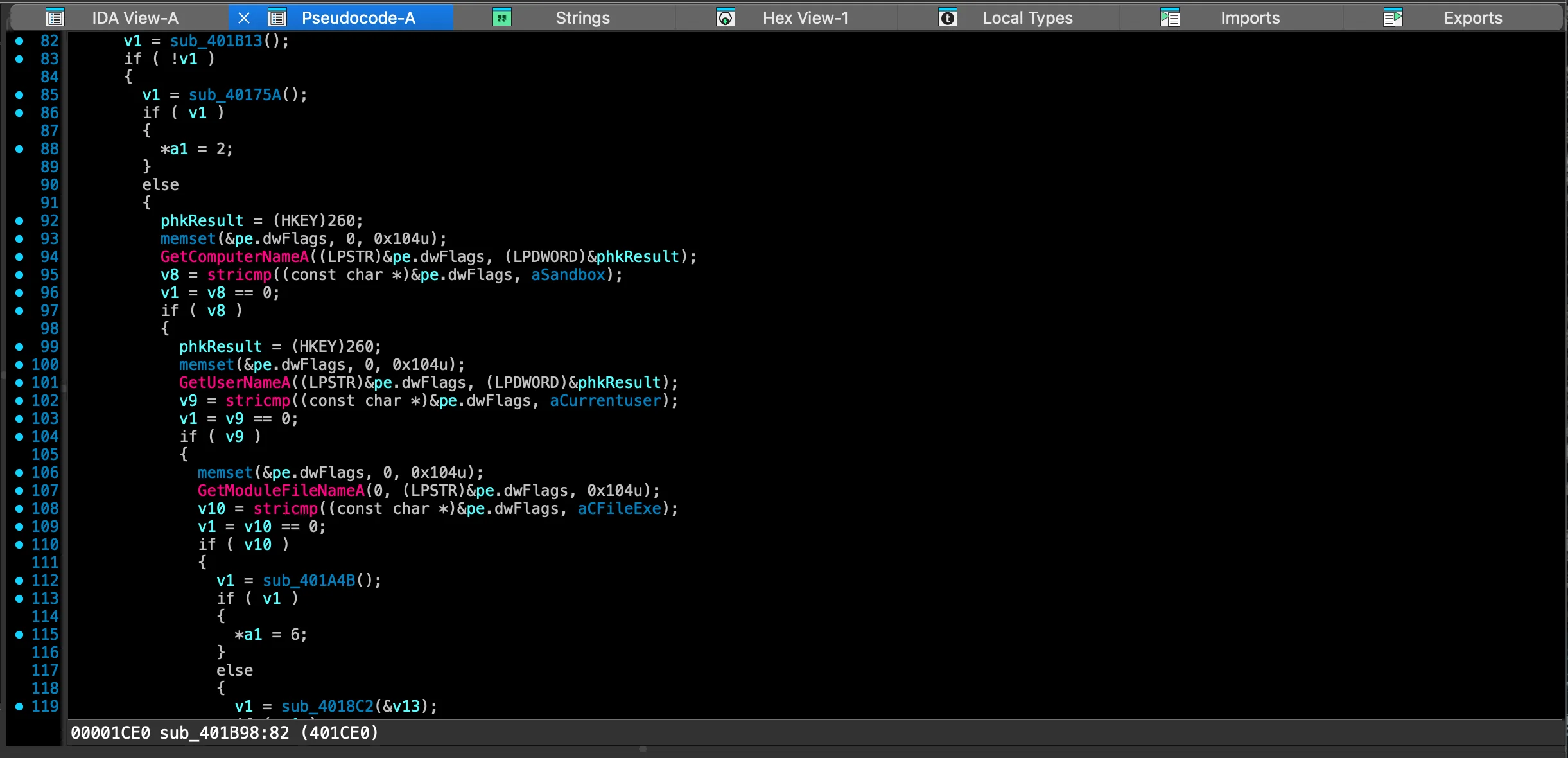
During static analysis of the primary executable (sample.exe) in IDA Pro, we investigated cross-references to system enumeration APIs such as CreateToolhelp32Snapshot, GetComputerNameA, and GetUserNameA. Tracing these references led us directly to the master anti-analysis routine located at memory address 0x401B98.
2. Analysis of Evasion Techniques
Function 0x401B98 serves as the malware's central defense mechanism against automated sandboxes and reverse engineering environments. It executes a multi-layered verification check before allowing the payload to run:
CreateToolhelp32Snapshot to iterate through active processes, explicitly searching for analysis binaries such as cv.exe.RegOpenKeyExA) associated with virtual machines and monitoring software, assigning a "detection score" for each artifact found. If the score exceeds a threshold (0x1E), the malware intentionally locks execution into an infinite loop (while(1);)."SANDBOX""CURRENTUSER""C:\file.exe"0x4018C2 to inspect the Process Environment Block (PEB->BeingDebugged and NtGlobalFlag), query IsDebuggerPresent(), and scan for active reverse engineering windows like "OllyDbg".Decompiled view of master anti-analysis function 0x401B98 illustrating automated sandbox and environment checks.
ANSWER
0x401B98Question 12
The malware will use completely different 3 IPs than the hardcoded ones, list them in order: 7x.xxx.xx.xxx,2xx.xx.xx.xx,1xx.xxx.xx.xxx
To capture these dynamically loaded IPs without manually reverse engineering the decoding algorithm, we observed the runtime memory state inside x32dbg:
0x401B98) by placing a breakpoint at relative call 0x00392295 and patching the instruction with NOPs (90 90 90 90 90).sub_D6A7C revealed direct pointers to the populated global IP buffers: asm
000D23E6 | BF 50520F00 | mov edi, sample_02250000.F5250 ; Pointer to IP #1
...
000D240E | 68 70540F00 | push sample_02250000.F5470 ; Pointer to IP #2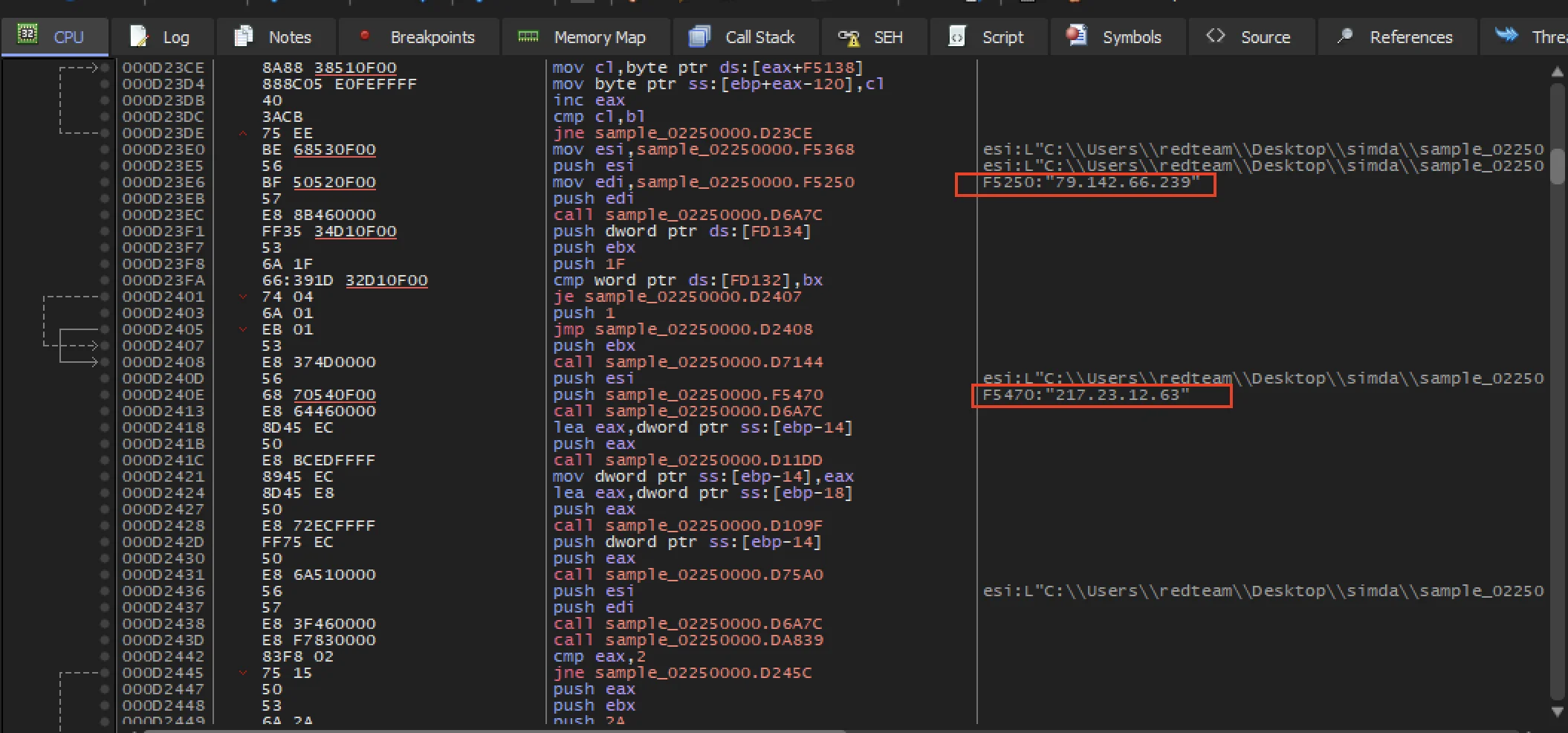
79.142.66.239 and 217.23.12.63). Navigating to the adjacent global string buffer at memory address 0x000F5578 inside Dump 1 revealed the third dynamic C2 server: text
000F5578 | 31 30 39 2E 32 33 36 2E 38 37 2E 31 30 36 00 | 109.236.87.106.
3. Indicator Extraction
Matching the exact octet formatting rules requested by the challenge (7x.xxx.xx.xxx, 2xx.xx.xx.xx, 1xx.xxx.xx.xxx), the active runtime Command and Control infrastructure is identified as:
79.142.66.239 (Buffer 0xF5250)217.23.12.63 (Buffer 0xF5470)109.236.87.106 (Buffer 0xF5578)ANSWER
79.142.66.239,217.23.12.63,109.236.87.106Question 13
To which Windows environment variable–based folder does the malware copy itself?
In function sub_405C5F, the malware calls Windows environment expansion and file copying routines:
ExpandEnvironmentStringsA("%appdaa%\\ScanDisc.exe", Dst,0x104u);
CopyFileA(CurrentFileName, Dst,0);
It copies the running executable directly into the user's Application Data folder under the hidden name ScanDisc.exe for persistence!
ANSWER
%APPDATA%Question 14
What is the registry key the malware uses for persistence?
Once the payload is successfully copied to %APPDATA%, it modifies Windows Registry keys to establish execution persistence upon user logon:
sub_4038E3 demonstrated direct API calls to RegCreateKeyExW targeting the current user's Hive.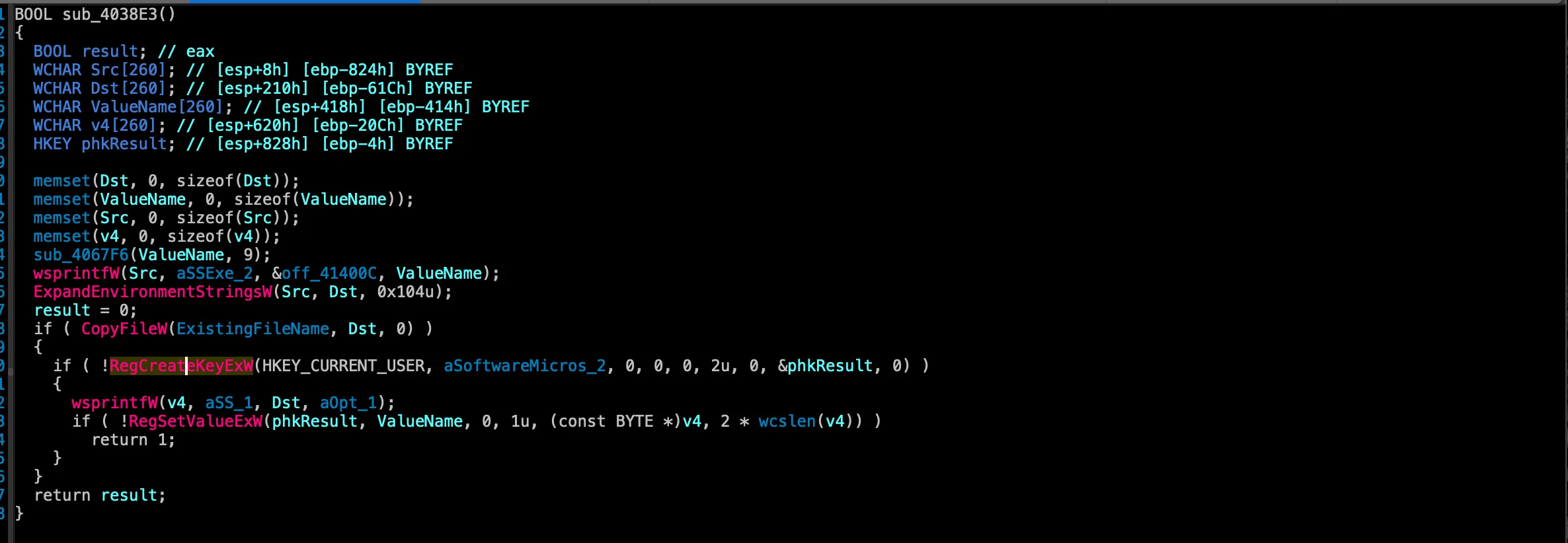
HKEY_CURRENT_USER\SOFTWARE\Microsoft\Windows\CurrentVersion\RunOnce registry key, ensuring that Windows automatically relaunches the payload every time the user logs into the system.
ANSWER
HKEY_CURRENT_USER\SOFTWARE\Microsoft\Windows\CurrentVersion\RunOnceQuestion 15
What is the argument the malware will launch itself with?
1. Analyzing the Persistence Command Line
To determine how the relocated binary executes upon system reboot, we examined the formatting routine inside the persistence function (sub_4038E3) using IDA Pro:
Decompiled sub_4038E3
BOOL sub_4038E3()
{
  BOOL result; // eax
  WCHAR Src[260]; // [esp+8h] [ebp-824h] BYREF
  WCHAR Dst[260]; // [esp+210h] [ebp-61Ch] BYREF
  WCHAR ValueName[260]; // [esp+418h] [ebp-414h] BYREF
  WCHAR v4[260]; // [esp+620h] [ebp-20Ch] BYREF
  HKEY phkResult; // [esp+828h] [ebp-4h] BYREF

  memset(Dst, 0, sizeof(Dst));
  memset(ValueName, 0, sizeof(ValueName));
  memset(Src, 0, sizeof(Src));
  memset(v4, 0, sizeof(v4));
  sub_4067F6(ValueName, 9);
  wsprintfW(Src, aSSExe_2, &off_41400C, ValueName);
  ExpandEnvironmentStringsW(Src, Dst, 0x104u);
  result = 0;
  if ( CopyFileW(ExistingFileName, Dst, 0) )
  {
    if ( !RegCreateKeyExW(HKEY_CURRENT_USER, aSoftwareMicros_2, 0, 0, 0, 2u, 0, &phkResult, 0) )
    {
      wsprintfW(v4, aSS_1, Dst, aOpt_1);
      if ( !RegSetValueExW(phkResult, ValueName, 0, 1u, (const BYTE *)v4, 2 * wcslen(v4)) )
        return 1;
    }
  }
  return result;
}RunOnce registry value, the malware constructs the execution string via wsprintfW using the format template "%s" %s.%APPDATA%\ScanDisc.exe), while the second parameter is hardcoded to the wide character string L"opt". This results in the final registry execution command: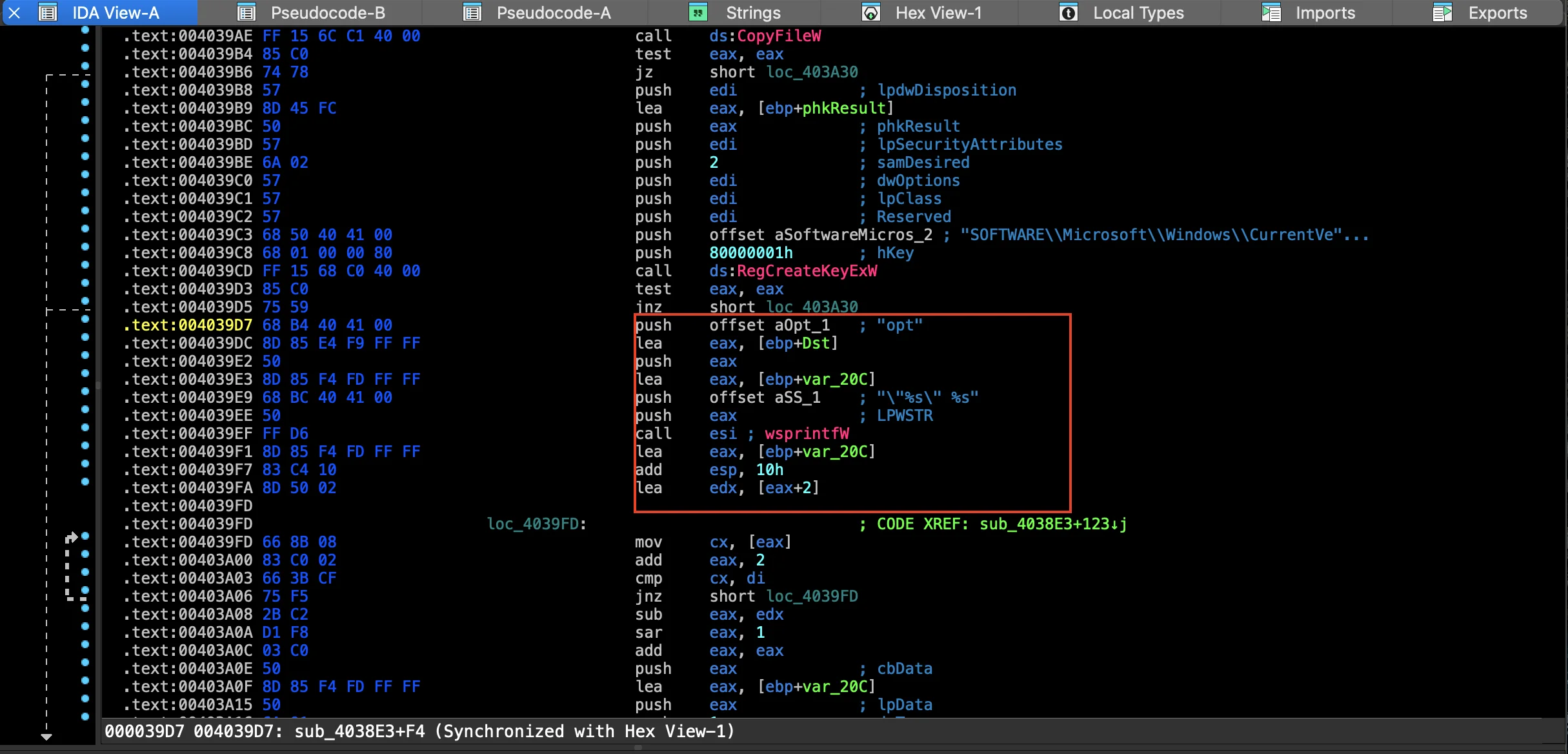
"C:\Users\<User>\AppData\Roaming\ScanDisc.exe" optANSWER
opt