Qbot (also known as QakBot or QuackBot) is indeed a, persistent, and highly sophisticated banking trojan that has been consistently packed or packed in a new layer of obfuscation for many years to evade detection by security software
It is considered a "Swiss Army knife" for threat actors, operating not only as a banking trojan to steal credentials but also as a malware loader for ransomware
Sample: https://malshare.com/sample.php?action=detail&hash=112a64190b9a0f356880eebf05e195f4c16407032bf89fa843fd136da6f5d515
File Identification
| Field | Value |
|---|---|
| File Name | Qakbot |
| MD5 | bce0df8721504d50f4497c0a0a2c090d |
| SHA-1 | 2c5b190d19f0f58e156bd1b28434701cea09cc23 |
| SHA-256 | 112a64190b9a0f356880eebf05e195f4c16407032bf89fa843fd136da6f5d515 |
| Vhash | 026086551d5c1c1c5c551214z2500927z27z6030028fz |
| Authentihash | 86da2bddaab0b1a3d6546dc35de29d8942856dc3eb8e64bd6be9e3dc097c2294 |
| Imphash | 829e83c1d2d988349a749b806aa9cfef |
| SSDEEP | 12288:qlQq2wwLHqpVxTp5WK1QAPPAV/Ykfgn6ggKh:u2wwT45xQwkfg93h |
| TLSH | T1F9D5CF27B560458BE7054A3684F6C9B026A1FEFD563520461EF0BE1BFBB1A934C11E8F |
| File Type | Win32 EXE (executable, windows, win32, pe, peexe) |
| Magic | PE32 executable (GUI) Intel 80386, for MS Windows |
| TrID | • Win32 Executable MS Visual C++ (generic) (47.3%) · • Win64 Executable (generic) (15.9%) · • Win32 Dynamic Link Library (generic) (9.9%) · • Win16 NE executable (generic) (7.6%) · • Win32 Executable (generic) (6.8%) |
| DetectItEasy | • PE32 · • Linker: Polink (2.50*) [GUI32,signed] · • Sign tool: Windows Authenticode (2.0) [PKCS #7] |
| Magika | PEBIN |
| File Size | 2.63 MB (2,755,088 bytes) |
Sections
| Index | Name | SHA-256 Hash | Entropy | File Ratio | Raw Size (Bytes) | Virtual Size (Bytes) | Raw Address (Begin) | Virtual Address |
|---|---|---|---|---|---|---|---|---|
| 0 | .text | 0917EF1437D686D73C90CE2823E761224AFF706BC2AFCF50FC14070A4AE5AB35 | 5.517 | 2.99 % | 82,432 | 82,058 | 0x00000400 | 0x00001000 |
| 1 | .rdata | CA63C02CAA8C0248F3F6A8291F23B0C2F64A6B933F9E7C99DF7E4B62762A7480 | 3.213 | 0.02 % | 512 | 263 | 0x00014600 | 0x00016000 |
| 2 | .data | 126425A525E41E910B9358492365743A2330C7F260247AEA3F906E09B298490F | 5.580 | 0.41 % | 11,264 | 11,300 | 0x00014800 | 0x00017000 |
| 3 | a2 | AF3AB617E13B364CA364C8A8192346E14E55A2271662E409424DBB415B1798B3 | 0.139 | 0.02 % | 512 | 10 | 0x00017400 | 0x0001A000 |
| 4 | a3 | 0F2F59AFFEEC6B89C23DFF01782CBE898B57D866326E828C5952104BAD4BEB5C | 1.157 | 89.96 % | 2,478,592 | 2,478,294 | 0x00017600 | 0x0001B000 |
| 5 | a32 | 60AE7E06BA7EA296D2D0A11FD046BA9098E1673CCBB76B81C7E72752B4100862 | 4.845 | 0.04 % | 1,024 | 1,010 | 0x00274800 | 0x00279000 |
| 6 | a322 | B76B11A36D44B4C17175B5AE7E018B975E79F7B02EEB6E44B4F143316343A33A | 5.474 | 4.61 % | 126,976 | 126,843 | 0x00274C00 | 0x0027A000 |
| 7 | .rsrc | 597AB4CED962CE1851893DF4A910C0F2A54D7A0034166CBF1006CA9153966D6C | 3.632 | 1.88 % | 51,712 | 51,416 | 0x00293C00 | 0x00299000 |
Key Observations
a3 section.a3 shows extremely low entropy (1.157), indicating it is almost entirely redundant data (null bytes or repetitive padding), effectively "bloating" the file size.a2 through a322 is a strong indicator of a custom packer or an obfuscation layer designed to make manual analysis more difficult.Imports
| Library (DLL) | Function Name | Binding | Location (VA) |
|---|---|---|---|
| KERNEL32.dll | Sleep | Implicit | 0x000188F8 |
GetLastError | Implicit | 0x00018900 | |
GetModuleHandleW | Implicit | 0x00018910 | |
LoadLibraryA | Implicit | 0x00018924 | |
GetProcAddress | Implicit | 0x00018934 | |
CreateMutexA | Implicit | 0x00018946 | |
VirtualAlloc | Implicit | 0x00018A8E | |
WriteFile | Implicit | 0x00018AAC | |
WinExec | Implicit | 0x000190EE | |
CreateThread | Implicit | 0x00018E26 | |
| USER32.dll | GetKeyState | Implicit | 0x000193D4 |
GetAsyncKeyState | Implicit | 0x000194B2 | |
BlockInput | Implicit | 0x00019450 | |
wsprintfW | Implicit | 0x00019530 | |
SendMessageW | Implicit | 0x0001953C | |
| ADVAPI32.dll | RegOpenKeyExW | Implicit | 0x000198E6 |
RegSetValueExW | Implicit | 0x000199E0 | |
CryptAcquireContextA | Implicit | 0x0001994C | |
CryptGenRandom | Implicit | 0x0001999A | |
CryptHashData | Implicit | 0x00019A68 | |
| GDI32.dll | CreateSolidBrush | Implicit | 0x00019664 |
DeleteObject | Implicit | 0x000196F6 | |
GetDeviceCaps | Implicit | 0x0001985C | |
| SHELL32.dll | ShellExecuteW | Implicit | 0x00019B28 |
SHCreateProcessAsUserW | Implicit | 0x00019AF8 | |
| SHLWAPI.dll | PathFindFileNameW | Implicit | 0x00019B92 |
PathCombineW | Implicit | 0x00019BBC | |
| ole32.dll | CoTaskMemFree | Implicit | 0x00019B66 |
| Library (DLL) | Binding | Import Count | Description |
|---|---|---|---|
| KERNEL32.dll | Implicit | 146 | Windows NT BASE API Client |
| USER32.dll | Implicit | 40 | Multi-User Windows USER API Client Library |
| GDI32.dll | Implicit | 37 | GDI Client Library |
| ADVAPI32.dll | Implicit | 33 | Advanced Windows 32 Base API |
| SHELL32.dll | Implicit | 6 | Windows Shell Library |
| SHLWAPI.dll | Implicit | 3 | Shell Light-weight Utility Library |
| ole32.dll | Implicit | 2 | Microsoft OLE for Windows |
Analysis of Imports
Based on these specific function calls, the file possesses several notable capabilities:
WinExec, CreateThread, and ShellExecuteW indicates the ability to launch other processes or run code in parallel.BlockInput (USER32) is a sensitive function often used by malware or utility tools to prevent the user from using their keyboard or mouse.ADVAPI32 imports (CryptHashData, CryptGenRandom) show the binary can generate or verify encrypted data and hashes.RegOpenKeyExW and WriteFile suggests it can modify system settings and drop files to the disk.SHELL32 and SHLWAPI suggests the program interacts with the Windows Explorer shell, likely for path manipulation or executing commands with higher-level shell functions.X32-DBG
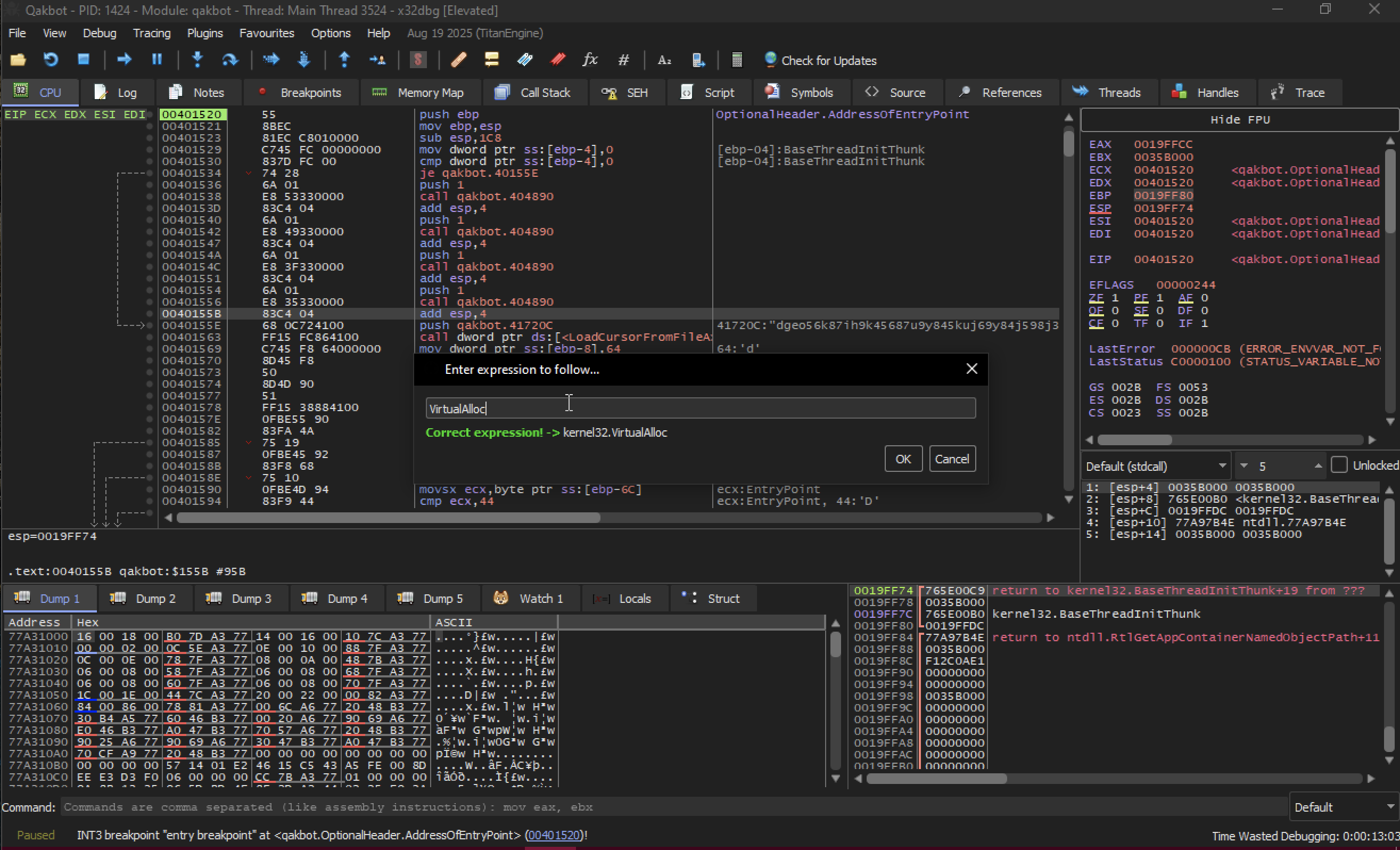
load the sample in x32dbg hit f9 to get into user space. ctrl + g go to VirtualAlloc
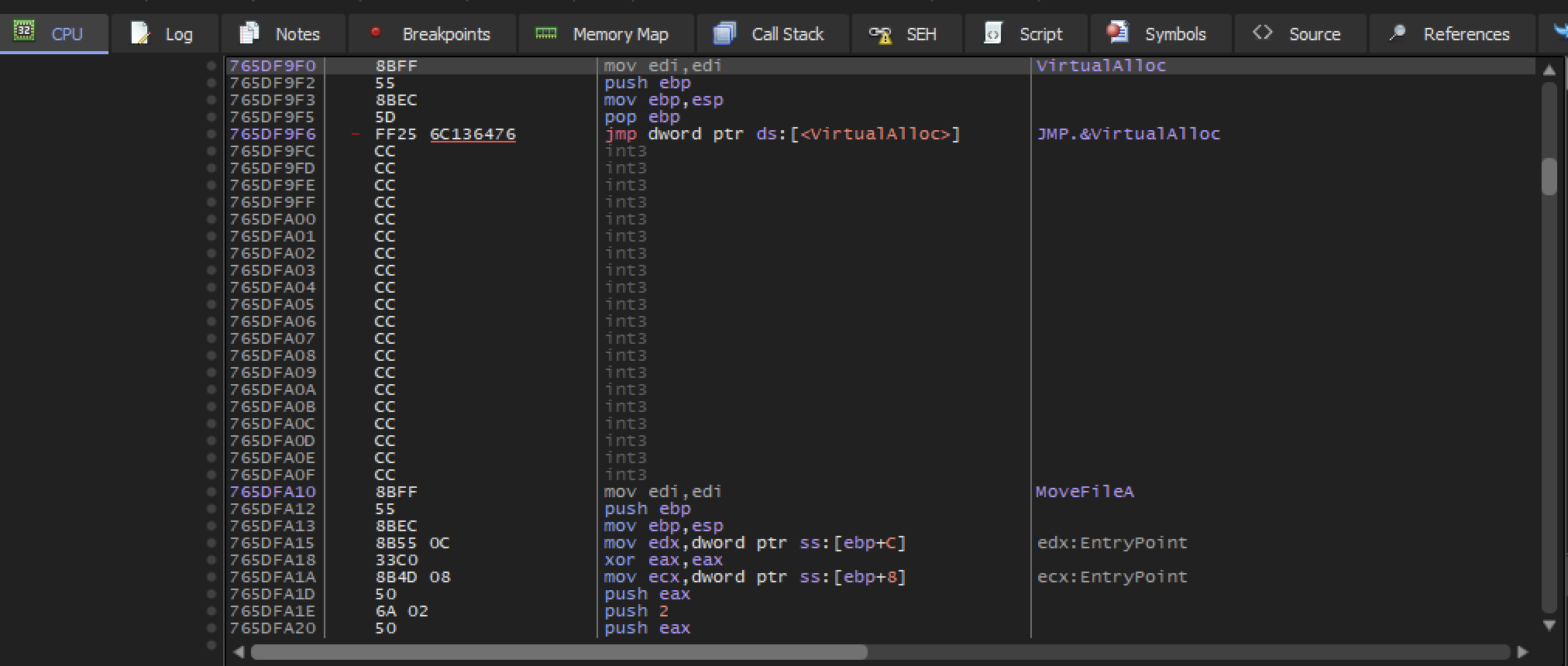
Set breakpoint, hit f9 until hit this breakpoint.
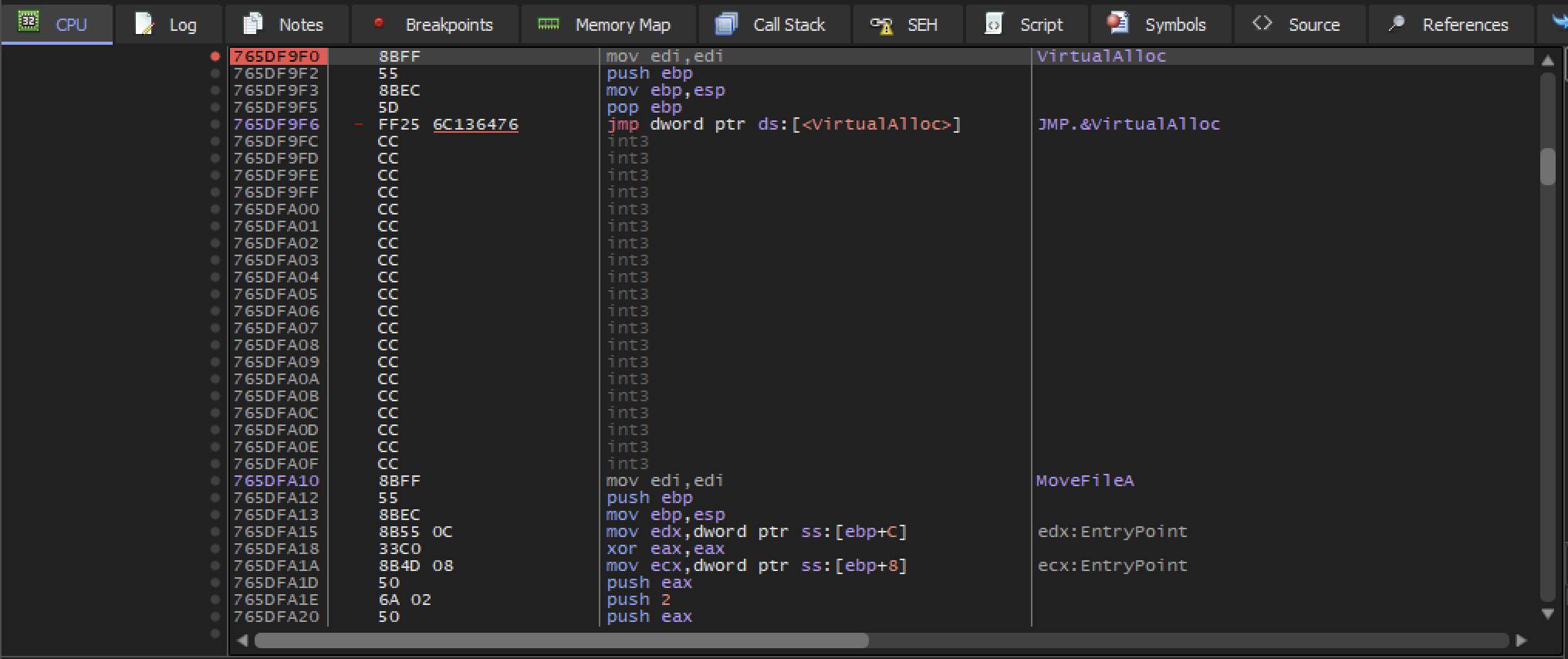
Then ctrl + f9 then f8 to get back to userspcae.
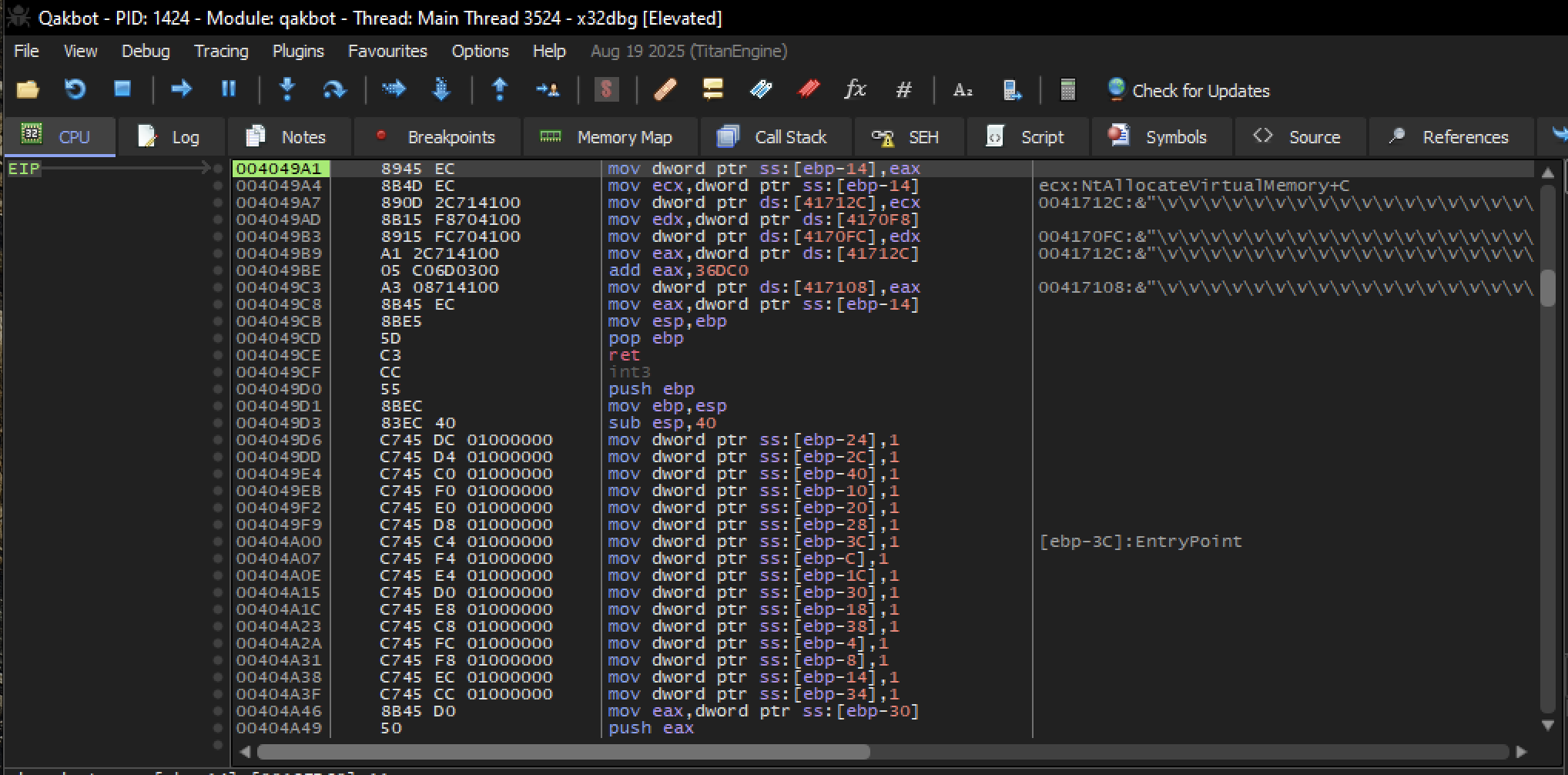
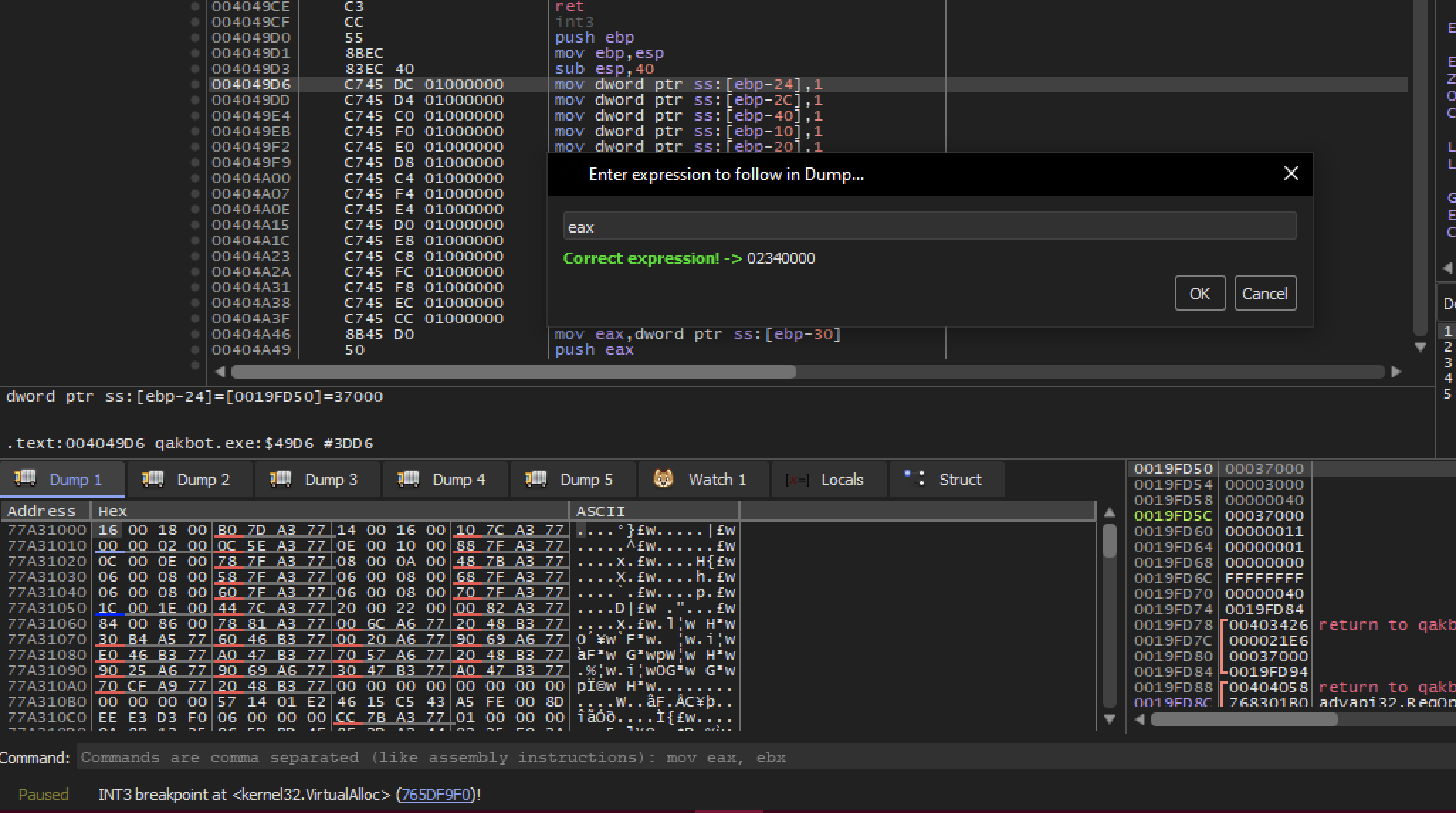
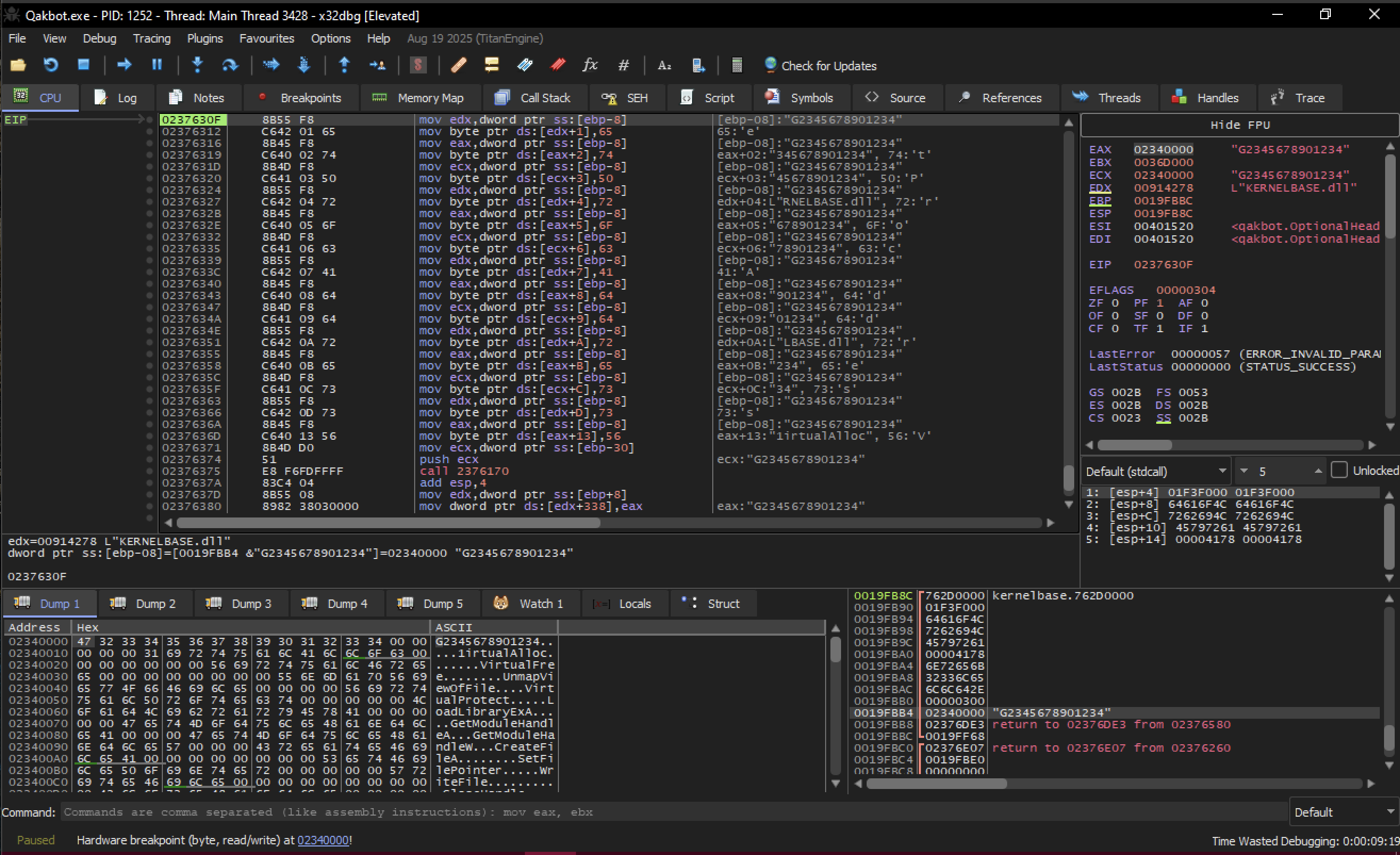
In hexdump ctrl + g follow eax.
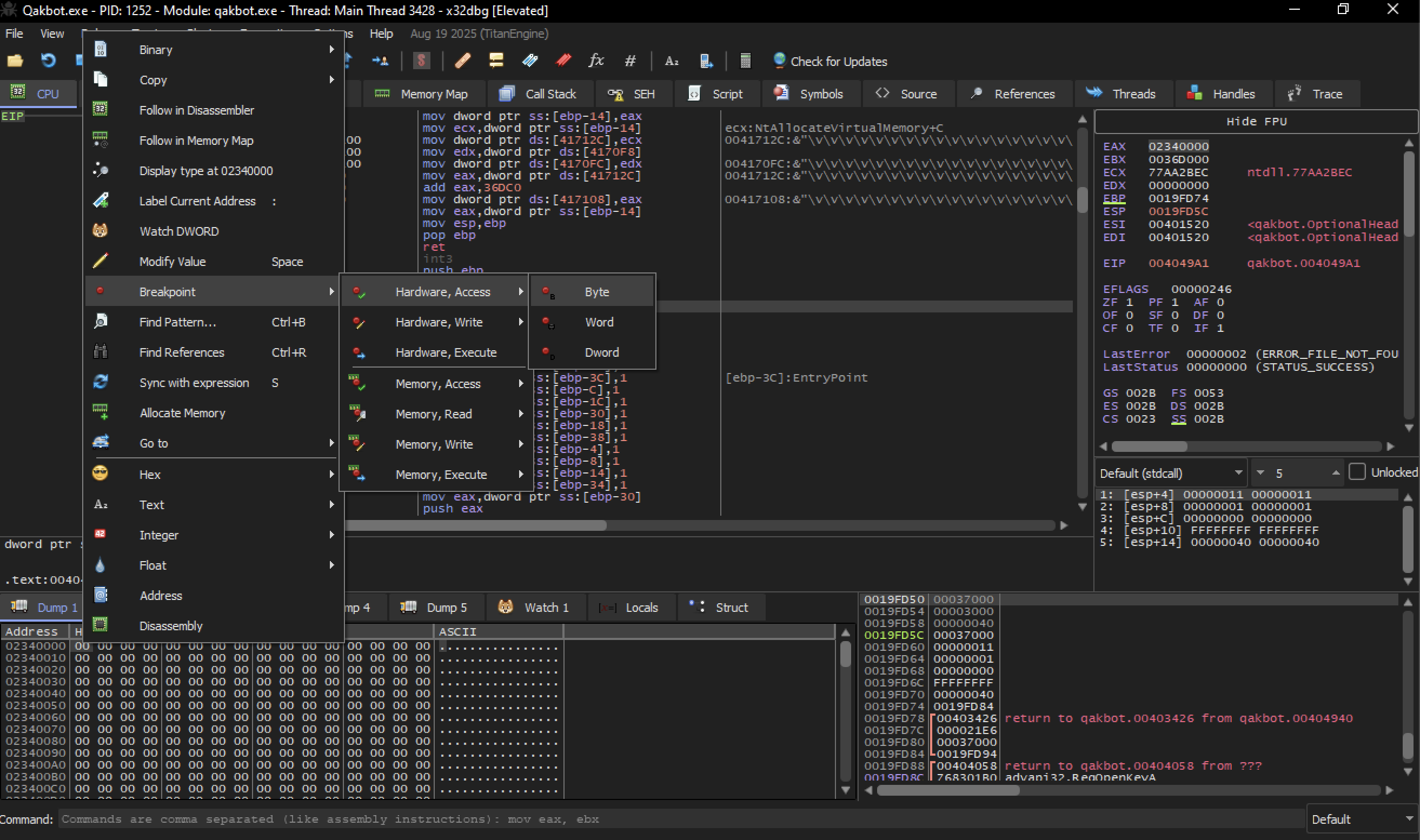
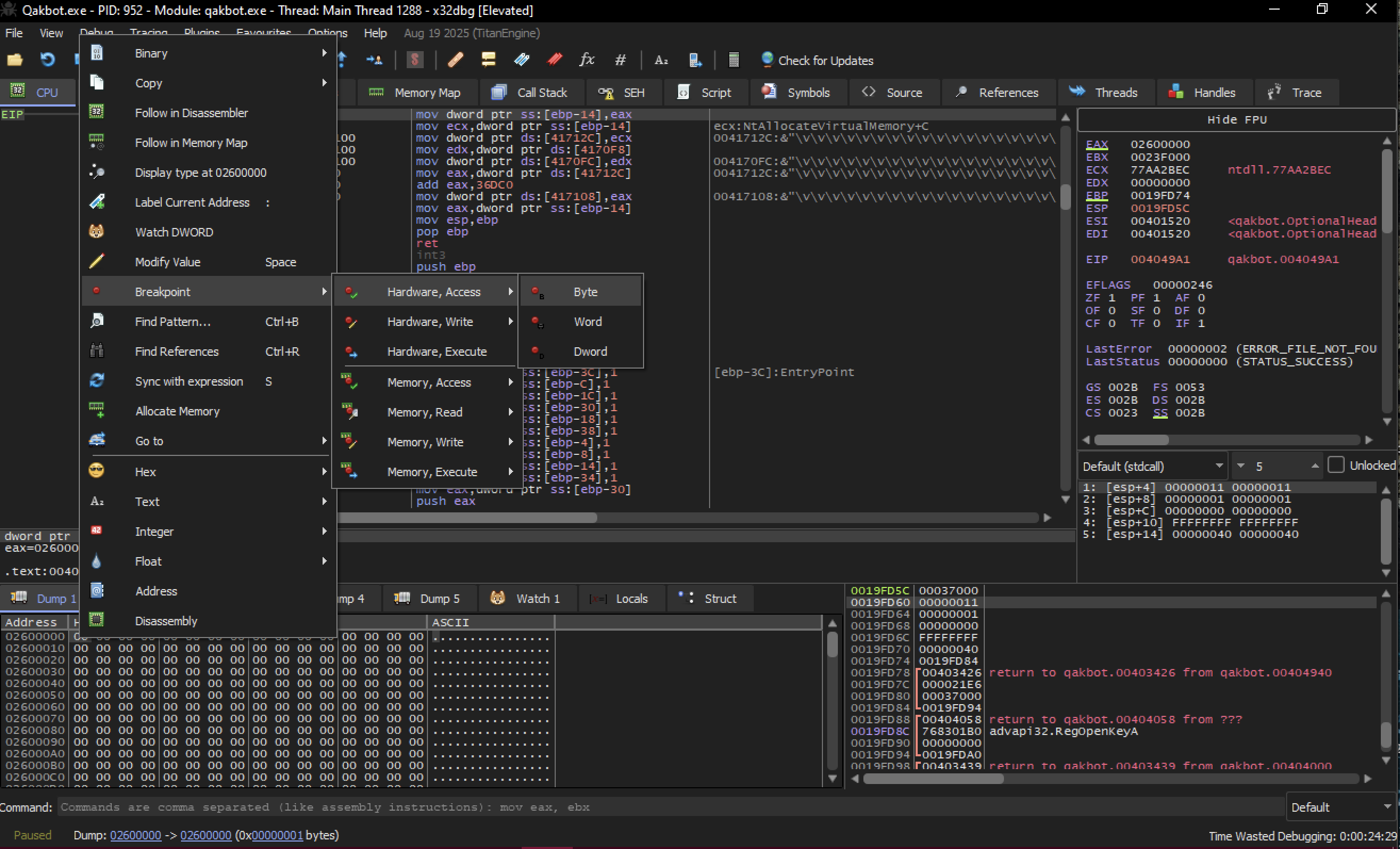
Set breakpoint.
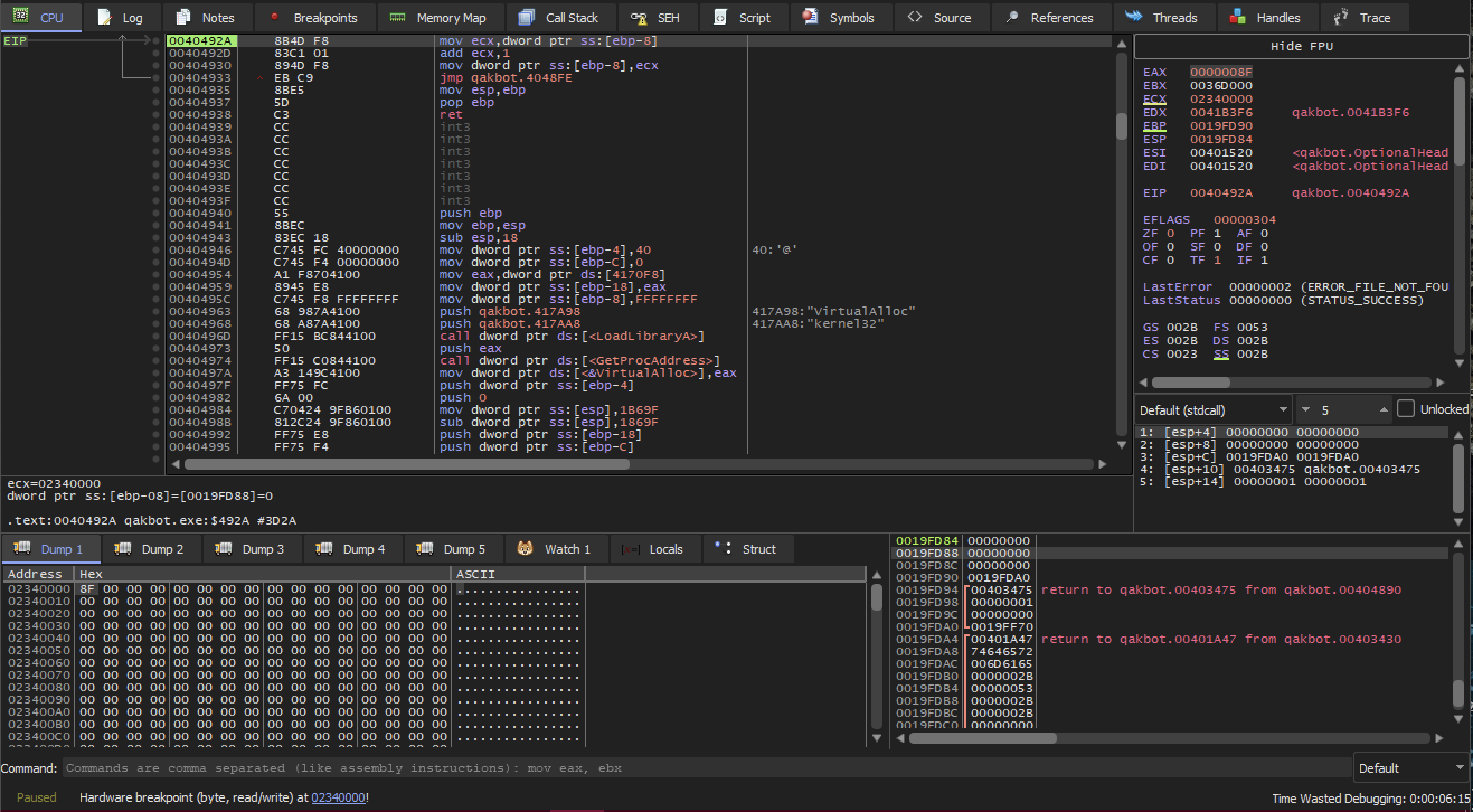
hit f9 we can see first byte 8F in the memory dump.
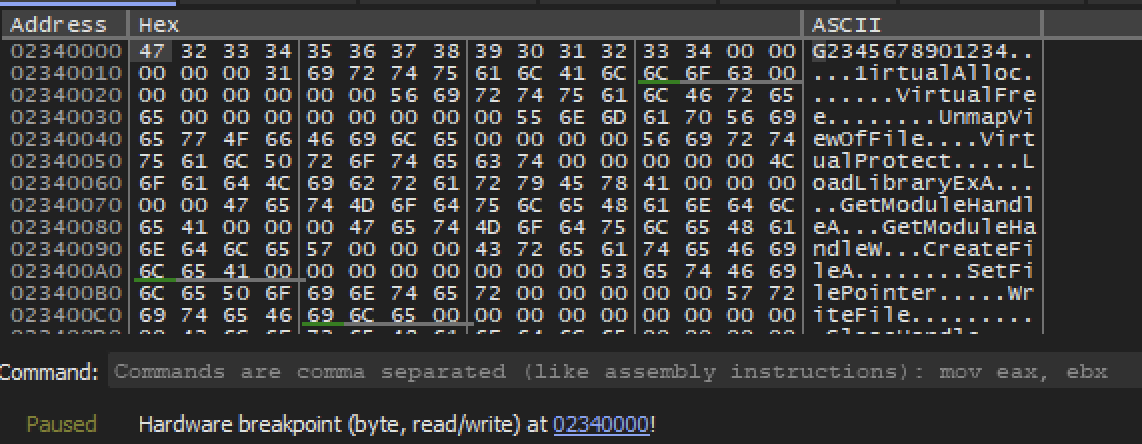
then hit f9 couple of times 7times we got this.
looks like an api lists.
I restarted the program disable VirtualAlloc breakpoint.
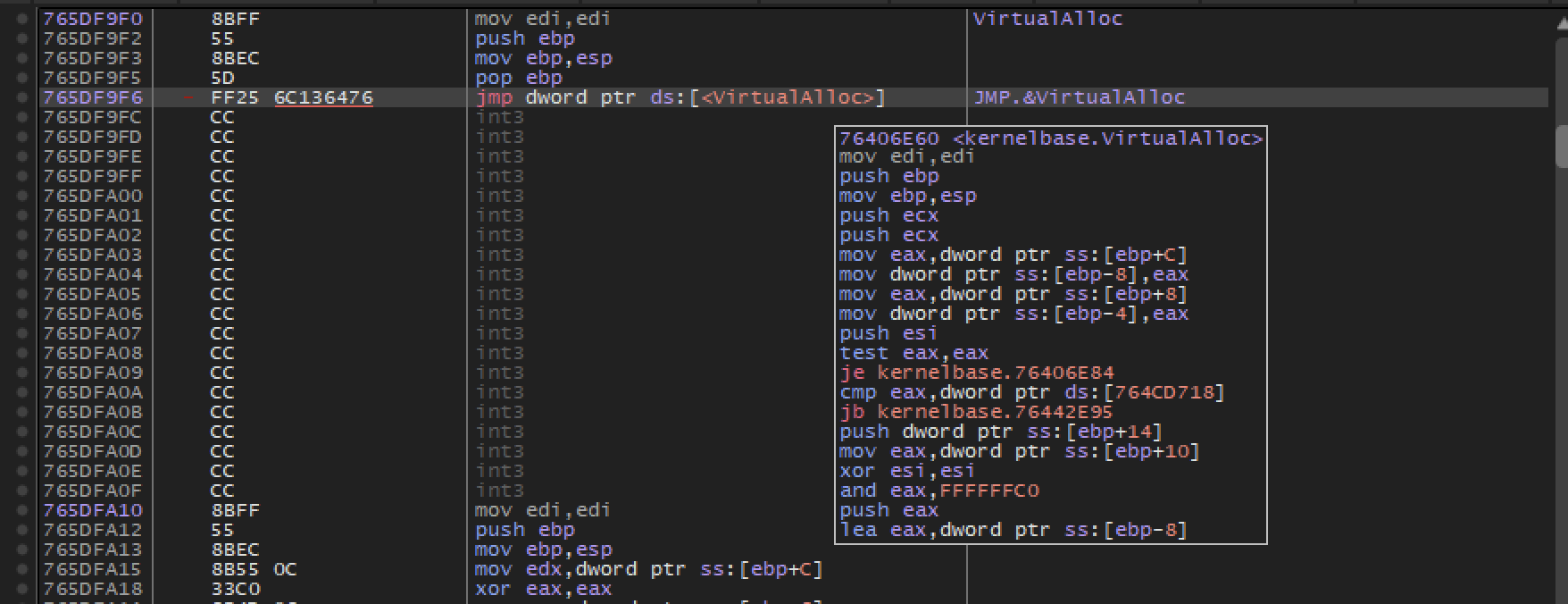
Inside VirtuallAlloc set Breakpoint, So Kernel32 Virtually calls Kernelbase Alloc
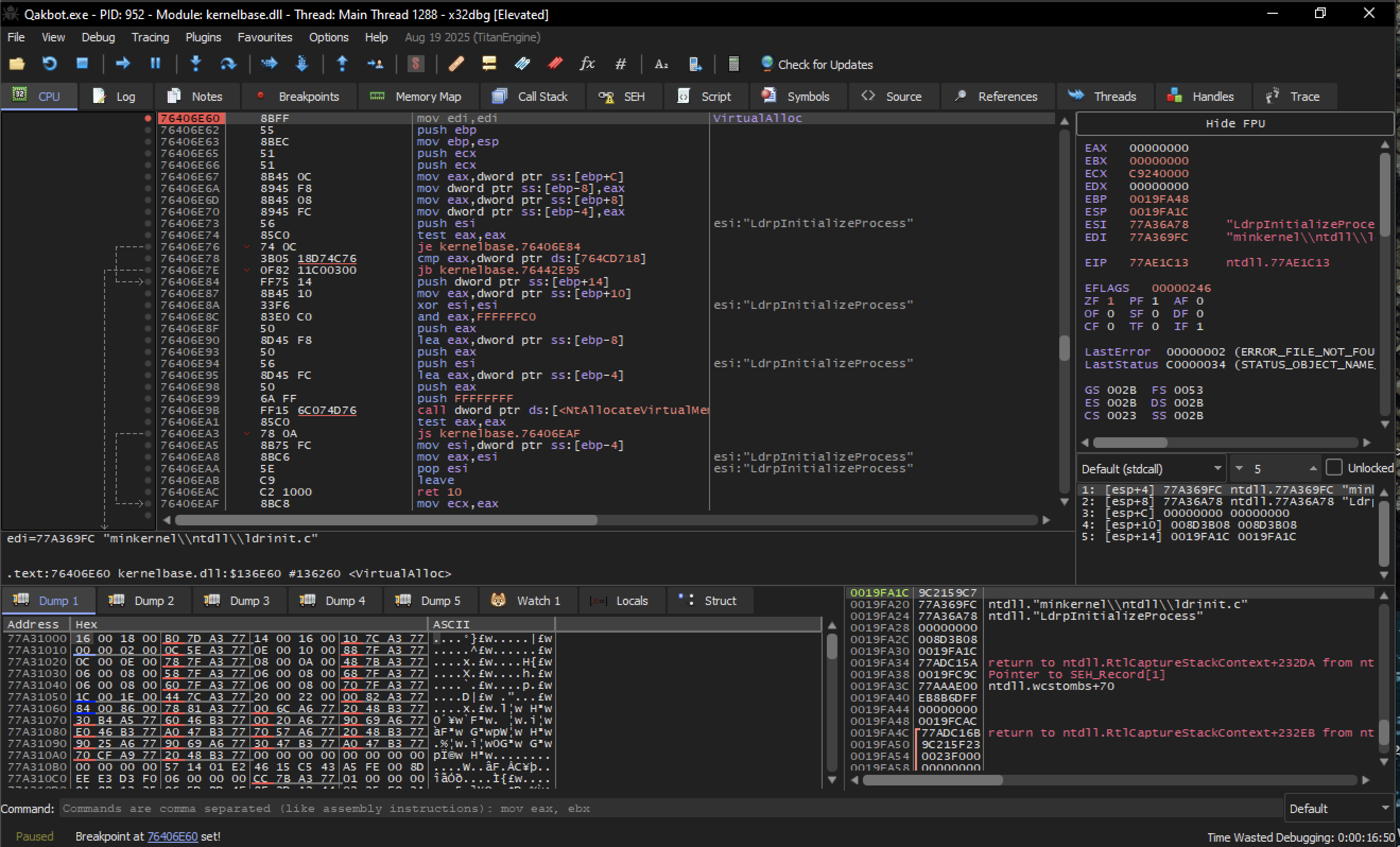
F9hit the break point
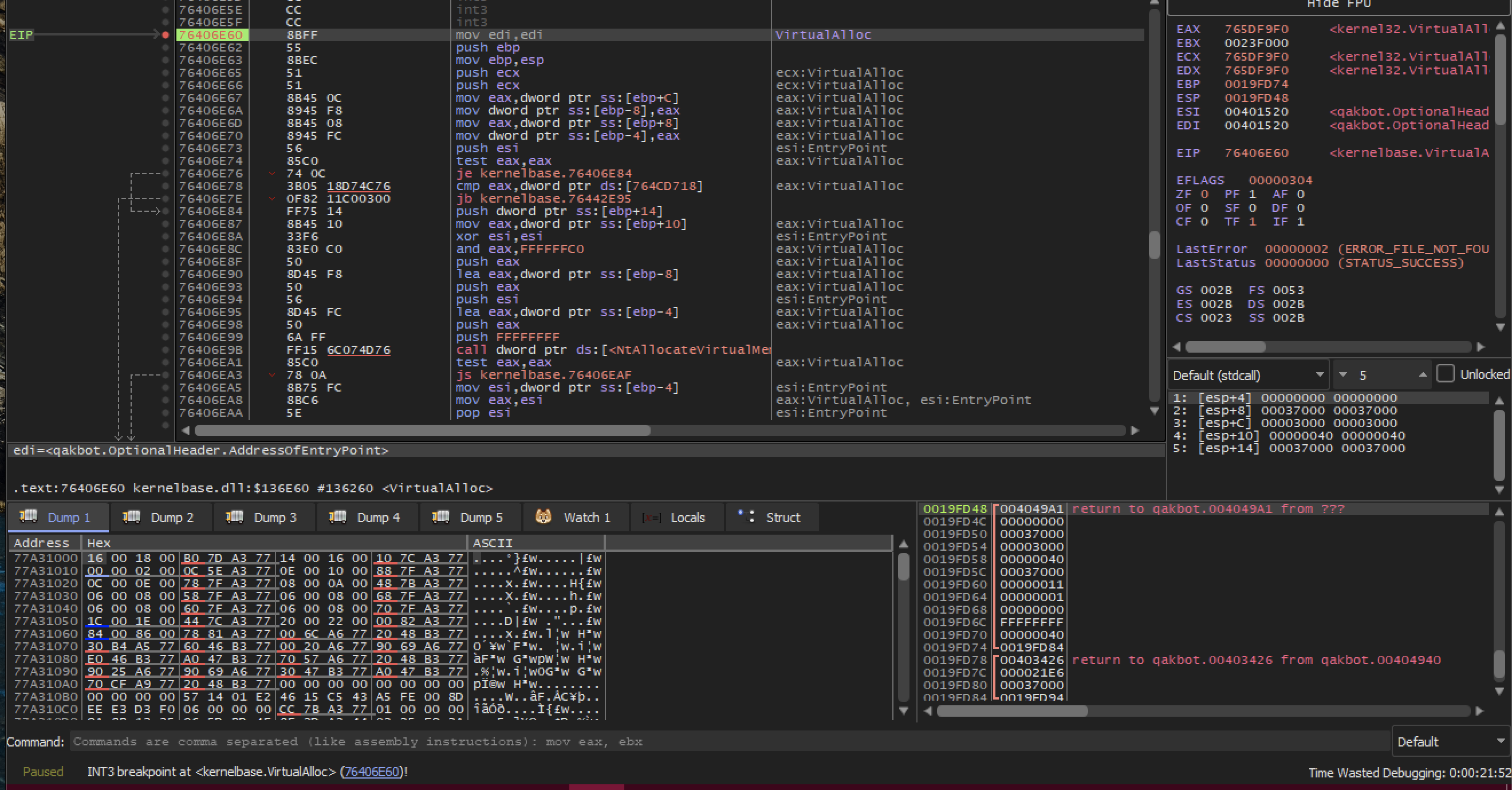
hit ctrl + F9 and F8 .
Then in memory dump ctrl + g Follow EAX.
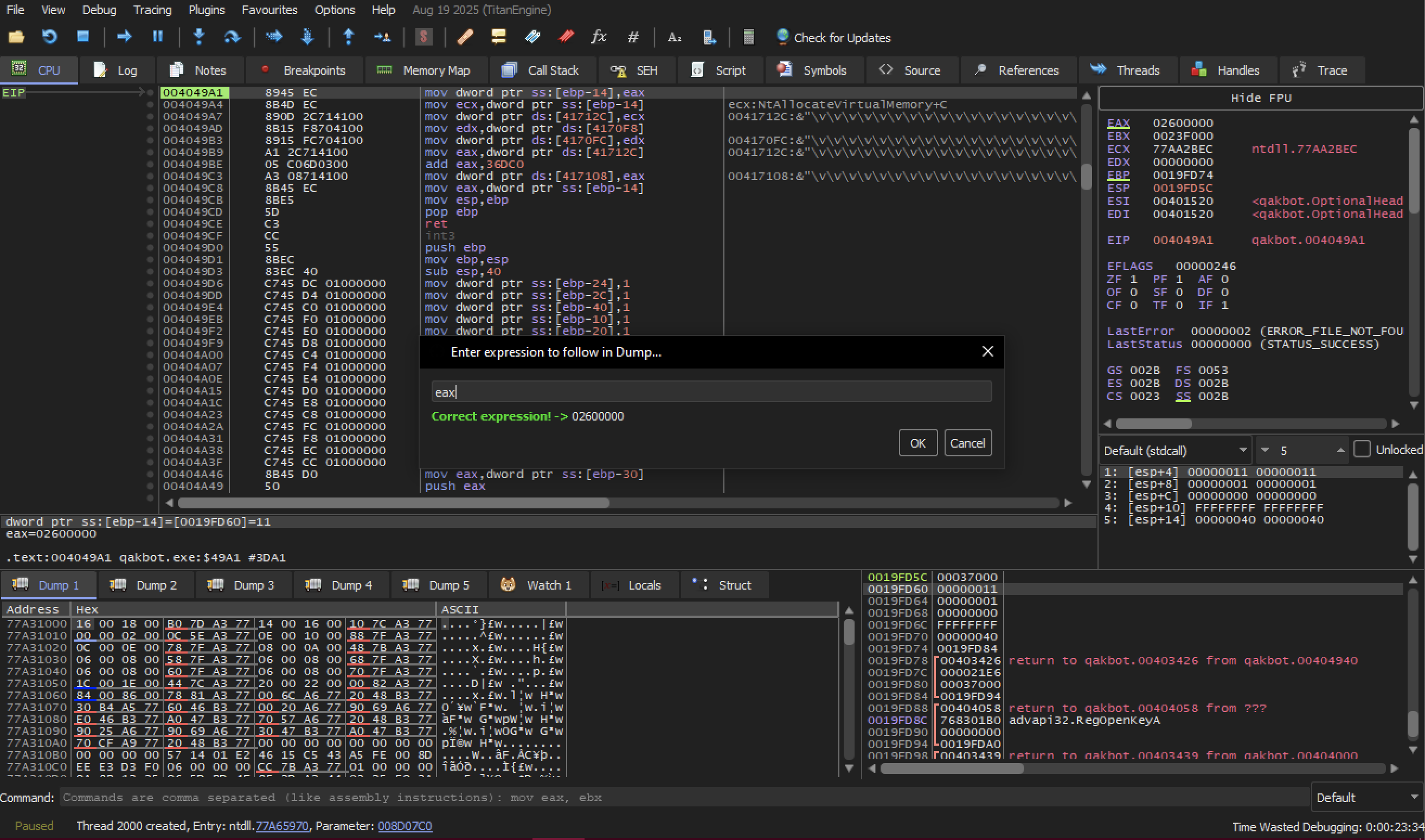
Set break point
As before hit f9 we see first byte 8F
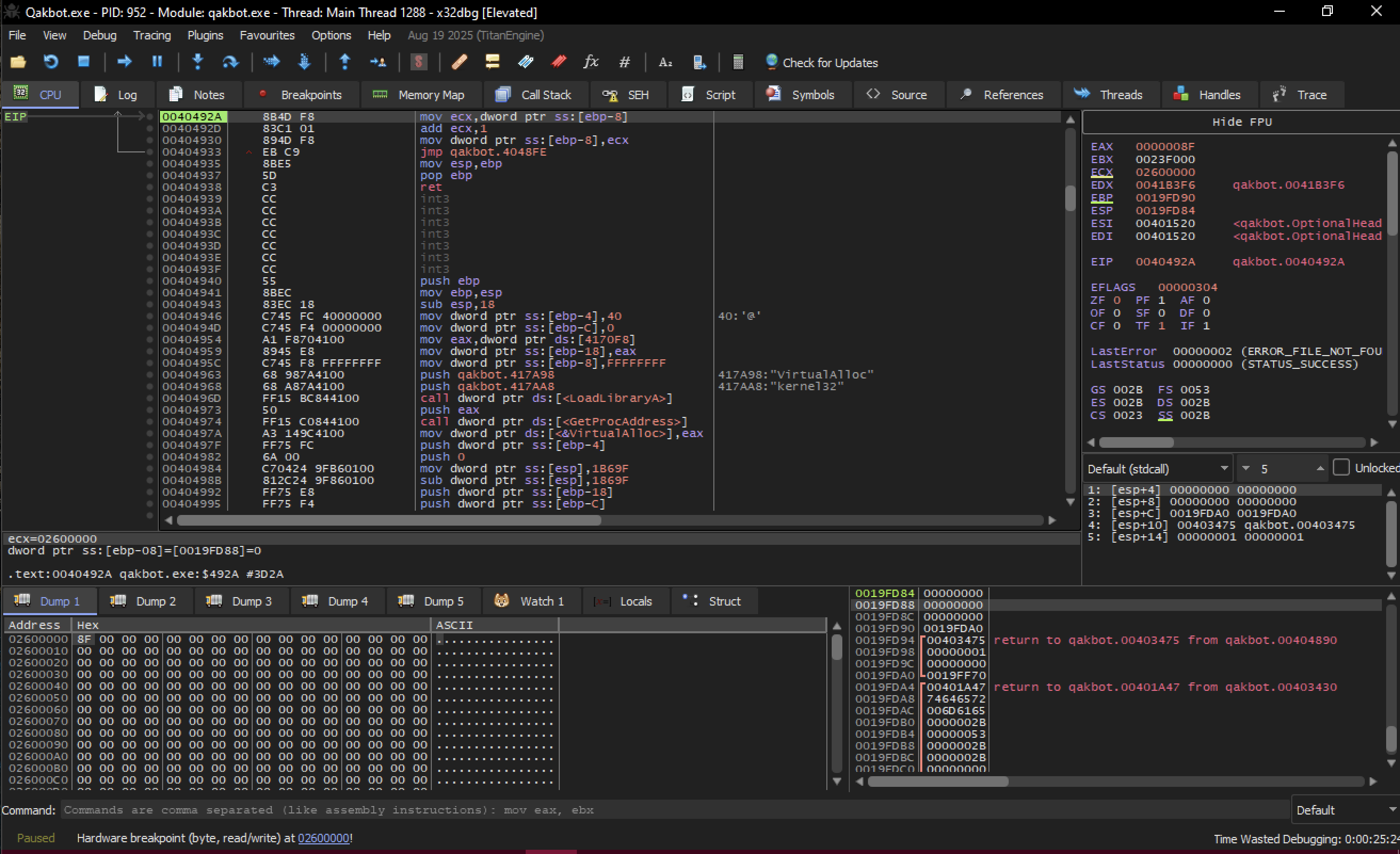
now hit F9 until you see clear text in memory dump or a virtualAlloc
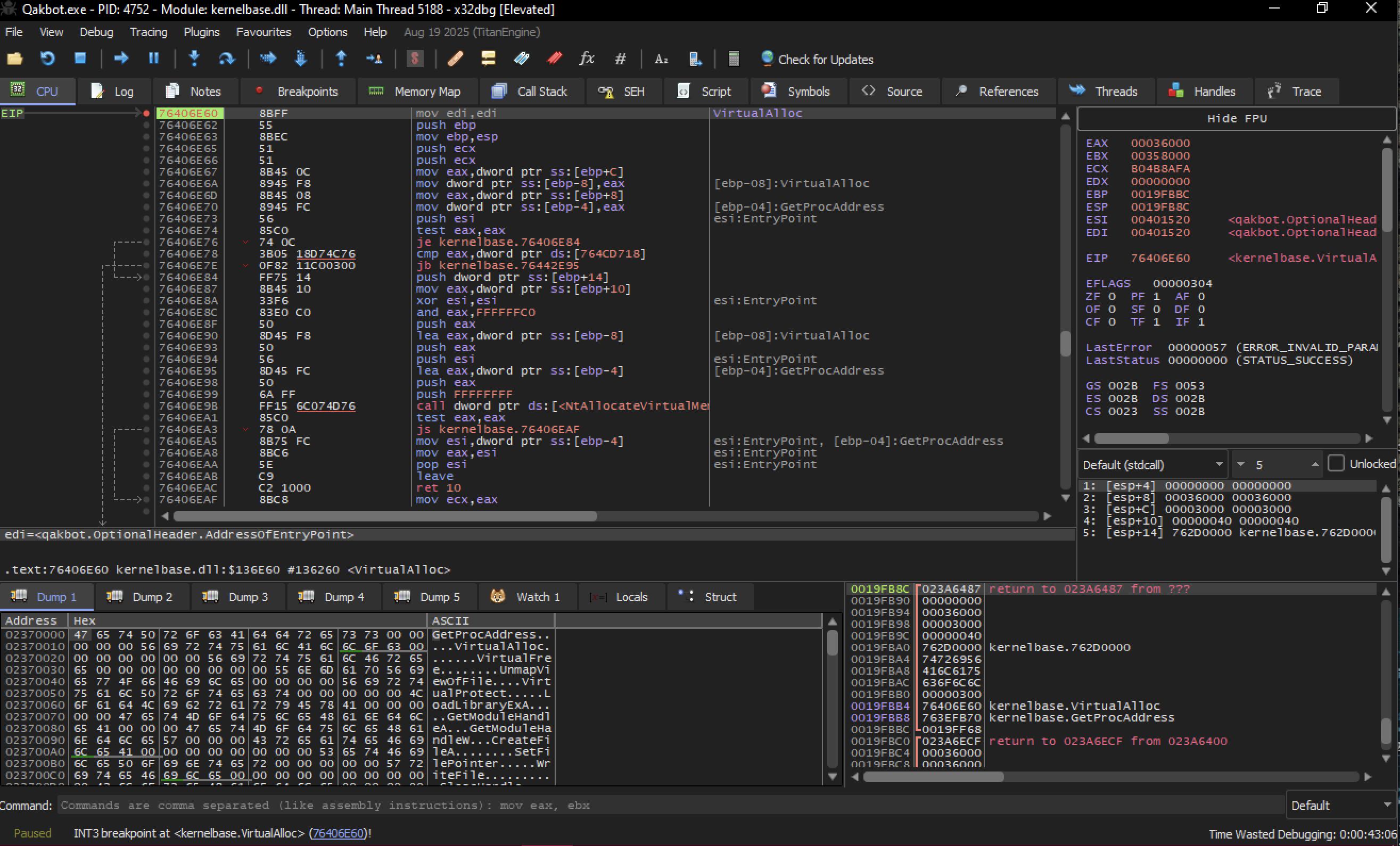
then ctrl + f9 then f8 .
in Memory dump2 Follow EAX set hardware breakpoint. hit f9 we can see the first byte
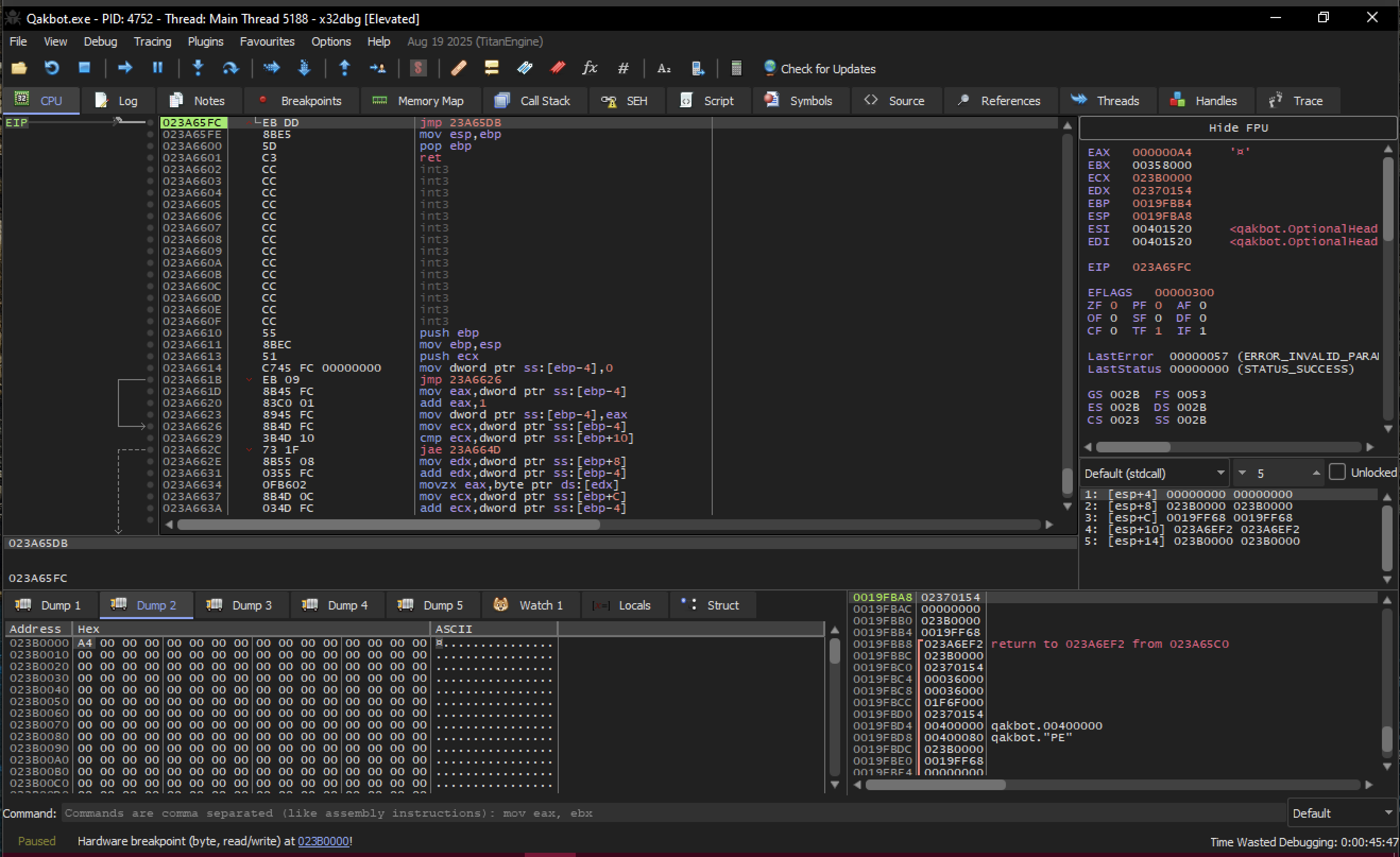
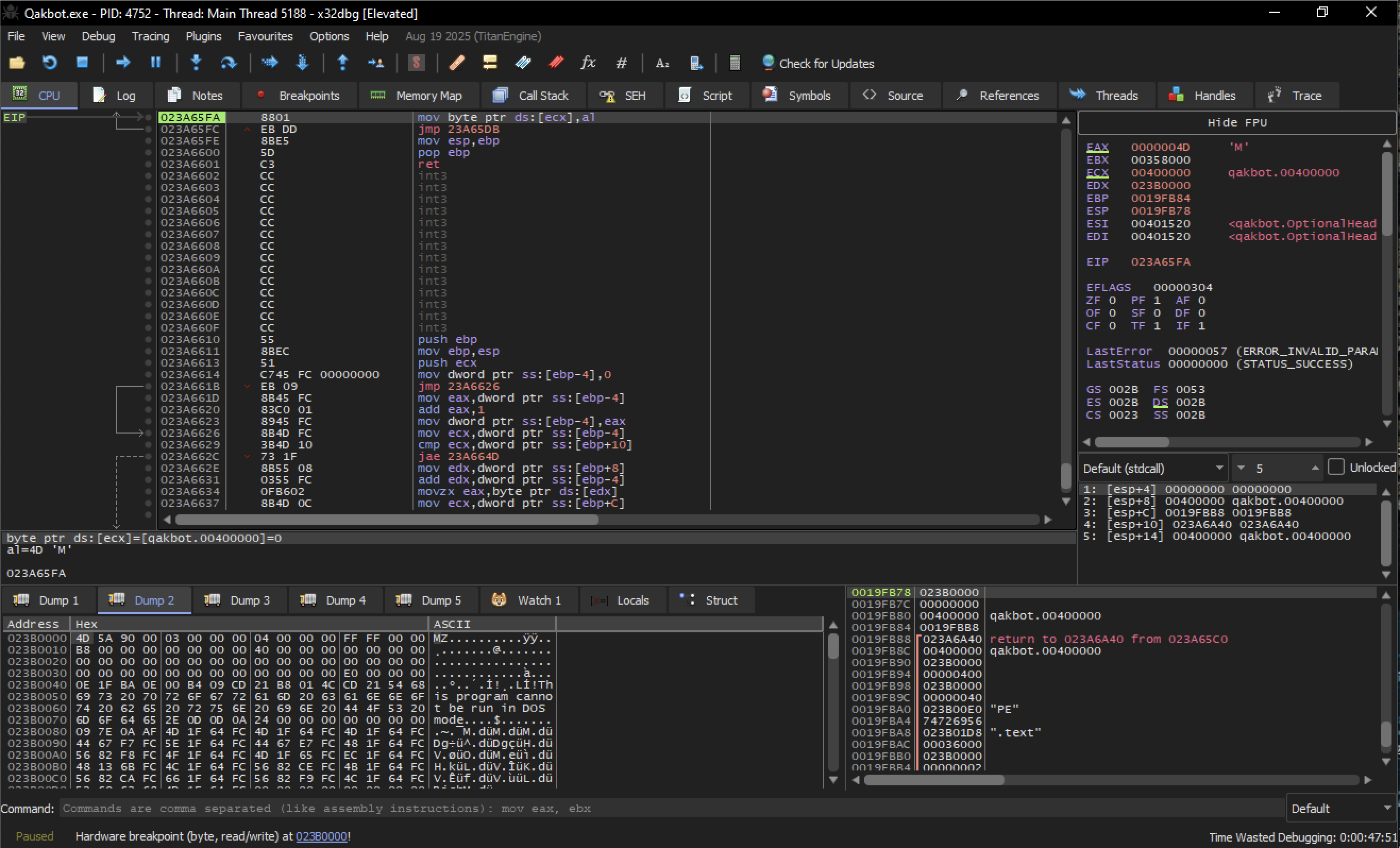
Continue hitting f9 four times.
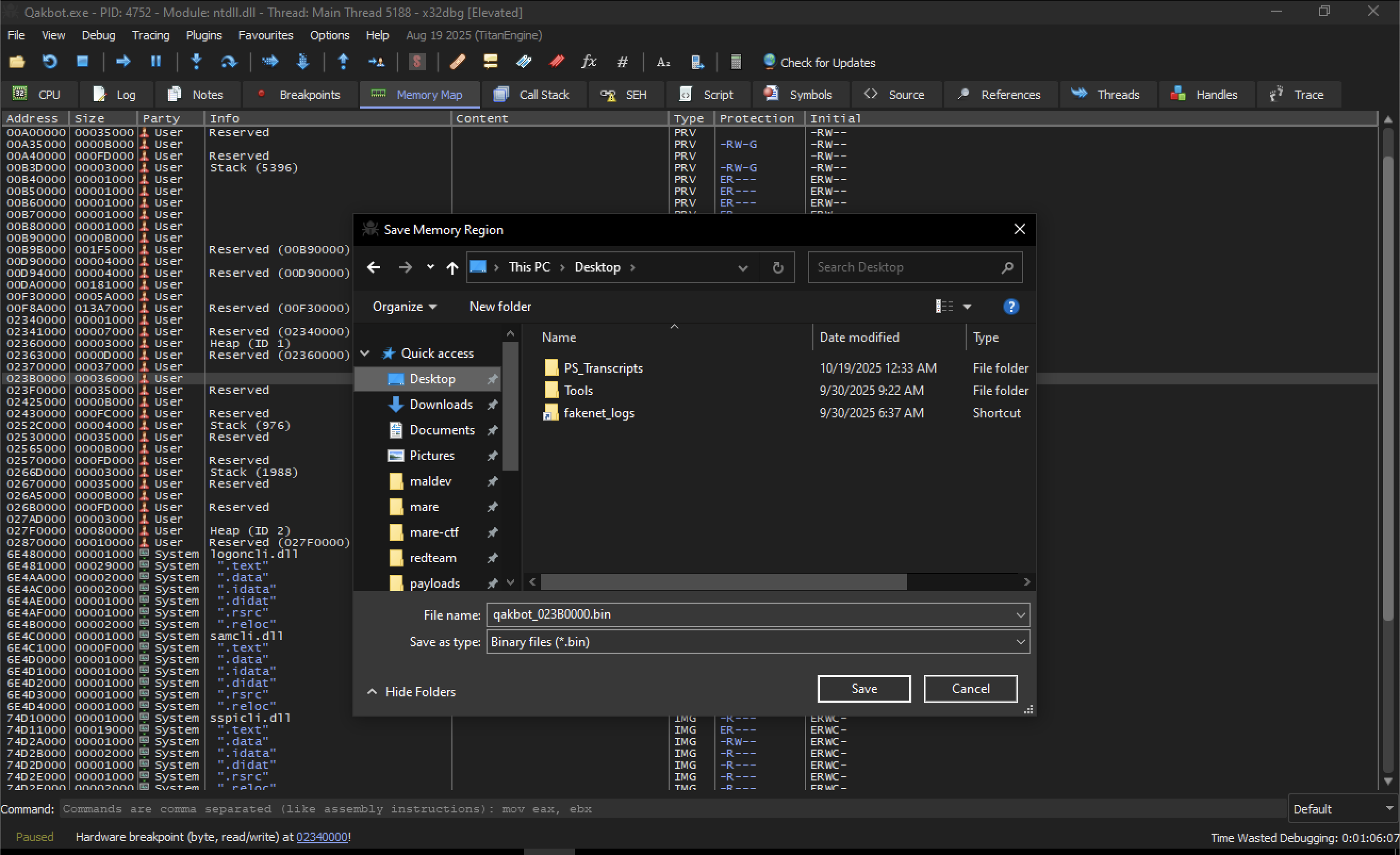
We get the MZ header
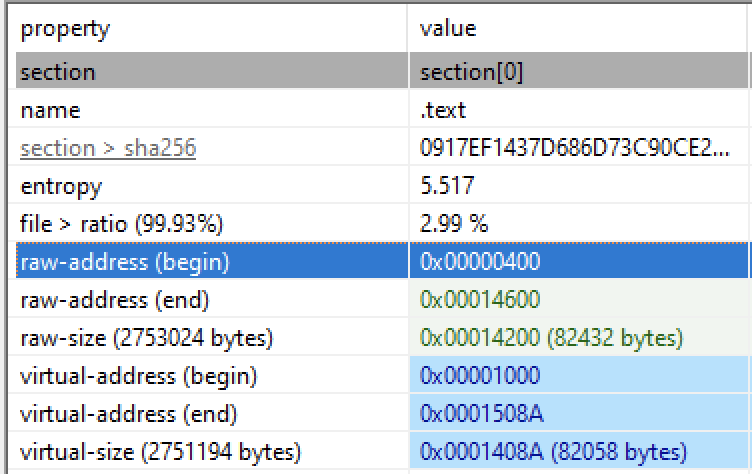
scrolling a bit after mz header end of the header the first section starts from 400 hex.
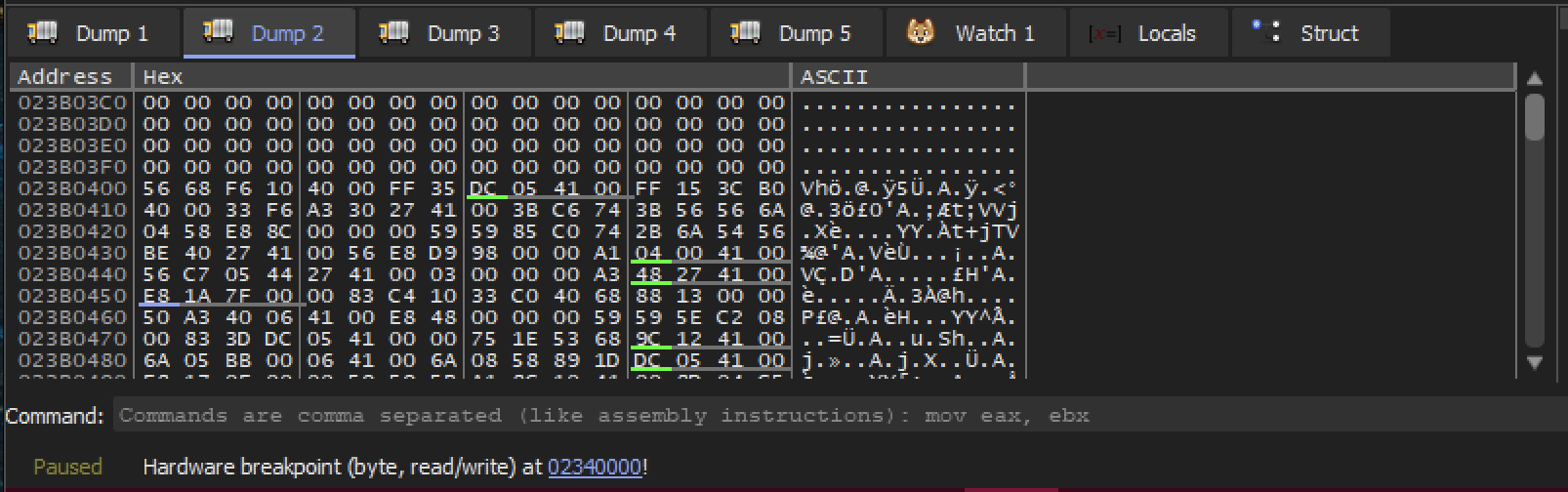
We can Verify it .text section begins with 400
Dump Memory
Now Some calculations
Open new dump file in any pe analyzer tool.
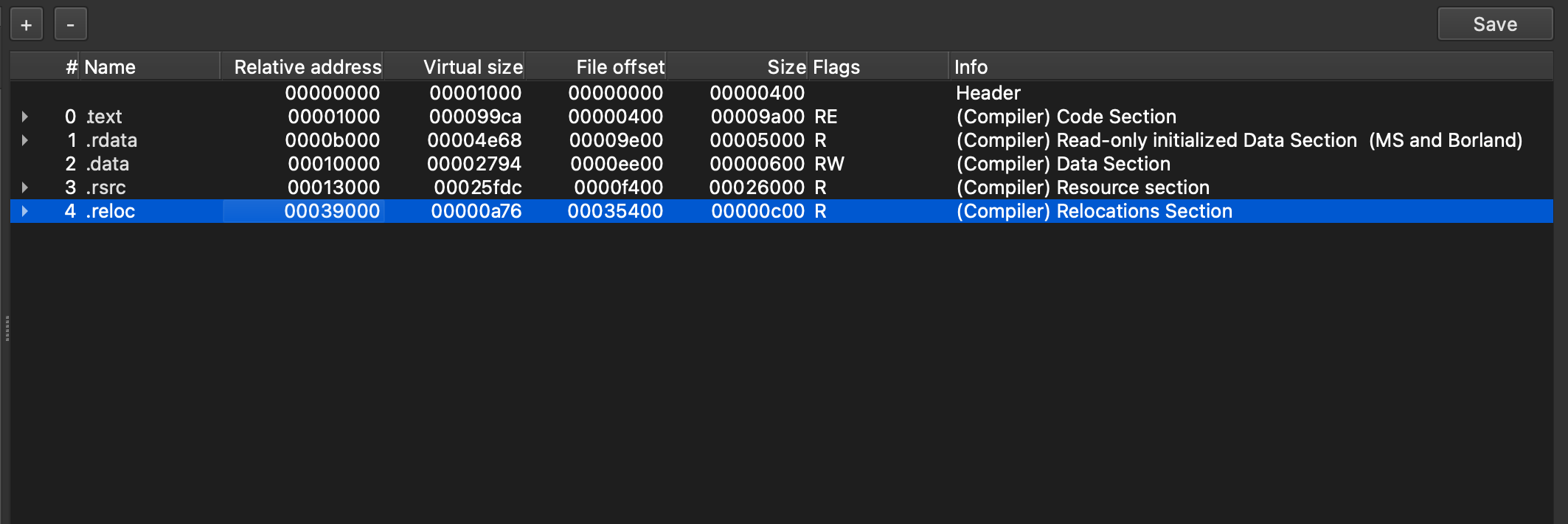
Let’s focus on .reloc end section of the binary.
Fileoffset + Size 35400 + C00 = 36000
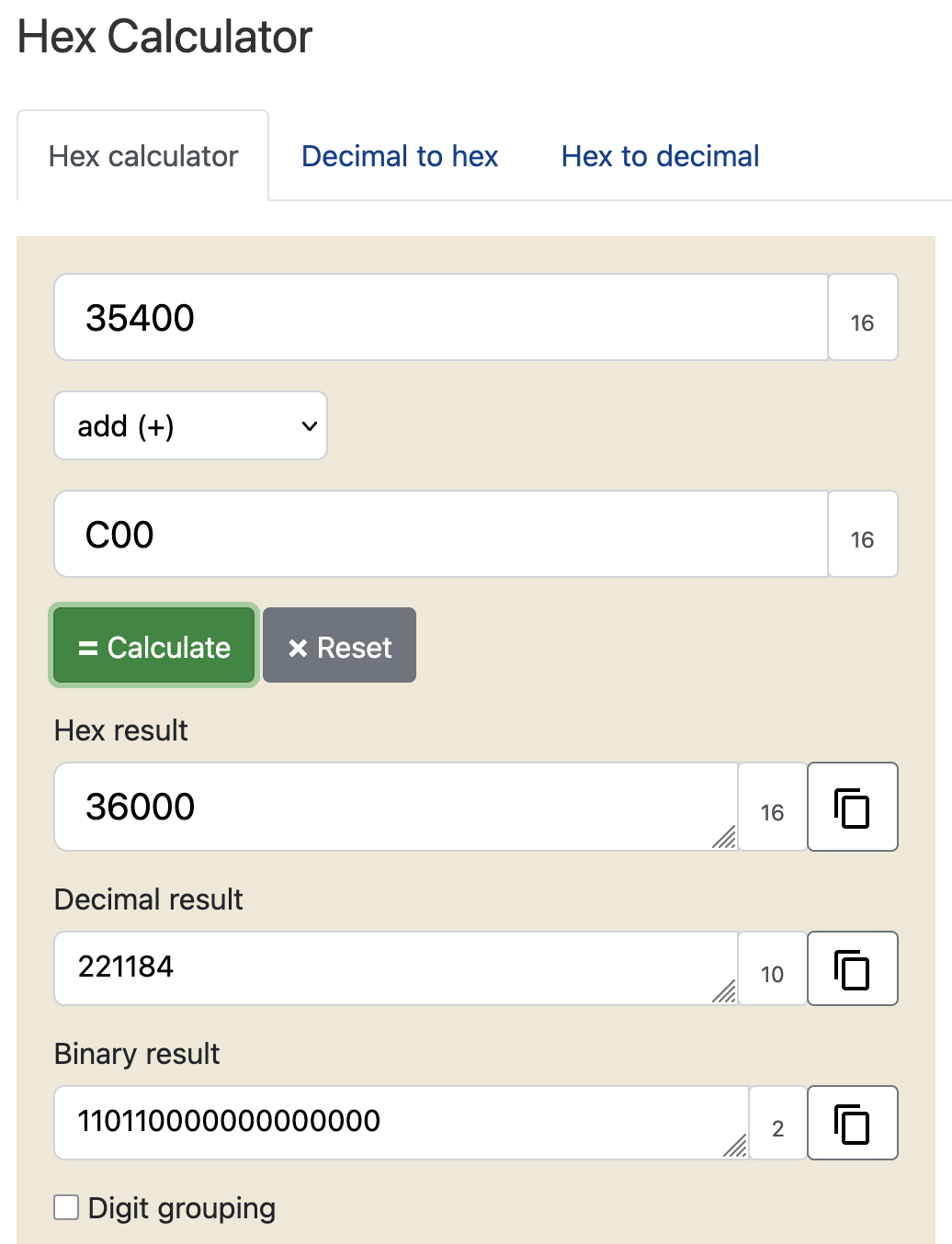
We can verify offset 36000 it’s point to the end of the file.
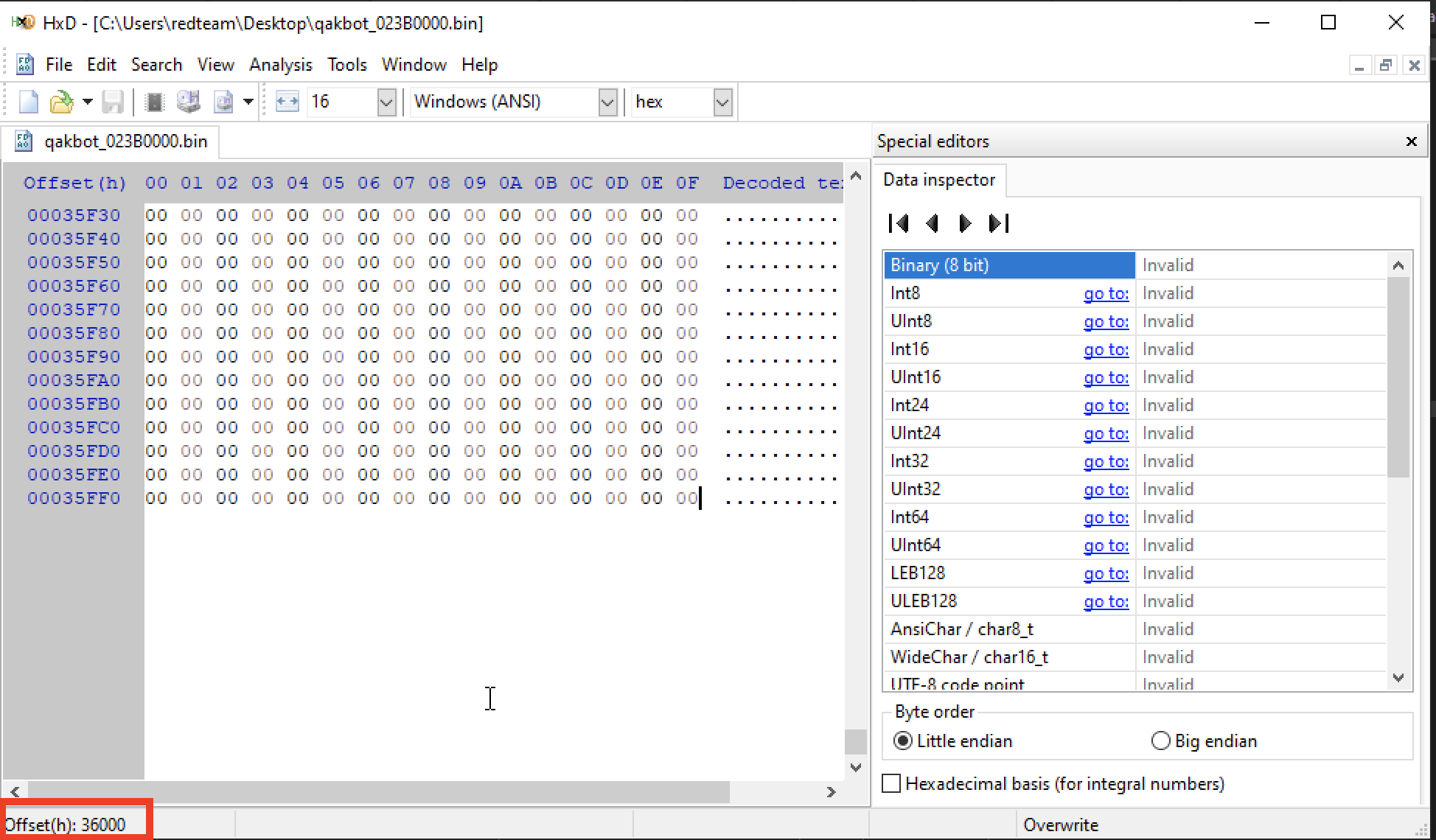
So we don’t need any cleanup.
qakbot023B0000.bin
Basic properties
| Property | Value |
|---|---|
| MD5 | 58e1c32eeb0130da19625e55ee48cf1e |
| SHA-1 | 00ae1c5066f67e5e71285de99bea8d8b67085743 |
| SHA-256 | f5ff6dbf5206cc2db098b41f5af14303f6dc43e36c5ec02604a50d5cfecf4790 |
| Imphash | f83b544e96ab46c08e00b6dc80fbb352 |
| Vhash | 025056657d15755198z4506033z67z33z4fz |
| Rich Header Hash | 39b9a9743747272230098b3403672606 |
| SSDEEP | 3072:4FCXMfyhFPZ8H7kJiIceKozOMeNJwOUJCfUfWcxQvAKChQztvWZZOtyFb8e:lXPFP6HWriMeN2rJCyWVDhM55 |
| TLSH | T11324F1017293E5FBDA4600390A49117726B4EE312C738647F2D077BD69F689FDA35AC2 |
| File Type | Win32 EXE (PE32 executable, GUI) |
| Compiler | Microsoft Visual C/C++ (16.00.40219) [Visual Studio 2010] |
| Linker | Microsoft Linker (10.00) with LTCG (Link Time Code Generation) |
| File Size | 216.00 KB (221,184 bytes) |
PE section
| Index | Name | Entropy | File Ratio | Raw Size | Virtual Size | Raw Address (Begin) | Virtual Address |
|---|---|---|---|---|---|---|---|
| 0 | .text | 6.386 | 17.82 % | 39,424 | 39,370 | 0x00000400 | 0x00001000 |
| 1 | .rdata | 7.515 | 9.26 % | 20,480 | 20,072 | 0x00009E00 | 0x0000B000 |
| 2 | .data | 4.390 | 0.69 % | 1,536 | 10,132 | 0x0000EE00 | 0x00010000 |
| 3 | .rsrc | 7.863 | 70.37 % | 155,648 | 155,612 | 0x0000F400 | 0x00013000 |
| 4 | .reloc | 5.475 | 1.39 % | 3,072 | 2,678 | 0x00035400 | 0x00039000 |
Key Observations for the Decrypted File
.rsrc section now accounts for over 70% of the file. Its extremely high entropy (7.863) suggests it contains compressed data, encrypted payloads, or high-resolution media.a2, a3), this file uses standard Microsoft compiler section names (.text, .rdata, etc.), confirming a successful "unpacking" or "decryption."[2] (.data), the virtual size (10,132 bytes) is significantly larger than the raw size (1,536 bytes). This is typical for uninitialized data or variables that expand in memory once the program is loaded..text section (where the executable code resides) has an entropy of 6.386, which is standard for a compiled C++ application.Decrypted Import Address Table Imports
| Library (DLL) | Functions |
|---|---|
| KERNEL32.dll | GetLastError, GetProcAddress, LoadLibraryA, lstrcmpiW, GetModuleHandleA, CloseHandle, GetCurrentProcessId, GetEnvironmentVariableW, lstrlenA, WideCharToMultiByte, lstrcatA, GetEnvironmentVariableA, MultiByteToWideChar, lstrlenW, lstrcatW, lstrcpyA, HeapAlloc, HeapFree, HeapCreate, VirtualAlloc, GetFileSize, lstrcmpiA, GetModuleFileNameA, GetThreadContext, GetCurrentProcess, CreateEventA, LoadLibraryW, TerminateProcess, DeleteFileW, ResumeThread, ExpandEnvironmentStringsW, GetComputerNameW, GetVolumeInformationW, ReleaseMutex, GetExitCodeProcess, GetSystemTimeAsFileTime, SetEnvironmentVariableW, GetTickCount, GetModuleFileNameW, GetSystemInfo, SetEnvironmentVariableA, GetVersionExA, GetWindowsDirectoryW, SetEvent, OpenEventA, CopyFileW, TerminateThread, CreateThread, GetFileAttributesA, GetFileAttributesW, GetCurrentThread, LocalAlloc, GetLocalTime, LocalFree, lstrcpyW, CreateDirectoryW, SleepEx, WaitForSingleObject, FreeLibrary, GetDriveTypeW, lstrcmpA, GetCommandLineW, ExitProcess, lstrcpynW, Sleep, SystemTimeToFileTime, GetSystemTime, GetModuleHandleW, CreateMutexA |
| ADVAPI32.dll | RegOpenKeyExW, RegEnumValueW, RegDeleteValueW, RegQueryInfoKeyW, LookupAccountNameW, EqualSid, SetServiceStatus, RegUnLoadKeyW, RegLoadKeyW, ConvertSidToStringSidW, RegSetValueExW, RegQueryValueExW, SetSecurityDescriptorDacl, InitializeSecurityDescriptor, GetTokenInformation, RegisterServiceCtrlHandlerA, StartServiceCtrlDispatcherA, RegCloseKey, SetFileSecurityW, OpenProcessToken, GetSidSubAuthority, OpenThreadToken, GetSidSubAuthorityCount, LookupAccountSidW, CreateProcessAsUserW |
| USER32.dll | CharUpperBuffA, MessageBoxA, GetClassNameA, CharUpperBuffW |
| SHELL32.dll | SHGetFolderPathW, CommandLineToArgvW, ShellExecuteW |
| ole32.dll | CoInitialize, CoInitializeEx, CoInitializeSecurity, CoSetProxyBlanket, CoUninitialize, CoCreateInstance |
| NETAPI32.dll | NetApiBufferFree, NetUserEnum, NetGetDCName |
| SETUPAPI.dll | SetupDiEnumDeviceInfo, SetupDiDestroyDeviceInfoList, SetupDiGetClassDevsA, SetupDiGetDeviceRegistryPropertyA |
| msvcrt.dll | _vsnprintf, _ltoa, _except_handler3, memset, _vsnwprintf, memcpy |
| USERENV.dll | GetUserProfileDirectoryW |
Critical Behavioral Indicators
Analyzing these specific imports reveals the binary's core capabilities:
GetThreadContext, VirtualAlloc, and ResumeThread is a classic signature for process hollowing, where the binary injects code into a suspended legitimate process.OpenProcessToken, GetTokenInformation, and CreateProcessAsUserW suggest the ability to manipulate user tokens or run tasks with administrative/SYSTEM privileges.NetUserEnum and NetGetDCName indicate that the file is designed to query domain controllers and list users on a network, common in reconnaissance phases.StartServiceCtrlDispatcherA and SetServiceStatus show the binary can operate as a Windows Service, allowing it to start automatically with the OS.SETUPAPI.dll imports suggest it is looking for specific hardware or drivers, possibly for environment keying or anti-VM checks.Sample 2
Sample: https://malshare.com/sample.php?action=detail&hash=1042f400ed776bc5d2c68becb386fb2ef3116417f96a67c14e8ca5b421ae7bc9
| Property | Value |
|---|---|
| MD5 | ce6d60aefd0bba037a50186818cc23cb |
| SHA-1 | 423155bd783bd5209f4ff05c23159fd75e2f4e5d |
| SHA-256 | 1042f400ed776bc5d2c68becb386fb2ef3116417f96a67c14e8ca5b421ae7bc9 |
| Vhash | 065086755555551d5f5510c1802007900ff6z156z1e0300fffz |
| Authentihash | 1eaac19b0627e9e53c1df7f9671718f5fc161355d78104950abc96bdf8915030 |
| Imphash | 09516c081315a6de933d15f22a94d805 |
| SSDEEP | 12288:WTZ3ESbJAzTU+HjLI2UxI3JacfhLwVSZR0mjieAqTVc2xrW/f:AfJ8ThHjLZ3JxhL57ueAUVcarW/f |
| TLSH | T140E4CEB26BE40C26D69ACA7541611E177067FF0D2FC0580B6DC8E63BDA12BD9BCD1E48 |
| File Type | Win32 EXE (PE32 executable, GUI) |
| TrID | Win32 Executable MS Visual C++ (47.3%), Win64 Executable (15.9%) |
| DetectItEasy | PE32; Sign tool: Windows Authenticode (2.0) |
| File Size | 648.52 KB (664,080 bytes) |
PE section
| Index | Name | SHA-256 (Full) | Entropy | File Ratio | Raw Size (Bytes) | Virtual Size | Characteristics |
|---|---|---|---|---|---|---|---|
| 0 | .text | 4EB5A21D4AA7DE4C2FCF4124FF224378F597DAF0B205E2F2680757BC46D74AA3 | 7.238 | 80.11% | 531,968 | 531,865 | Execute, Read |
| 1 | .rdata4 | 1E8428ACD7003A0DF93471CE69B1CFD9A4A50D6D148AB95AB5E0E16C0FE14FB7 | 5.903 | 0.08% | 512 | 483 | Read |
| 2 | .rdata3 | 1E8428ACD7003A0DF93471CE69B1CFD9A4A50D6D148AB95AB5E0E16C0FE14FB7 | 5.903 | 0.08% | 512 | 483 | Read |
| 3 | .rdata2 | 1E8428ACD7003A0DF93471CE69B1CFD9A4A50D6D148AB95AB5E0E16C0FE14FB7 | 5.903 | 0.08% | 512 | 483 | Read |
| 4 | .rdata | B17141BD9DEB3C6FBA87E5CE806D4CC11A98F8A5A4CB699296D4EBA8E608ADA2 | 3.378 | 0.08% | 512 | 280 | Read |
| 5 | .data | 57EA9046FE23666E1C9AA5C428B274D4F340B0D8FE6411D788E0ED570744E5D7 | 5.513 | 18.58% | 123,392 | 123,396 | Read, Write |
| 6 | .rdata5 | 1E8428ACD7003A0DF93471CE69B1CFD9A4A50D6D148AB95AB5E0E16C0FE14FB7 | 5.903 | 0.08% | 512 | 483 | Read, Write, Exec* |
| 7 | .rsrc | 716AEBF3D58674C078A9F93F3A5D020AB0E7D33A072DBCDEC0E43A9C4C2F7ED7 | 5.903 | 0.62% | 4,096 | 3,824 | Read |
Memory and Execution offsets
| Item | Value | Section Association |
|---|---|---|
| Entry Point | 0x00082630 | Falls outside standard .text mapping |
| Base of Code | 0x00001000 | .text |
| Base of Data | 0x00083000 | .rdata4 |
| Import Directory | 0x0009F870 | .data |
| Resource Directory | 0x000A7000 | .rsrc |
| Import Address Table | 0x000A06D4 | .data |
.rdata4, .rdata3, .rdata2, and .rdata5 share the exact same SHA-256 hash. This indicates these sections are likely duplicates or placeholders filled with the same static data..text section has an entropy of 7.238. This is quite high for standard executable code and often suggests the code is either compressed or contains an embedded encrypted payload.0x00082630, which places it far beyond the .text section's virtual end. This suggests the execution starts in a later section (likely the self-modifying .rdata5 or a custom tail), a common trait of packed malware.Imports
| Library (DLL) | Notable Functions |
|---|---|
| KERNEL32.dll | VirtualAlloc, VirtualProtect, WriteProcessMemory, ReadProcessMemory, CreateProcessW, WinExec, CreateThread, Module32FirstW, GetThreadContext, SetThreadPriority, SleepEx, GetTickCount, QueryPerformanceFrequency, MapViewOfFile, CreateFileMappingW |
| USER32.dll | SetWindowsHookExW, GetAsyncKeyState, GetKeyState, GetForegroundWindow, OpenDesktopW, AttachThreadInput, keybd_event, OpenClipboard, GetClipboardData, EmptyClipboard, EnumDisplayMonitors |
| ADVAPI32.dll | RegCreateKeyExA, RegSetValueExA, RegDeleteValueA, RegDeleteKeyA, RegOpenKeyExA, RegFlushKey, RegQueryInfoKeyA |
| GDI32.dll | BitBlt, StretchBlt, CreateCompatibleBitmap, SelectObject, CreateCompatibleDC, GetDeviceCaps, DeleteObject |
| SHELL32.dll | ShellExecuteExW, SHCreateProcessAsUserW, SHChangeNotify, SHGetPathFromIDListW, DoEnvironmentSubstA |
| COMCTL32.dll | ImageList_BeginDrag, ImageList_DragMove, ImageList_DragEnter, ImageList_EndDrag, DPA_DeleteAllPtrs |
| ole32.dll | CoCreateInstance, CoInitializeEx, CoUninitialize, DoDragDrop |
MITRE ATT&CK Mapping
| Tactic | Technique | ID | Indicators (API/Logic) |
|---|---|---|---|
| Persistence | Boot or Logon Autostart Execution: Registry Run Keys | T1547.001 | RegCreateKeyExA, RegSetValueExA |
| Privilege Escalation | Process Injection: Process Hollowing | T1055.012 | VirtualAllocEx, WriteProcessMemory, ResumeThread, GetThreadContext |
| Defense Evasion | Obfuscated Files or Information: Software Packing | T1027.002 | High entropy in .text (7.238), Self-modifying .rdata5 section |
| Virtualization/Sandbox Evasion: Time-Based Evasion | T1497.003 | QueryPerformanceFrequency, GetTickCount | |
| Indicator Removal: File Deletion | T1070.004 | DeleteFileW, RemoveDirectoryW | |
| Discovery | System Information Discovery | T1082 | GetVersionExW, GetSystemInfo, GlobalMemoryStatusEx |
| Process Discovery | T1057 | Module32FirstW | |
| Collection | Input Capture: Keylogging | T1056.001 | GetAsyncKeyState, GetKeyState |
| Screen Capture | T1113 | BitBlt, StretchBlt, CreateCompatibleDC | |
| Archive Collected Data: Clipboard Data | T1115 | OpenClipboard, GetClipboardData | |
| Execution | Shared Modules | T1129 | Extensive use of LoadLibraryW and GetProcAddress |
Initial Observations
Technical Summary:
This binary is a digitally signed Win32 executable that exhibits strong characteristics of a packed surveillance tool or Remote Access Trojan (RAT).
1. Delivery & Structure
.text (7.238) and the existence of a self-modifying, executable section (.rdata5) indicate the core logic is encrypted or compressed.0x00082630) located outside the main code section, which is a classic indicator of a packer stub.2. Core Capabilities (via Imports)
WriteProcessMemory and VirtualProtect, likely to hide its presence within legitimate system tasks.GetAsyncKeyState).OpenClipboard).ADVAPI32.dll) suggests it modifies system "Run" keys to ensure it starts automatically upon reboot.3. Operational Risk
The combination of Keylogging, Clipboard access, and Screen capture suggests this sample is designed for credential harvesting and user monitoring. Its ability to inject code further increases the risk of it evading standard task manager detection.
Unpacking
X32 DBG
Setting breakpoint on VirtuallAlloc
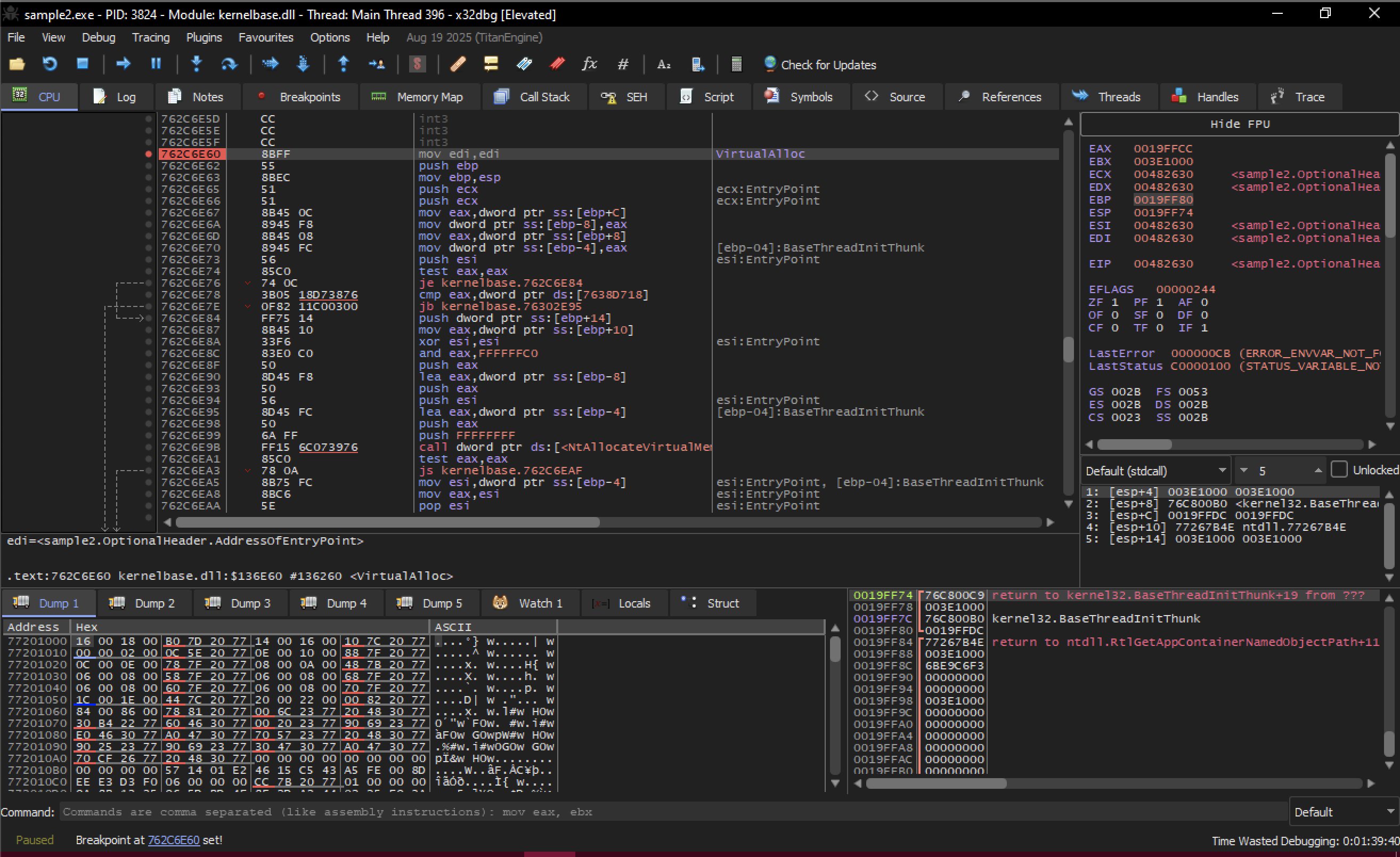
After hitting the breakpoint ctrl + f9 and f8
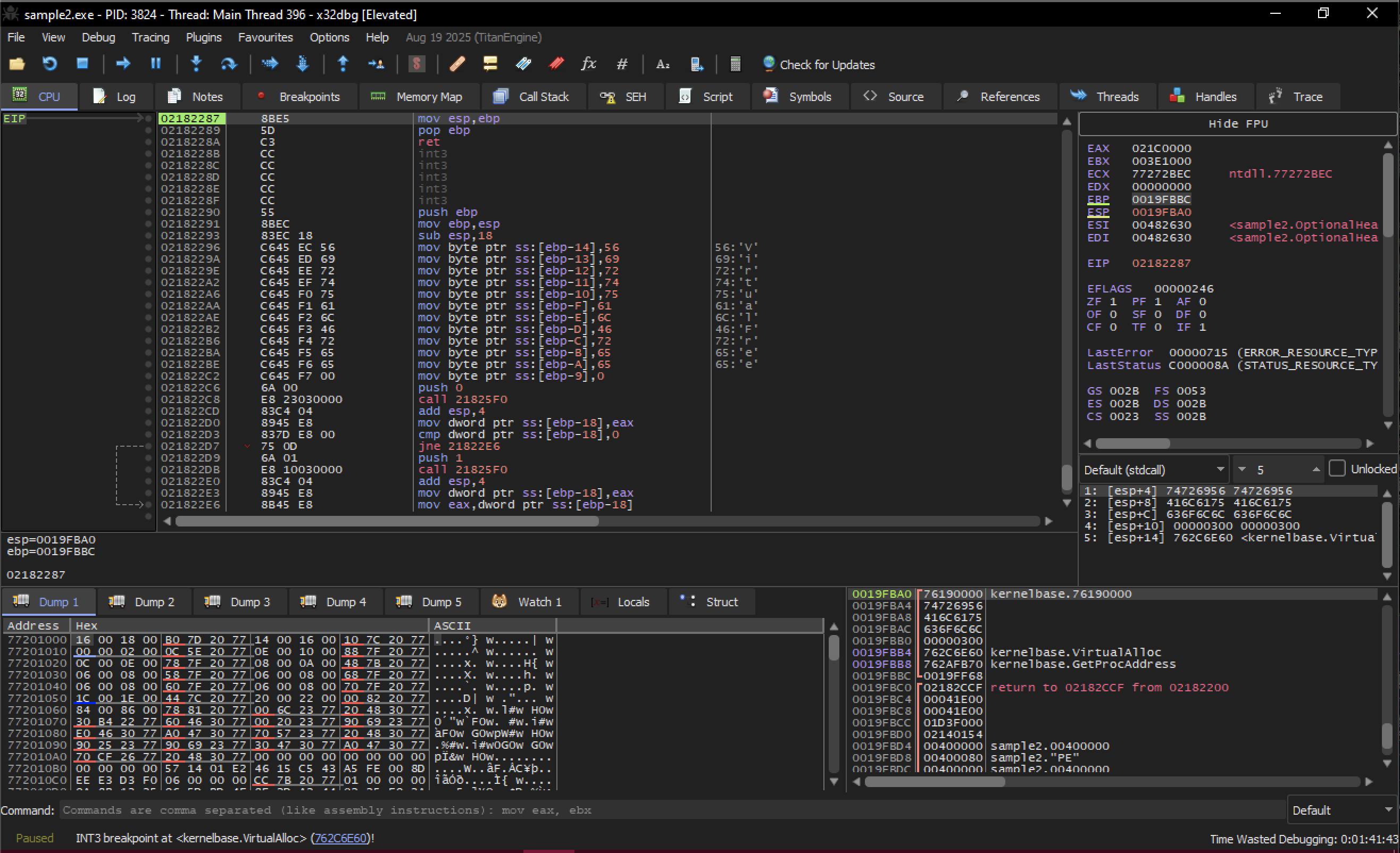
Follow eax in memory dump.
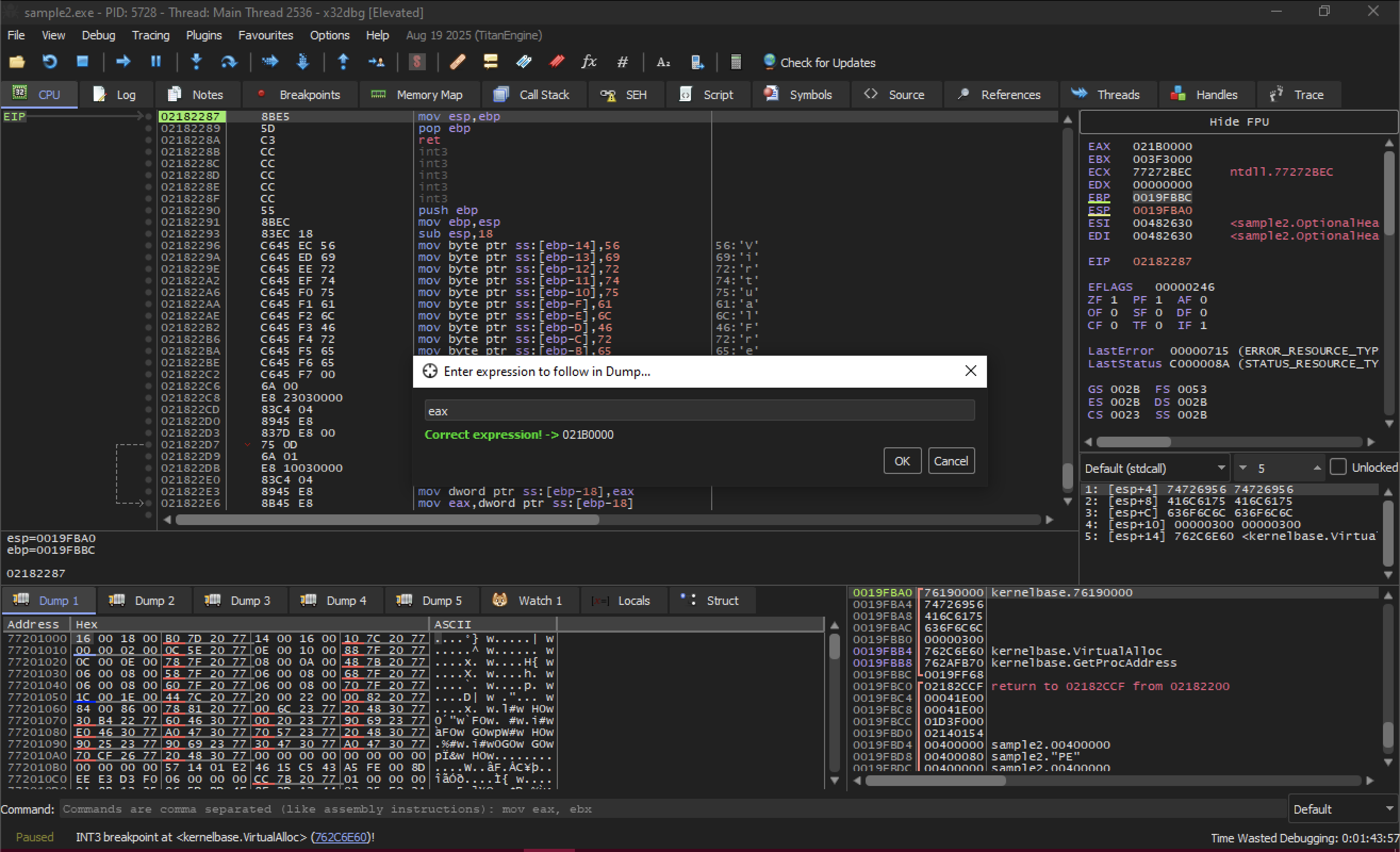
Setting hardware breakpoints.
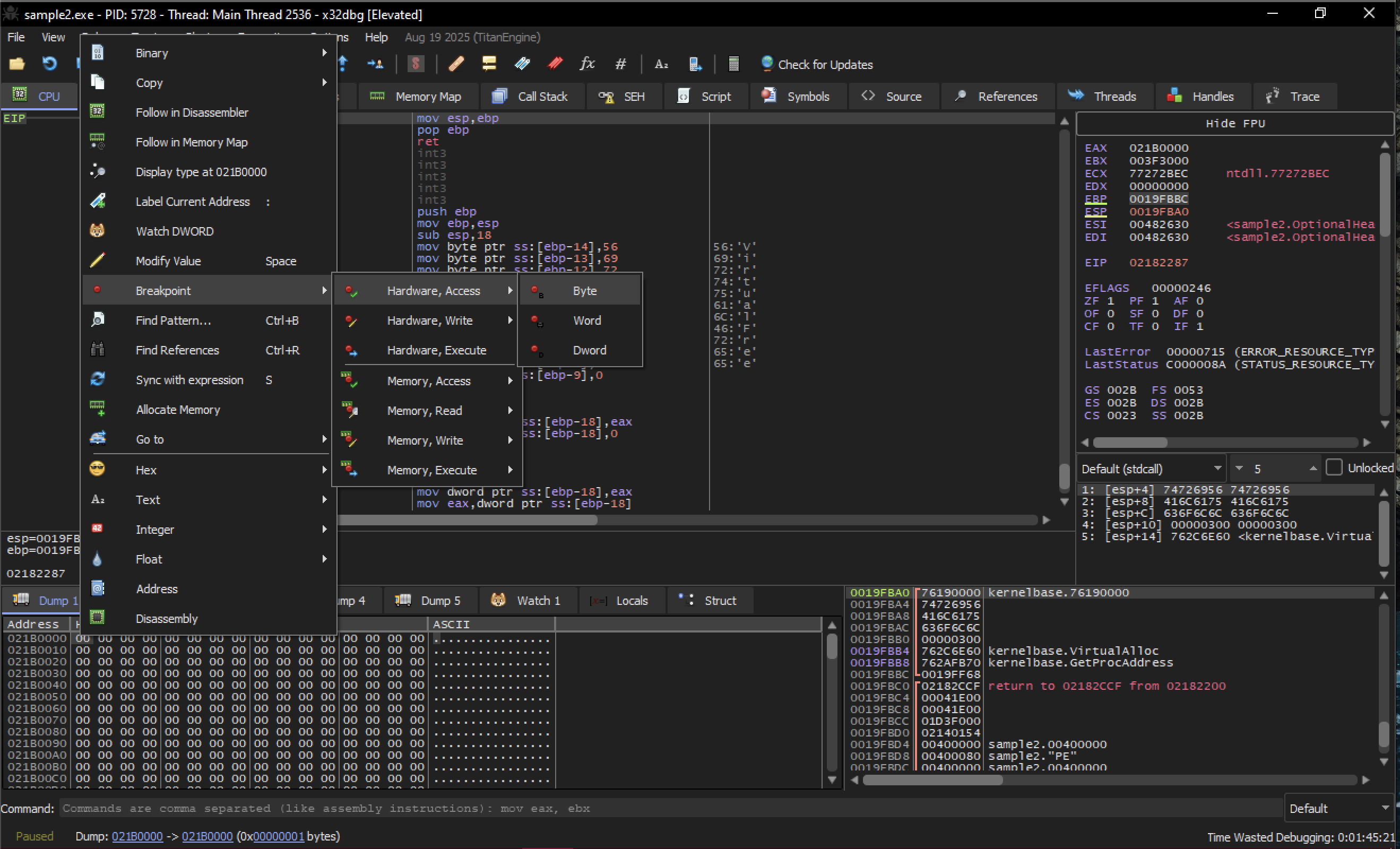
Then f9 we can see the first byte A4
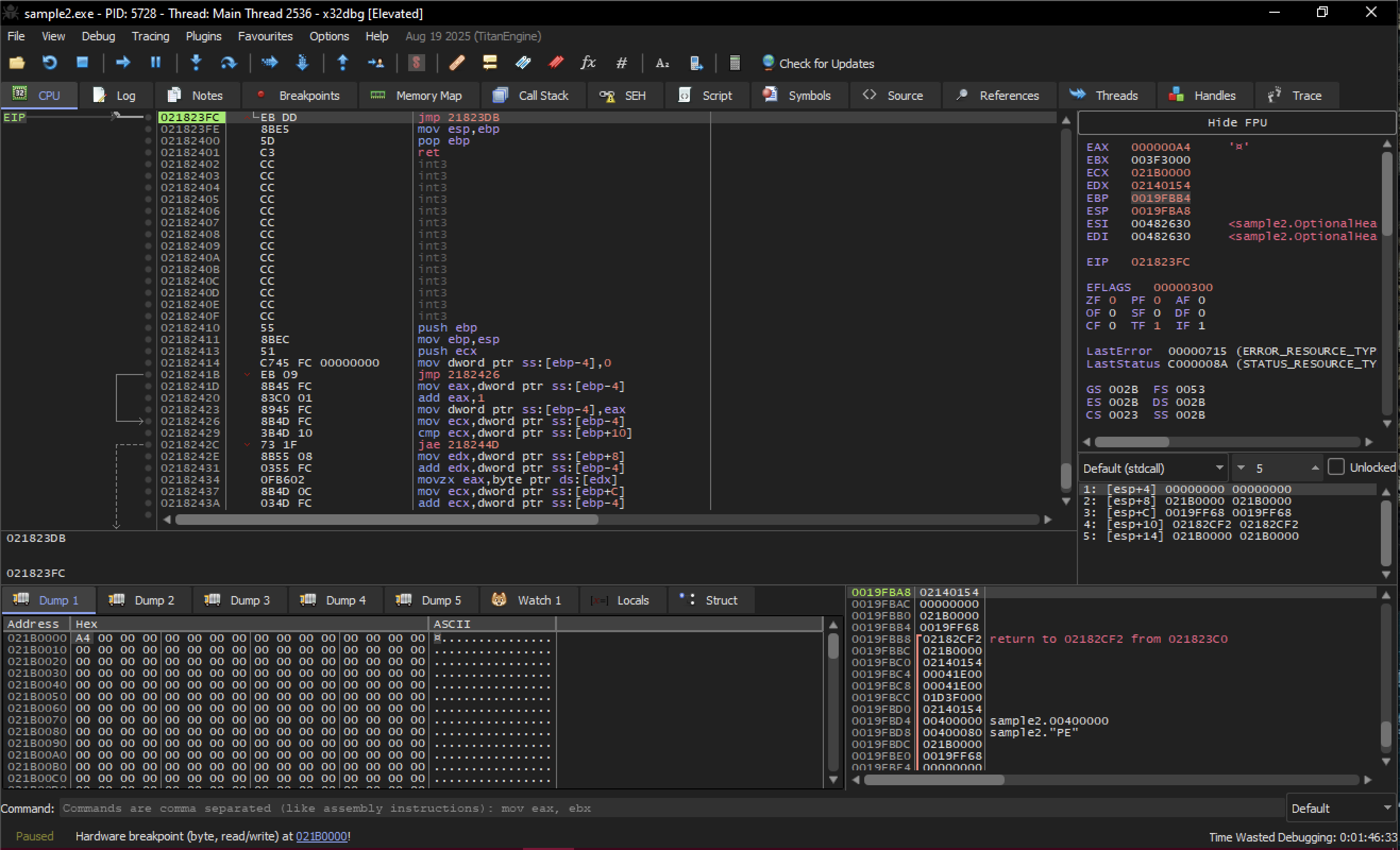
hit f9 couple of times. until you see the MZ header decoded.
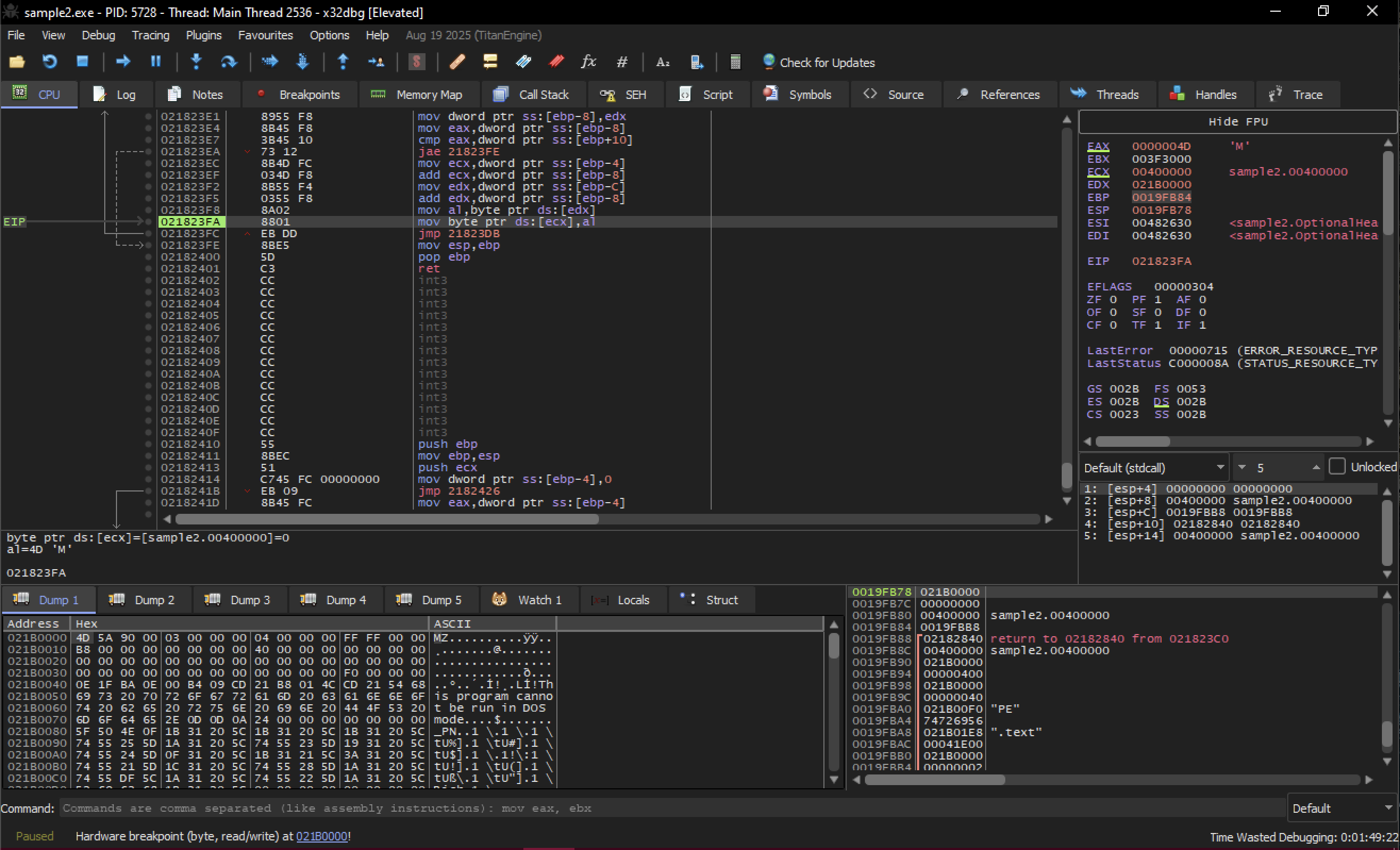
We can see the .text section starts from 400 hex
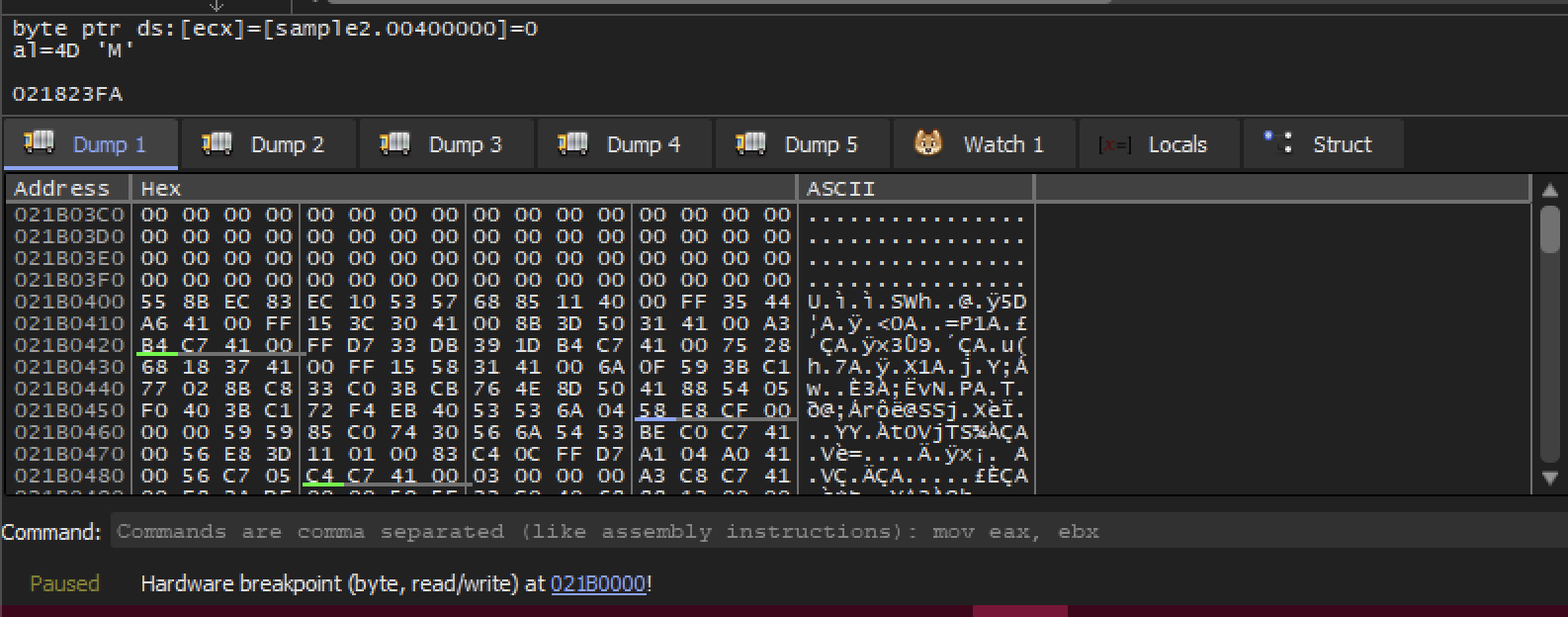
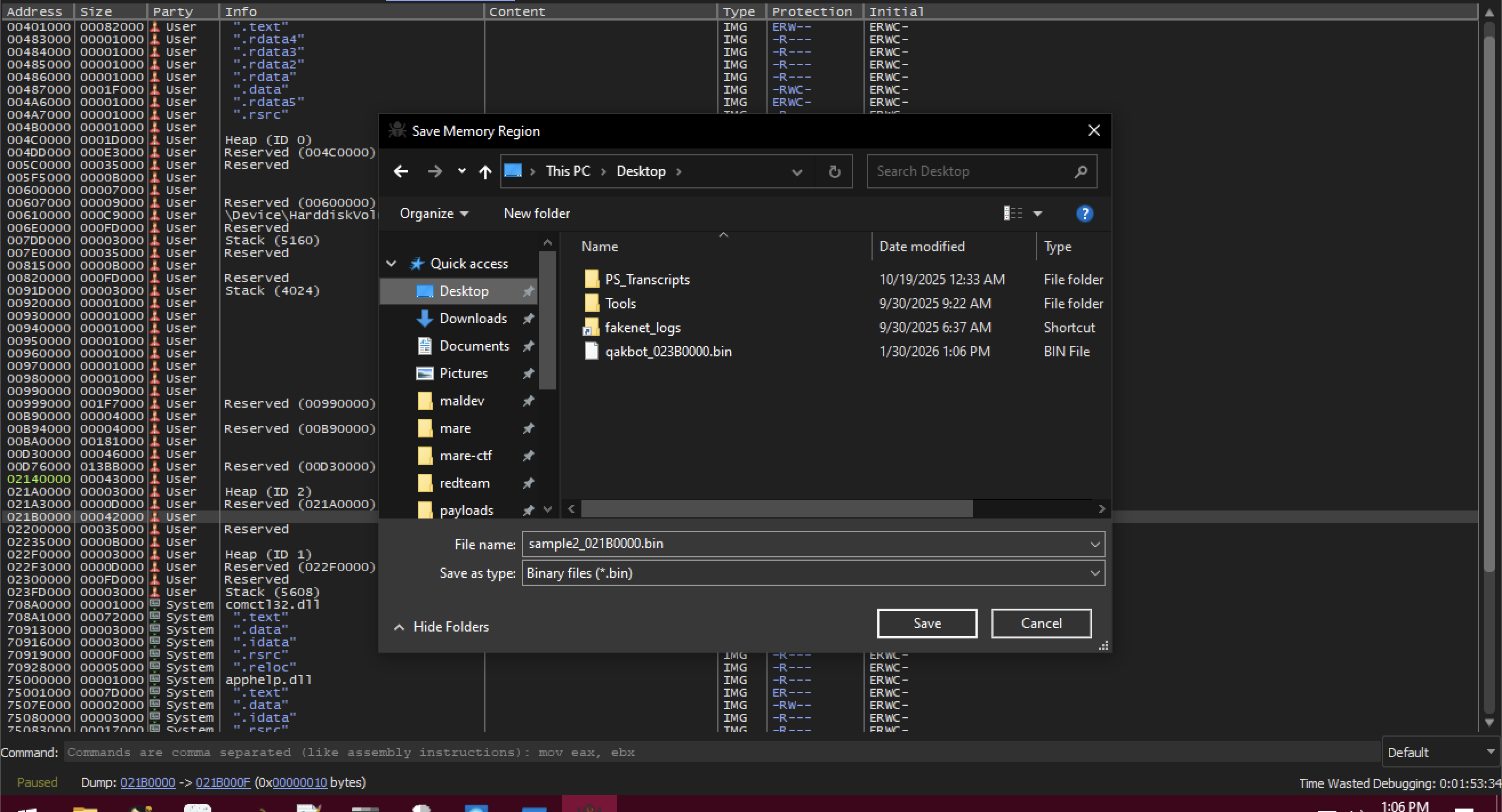
We will dump this.
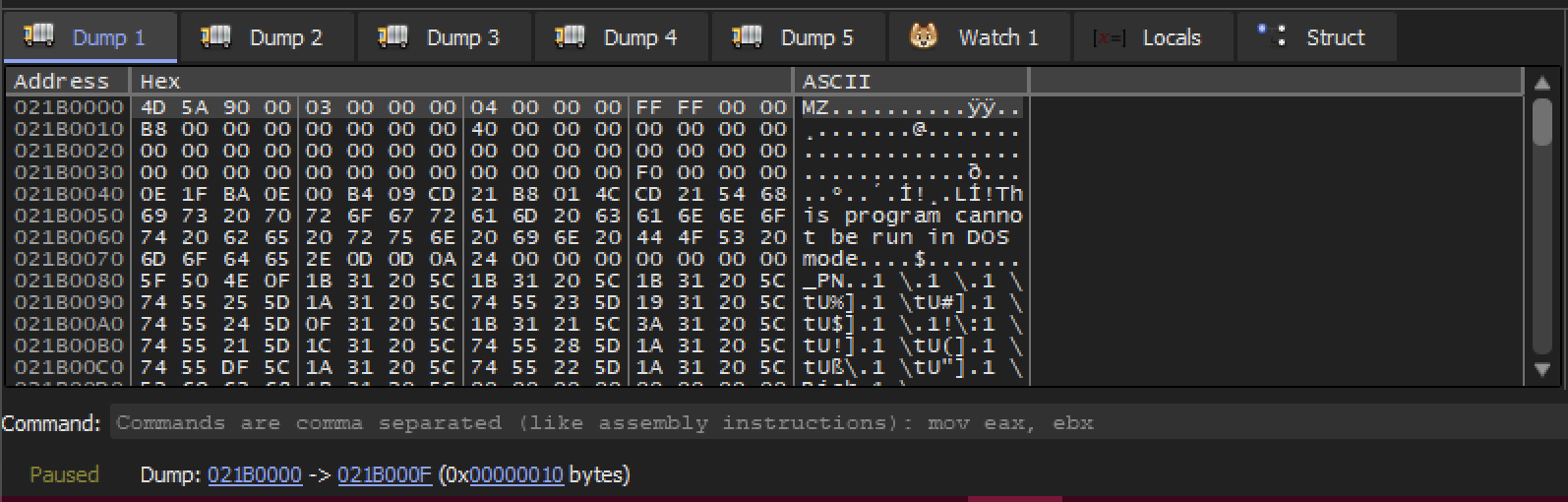
Dump memory to file.
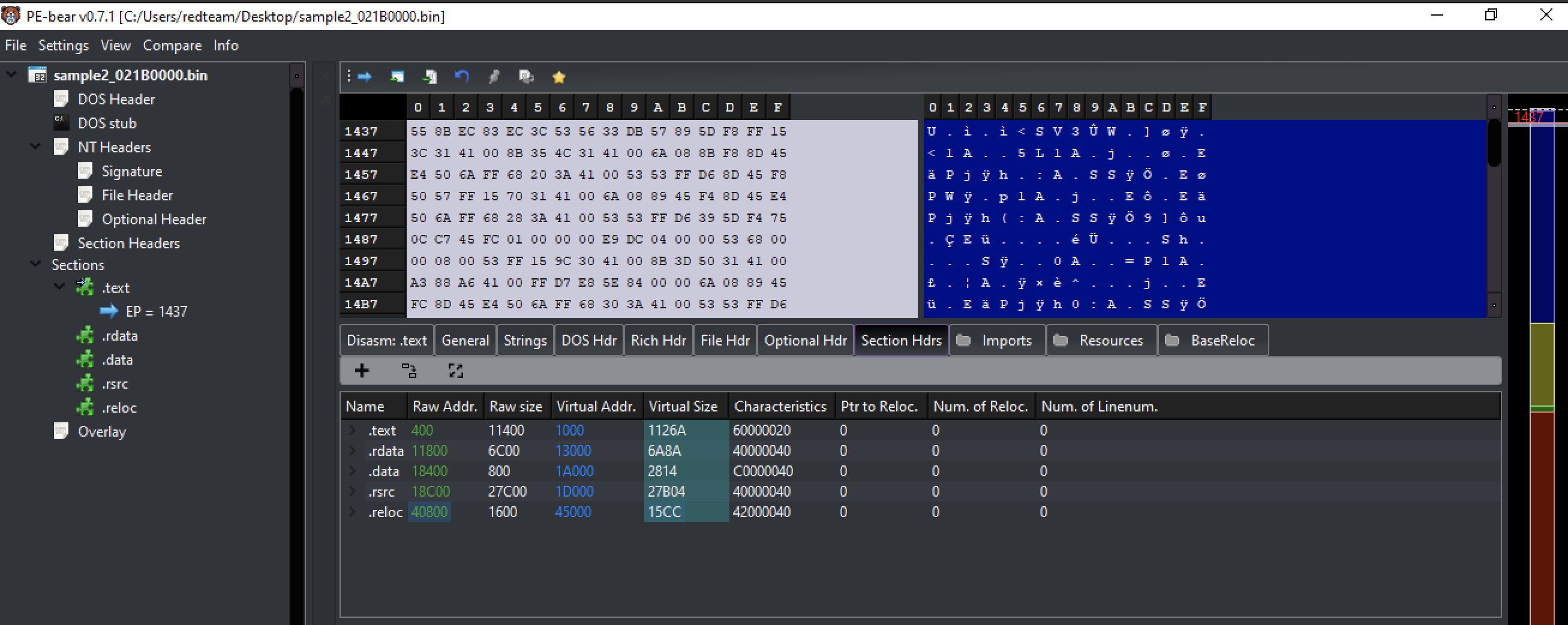
Open the the dumped bin file into pe bear.
last section .reloc
Raw Addr. + Raw size
0x40800 + 0x1600 = 0x41E00
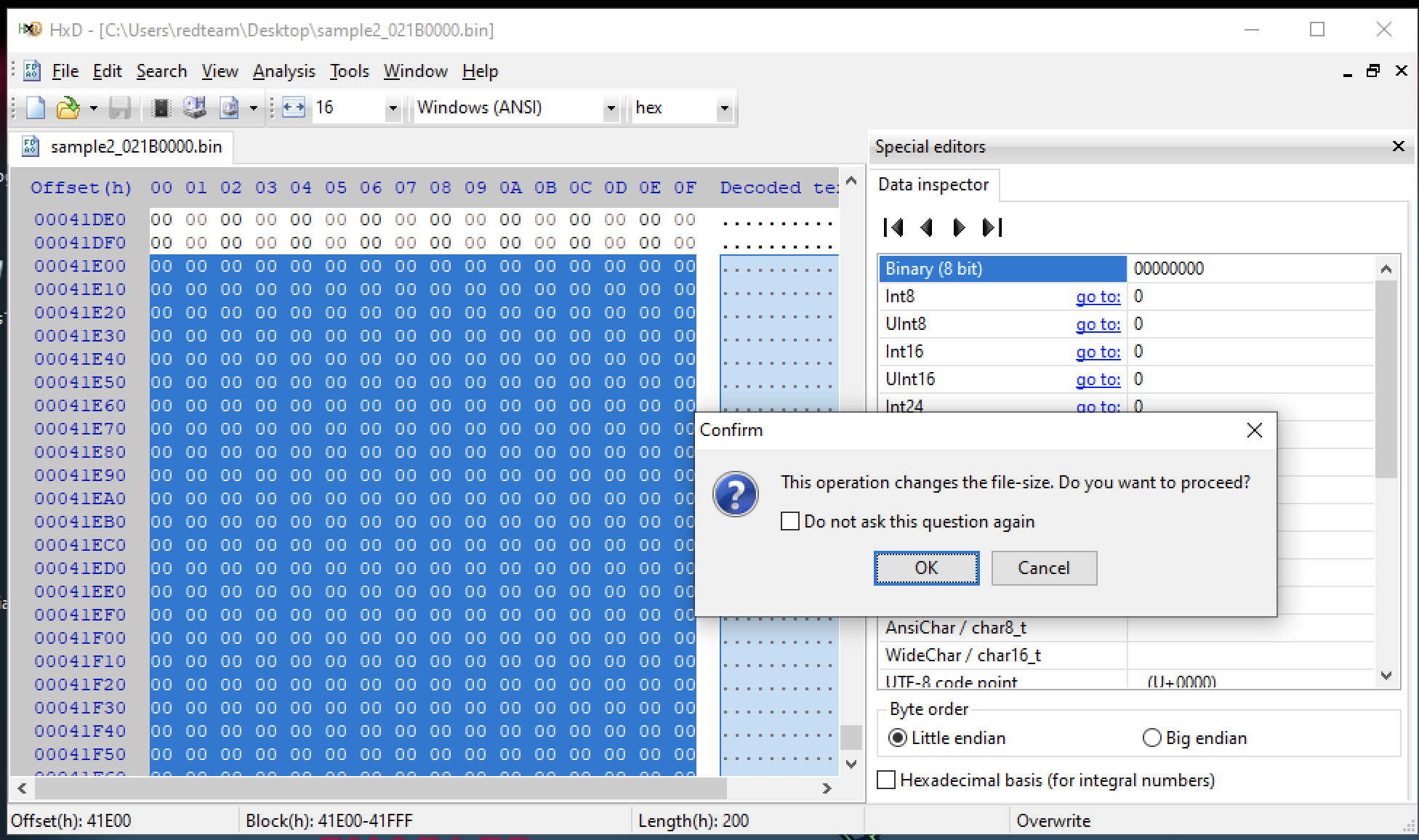
now open the file in hxd and go to offset 0x41E00 to verify.
We can see there are bytes after 41E00 because this unpacked file didn’t stopped at the end of the heap.
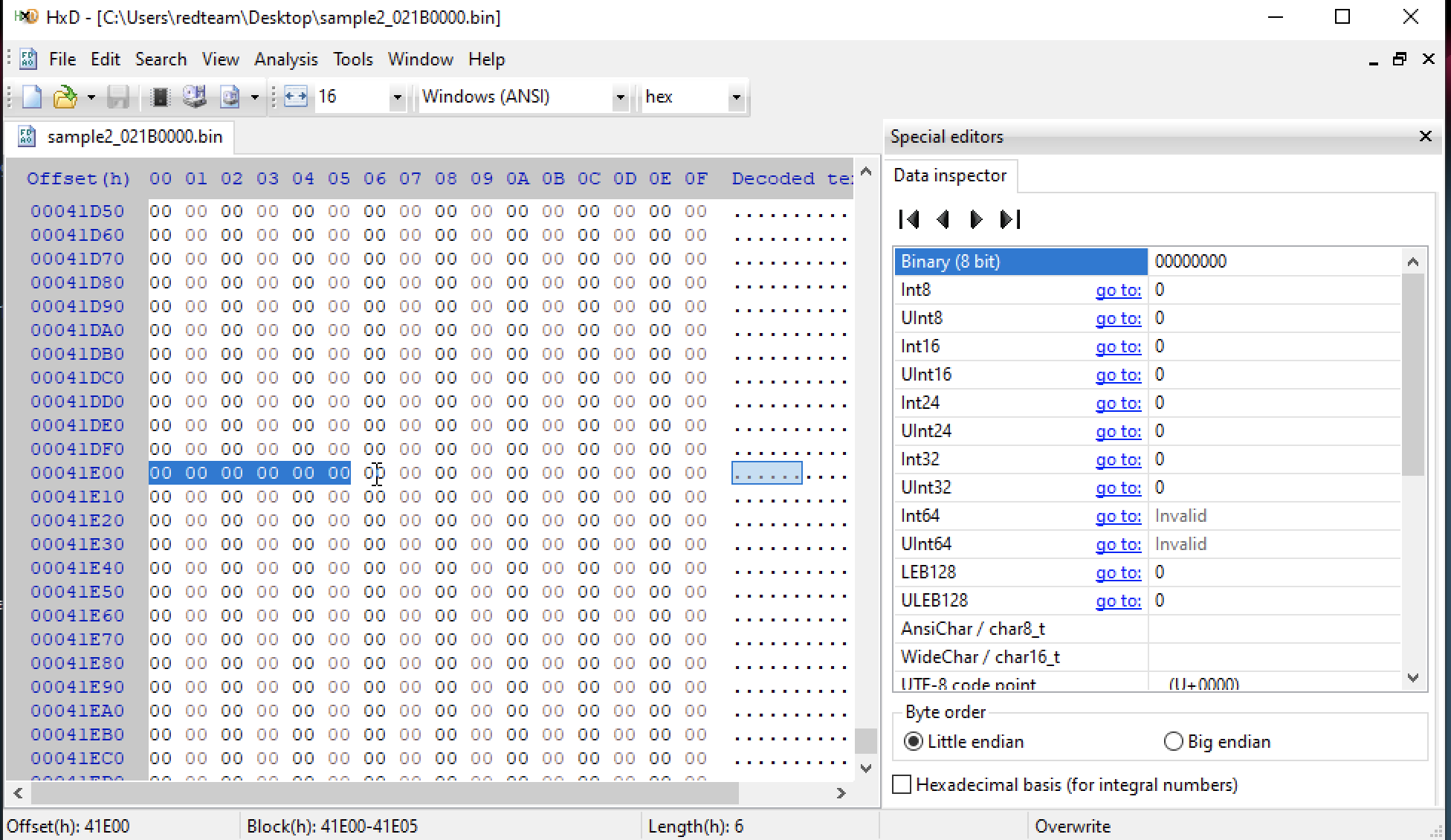
Select and delete everything after 41E00 and make surer to save it.