Executive Summary
Analysis Overview
The sample is a 384 KB Emotet loader (SHA-256: b1cad1540ecb290088252635f8e130022eed7486eb128c0ca3d676945d60a9fc) compiled with Visual Studio 2005. It uses a packer to obfuscate its core logic and incorporates anti-debugging (IsDebuggerPresent) and GUI-based anti-sandbox techniques (USER32/GDI32 imports).
Persistence
Upon detonation, the malware replicates itself to C:\Windows\SysWOW64\rebrandcmp.exe. The persistent file remains identical in hash to the original packed loader.
Core Extraction
Dynamic analysis via x32dbg and monitoring of VirtualAlloc enabled the extraction of the core payload. The unpacked binary is a 62.69 KB executable (SHA-256: 96488477ed1702984c1fa3f56873e9aac4efb871f97a03eea50233b13080c2f0) compiled with Visual Studio 2013.
Technical Indicators
0x0000CD97.text (6.75) and .data (7.162)..data section expands from 4 KB (raw) to 16 KB (virtual), indicating encrypted configuration buffers.Sample Metadata
| Property | Details / Value |
|---|---|
| MD5 | f3f48c57c38bff2ddd220f20569e1ee6 |
| SHA-1 | 0421127f1bcca91a6ab2a570a47f8159101b751a |
| SHA-256 | b1cad1540ecb290088252635f8e130022eed7486eb128c0ca3d676945d60a9fc |
| Vhash | 035056555d1d5517z70057mz17ez1 |
| Authentihash | a3a64d72a568e549fa5f437b371f418445ee04c6ff6636a24318a543c23398f3 |
| Imphash | efe1c3568d5733ccb1e9d2b524c47cea |
| Rich PE header hash | 24ae9e717eb5d67a8cc4a0b4b12ce081 |
| SSDEEP | 3072:iYyIxN7LMWf+GPBLi21ocO2jytUkU4uDQUiysA+30Sor6KH7j0m43ayYZt:GIx5MKQUJkqDDj+xW6KH7IuN |
| TLSH | T1A884B00532A4D4B2D89701BF8D03C33556B6F0A45B269BC377D40D9E9BA46E1BA3B3C9 |
| File type | Win32 EXE (executable, 32-bit, GUI, win32, pe, peexe) |
| Magic | PE32 executable (GUI) Intel 80386, for MS Windows |
| TrID | Win32 Executable MS Visual C++ (generic) (47.3%), Win64 Executable (generic) (15.9%), Win32 Dynamic Link Library (generic) (9.9%), Win16 NE executable (generic) (7.6%), Win32 Executable (generic) (6.8%) |
| DetectItEasy | PE32; Compiler: EP:Microsoft Visual C/C++ (2005) [EXE32]; Compiler: Microsoft Visual C/C++ (14.00.50727) [C++/book]; Linker: Microsoft Linker (8.00.50727); Tool: Visual Studio (2005) |
| Magika | PEBIN |
| File size | 384.00 KB (393,216 bytes) |
| Signature | Microsoft Linker 8.0 |
| Entry Point Location | 0x0000E022 (section [.text]) |
| First 32 Bytes (Hex) | 4D 5A 90 00 03 00 00 00 04 00 00 00 FF FF 00 00 B8 00 00 00 00 00 00 00 40 00 00 00 00 00 00 00 |
| First 32 Bytes (Text) | MZ................................@.............. |
| Entry Point Bytes (Hex) | E8 59 9C 00 00 E9 16 FE FF FF CC CC CC CC 8B 4C 24 04 F7 C1 03 00 00 00 74 24 8A 01 83 C1 01 84 |
| Compiler Stamp | Sun Oct 06 18:38:52 2019 (UTC) |
| Debug Stamp | Sun Oct 06 18:38:52 2019 (UTC) |
| Export Stamp | Sun Oct 06 18:38:52 2019 (UTC) |
| Original File Name | Emetim.exe |
| Version/Manifest | n/a |
PE Sections
| Feature | .text (Section 0) | .rdata (Section 1) | .data (Section 2) | .idata (Section 3) | .rsrc (Section 4) |
|---|---|---|---|---|---|
| Entropy | 5.740 | 5.337 | 3.112 | 4.678 | 0.725 |
| File Ratio | 60.42 % | 34.38 % | 2.08 % | 1.04 % | 1.04 % |
| Raw Address | 0x00001000 | 0x0003B000 | 0x0005C000 | 0x0005E000 | 0x0005F000 |
| Raw Size | 237,568 bytes | 135,168 bytes | 8,192 bytes | 4,096 bytes | 4,096 bytes |
| Virtual Address | 0x00001000 | 0x0003B000 | 0x0005C000 | 0x00061000 | 0x00062000 |
| Virtual Size | 236,815 bytes | 132,766 bytes | 16,432 bytes | 4,044 bytes | 590 bytes |
| Characteristics | 0x60000020 | 0x40000040 | 0xC0000040 | 0xC0000040 | 0x40000040 |
| Permissions | Read / Execute | Read | Read / Write | Read / Write | Read |
Import Table
| Capability | Associated Imports (Summary) | Source DLL |
|---|---|---|
| Memory Management | VirtualAlloc, VirtualFree, HeapAlloc, HeapFree, HeapReAlloc, HeapCreate, HeapDestroy | KERNEL32.dll |
| Process/Thread Control | GetCurrentProcess, TerminateProcess, ExitProcess, GetCurrentThreadId, Sleep, TlsAlloc/Free, RtlUnwind | KERNEL32.dll |
| Anti-Analysis | IsDebuggerPresent, UnhandledExceptionFilter, SetUnhandledExceptionFilter, QueryPerformanceCounter, GetTickCount | KERNEL32.dll |
| File / I/O Operations | CreateFileA, ReadFile, WriteFile, CloseHandle, SetFilePointer, FlushFileBuffers, GetStdHandle, SetStdHandle | KERNEL32.dll |
| Dynamic Loading | GetProcAddress, LoadLibraryA, FreeLibrary, GetModuleHandleA, GetModuleFileNameA | KERNEL32.dll |
| GUI & User Interaction | CreateWindowExA, RegisterClassExA, ShowWindow, UpdateWindow, GetMessageA, DispatchMessageA, DefWindowProcA | USER32.dll |
| Graphics Rendering | BitBlt, CreateCompatibleDC, SelectObject, DeleteDC, GetObjectA, DeleteObject, GetStockObject | GDI32.dll |
| Localization/Strings | GetLocaleInfoA/W, GetCPInfo, WideCharToMultiByte, MultiByteToWideChar, GetStringTypeA/W, LCMapStringA/W | KERNEL32.dll |
| System Info/Env | GetVersionExA, GetCommandLineA, GetEnvironmentStrings, SetEnvironmentVariableA, GetTimeZoneInformation | KERNEL32.dll |
Description
This is a 32-bit Win32 GUI executable (384 KB) identified as an Emotet loader, compiled via Visual Studio 2005 with an entry point at 0x0000E022. Key technical indicators include:
.data section's virtual vs. raw size and high entropy in .text, suggesting memory-resident payload decompression.VirtualAlloc), anti-analysis (IsDebuggerPresent), and dynamic loading (LoadLibraryA).Emetim.exe and debug path Emetim.pdb, with 2019 timestamps.Detonation
Upon detonation, the malware initiates a persistence routine by replicating its own binary. It copies itself to the system directory at C:\Windows\SysWOW64\rebrandcmp.exe. The file is renamed to blend in with legitimate system components. Comparison of the SHA-256 hashes confirms that the persistence file is an identical copy of the original packed loader.
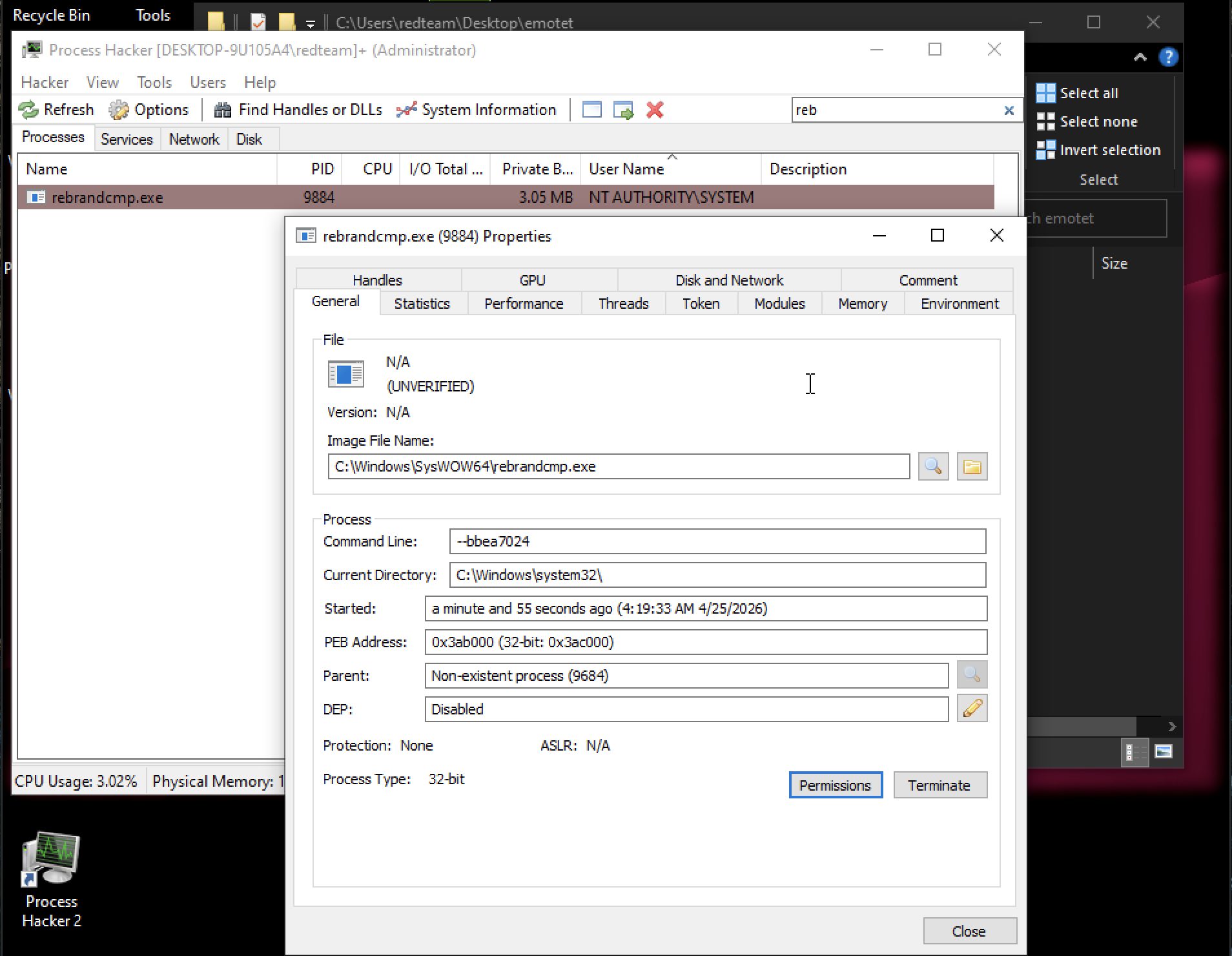
c:\Windows\SysWOW64
λ md5sum.exe rebrandcmp.exe
f3f48c57c38bff2ddd220f20569e1ee6 *rebrandcmp.exe| Phase | Activity | Details |
|---|---|---|
| Persistence | File System Replication | The sample copies itself to a system directory to ensure execution after reboot. |
| Source Path | sample-emotet.exe | Original execution path. |
| Target Path | C:\Windows\SysWOW64\rebrandcmp.exe | 32-bit System directory (Masquerading). |
| File Integrity | Identical Hash | Verified via MD5; no changes made to the binary on disk. |
Payload Unpacking (x32dbg)
System Breakpoint
You can see the top module is set to sample-emotet.exe beside it Entrypoint .
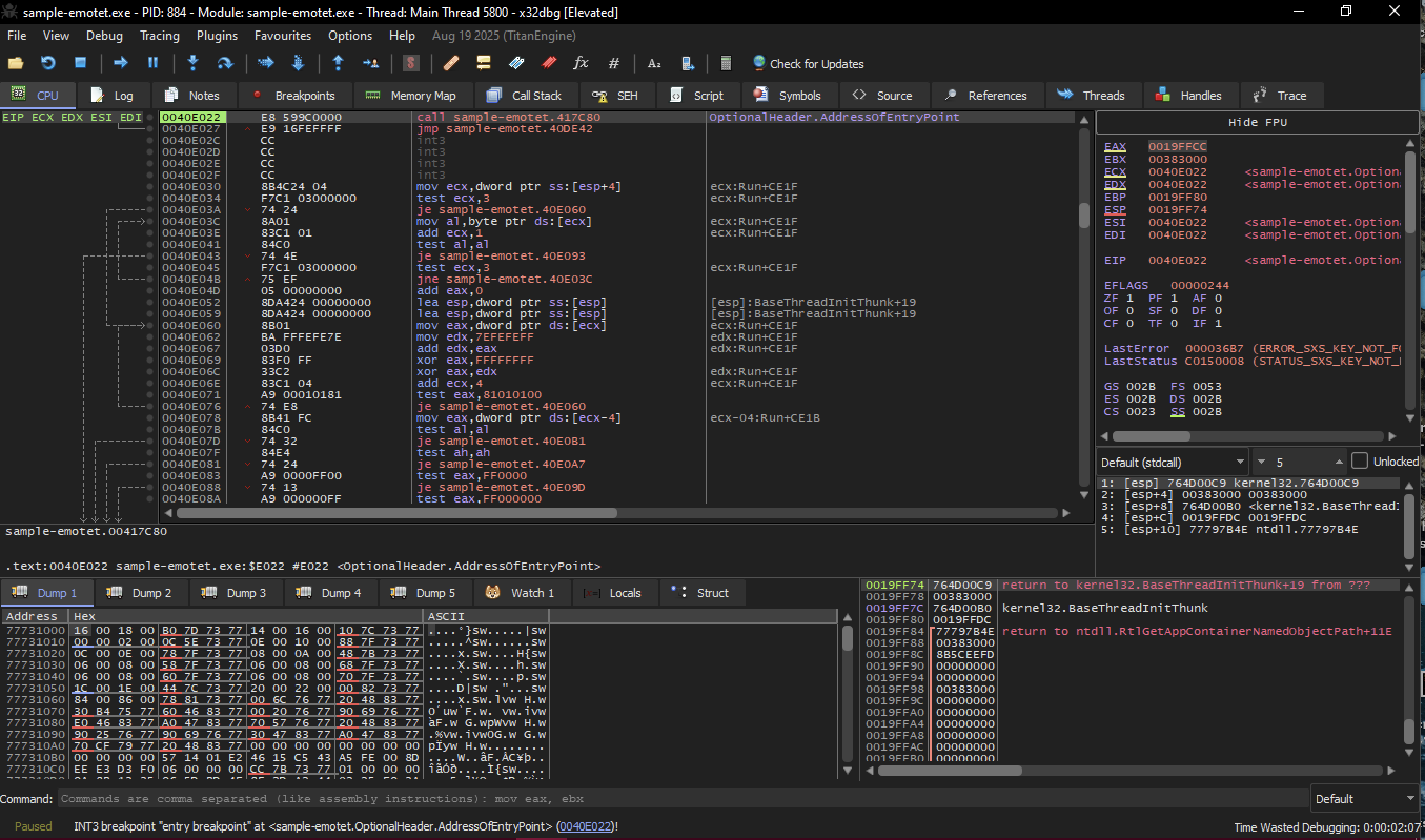
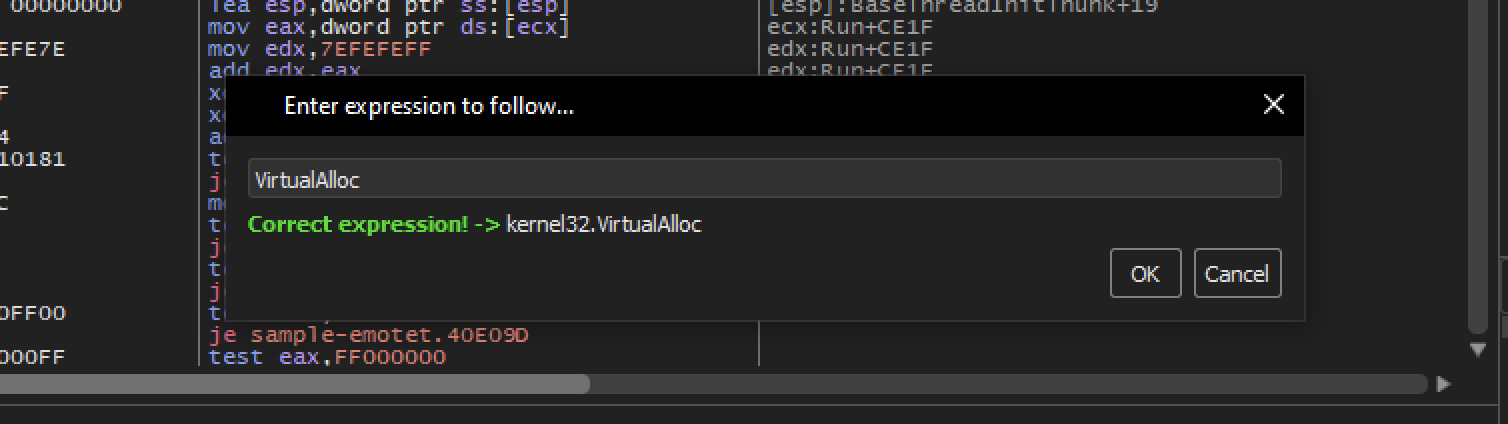
One of the common techniques is to set a breakpoint on VirtualAlloc.
Now in x32dbg ctrl + g enter VirtualAlloc
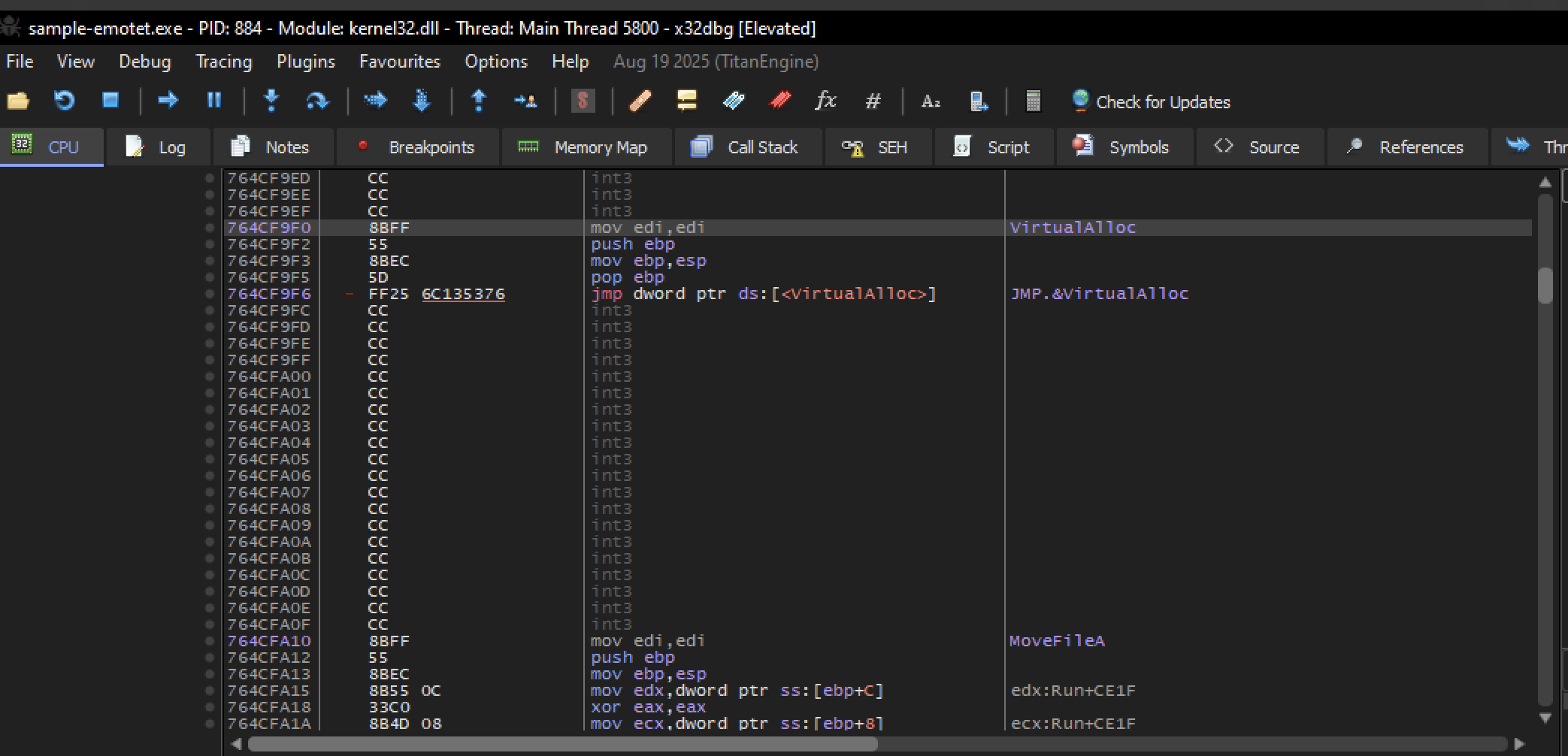
We can see at the top it’s set to Module Kernel32.dll, We are at the start of VirtualAlloc.
The Return Address Strategy
When VirtualAlloc is called, the OS hasn't actually given the malware the memory address yet. You need to see where that memory lands.
Set Breakpoint. then run it.
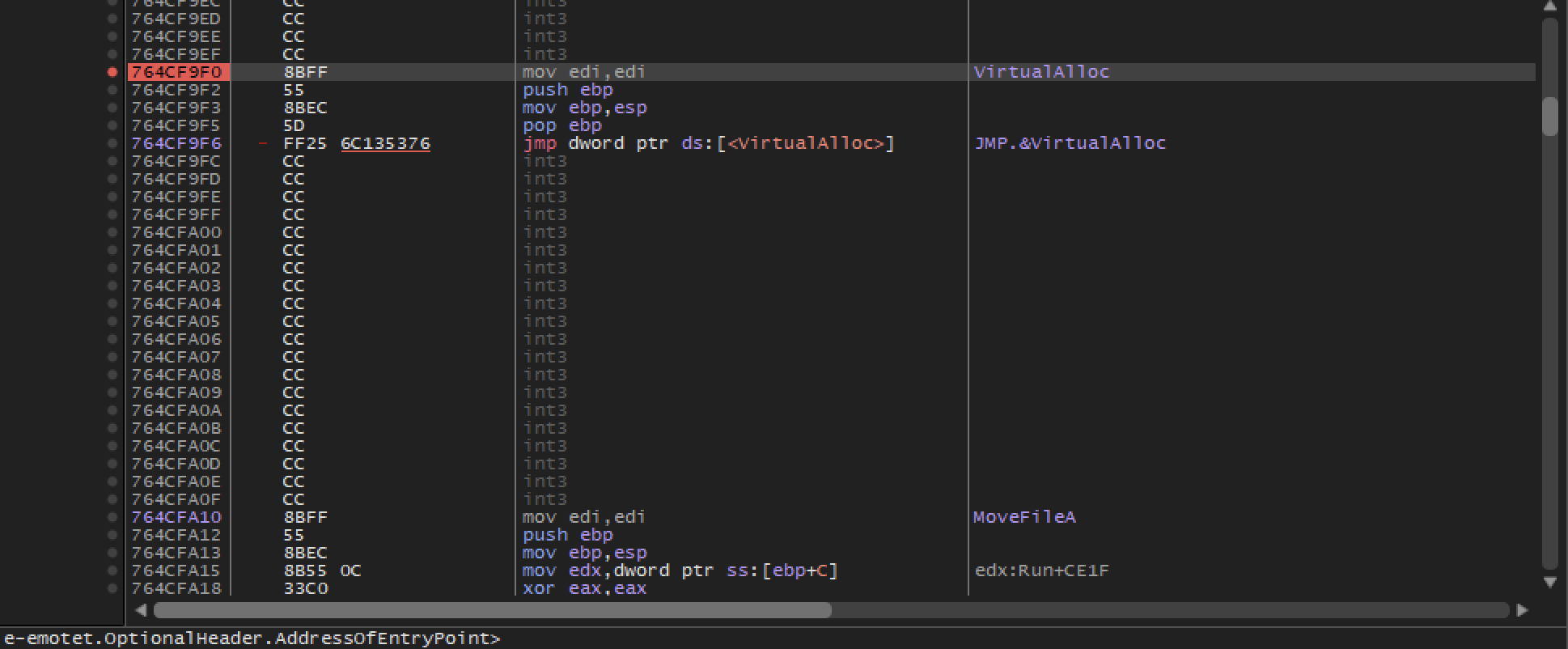
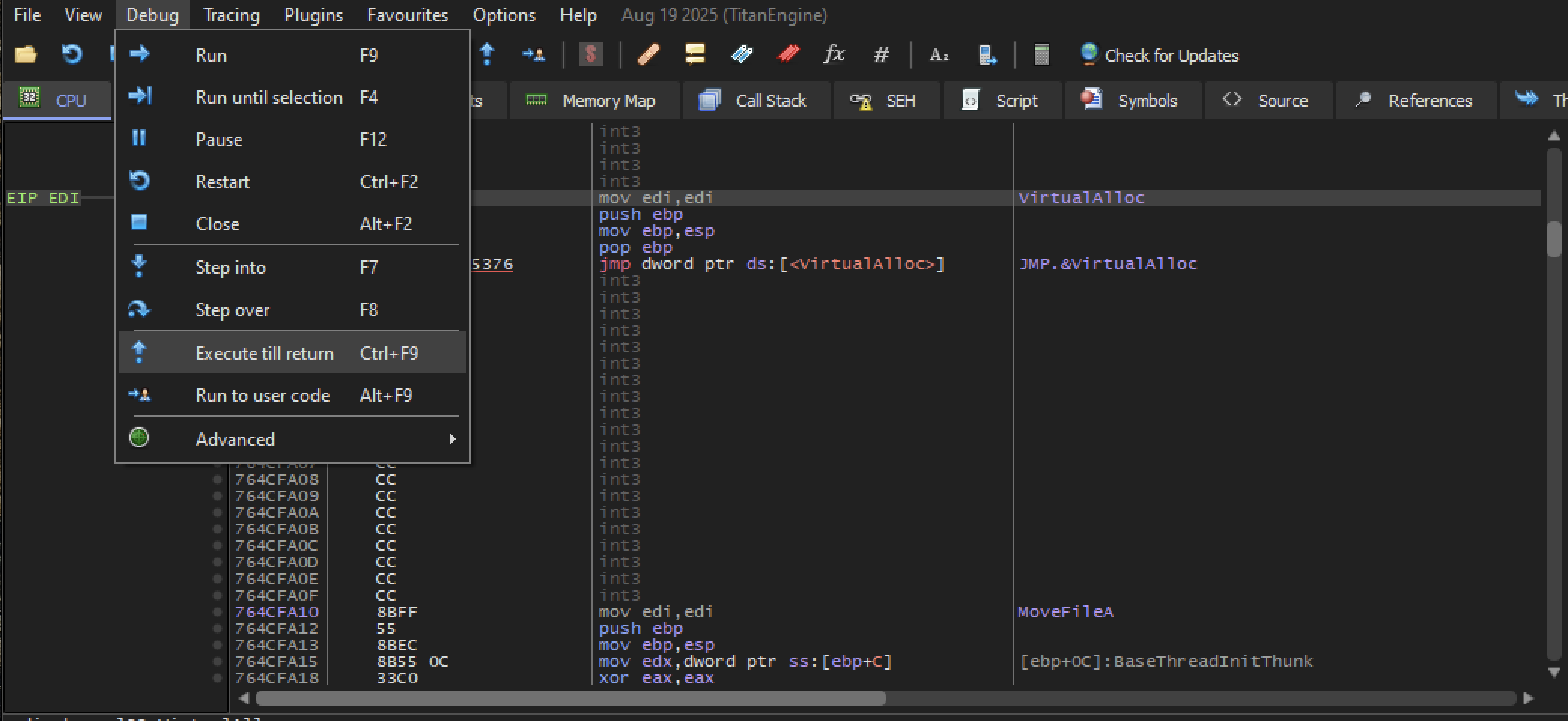
Break point hit, now execute till return.
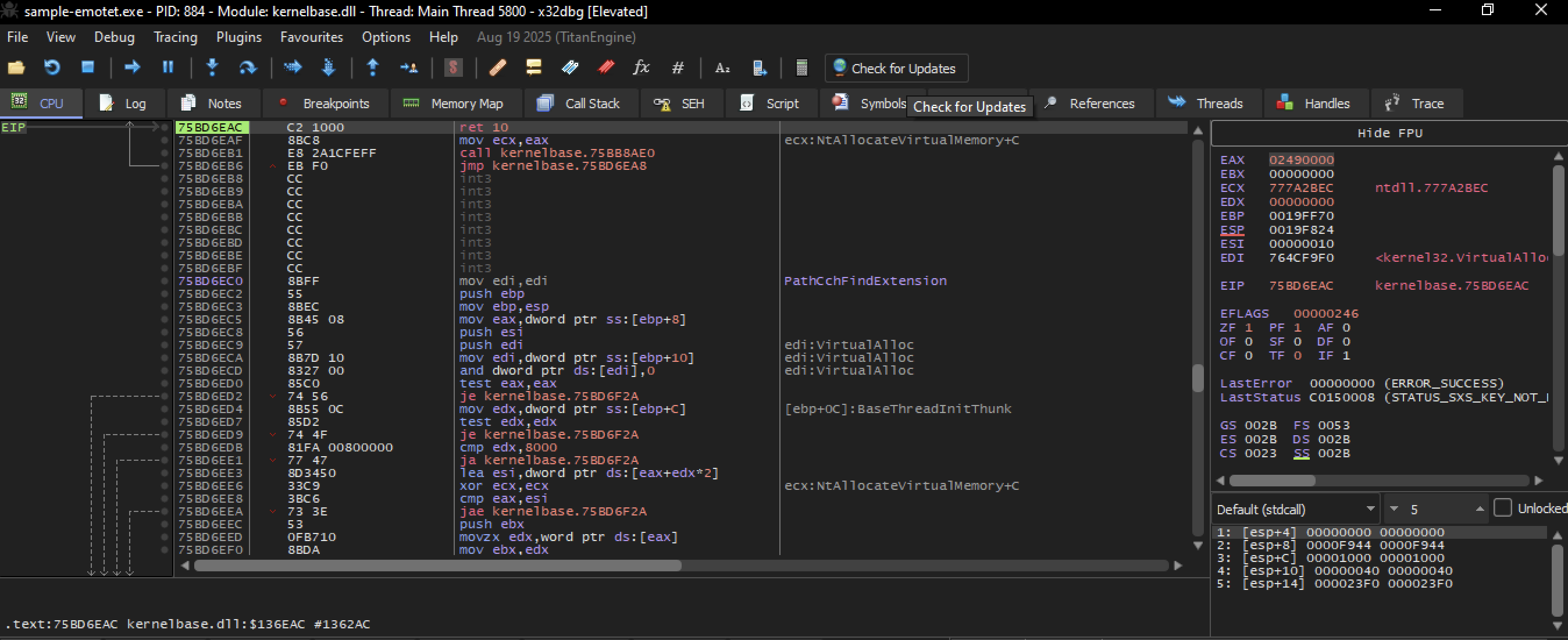
Reached return address
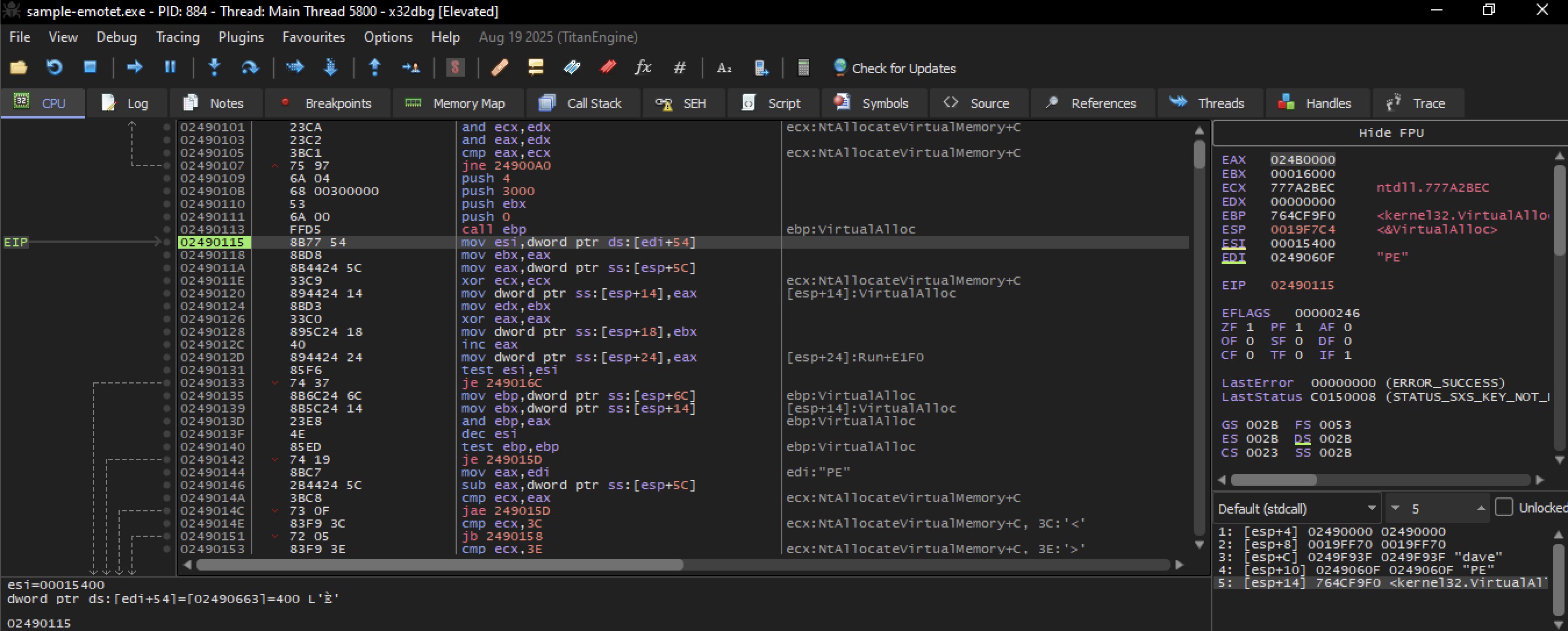
Now step over press: F8
We can see a call to ebp . That’s where VirtualAlloc been stored.
Follow in Dump
follow the argument [edi+54] .
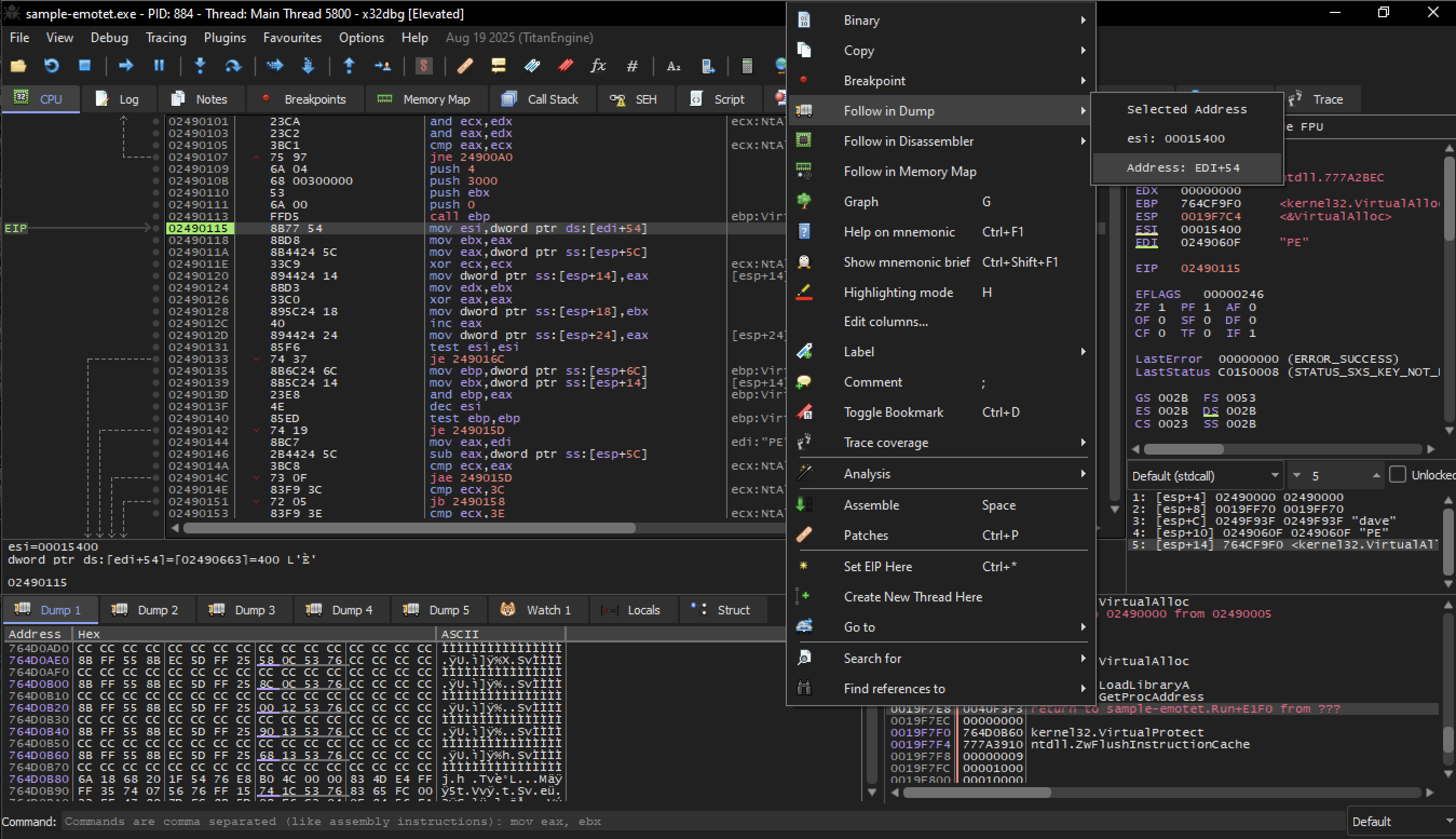
In the memory dump scroll down a bit look for mz header.
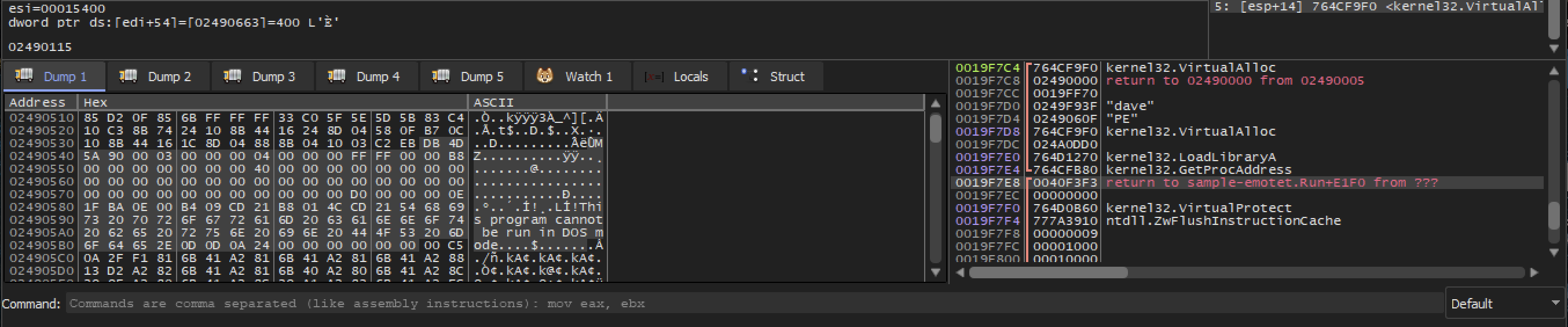
So we found a executable here which could potentially be our unpacked code.
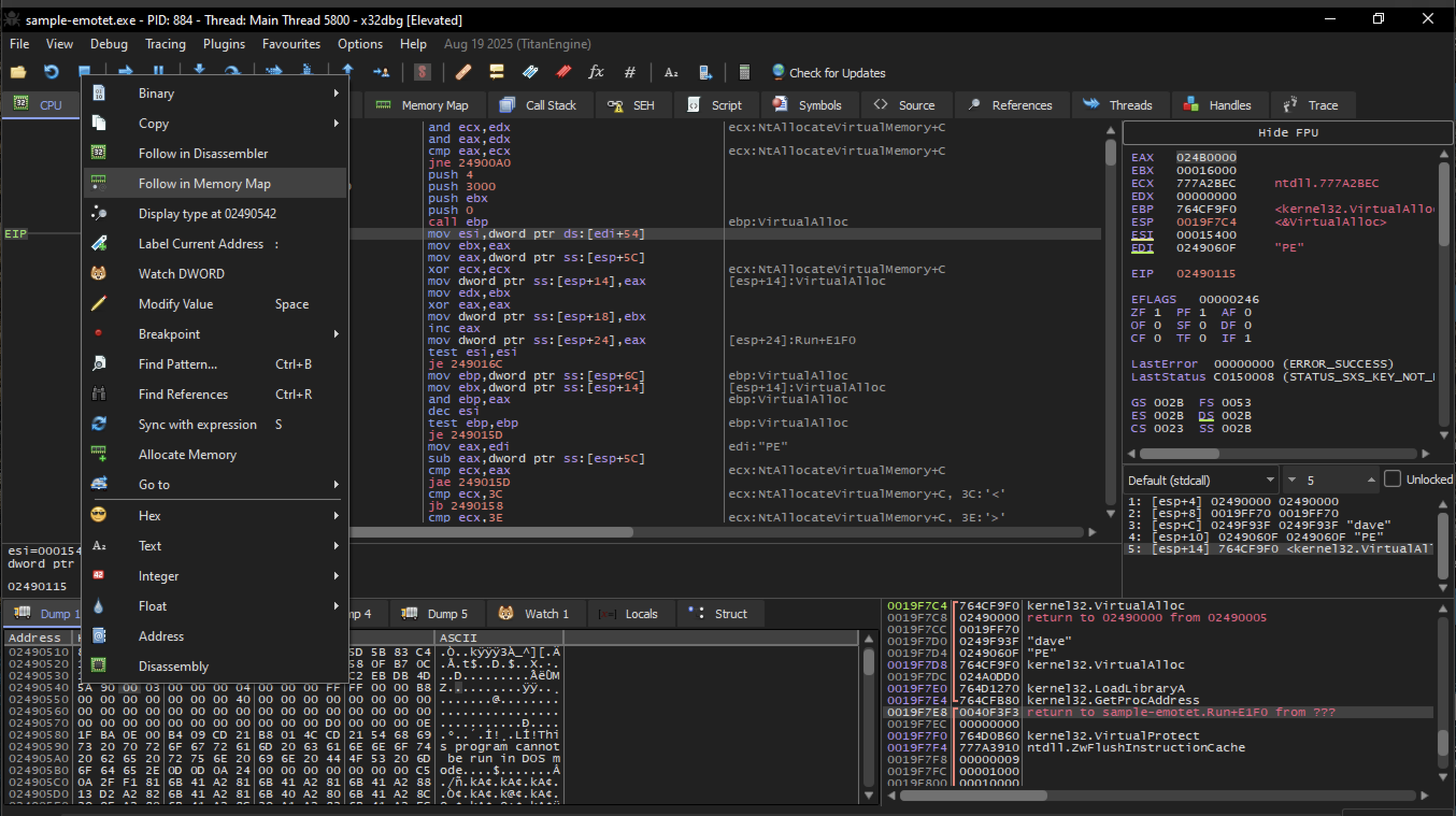
Follow in Memory Map
Right click in the memory map space then follow in memory map.
Inspecting the Protection column in the Memory Map tab is one of the most reliable ways to narrow down where the "real" malware is hiding.
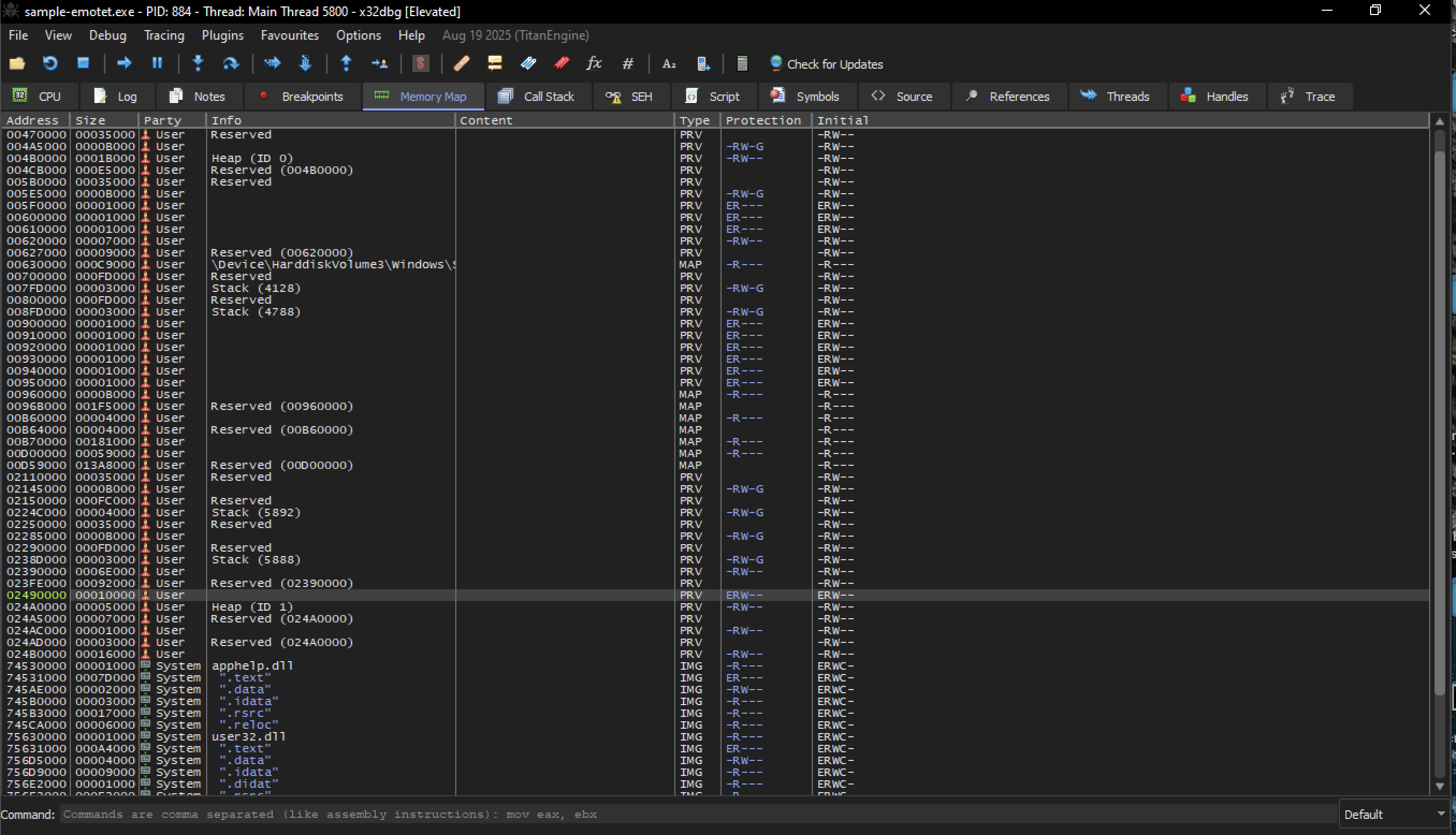
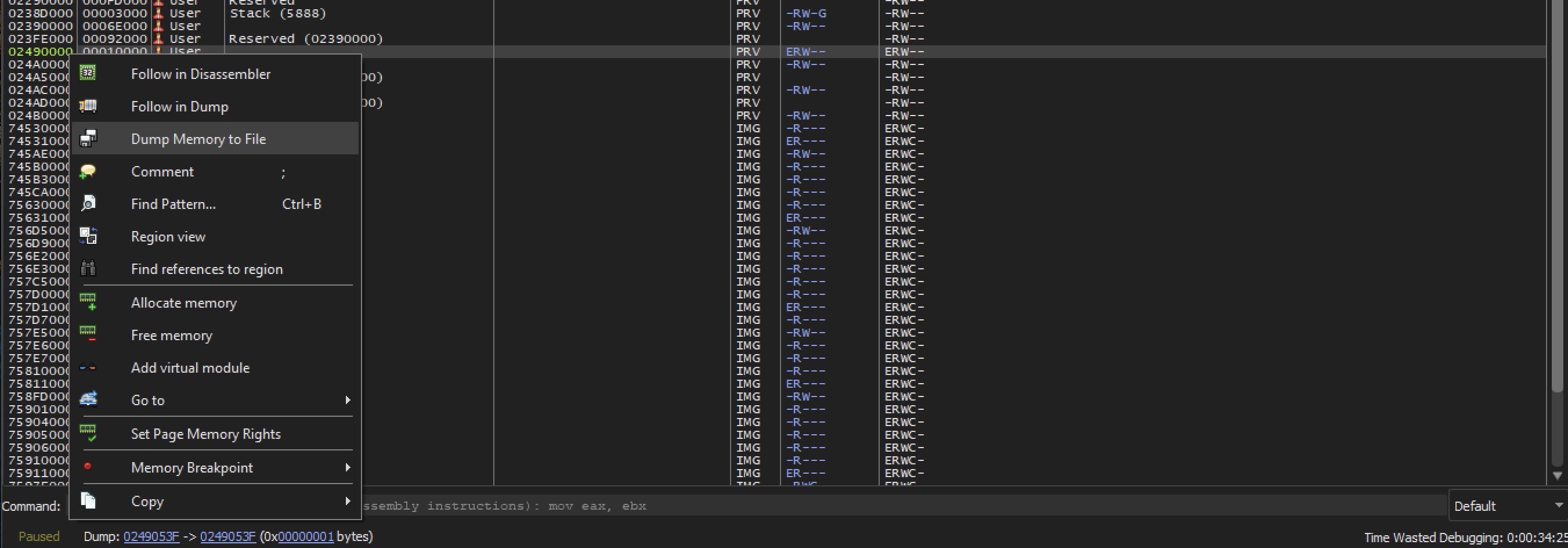
Right click on the memory address then Dump Memory to File.
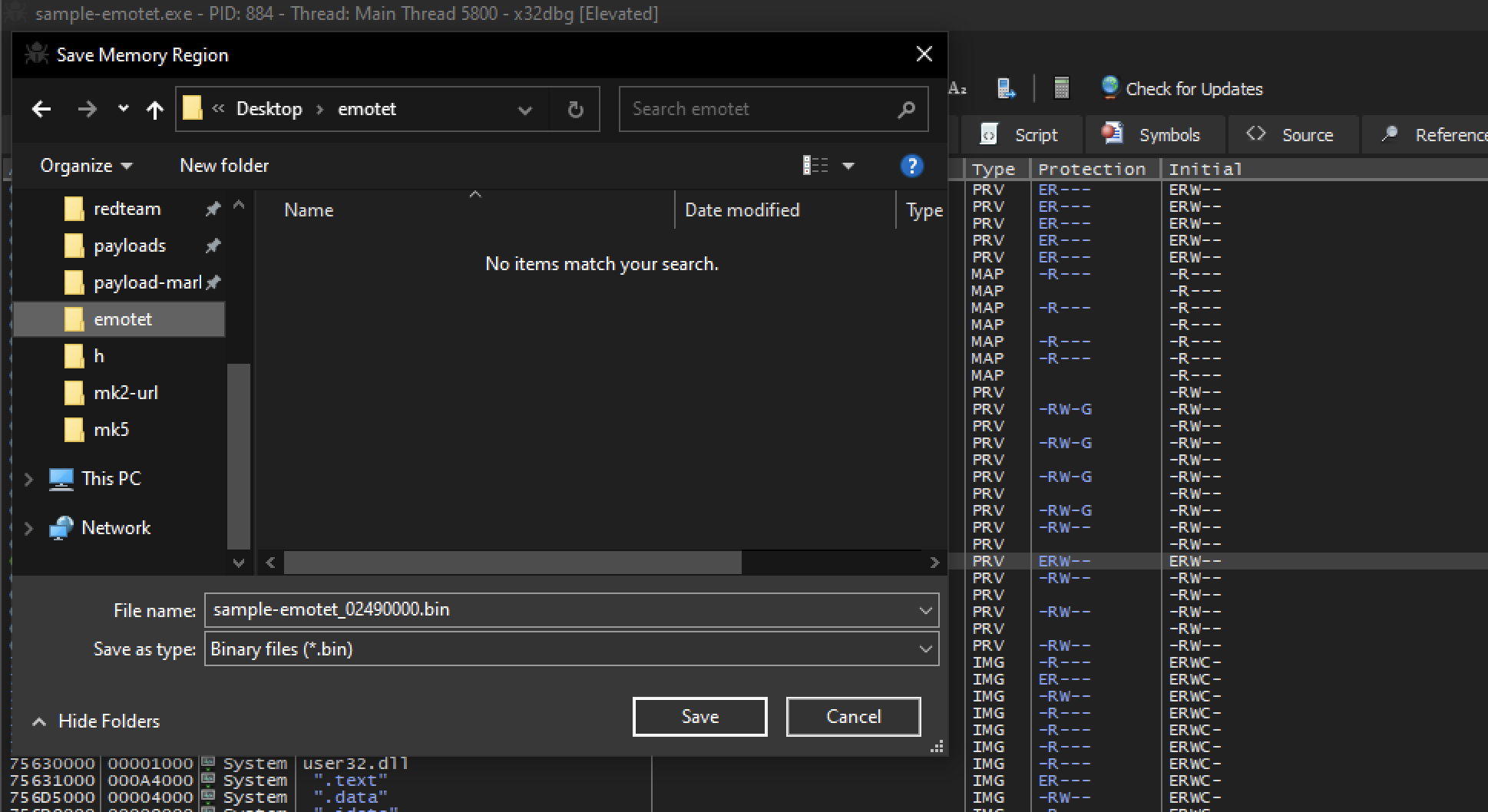
Save it
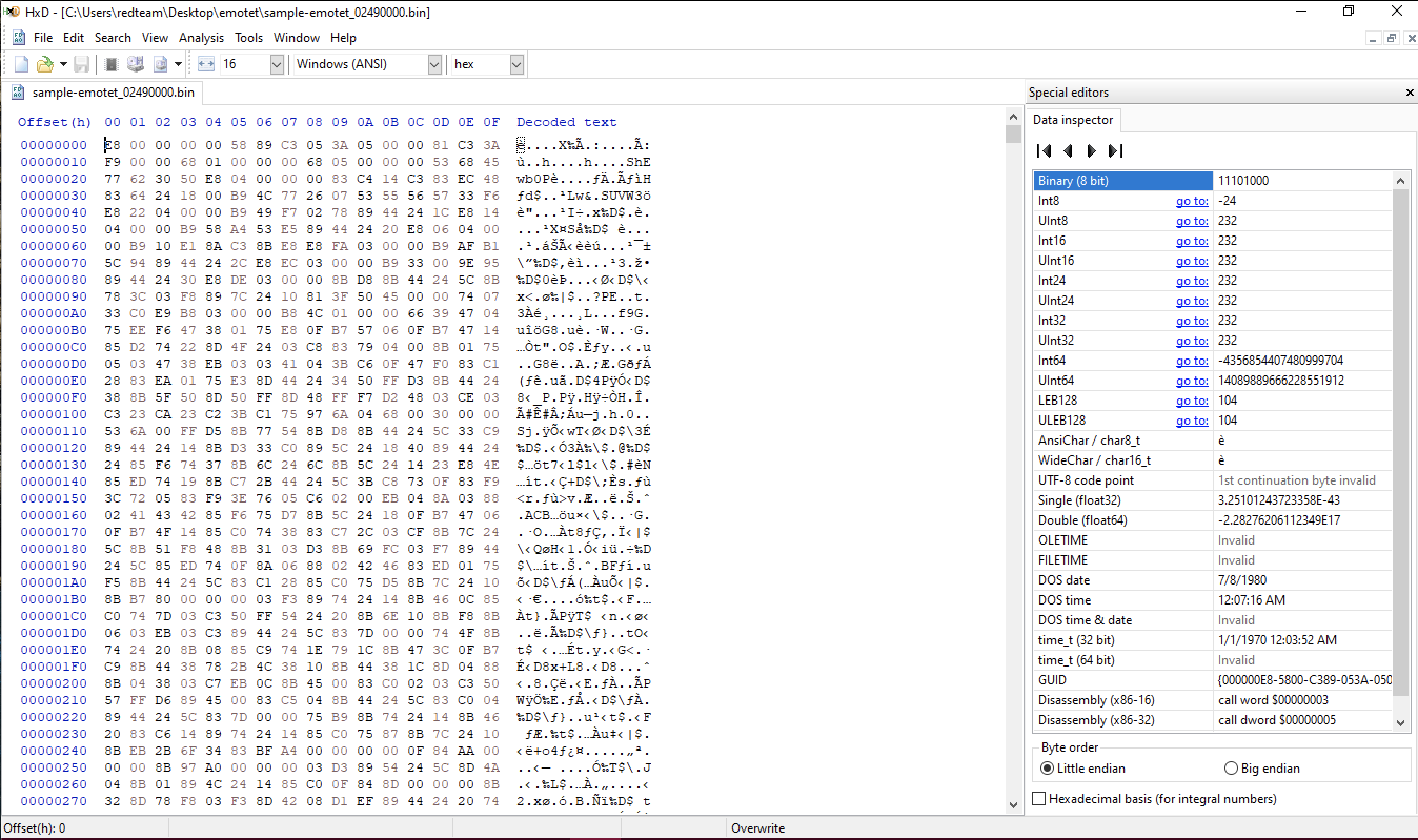
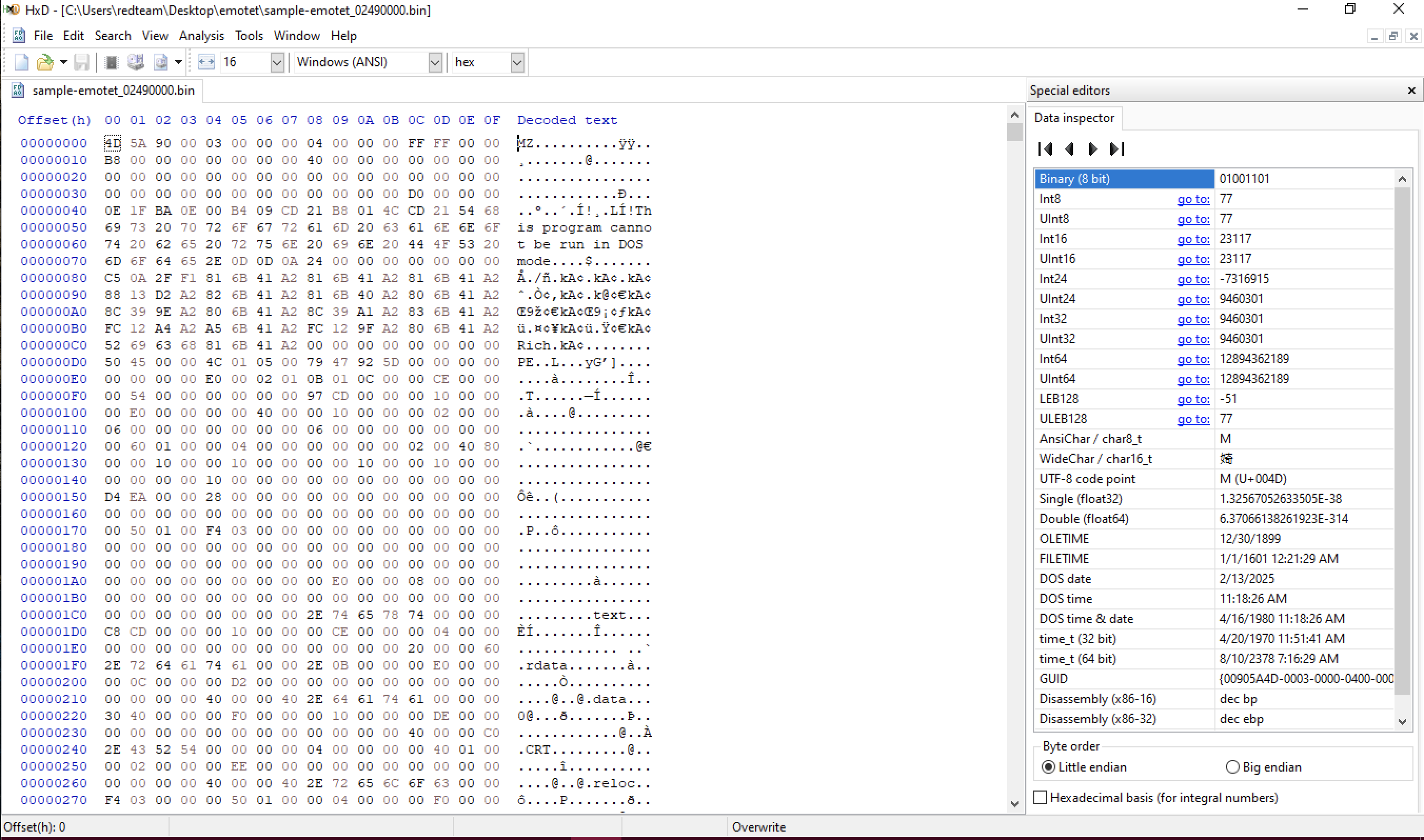
Hxd
Opening the dumped file in hxd.
We don’t actually have a clean executable, there’s bunch of junk code.
Search for mz
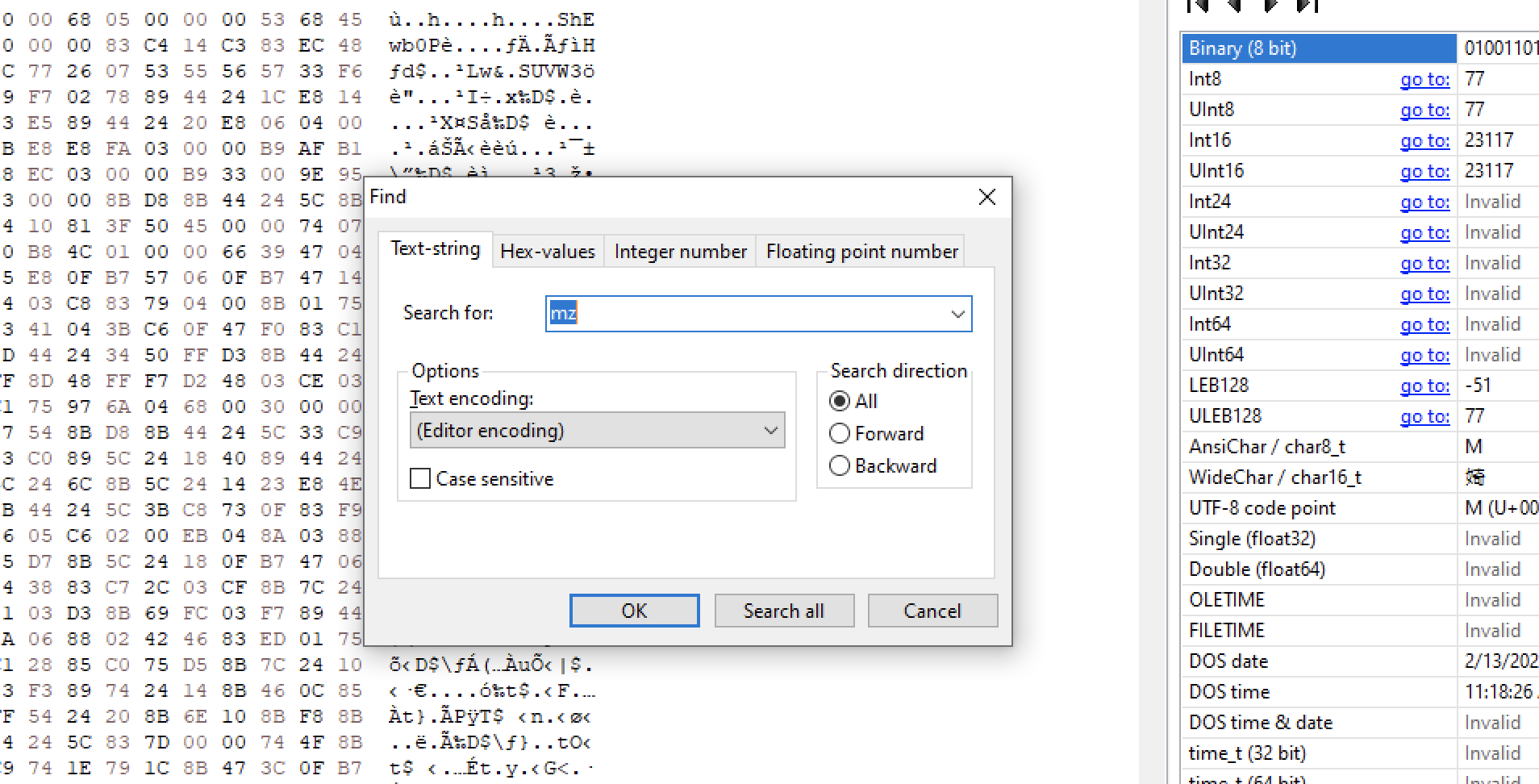
Select the above junk code and delete it. save it for clean PE file.
Static Analysis
Now we will load the dumped bin file in PE studio.
Extracted Payload: Basic Properties
| Property | Value |
|---|---|
| MD5 | 10e60d2522a420d2fb67b7ea740b577d |
| SHA-1 | eada7805202e266cb8f340c78ce1f9a46e72a1ff |
| SHA-256 | 96488477ed1702984c1fa3f56873e9aac4efb871f97a03eea50233b13080c2f0 |
| Vhash | 064056651d75156bz1!z |
| Authentihash | 1b983a357892cf075e45698f43317fb48ead1ceb3474f2075ec3f4c2a135bcc0 |
| Imphash | 009889c73bd2e55113bf6dfa5f395e0d |
| Rich Header Hash | 79f456b92ebfd331beab8d6e8bc43bb3 |
| SSDEEP | 1536:4ABSiu85ZhssK0Xvkv96rksc/cqNcigRSMe+K0irHae0IAin:nLZhsUXvkF3/cqNdgR2T |
| TLSH | T13953AF03D30BC47DF69380BD351FB5BF412839385662A99EFA478689A424BE176E1F07 |
Extracted Payload: Section Analysis
| Feature | .text | .rdata | .data | .CRT | .reloc |
|---|---|---|---|---|---|
| Entropy | 6.750 | 4.205 | 7.162 | 0.061 | 6.354 |
| File Ratio | 82.15 % | 4.79 % | 6.38 % | 0.80 % | 1.60 % |
| Raw Address | 0x00000400 | 0x0000D200 | 0x0000DE00 | 0x0000EE00 | 0x0000F000 |
| Raw Size | 52,736 bytes | 3,072 bytes | 4,096 bytes | 512 bytes | 1,024 bytes |
| Virtual Address | 0x00001000 | 0x0000E000 | 0x0000F000 | 0x00014000 | 0x00015000 |
| Virtual Size | 52,680 bytes | 2,862 bytes | 16,432 bytes | 4 bytes | 1,012 bytes |
| Characteristics | 0x60000020 | 0x40000040 | 0xC0000040 | 0x40000040 | 0x42000040 |
| Permissions | Read/Execute | Read | Read/Write | Read | Read/Discard |
Imports
KERNEL32.dll