Tool: https://github.com/hasherezade/mal_unpack
Executive Summary
The sample is position-independent shellcode (PIC) for 32-bit Windows. It implements runtime API resolution by hash, decompression of an embedded payload, CPUID-based environment checks, and thread-based execution with a state machine. No import table is present; the only static string is KERNEL32.dll, indicating manual resolution of Windows APIs from kernel32. The code is consistent with loader/dropper or first-stage shellcode commonly seen in exploit payloads, packed malware, or modular implants.
Risk level: High — capable of loading and executing arbitrary second-stage payloads, evading static import analysis, and adapting execution based on CPU environment.File Properties
| Property | Value |
|---|---|
| File Name | mount.exe |
| MD5 | 5597dc44aecd6b21cb115c3157b8b283 |
| SHA-1 | 8b70fcc08fc3125f1a141f75ebfc9762ddb133b0 |
| SHA-256 | ac2309dcfaaf6e95c5de49910db3c8fdc44ce36948ad5fa61320cab0315b0b5b |
| Vhash | 015046656d151az45nz1ez1 |
| Authentihash | b45403c22c16b911f07ccd89488f193bfc2baa61af5267cea0738112d2cedbc5 |
| Imphash | e28e04a7ac948b435bd640e83b2d285c |
| Rich PE Header Hash | 05e00c445df281f24266aee892fbdb93 |
| SSDEEP | 3072:4efx+Z+FjoD/aPkInA/n7kl7m56mztCb+ZLhzI5alj/5ISf:4e4+pPkAA/gJm5tg+ZLhzialjyu |
| TLSH | T1C904C0223A40D473D427A1724860DA74EF3866714B7C95DB7BE903BE9F603E0923E35A |
| File Type | Win32 EXE (executable, windows, pe, peexe) |
| Magic | PE32 executable (GUI) Intel 80386, for MS Windows |
| TrID | • Win32 Executable MS Visual C++ (47.3%) · • Win64 Executable (15.9%) · • Win32 Dynamic Link Library (9.9%) · • Win16 NE executable (7.6%) · • Win32 Executable (6.8%) |
| DetectItEasy | • PE32 · • Compiler: Microsoft Visual C/C++ (2008-2010) · • Linker: Microsoft Linker (9.00.21022) · • Tool: Visual Studio (2008) |
| Magika | PEBIN |
| File Size | 174.50 KB (178,688 bytes) |
PE Sections
| Property | .text (Section 0) | .rdata (Section 1) | .data (Section 2) | .rsrc (Section 3) |
|---|---|---|---|---|
| Entropy | 6.723 | 6.279 | 3.513 | 4.072 |
| SHA-256 | 7DEA6528B5B... | D57077C9F62... | 4B6A56676EF... | 43C67A2F650... |
| File Ratio | 40.11% | 55.30% | 3.44% | 0.57% |
| Raw Address (Start) | 0x00000400 | 0x00011C00 | 0x00029E00 | 0x0002B600 |
| Raw Address (End) | 0x00011C00 | 0x00029E00 | 0x0002B600 | 0x0002BA00 |
| Raw Size | 71,680 bytes | 98,816 bytes | 6,144 bytes | 1,024 bytes |
| Virtual Address | 0x00001000 | 0x00013000 | 0x0002C000 | 0x00030000 |
| Virtual Size | 71,471 bytes | 98,306 bytes | 13,148 bytes | 874 bytes |
Observations
.text section (where the executable code lives) has an entropy of 6.723. While high, it is generally below the typical threshold for packed malware (usually >7.0), suggesting the code is likely obfuscated or compressed but perhaps not fully packed with a tool like UPX..data section, the virtual size (13,148 bytes) is significantly larger than the raw size (6,144 bytes). This is common for uninitialized data (BSS) that occupies space in memory but not on disk.IAT
| Function Name | Flag | Binding | Extra | Address 1 | Address 2 | Library |
|---|---|---|---|---|---|---|
| WriteFile | x | implicit | - | 0x0002AC8A | 0x0002AC8A | KERNEL32.dll |
| WriteConsoleW | - | implicit | - | 0x0002AF8E | 0x0002AF8E | KERNEL32.dll |
| WriteConsoleA | - | implicit | - | 0x0002AF68 | 0x0002AF68 | KERNEL32.dll |
| WideCharToMultiByte | - | implicit | - | 0x0002ADFC | 0x0002ADFC | KERNEL32.dll |
| VirtualFree | - | implicit | - | 0x0002AC50 | 0x0002AC50 | KERNEL32.dll |
| VirtualAlloc | x | implicit | - | 0x0002AC5E | 0x0002AC5E | KERNEL32.dll |
| UnhandledExceptionFilter | - | implicit | - | 0x0002AB42 | 0x0002AB42 | KERNEL32.dll |
| TlsSetValue | - | implicit | - | 0x0002AD2A | 0x0002AD2A | KERNEL32.dll |
| TlsGetValue | - | implicit | - | 0x0002AD10 | 0x0002AD10 | KERNEL32.dll |
| TlsFree | - | implicit | - | 0x0002AD38 | 0x0002AD38 | KERNEL32.dll |
| TlsAlloc | - | implicit | - | 0x0002AD1E | 0x0002AD1E | KERNEL32.dll |
| TerminateProcess | - | implicit | - | 0x0002AB1A | 0x0002AB1A | KERNEL32.dll |
| Sleep | - | implicit | - | 0x0002AACE | 0x0002AACE | KERNEL32.dll |
| SetUnhandledExceptionFilter | - | implicit | - | 0x0002AB5E | 0x0002AB5E | KERNEL32.dll |
| SetStdHandle | - | implicit | - | 0x0002AEAA | 0x0002AEAA | KERNEL32.dll |
| SetLastError | - | implicit | - | 0x0002AD42 | 0x0002AD42 | KERNEL32.dll |
| SetHandleCount | - | implicit | - | 0x0002ABC0 | 0x0002ABC0 | KERNEL32.dll |
| SetFilePointer | - | implicit | - | 0x0002AF56 | 0x0002AF56 | KERNEL32.dll |
| RtlUnwind | - | implicit | - | 0x0002AC08 | 0x0002AC08 | KERNEL32.dll |
| RaiseException | x | implicit | - | 0x0002AC3E | 0x0002AC3E | KERNEL32.dll |
| QueryPerformanceCounter | - | implicit | - | 0x0002AE2C | 0x0002AE2C | KERNEL32.dll |
| MultiByteToWideChar | - | implicit | - | 0x0002AE86 | 0x0002AE86 | KERNEL32.dll |
| LoadStringW | - | implicit | - | 0x0002AA94 | 0x0002AA94 | USER32.dll |
| LoadLibraryA | - | implicit | - | 0x0002AD78 | 0x0002AD78 | KERNEL32.dll |
| LeaveCriticalSection | - | implicit | - | 0x0002ABA8 | 0x0002ABA8 | KERNEL32.dll |
| LCMapStringW | - | implicit | - | 0x0002AD68 | 0x0002AD68 | KERNEL32.dll |
| LCMapStringA | - | implicit | - | 0x0002AEFC | 0x0002AEFC | KERNEL32.dll |
| IsValidCodePage | - | implicit | - | 0x0002ACFE | 0x0002ACFE | KERNEL32.dll |
| IsDebuggerPresent | - | implicit | - | 0x0002AB7C | 0x0002AB7C | KERNEL32.dll |
| InterlockedIncrement | - | implicit | - | 0x0002ACB8 | 0x0002ACB8 | KERNEL32.dll |
| InterlockedDecrement | - | implicit | - | 0x0002ACD0 | 0x0002ACD0 | KERNEL32.dll |
| InitializeCriticalSectionAndSpinCount | - | implicit | - | 0x0002AD88 | 0x0002AD88 | KERNEL32.dll |
| HeapSize | - | implicit | - | 0x0002AEF0 | 0x0002AEF0 | KERNEL32.dll |
| HeapReAlloc | - | implicit | - | 0x0002AC6E | 0x0002AC6E | KERNEL32.dll |
| HeapFree | - | implicit | - | 0x0002AC24 | 0x0002AC24 | KERNEL32.dll |
| HeapCreate | - | implicit | - | 0x0002AC7C | 0x0002AC7C | KERNEL32.dll |
| HeapAlloc | - | implicit | - | 0x0002AAAE | 0x0002AAAE | KERNEL32.dll |
| GetTickCount | - | implicit | - | 0x0002AE46 | 0x0002AE46 | KERNEL32.dll |
| GetSystemTimeAsFileTime | - | implicit | - | 0x0002AE6C | 0x0002AE6C | KERNEL32.dll |
| GetStringTypeW | - | implicit | - | 0x0002AF1E | 0x0002AF1E | KERNEL32.dll |
| GetStringTypeA | - | implicit | - | 0x0002AF0C | 0x0002AF0C | KERNEL32.dll |
| GetStdHandle | - | implicit | - | 0x0002ABD2 | 0x0002ABD2 | KERNEL32.dll |
| GetStartupInfoA | - | implicit | - | 0x0002AB08 | 0x0002AB08 | KERNEL32.dll |
| GetProcAddress | - | implicit | - | 0x0002AAD6 | 0x0002AAD6 | KERNEL32.dll |
| GetOEMCP | - | implicit | - | 0x0002ACF2 | 0x0002ACF2 | KERNEL32.dll |
| GetModuleHandleW | - | implicit | - | 0x0002AABA | 0x0002AABA | KERNEL32.dll |
| GetModuleHandleA | - | implicit | - | 0x0002AF42 | 0x0002AF42 | KERNEL32.dll |
| GetModuleFileNameA | - | implicit | - | 0x0002AC96 | 0x0002AC96 | KERNEL32.dll |
| GetLocaleInfoA | - | implicit | - | 0x0002AF30 | 0x0002AF30 | KERNEL32.dll |
| GetLastError | - | implicit | - | 0x0002AC14 | 0x0002AC14 | KERNEL32.dll |
| GetFileType | - | implicit | - | 0x0002ABE2 | 0x0002ABE2 | KERNEL32.dll |
| GetEnvironmentStringsW | x | implicit | - | 0x0002AE12 | 0x0002AE12 | KERNEL32.dll |
| GetEnvironmentStrings | x | implicit | - | 0x0002ADCA | 0x0002ADCA | KERNEL32.dll |
| GetCurrentThreadId | x | implicit | - | 0x0002AD52 | 0x0002AD52 | KERNEL32.dll |
| GetCurrentProcessId | x | implicit | - | 0x0002AE56 | 0x0002AE56 | KERNEL32.dll |
| GetCurrentProcess | x | implicit | - | 0x0002AB2E | 0x0002AB2E | KERNEL32.dll |
| GetConsoleOutputCP | - | implicit | - | 0x0002AF78 | 0x0002AF78 | KERNEL32.dll |
| GetConsoleMode | - | implicit | - | 0x0002AECA | 0x0002AECA | KERNEL32.dll |
| GetConsoleCP | - | implicit | - | 0x0002AEBA | 0x0002AEBA | KERNEL32.dll |
| GetCommandLineA | - | implicit | - | 0x0002AAF6 | 0x0002AAF6 | KERNEL32.dll |
| GetCPInfo | - | implicit | - | 0x0002ACAC | 0x0002ACAC | KERNEL32.dll |
| GetACP | - | implicit | - | 0x0002ACE8 | 0x0002ACE8 | KERNEL32.dll |
| FreeEnvironmentStringsW | - | implicit | - | 0x0002ADE2 | 0x0002ADE2 | KERNEL32.dll |
| FreeEnvironmentStringsA | - | implicit | - | 0x0002ADB0 | 0x0002ADB0 | KERNEL32.dll |
| FlushFileBuffers | - | implicit | - | 0x0002AEDC | 0x0002AEDC | KERNEL32.dll |
| ExitProcess | - | implicit | - | 0x0002AAE8 | 0x0002AAE8 | KERNEL32.dll |
| EnterCriticalSection | - | implicit | - | 0x0002AB90 | 0x0002AB90 | KERNEL32.dll |
| DeleteCriticalSection | - | implicit | - | 0x0002ABF0 | 0x0002ABF0 | KERNEL32.dll |
| CreateFileA | - | implicit | - | 0x0002AE9C | 0x0002AE9C | KERNEL32.dll |
| CloseHandle | - | implicit | - | 0x0002AC30 | 0x0002AC30 | KERNEL32.dll |
Description
The Import Address Table (IAT) is a key structure in PE files that lists the external functions the program needs to run.
IsDebuggerPresent suggests the file may have anti-debugging capabilities to detect if it's being analyzed.VirtualAlloc and VirtualFree are often used by malware for shellcode injection or unpacking.GetModuleFileNameA and GetCommandLineA are commonly used to gather environment data or verify its own location before executing further stages.Automated unpacking using malunpack
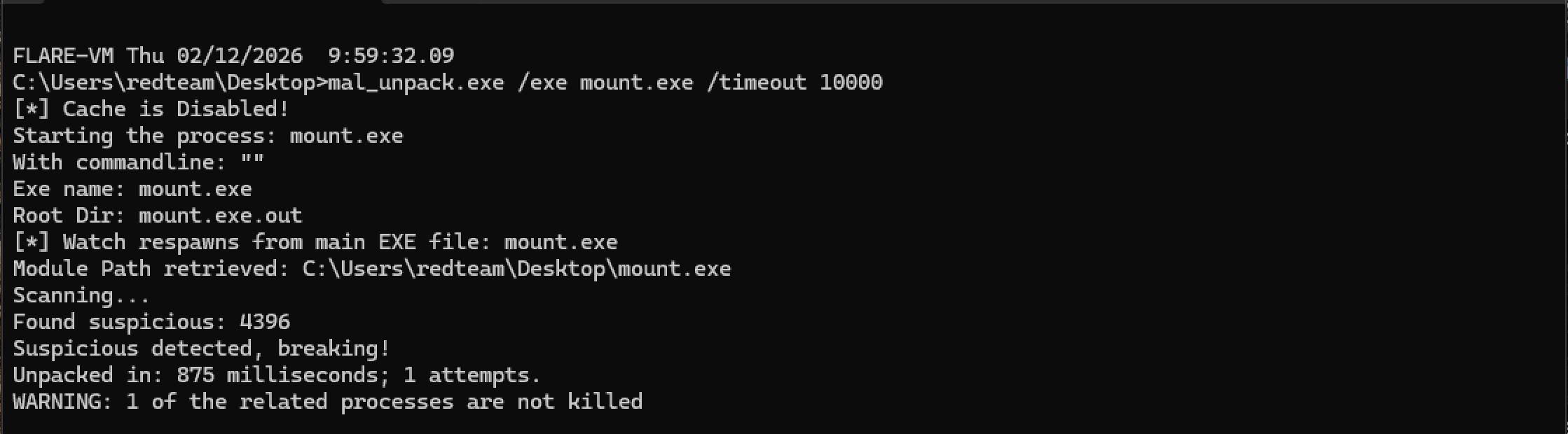
Fig 1 - Unpacking using mal_unpack
This tool unpacked the sample and put it in mount.exe.out directory.
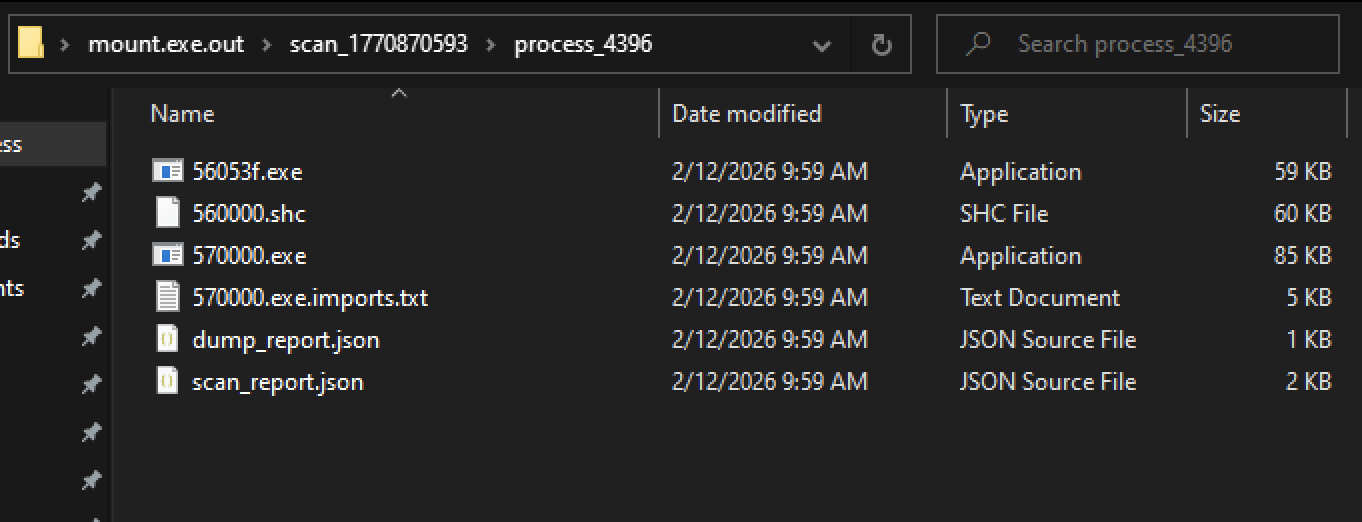
Fig 2 - Output dir
There’s a lot of files we’ll be focusing on .shc shellcode file.
Binary Ninja Analysis
Open the shellcode file in binary ninja. Choose appropriate platform windows-x86
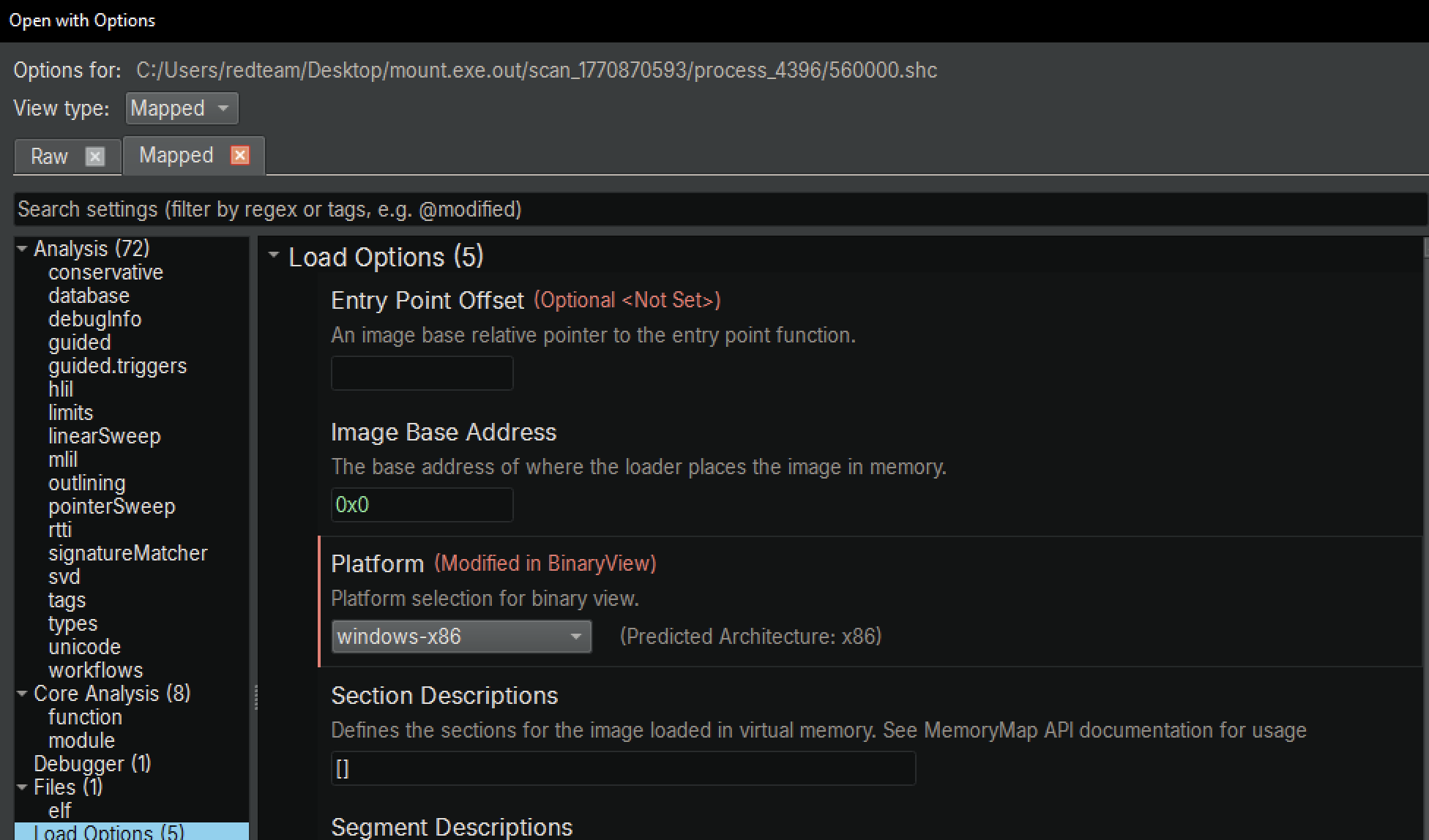
Fig 3 - Opening shellcode in binary ninja
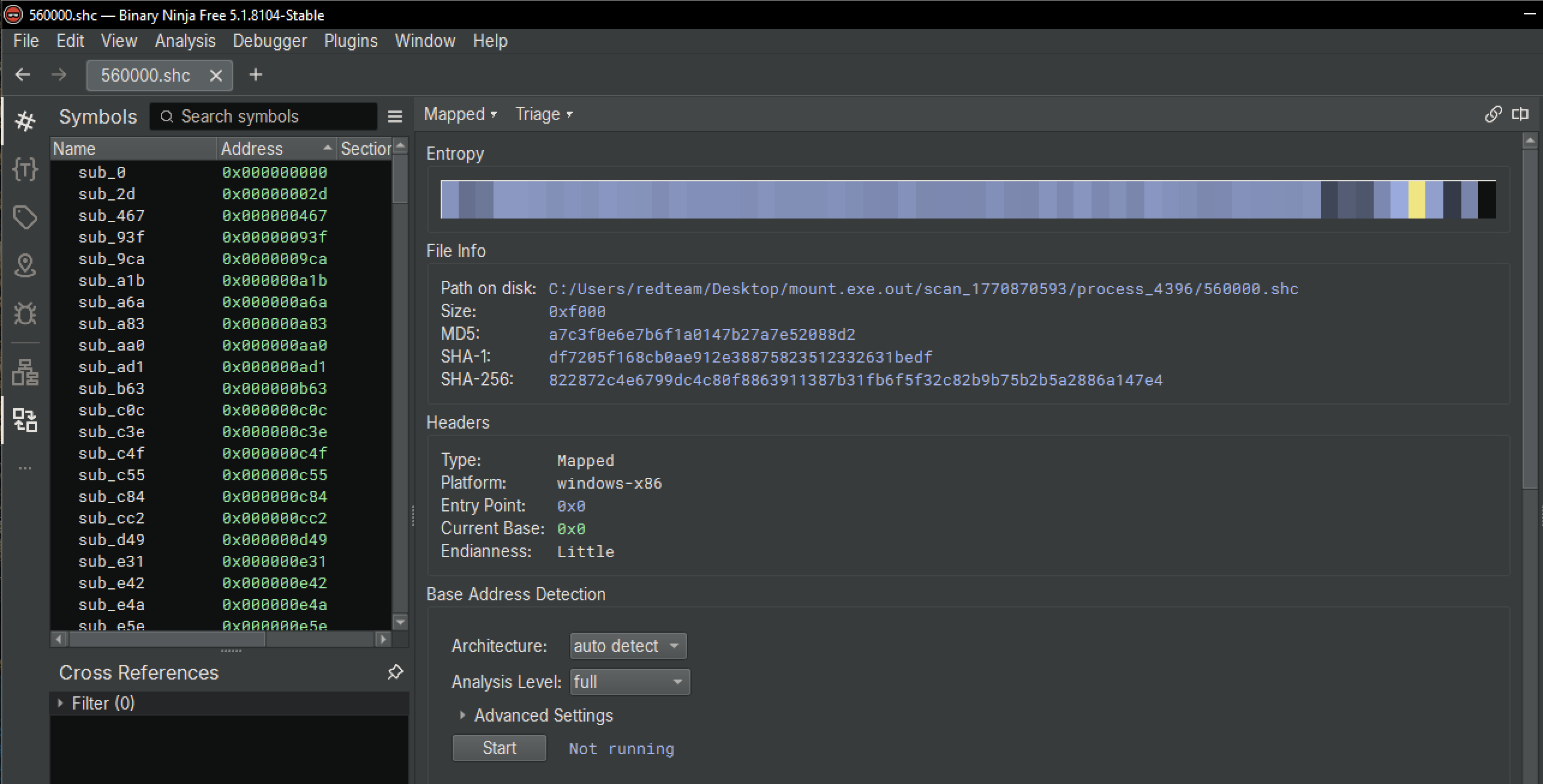
Fig 4 - binary ninja Triage summary
Switch to linear for high level representation.
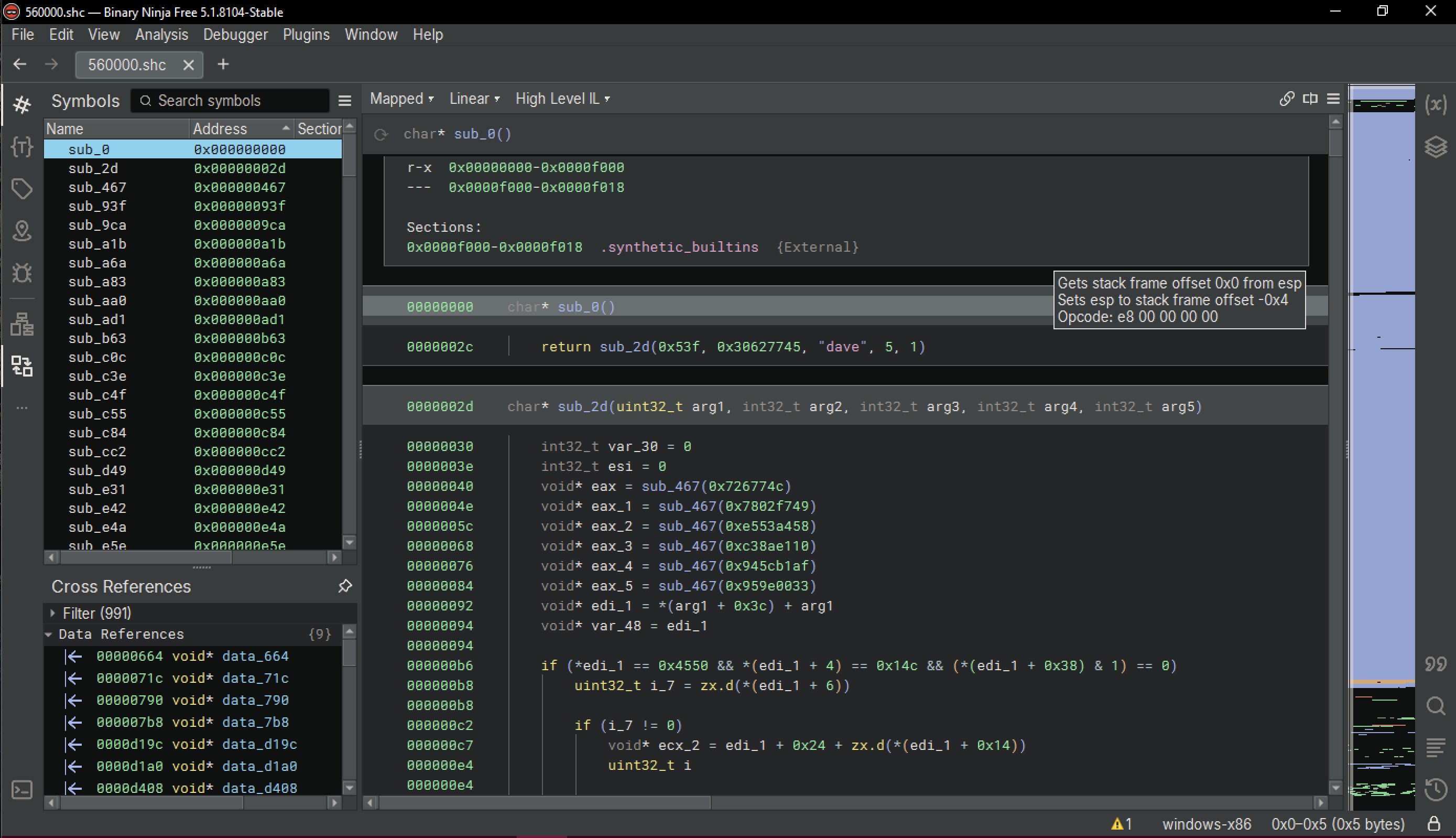
Fig 5 - Linear View of binary ninja
The sample utilizes a custom implementation of dynamic API resolution to hide its true capabilities from static analysis tools and the Import Address Table (IAT).
Mechanism: PEB Traversing & ROR13 Hashing
Instead of calling Windows APIs directly, the malware manually locates the Process Environment Block (PEB) via the Thread Environment Block (TEB) at fs:[30h]. It then iterates through the InLoadOrderModuleList to find loaded system DLLs (typically kernel32.dll or ntdll.dll).
Once a DLL is located, the malware parses the PE Export Directory to find function names.
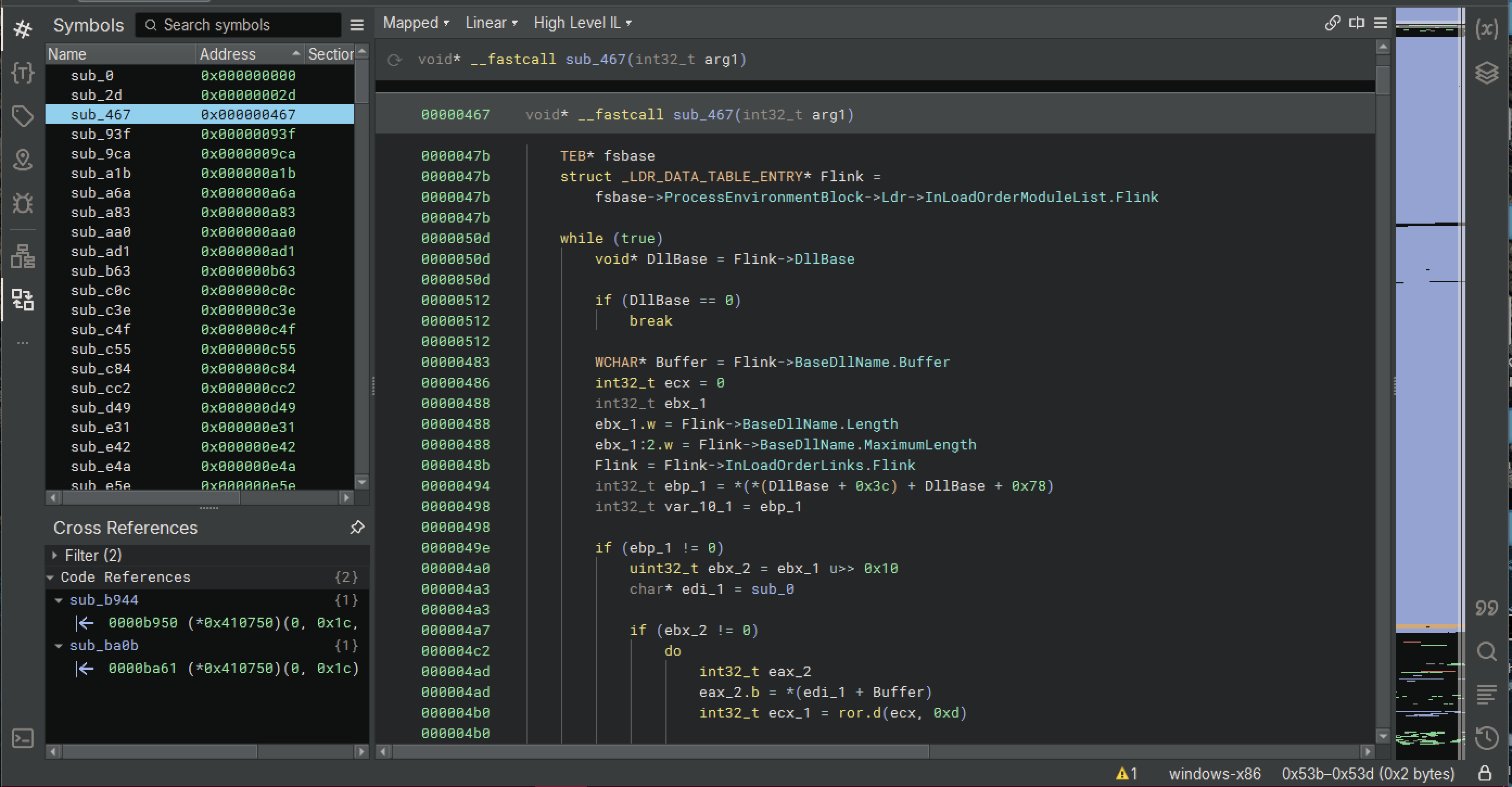
Fig 6 - Function sub_467(0x726774c)
Shellcode Information
| Field | Value |
|---|---|
| Format | Raw shellcode (no PE/ELF header in analyzed dump) |
| Architecture | x86 (32-bit) |
| Size | ~61 KB (0x00000000 – 0x0000EFFF) |
| Entry point | shellcode_entry (offset 0x0000B78D in dump) |
| Static strings | KERNEL32.dll (offset 0x0000D45F) |
| Imports | None (dynamic resolution only) |
| Exports | None |
Technical Analysis
Memory layout
| Component | Description |
|---|---|
| Single Segment | One contiguous executable/data region (ram) from base to 0xEFFF. |
| API Table | Function pointers stored at offset 0xD000. The first slot acts as an API trampoline for dynamic calls. |
| Hash Tables | API hash lists located at offsets 0xEF00 and 0xFFC0, referenced during the initialization phase. |
Anti-Analysis & Evasion
| Technique | Implementation |
|---|---|
| No Import Table | All Windows APIs are resolved at runtime; static analysis cannot identify imported functions. |
| API Hashing | Export names are hashed using the formula: $hash = hash \times 0x1003f + *name$. |
| Single Static String | Only KERNEL32.dll exists in plaintext; no other DLL or API names are present. |
| CPUID Checks | Verifies "GenuineIntel" and specific Intel family/model/stepping (e.g., 0x106C0, 0x20660). Likely used to detect and avoid VM/Sandbox environments. |
| Timing | Implements tick-count-based delays (3–8 second ranges) to bypass automated sandbox analysis. |
API Resolution (PEB-based)
The shellcode utilizes a multi-step process to interact with the Windows OS without static linked dependencies:
PEB -> Ldr -> InMemoryOrderModuleList.0x78).0x00000A6A.0x40D000. The specific APIs selected are driven by hash lists at 0x40EF00 and 0x40FFC0.0x0000C7B1 (JMP [0x40D000]), ensuring no direct API references exist at the actual call sites.Execution flow
shellcode_entry (0xB78D)
  ├── Resolve kernel32 (PEB)
  ├── Get system directory / build path
  ├── CreateThread(..., FUN_0000A524, ...)
  └── FUN_0000A524 (message/wait loop)
        └── Wait → FUN_0000A465 (state machine)
              State 0: FUN_00005C69, FUN_00006B55, FUN_0000C04A (init, resolve APIs, create thread)
              State 1: FUN_00007EF1 … FUN_00009A2F, FUN_00005A04 (setup)
              State 2: FUN_0000A358 (main logic)
                    ├── GetTickCount, timing
                    ├── FUN_0000A5D7
                    ├── FUN_00005A43 (decompression)
                    │     └── Inflate (zlib-style) → decompressed payload
                    ├── FUN_00005BD6 / FUN_0000C0FC / FUN_0000A679 (payload execution path)
                    └── Optional: FUN_0000C384, FUN_0000C0B7, FUN_0000C45D
              State 3: Cleanup (e.g. close handle)
Payload Handling
| Property | Details |
|---|---|
| Algorithm | Zlib-compatible Deflate/Inflate. |
| Core Routine | FUN_00004413 (Inflate implementation). |
| Data Flow | FUN_00005812 → FUN_000023B2 → FUN_0000218E. |
| Buffer Strategy | Uses an 8 KB ring buffer to maintain stream state during decompression. |
| Dual-Capability | FUN_000028C1 builds Huffman/length tables for Deflate, suggesting the malware can also compress data (potentially for exfiltration or C2 staging). |
Execution Logic: Routine FUN_00005A43 initializes the inflate pipeline. The resulting decompressed data is then passed to FUN_0000A679, which likely handles the execution of the next-stage binary or the parsing of a decrypted configuration file.
Environment & Capability Detection
The sample performs deep hardware inspection to ensure it is running on a specific target environment and to avoid detection by security researchers using generic virtual machines.
CPUID instruction to confirm the "GenuineIntel" vendor string._DAT_00411AD8).0x200 and 0x20).Inferred Windows API Usage
Since the malware uses dynamic resolution via ROR13 hashing, the following APIs are inferred based on the operational context of the code and observed memory constants:
| Inferred Role | Usage Context |
|---|---|
| GetProcAddress / LoadLibrary | Core resolution of kernel32.dll exports (e.g., trampoline index 10). |
| GetTickCount | Implements anti-sandbox timing and execution pacing (3–8s delays). |
| VirtualAlloc / HeapAlloc | Memory management for the decompressed payload (allocator at 0x40FD8C). |
| CreateThread | Asynchronous execution; spawns a worker thread for the main loop (FUN_0000A524). |
| WaitForSingleObject | Event synchronization and loop timing (4–8s intervals). |
| GetSystemDirectory | Environment discovery; likely used to locate target paths for dropped files. |
| memcpy / memset | Native memory manipulation for block copying and zeroing out state. |
Behavioral Summary
The following table summarizes the execution lifecycle of the shellcode from initial entry to final payload delivery.
| Phase | Behavior |
|---|---|
| 1. Load | Shellcode is injected or executed via an exploit, packed stub, or reflective loader. |
| 2. Init | Manually traverses the PEB to locate kernel32.dll; resolves APIs by hash and populates the jump table. |
| 3. Setup | Hardware inspection (CPUID) is performed; memory is allocated; environment paths are gathered. |
| 4. Run | Enters a timed wait loop. Once sandbox/timing checks pass, the embedded payload is decompressed (Zlib) and executed in memory. |
| 5. Cleanup | Reaches "State 3": Closes open handles, clears sensitive memory regions, and terminates the process. |
Indicators of Compromise (IOCs)
Static Indicators
| Type | Value |
|---|---|
| String | KERNEL32.dll |
| Hash Constant | API hash multiplier 0x1003f |
| Code Pattern | Indirect call via JMP [0x40D000] (or equivalent at runtime base) |
| CPUID Check | "GenuineIntel" (0x49656E69, 0x6C65746E, 0x756E6547) |
| Key Offsets | Entry: 0xB78D; Trampoline: 0xC7B1; Hash: 0x0A6A; Resolver: 0x0B63 |
Capabilities Assessment
This assessment provides a high-level overview of the functions currently integrated into the analyzed shellcode.
| Capability | Present | Notes |
|---|---|---|
| Runtime API Resolution | Yes | Hash-based; focuses on kernel32.dll in this specific sample. |
| Payload Decompression | Yes | Uses a Zlib-style inflate engine for secondary stage delivery. |
| Thread Creation | Yes | Main malicious logic is offloaded to a separate worker thread. |
| Environment Check | Yes | Rigorous Intel CPUID and feature flag verification. |
| Anti-Sandbox Timing | Yes | Uses GetTickCount to implement execution delays. |
| Persistence | No | Not observed; likely handled by the second-stage payload. |
| Network / C2 | No | Not observed in this loader; likely resides in the decompressed data. |
| File / Registry Ops | No | Likely implemented in the next stage after API resolution. |